


Table of Contents Show
Parametric thinking is changing how we plan, test, and deliver interiors. Instead of drawing one fixed layout and hoping it fits, we encode relationships and performance goals so a space can adapt as constraints shift. In this guide, we share how we approach designing parametric interior spaces, from the logic behind it to the day‑to‑day workflow, tools we lean on, and the human factors that ground every decision.
What Is Parametric Interior Design?
Parametric interior design uses rule-based models where geometry responds to parameters, numbers, ranges, and conditions tied to real project constraints. Think of it as defining the “why” behind a layout so the “what” (furniture plans, partitions, lighting arrays) can update intelligently.
Instead of manually redrawing when headcount changes or a code requirement shifts, we adjust inputs, like desk module size, aisle widths, daylight targets, and the system resolves downstream geometry. The payoff is speed, traceability, and the ability to explore many viable options before committing.
We apply it to offices (seating density vs. comfort), retail (merchandising grids that flex seasonally), hospitality (modular rooms with varied fit-outs), healthcare (clearances, adjacencies), and education (agile learning zones).

Principles, Advantages, And Use Cases
Rule-Based Relationships And Constraints
We start by translating requirements into relationships. Examples:
- Aisles maintain minimum widths while optimizing walk distances.
- Meeting rooms snap to daylight bands and acoustic zones.
- Ceiling baffle spacing follows reverberation targets and sprinkler coverage.
Constraints act as safety rails: code clearances, door swing arcs, ADA reach ranges, egress capacities. Relationships are the elastic bands: adjacency strengths, daylight preference scores, circulation sightlines.

Performance-Driven Design And Flexibility
Because parameters map to performance, we can test outcomes in real time: daylight factors, circulation efficiency, seat utilization, acoustic absorption, and even embodied carbon of finish packages. We don’t just “draw a plan”: we measure how it performs.
Advantages we see repeatedly:
- Faster iteration with fewer redlines when inputs change.
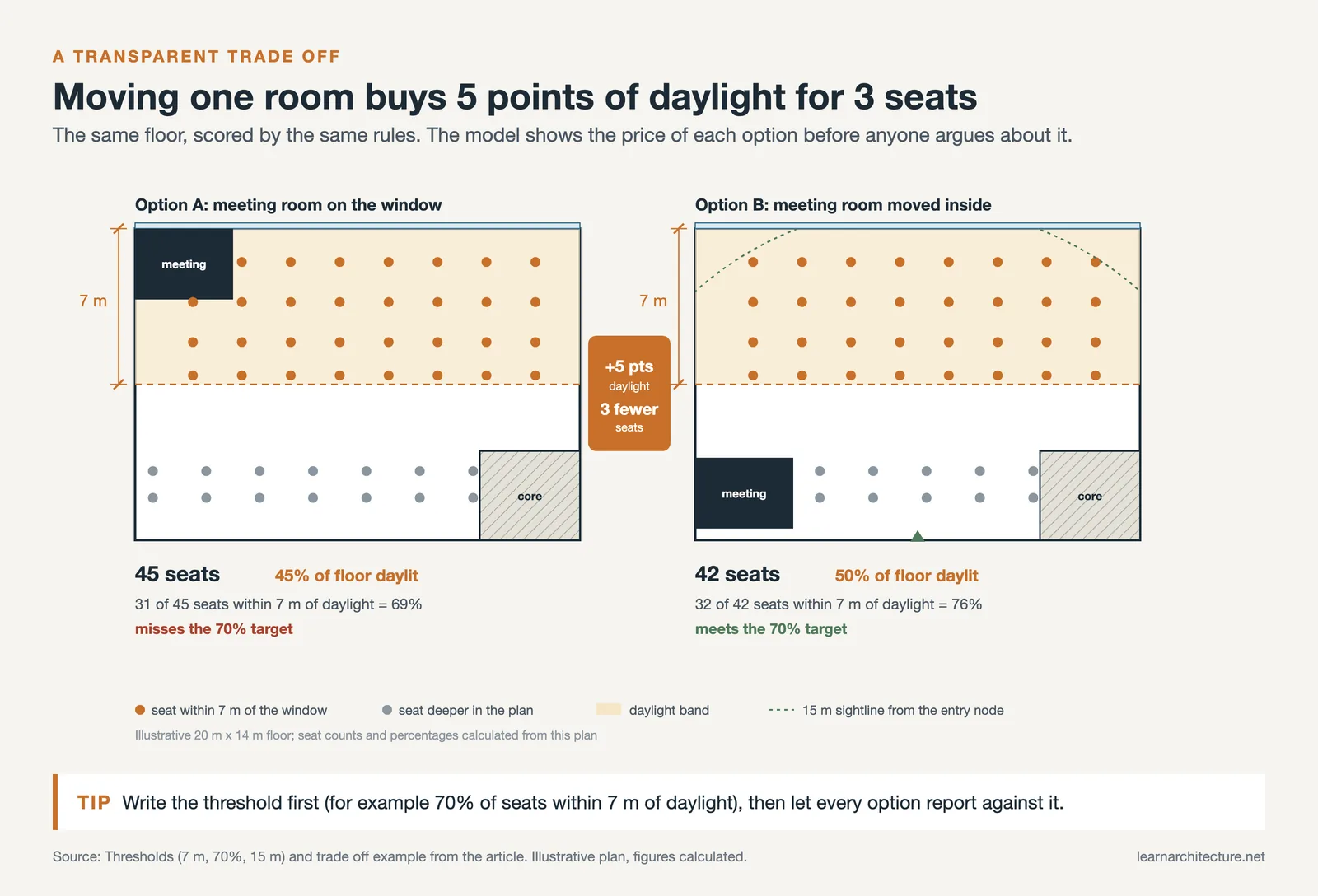
- Transparent trade-offs (e.g., +5% daylight = −3 seats in zone A).
- Data-rich handoffs to BIM and fabrication.
Common use cases include test-fits at scale, retail rollouts with local variations, adaptive wayfinding systems, and specialty ceilings or walls with variable patterns driven by lighting or acoustic criteria.
Workflow: From Brief To Parametric Model
Defining Constraints, KPIs, And Success Criteria
We begin with a tight brief translated into quantifiable levers:
- Constraints: lease lines, core locations, MEP zones, structural grids, codes.
- KPIs: daylight autonomy, average travel distance, collaboration-to-focus ratios, target reverberation time, energy use intensity proxies.
- Success thresholds: “At least 70% of open seats within 7m of daylight” or “Wayfinding nodes visible within 15m in public areas.” Clear definitions keep the model honest.
We also agree on ranges, what can move, what’s fixed, and how far we can push it. That upfront negotiation prevents model sprawl later.

Building Parameters, Dependencies, And Logic
We structure the model in layers:
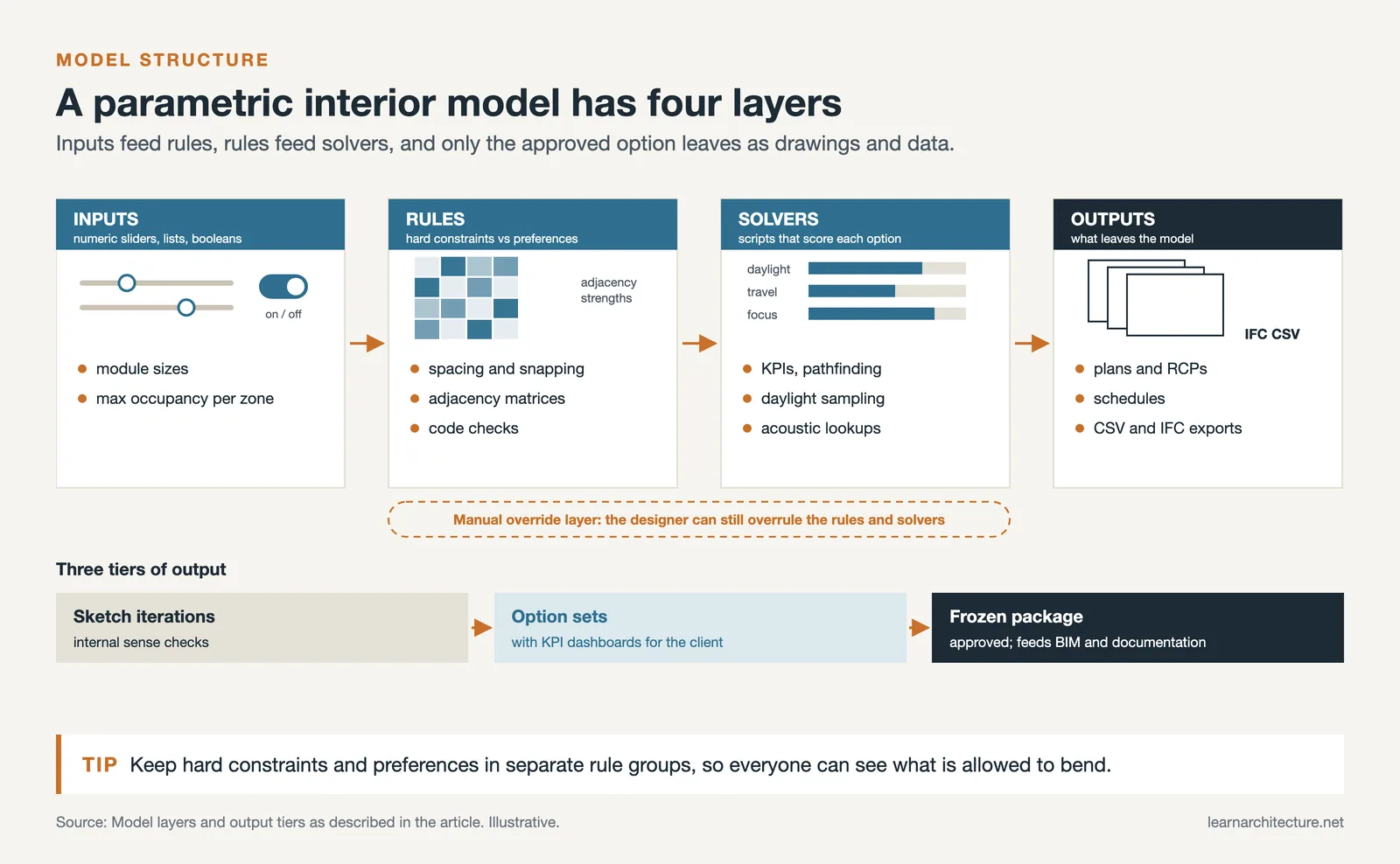
- Inputs: numeric sliders, lists, and booleans (e.g., module sizes, max occupancy per zone).
- Rules: spacing, snapping, adjacency matrices, and code checks.
- Solvers/evaluators: scripts for KPIs, pathfinding, daylight sampling, acoustic lookups.
- Outputs: plans, RCPs, schedules, and data exports (CSV/IFC).
A few practical moves we rely on:
- Name everything clearly: version rules like we would code.
- Isolate “hard constraints” from “preferences” so we know what can bend.
- Keep a manual override layer for design judgment, because we still design.
Iterating, Evaluating, And Versioning
We run scenarios, label them, and keep a lightweight changelog: inputs, timestamp, results. Side‑by‑side comparisons show trade-offs quickly. When a stakeholder requests a change, say, more huddle rooms, we dial the parameters, re-run KPIs, and publish a new version without destabilizing the whole set.
We’ll often keep three tiers of outputs:
- Sketch iterations for internal sense‑checking.
- Option sets with KPI dashboards for client review.
- Approved “frozen” packages that feed BIM and documentation.
Tools, Data, And Fabrication Considerations
Software And Scripting Options
We mix visual and scripted tools depending on scope:
- Rhino + Grasshopper for geometry and custom logic: Python/C# for extensions.
- Revit + Dynamo for BIM‑centric parametrics and schedules.
- Blender or Houdini for complex patterns: Speckle for data exchange.
- Ladybug Tools for climate/daylight: acoustics plugins or lookup scripts for RT targets.
Pick the stack based on the deliverable: test‑fit speed, BIM integration, or fabrication fidelity.

Integrating Performance And Human Data
Inputs aren’t just geometry. We bring in:
- Sensor data or POE studies: occupancy, comfort feedback.
- Ergonomic datasets and ADA/IBC rulesets.
- Material libraries with acoustic, reflectance, and carbon factors.
The model becomes a living conversation between people, performance, and place.
From Digital Model To Materials And Making
For custom interiors, feature walls, ceilings, casework, we map parameters to parts: panel sizes, kerf allowances, tolerances, and labels. We then output nests and CAM data for CNC, laser cutting, or 3D printing. Early alignment with fabricators saves headaches: sheet sizes, tool radii, finish sequences, and installation order matter as much as the pattern itself.
Human-Centered Quality And Project Delivery
Comfort, Accessibility, And Wayfinding
We fold human factors into the logic from day one: sightlines for intuitive routes, tactile and visual cues, contrast ratios for signage, and acoustic zoning for focus vs. buzz. Accessibility isn’t a checkbox, clear floor spaces, turning radii, reach ranges, and assistive tech all become parameters we can test.

Collaboration, Documentation, And Change Management
Parametric models shine when teams collaborate. We document inputs, defaults, and assumptions in plain language so stakeholders can challenge or confirm them. Change requests map to parameters: impacts are visible and quantified. We publish versioned drawings, schedules, and data extracts, then lock milestones to avoid drift while still keeping a path for controlled updates.
Conclusion
Designing parametric interior spaces isn’t about flashy scripts, it’s about clarity, leverage, and outcomes people can feel. When rules reflect real constraints and human needs, we get spaces that adapt gracefully, perform better, and are simpler to deliver. The tools help, but the mindset does the heavy lifting.
- 3D interior modeling
- advanced interior design techniques
- architectural interior design
- creative interior spaces
- custom interior solutions
- designing flexible spaces
- innovative space planning
- interior design inspiration
- interior design process
- interior design software
- interior design strategies
- interior design tips
- interior design trends
- interior space planning
- Modern interior design
- parametric architecture
- parametric design guide
- parametric furniture design
- parametric interior design
- space optimization ideas









Leave a comment