


Table of Contents Show
Skidmore, Owings & Merrill has delivered a monumental achievement with the National Museum of the United States Army, representing the first comprehensive institution devoted to chronicling the nation’s oldest military service. Situated just outside the capital in Fort Belvoir, Virginia, this architectural endeavor extends across 185,000 square feet and functions as both an educational center and the Army’s symbolic threshold to the public realm. Rather than fixating on battles or conflicts, the facility centers its narrative on the individual soldier, weaving together centuries of dedication, bravery, and personal sacrifice.

Design Philosophy and Spatial Narrative
The architectural vision prioritizes visitor experience above all else, establishing a journey through military history that emphasizes human stories over warfare statistics. SOM’s design team crafted a building that operates as more than a repository for artifacts—it transforms into a storytelling medium where spatial sequences guide visitors through chronological periods of Army evolution. The structure’s orientation and circulation patterns were meticulously planned to create intuitive wayfinding while maintaining visual connections between different exhibition zones. This approach aligns with contemporary museum architecture principles that prioritize engagement and accessibility.
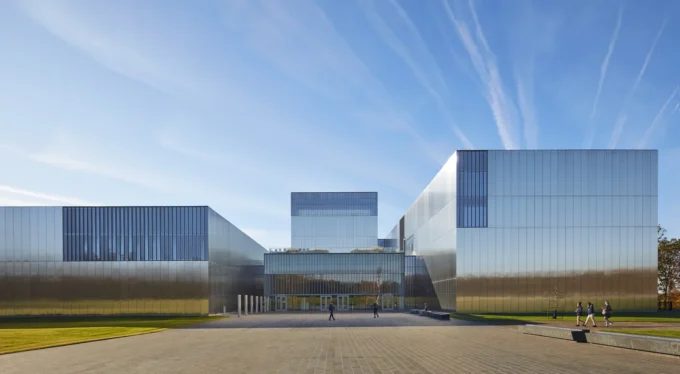
Materiality plays a crucial role in establishing the museum’s identity and connection to military tradition. The design incorporates robust materials that evoke strength and permanence—qualities synonymous with Army values. Exterior surfaces feature carefully selected metals that reference military equipment and vehicles, while interior spaces employ warm terrazzo flooring that softens the institutional character. These material choices create a balance between formality and approachability, ensuring the space feels welcoming to civilian visitors while maintaining appropriate gravitas for its subject matter.

Architectural Form and Symbolic Expression
The building’s volumetric composition responds thoughtfully to its context while projecting institutional significance. SOM developed a form language that reads as contemporary yet timeless, avoiding trendy gestures that might date the structure prematurely. The massing strategy distributes program elements across multiple levels, creating opportunities for dramatic interior volumes in key gathering spaces. Vertical circulation elements become architectural features in their own right, offering moments of pause and reflection between gallery sequences.
Facade articulation reflects the dual nature of the institution’s mission—serving as both archive and active community resource. Glazing patterns alternate between transparent zones that invite visual engagement and solid panels that provide necessary environmental control for artifact preservation. The Metalwërks cladding system contributes textural richness while maintaining durability appropriate for a structure designed to serve multiple generations. This treatment demonstrates how cultural architecture can express institutional character through material assembly rather than relying solely on symbolic ornament.

Interior Experience and Exhibition Design Integration
Within the museum, spatial hierarchies establish clear distinctions between primary exhibition galleries and supporting program areas. The design accommodates diverse exhibit types—from intimate display cases requiring careful lighting control to expansive halls capable of housing large military vehicles and equipment. Ceiling heights vary strategically throughout, with soaring spaces at entrance sequences and compressed zones creating intimacy around personal soldier narratives. This dimensional variety prevents monotony while supporting different modes of visitor engagement.
Lighting design emerged as a critical component in shaping visitor perception and protecting sensitive historical materials. The architecture incorporates sophisticated daylight management systems that admit natural illumination where appropriate while maintaining strict environmental controls in artifact-sensitive zones. Artificial lighting layers create flexibility for exhibition designers, allowing them to adjust ambiance according to specific display requirements. Skyfold operable partitions provide additional adaptability, enabling the facility to host special events and educational programming beyond traditional museum functions.

Technical Systems and Performance Criteria
Behind the architectural expression lies comprehensive building systems infrastructure designed to meet stringent preservation standards. Climate control maintains precise temperature and humidity parameters essential for protecting historical artifacts across different material types. The structural framework employs efficient spans that minimize column intrusions in exhibition spaces while providing necessary load capacity for heavy objects including suspended aircraft and armored vehicles. These technical achievements remain largely invisible to visitors, yet prove fundamental to the museum’s operational success.
Accessibility considerations permeate every aspect of the design, reflecting commitment to inclusive public service. Circulation routes accommodate visitors with varying mobility capabilities, while exhibit mounting heights and sightline studies ensure content remains legible to diverse audiences. Audio description systems and tactile elements supplement visual displays, creating multisensory experiences that broaden engagement possibilities. This attention to universal design principles demonstrates how contemporary institutional architecture can serve entire communities effectively.

Urban Context and Site Integration
The museum’s placement within Fort Belvoir required careful negotiation between security protocols and public accessibility. SOM’s site strategy establishes a distinct arrival sequence that transitions visitors from secured military installation to welcoming cultural facility. Landscape elements frame the building while providing orientation cues and outdoor gathering spaces. Indigenous plantings reduce maintenance requirements while connecting the project to regional ecological systems, exemplifying sustainable design thinking applied to institutional contexts.
Parking and service logistics operate discreetly, preserving the dignified character of the visitor approach. Separate circulation paths accommodate school groups and special events without disrupting general admission flows. The overall site planning reflects sophisticated understanding of institutional operations while maintaining design quality throughout supporting program elements. This comprehensive approach to site development sets standards for how cultural facilities can function within complex security environments without compromising visitor experience.

Legacy and Educational Impact
Completing in 2020, the National Museum of the United States Army immediately established itself as a significant addition to Washington’s constellation of memorial and educational institutions. The facility welcomes diverse audiences—from military families seeking connection to service history to students engaging with American heritage for the first time. Educational programming extends the architecture’s mission, offering workshops, lectures, and interactive experiences that complement static exhibitions. The building’s design flexibility ensures it can adapt to evolving pedagogical approaches and changing exhibition content over its operational lifespan.
SOM’s achievement demonstrates how architecture can honor complex histories while remaining accessible and engaging for contemporary audiences. The project avoids militaristic bombast, instead offering thoughtful spaces for reflection, learning, and remembrance. By centering individual soldier experiences rather than glorifying conflict, the museum contributes meaningfully to national conversations about service and sacrifice. This nuanced approach positions the facility as a model for how institutional architecture can serve educational missions while respecting the weight of historical subject matter. Similar sensitivity to narrative can be found in other acclaimed museums documented on platforms like Dezeen and Designboom.
Photography: Dave Burk | SOM


- Army museum Washington DC
- cultural architecture
- educational museum architecture
- Fort Belvoir museum
- Institutional architecture
- metalwork facades
- military museum design
- museum design methods
- National Museum United States Army
- Skidmore Owings & Merrill
- SOM architecture
- terrazzo flooring design
- veteran memorial architecture







Leave a comment