


Table of Contents Show
In Ota City, Gunma Prefecture, one of Japan’s historic automotive production hubs, Furukawa Manufacturing has operated for decades as a behind-the-scenes powerhouse. The company specializes in designing tailored production systems for major automobile and component manufacturers, integrating industrial robots for welding, handling, and assembly. Despite its technical influence and long-standing client relationships, Furukawa remained largely invisible to the general public. Confidential workflows and dispersed facilities made it difficult for the company to express its identity or attract new talent. Recognizing the need for transformation, the company commissioned Jo Nagasaka + Schemata Architects to design a new consolidated headquarters and factory: an architectural statement capable of elevating its brand, culture, and long-term future.

Unifying Functions Through a Clear Spatial Order
The project brings together functions previously scattered across multiple sites and buildings, creating a cohesive campus on a 20,000 m² rectangular plot surrounded by public roads. Instead of enclosing the site with fences or physical boundaries, the architects embraced openness. Parking areas, circulation routes, and exterior spaces were paved continuously with asphalt to visually merge the campus with its surroundings. Road signage, directional symbols, and markings, styled after standard municipal traffic graphics, extend the logic of the public streetscape into the interior of the site.
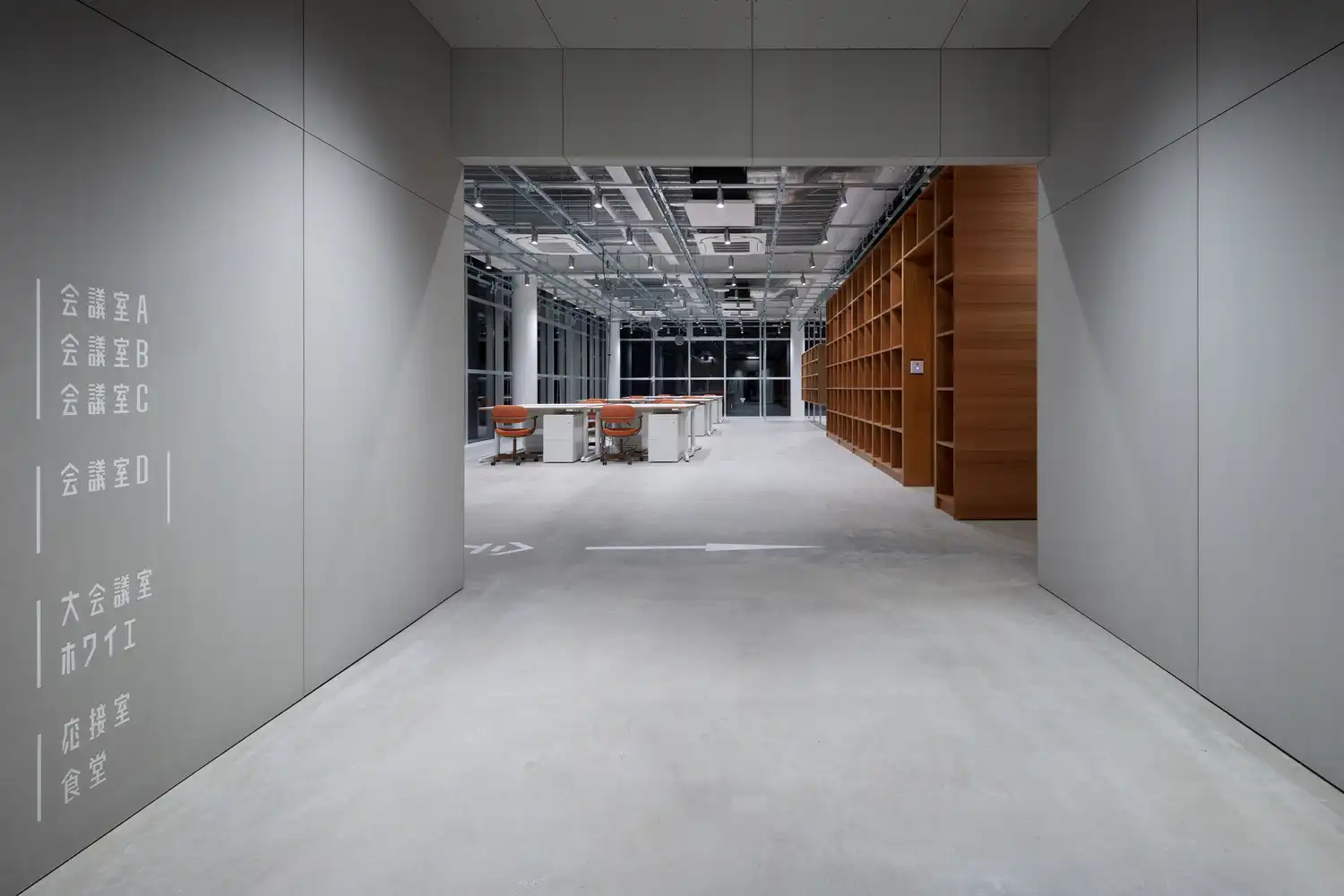
To organize the many layers of the complex, the architects introduced a 1.2-meter grid system across the entire site. This grid informed the placement of buildings, exterior elements, glass partitions, furnishing systems, lighting layouts, and even signage. By adopting a single ordering device for both architectural and landscape elements, the design achieves coherence despite the variety of functions, from production zones to executive offices. The visible alignment of grids becomes a subtle but powerful identity marker, communicating precision, logic, and technological rigor.

Architecture That Communicates Openness and Craftsmanship
The headquarters building is programmed vertically, with each floor designed according to the operational relationships between departments. The first floor hosts an 80-seat cafeteria, envisioned as a social hub that anchors the building and creates a welcoming first impression. It connects to a double-height atrium that continues into the second floor, where a large multipurpose conference and training room accommodates visitors and internal workshops. This strategic stacking strengthens communication between teams while offering flexible, comfortable spaces for presentations and collaboration.
On the third and fourth floors, open-plan office environments bring together desk clusters, shared meeting rooms, and enclosed collaborative areas. The fifth floor hosts the president’s office, executive meeting rooms, private reception areas, and a generous terrace for informal outdoor gatherings. While each floor varies in scale and function, the shared grid system ensures unity. Raceways, partitions, lighting fixtures, and interface details remain consistent, creating a building that communicates its own internal logic.

The design of the façade reinforces the company’s renewed identity. Large expanses of glass reveal the structured interiors and invite natural light deep into the workspaces, while the alignment of mullions and exterior modules echoes the grid. Inside, Schemata Architects’ characteristic material honesty is evident in exposed finishes, simple detailing, and a restrained palette that foregrounds clarity and function. The architecture eschews decorative excess in favor of precision, reflecting the company’s engineering culture.
Integrated Exterior + Interior Design as a Brand Strategy
The factory and office buildings are linked not only physically but graphically. Exterior markings blend seamlessly with architectural grids, creating a cohesive language across asphalt, structure, and program. This graphic consistency communicates a forward-looking corporate identity: visible, legible, and contemporary. It also transforms the site into an intuitive navigation environment for employees, visitors, and logistics operations.
This new transparency stands in contrast to the company’s historically confidential and inward-facing character. While production processes remain secure, the architectural openness allows the company to project confidence and clarity. It becomes a visible workplace where potential employees, partners, and community members can understand who Furukawa is and what it does.
Cultural Impact, Recruitment Transformation, and Operational Efficiency
Beyond spatial efficiency and aesthetics, the project has had meaningful cultural and economic impacts. The new campus serves as the centerpiece of the company’s rebranding initiative, directly addressing the nationwide challenge of labor shortages in manufacturing. By presenting a strong architectural identity and a clear image of technological expertise, Furukawa has significantly improved recruitment outcomes. The company reports a tenfold increase in applications, particularly from experienced women living in the region, an important demographic for sustaining long-term workforce development.
Internally, consolidating the headquarters and production facilities has strengthened communication between design teams and factory staff. Engineers can observe production outcomes in real time, shortening feedback loops and improving both quality and productivity. The architecture thus becomes not only a symbol of the company’s values but also a tool for operational optimization.

A Visible Future for a Previously Invisible Industry
Furukawa Manufacturing’s new office and factory complex marks a milestone, turning a historically hidden industrial operation into an open, expressive, and future-oriented presence. Through a disciplined grid, transparent planning, and integrated exterior and interior design, Schemata Architects created a headquarters that reflects precision while fostering connection. The building stands as a model for how architecture can transform recruitment, brand identity, and collaborative culture within the manufacturing sector.
Photography: Takumi Ota


- Architecture for Recruitment Strategy
- Brand Identity Through Architecture
- Contemporary Factory Design
- Corporate campus architecture
- Furukawa Manufacturing
- Furukawa Manufacturing Office and Factory
- Grid-Based Architectural Design
- Headquarters Architecture Japan
- Industrial Architecture Japan
- Integrated Exterior–Interior Design
- Japanese Industrial Design
- Jo Nagasaka
- Jo Nagasaka Furukawa Project
- Manufacturing facility design
- Modern Industrial Campus
- Office and Factory Integration
- Ota City Architecture
- Schemata Architects
- Schemata Architects Projects
- Transparent façade design
- Workplace Architecture Japan









Leave a comment