


Table of Contents Show
In the vast expanse of Inner Mongolia’s Xilingol League, where ancient volcanic forces once shaped the earth, a remarkable hospitality project emerges as both architectural statement and ecological intervention. PLAT ASIA’s Volcano-In Hotel of Arrivals, completed in 2025, demonstrates how contemporary architecture can address environmental degradation while creating compelling guest experiences. Spanning 1,634 square meters, this project transforms a site scarred by 150,000 years of erosion into a catalyst for landscape regeneration.

Geological Context and Environmental Challenge
The site occupies a distinctive position within a collapsed volcanic cone that has fractured into nine hillocks now carpeted with steppe vegetation. Unlike the verdant surroundings where diverse plant communities flourish, the southeastern sector (the hotel’s location) presents a starkly different picture. Working alongside geologists and indigenous herders, the design team uncovered the root cause: positioned leeward of prevailing northwest winds, this zone has become a trap for snow and sand accumulation over millennia. The resulting deposits, extending more than two meters deep in places, create hostile conditions where even hardy grassland species struggle to establish themselves. This environmental wound demanded more than simple construction; it required architectural healing.
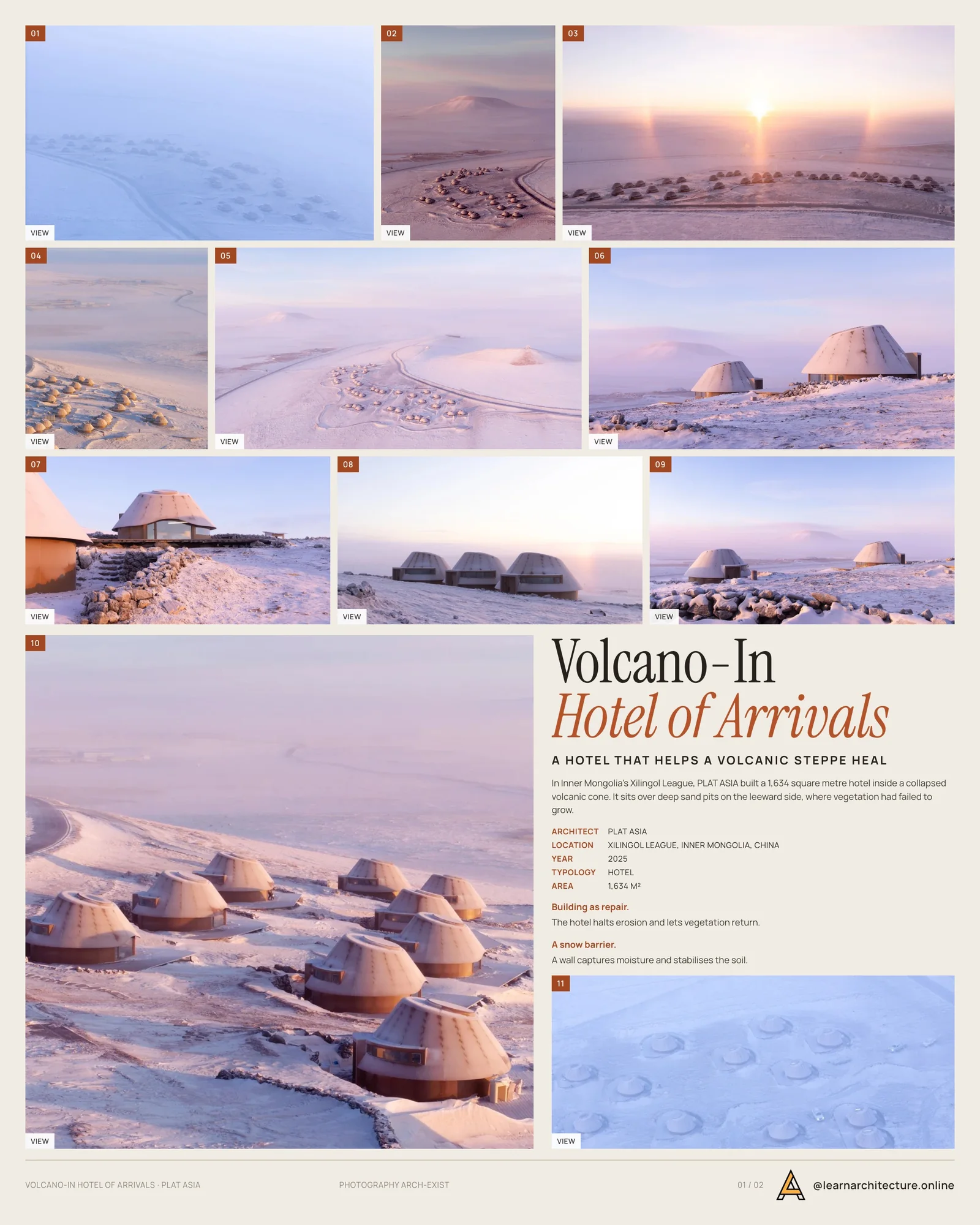
Rather than avoiding the degraded terrain, PLAT ASIA embraced it as an opportunity. The strategic decision to build directly over these deep sand pits serves multiple ecological purposes: halting further erosion, displacing destructive accumulation with constructed form, and establishing conditions for vegetation recovery. A protective snow barrier wall forms part of the intervention, capturing moisture, stabilizing soil, and creating microclimates favorable for plantings. This approach positions the hotel not merely as a visitor facility but as an active participant in landscape restoration, demonstrating architecture’s potential to reverse environmental damage rather than compound it.

Architectural Language Drawn from Geological Memory
The design vocabulary directly references the site’s volcanic heritage without resorting to literal mimicry. Steel structure and membrane roof systems create bold, angular forms that evoke the fractured geology of the collapsed cone while maintaining distinctly contemporary expression. Glass curtain walls by TONGCHUANGHUAJIAN Group establish visual permeability, framing dramatic vistas across the grassland toward the distant hills, remnants of the original volcanic formation. This transparency serves practical and poetic functions simultaneously, minimizing the structure’s visual mass while connecting interior experiences to the vast landscape beyond.
Lead architect Bian Baoyang, working with project architects Ma Xuan and Guo Lulu, orchestrated an integrated design approach where architecture, landscape, and interiors function as unified expression. The architecture and interior design team (including Liu Xinwei, Yang Lu, Dong Zijuan, Zhang Chaowei, Ran Haoyu, and Zhang Kaijie) collaborated closely with landscape designers Zhang Xiaozhan and Wang Xiaochun to ensure seamless integration between built form and restored terrain. This holistic methodology reflects contemporary practice’s evolution beyond isolated disciplines toward comprehensive environmental design, a approach championed by firms exploring sustainable architecture globally.

Technical Resolution and Construction Methodology
Realizing PLAT ASIA’s vision required sophisticated technical collaboration. Beijing Zhongtian Jianzhong Engineering Design handled construction documentation while Beijing Jinshengjie Membrane Structure Technology delivered specialized steel structure design and fabrication. The membrane roof system, a defining architectural element, demanded precise engineering to withstand Inner Mongolia’s extreme continental climate where winter temperatures plunge well below freezing and summer winds sweep across open grassland.
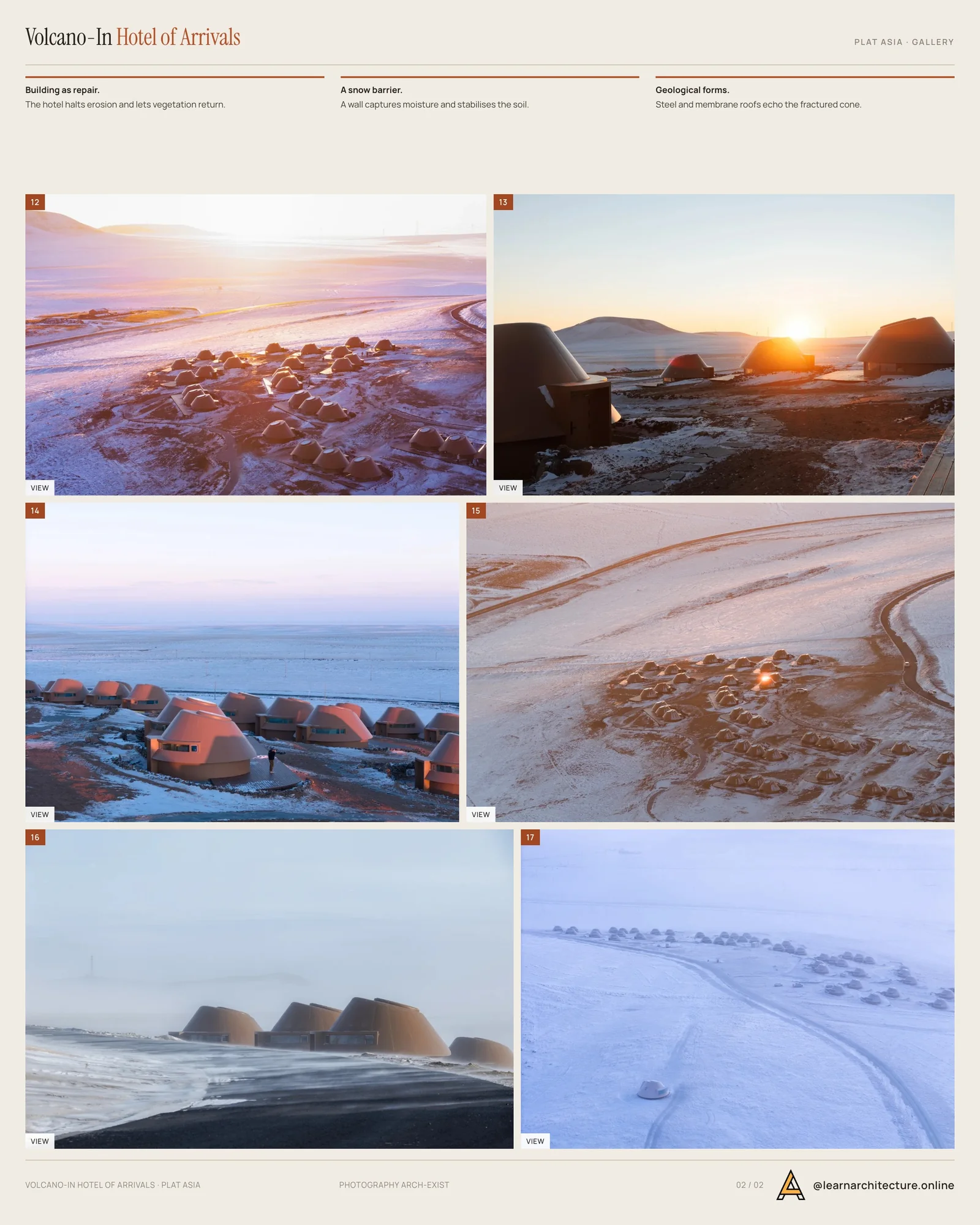
Beijing Wuse International Lighting developed illumination strategies that enhance both interior atmospheres and the building’s dramatic nighttime presence against the dark steppe sky. Inner Mongolia TianLong Construction, serving as general contractor, coordinated these specialized systems while managing conventional construction sequences. The integration of smart systems by LifeSmart adds contemporary hospitality amenities, allowing guests to control environmental conditions while the building’s monitoring systems optimize energy consumption. This technical complexity, invisible to visitors, enables the project’s environmental performance and operational efficiency.

Hospitality Experience Within Volcanic Landscape
The hotel’s spatial organization responds directly to its dual mission: providing compelling guest experiences while minimizing environmental impact. Public spaces orient toward panoramic views of the volcanic hills, transforming geological context into constantly changing visual drama as light and weather conditions shift across the grassland. Guest accommodations balance privacy with connection to surroundings, each space calibrated to frame specific landscape aspects while maintaining thermal comfort through passive design strategies complemented by active systems.
Interior materiality creates deliberate counterpoint to the harsh exterior environment: refined surfaces and controlled lighting establish sanctuaries of comfort while large glazed openings maintain visual connection to the raw landscape beyond. This dialectic between protection and exposure, between refined interior and rugged exterior, generates the project’s experiential richness. The design acknowledges that contemporary hospitality architecture must deliver not just functional accommodation but memorable experiences rooted in specific place and context, lessons equally applicable to hotel design worldwide.

Regenerative Architecture as Development Model
Beyond its immediate architectural achievement, the Volcano-In Hotel proposes a provocative model for development in ecologically sensitive or degraded sites. Rather than seeking pristine locations or accepting environmental compromise as inevitable construction byproduct, PLAT ASIA demonstrates how building projects can actively improve ecological conditions. The vegetated snow barrier, strategic site grading, and indigenous plant selections work collectively to begin reversing 150 millennia of erosion, a timeline that puts human intervention in humbling perspective while demonstrating architecture’s potential positive impact.
This regenerative approach aligns with growing recognition that architecture must engage climate crisis and biodiversity loss as central design challenges, not peripheral concerns. Projects like the Volcano-In Hotel, alongside other examples of sustainable architecture, demonstrate that environmental responsibility and design excellence need not conflict; indeed, ecological engagement can generate distinctive architectural character impossible through conventional approaches. As global development pressure intensifies, particularly in China where rapid urbanization continues reshaping vast territories, such precedents become increasingly valuable.
Photographed by Arch-Exist, the completed project reveals how bold contemporary form can emerge from rigorous site response and environmental commitment. The Volcano-In Hotel of Arrivals stands as both destination and demonstration: proof that hospitality architecture can simultaneously serve guests, restore landscapes, and advance disciplinary discourse on architecture’s ecological responsibilities. In Inner Mongolia’s ancient volcanic terrain, PLAT ASIA has created not just a hotel but a vision of how building and healing might become synonymous acts.
Photography: Arch-Exist
- crater-inspired hospitality
- ecological restoration architecture
- environmental architecture China
- Grassland architecture
- hospitality architecture 2025
- Inner Mongolia hotel design
- PLAT ASIA architecture
- regenerative design
- sand dune restoration
- Sustainable hotel design
- volcanic cone hotel
- volcanic landscape architecture
- Volcano-In Hotel
- Xilingol League project










Leave a comment