


Table of Contents Show
Nestled deep within Zhongcha Valley in Jiuzhaigou, Rissai Valley, a Ritz-Carlton Reserve designed by WATG in collaboration with CSWADI, offers an immersive encounter between luxury hospitality, ancient culture, and dramatic mountain landscapes. As Marriott International’s first Reserve property in China, and the sixth of its kind worldwide, the resort represents a highly curated approach to seclusion, authenticity, and contextual architecture. The name “Rissai,” meaning stockade village in Tibetan, reflects a place shaped by centuries of human settlement and spiritual connection to the land.
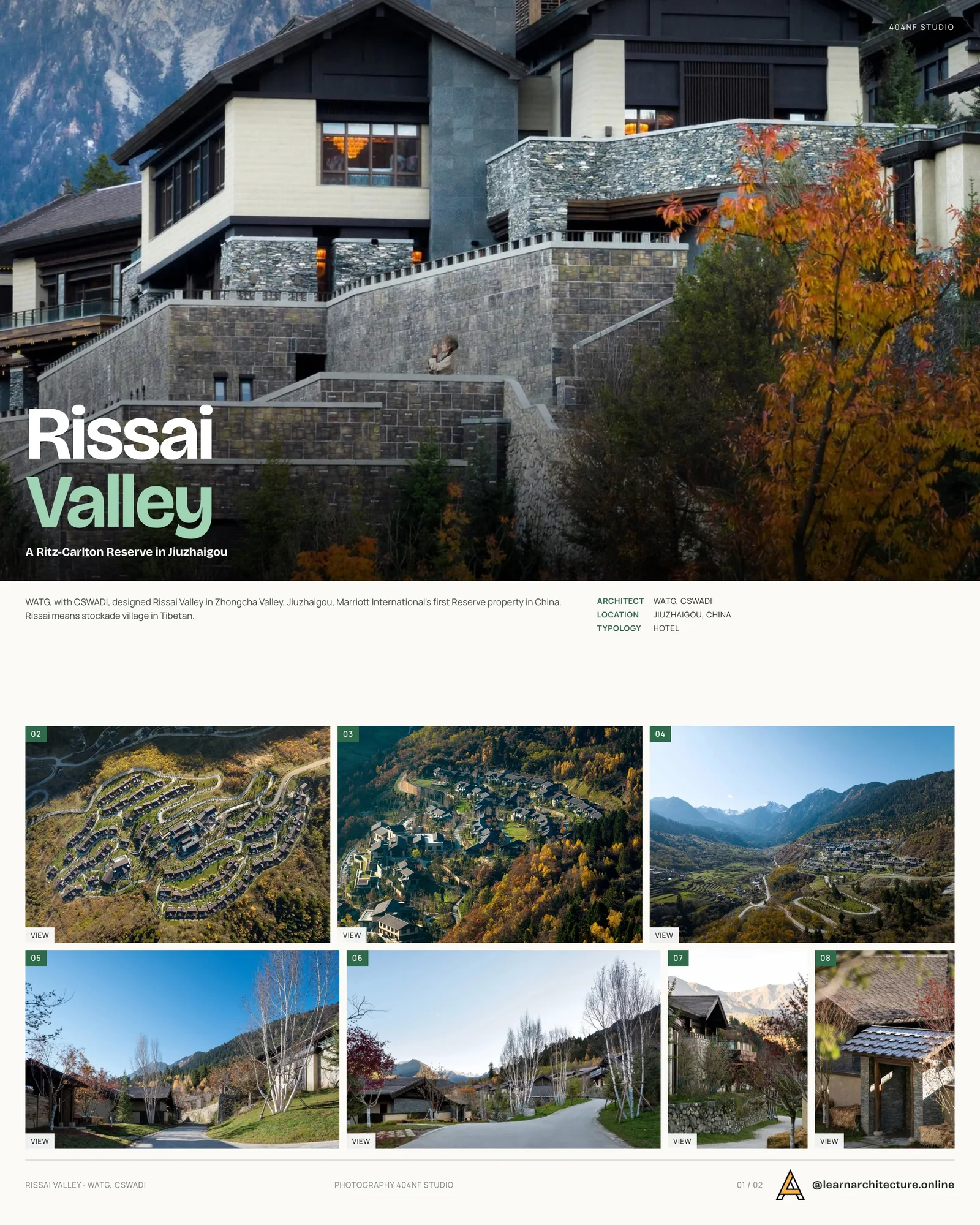

Arrival as a Ritual and Spatial Transition
The guest journey to Rissai Valley is intentionally choreographed as a gradual detachment from the outside world. Accessed by a winding mountain road, visitors pass through a traditional village gate that marks the threshold between everyday life and the private realm of the resort. From this point, guests are escorted by sightseeing vehicles accompanied by personal butlers, reinforcing a sense of ritual, care, and controlled discovery.
Positioned on a west-high to east-low hillside reaching elevations of up to 2,400 meters, the site presents a vertical difference of 89 meters and faces the authentic Tibetan settlement of Bori’e Village. Rather than dominating the terrain, the masterplan responds delicately to it, framing views of snow-capped peaks and ancient villages while preserving visual continuity with its cultural surroundings.

Masterplan Inspired by Tibetan Village Patterns
Spread across a 166,088 m² site with a total gross floor area of 36,217 m², the resort accommodates 87 luxury villas, public facilities, and a dedicated spa. The spatial organization draws inspiration from scattered Tibetan mountain villages, where buildings appear organically placed rather than rigidly planned. Structures follow natural contour lines, minimizing excavation and allowing architecture to merge seamlessly with the landscape.
At the heart of the valley lies the central public zone, anchoring the resort socially and spatially. From here, guest villas disperse outward, creating layers of privacy and reinforcing the resort’s defining concept: luxury through seclusion rather than spectacle. The resulting environment feels intimate, calm, and deeply embedded in its geographic context.

Architecture Shaped by Terrain and Tradition
Architecturally, the resort reinterprets traditional Tibetan stilted houses, adapting vernacular forms to meet contemporary luxury standards. Guest villas typically feature one above-ground living floor, carefully positioned to maximize views, and a stilted service level below. Public buildings expand vertically, incorporating two above-ground floors and three stilted levels, discreetly accommodating back-of-house functions.
Entrances are thoughtfully aligned with the natural slope, ensuring clear separation between guest and service circulation while maintaining effortless accessibility. Every villa enjoys an east-facing terrace, with a minimum spacing of seven meters between building rows. This ensures unobstructed panoramas across the valley and reinforces a powerful connection to the surrounding mountainscape.

Courtyards and Spatial Gradients of Privacy
A defining spatial feature of Rissai Valley is its use of courtyards as transitional spaces. Arrival sequences unfold through open “front courtyards” designed for drop-off and social interaction, gradually transitioning into smaller, more intimate guest courtyards. These layered outdoor spaces mirror traditional settlement patterns, guiding guests from communal experiences toward solitude and reflection.
This careful gradation (from public to private, from open landscape to enclosed sanctuary) enhances the sense of homecoming, a core emotional goal of the resort’s design philosophy.

Façade Language and Interior Storytelling
The architectural expression draws heavily from Tibetan-Qiang watchtowers and plank houses, featuring three-section façades, gable-hip roofs, and textured walls that reinterpret traditional rammed earth construction. Details such as the “Bianma Wall”, a historic masonry technique, are reimagined using contemporary materials while preserving their tactile and symbolic qualities.
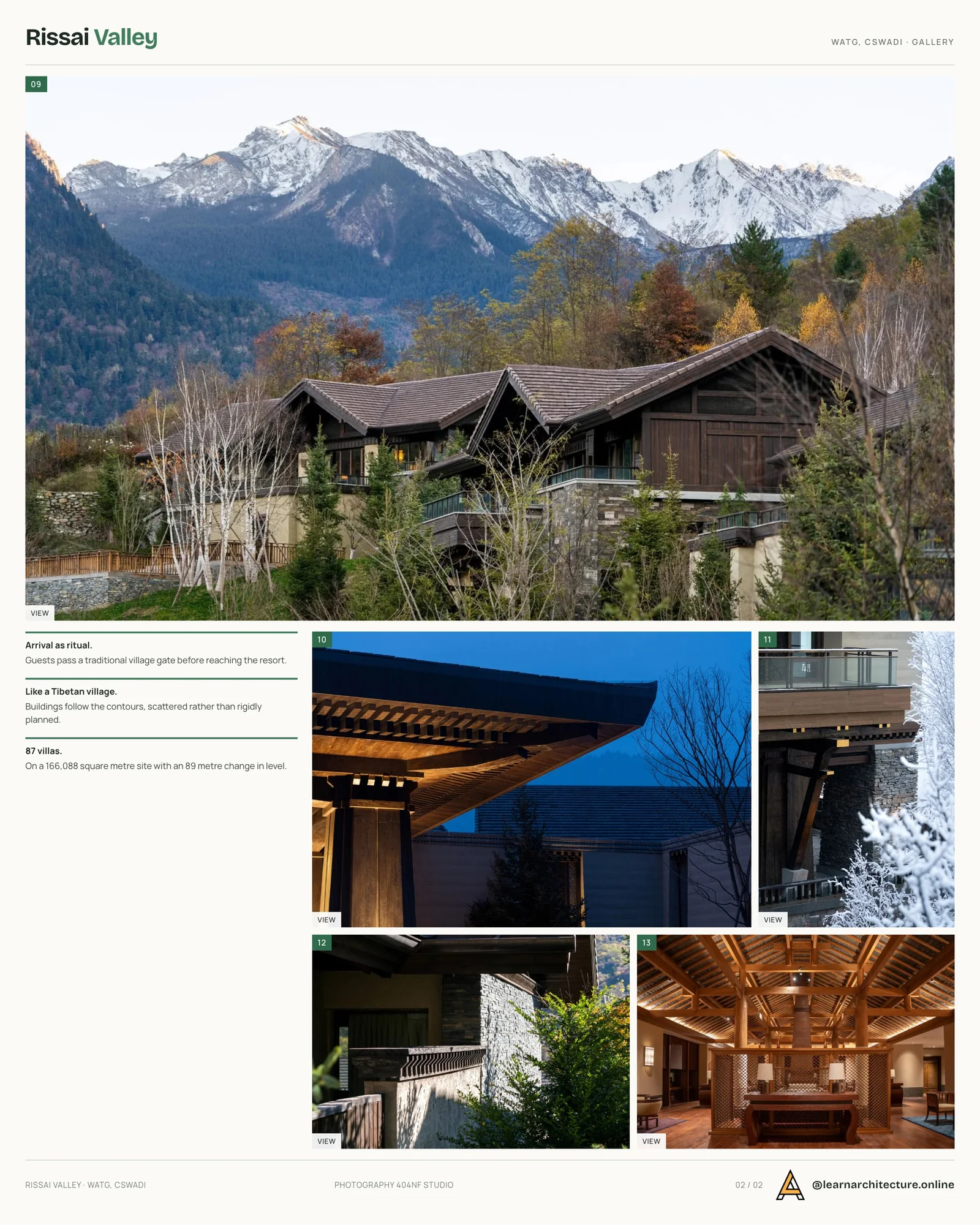
Inside, the design emphasizes wooden structural elements, evoking warmth and craftsmanship. Central fire pit motifs reference traditional Tibetan hearths, while auspicious patterns are used to articulate space and guide movement. Carefully curated displays of local antique objects strengthen the narrative continuity, creating interiors that feel personal, cultural, and rooted rather than staged.

Sustainable Design at High Altitude
Environmental sensitivity is integral to the project’s execution. The architecture responds to wind direction, solar exposure, and temperature extremes through terrain-based shielding strategies and optimized window-to-wall ratios. Locally sourced materials, such as natural stone slabs and anti-corrosive timber, reduce transportation impact while reinforcing regional identity.
Structurally, frame and shear wall systems ensure stability under high-altitude conditions, while dual power supply systems enhance operational resilience. These technical solutions support long-term durability without compromising the resort’s visual harmony with the landscape.

Harmony Between Humanity and Nature
Guided by the principle of harmony between humanity and nature, Rissai Valley does not impose luxury upon the land but allows it to emerge from it. Architecture, landscape, and culture coexist in a quiet balance, offering guests an experience that is immersive rather than ornamental. Through sensitive planning, cultural respect, and environmental integration, the resort becomes both a destination and a continuation of the valley’s living history.
A Contemporary Model for Culturally Embedded Luxury
Rissai Valley stands as a refined example of how luxury hospitality architecture can honor indigenous culture, protect fragile landscapes, and deliver deeply personal experiences. Rather than isolating guests from their surroundings, the resort invites them into an authentic dialogue with Tibetan-Qiang heritage and the majestic Jiuzhaigou landscape, offering not just accommodation, but meaningful belonging.
Photography: 404NF STUDIO


- Architecture in Sichuan
- Chinese luxury hospitality
- Contemporary vernacular design
- CSWADI architecture
- Cultural landscape resorts
- Eco-conscious resort design
- High-altitude hotel design
- Jiuzhaigou resort design
- Landscape-integrated architecture
- Luxury resort architecture
- Mountain hospitality architecture
- Nature-integrated hotel design
- Rissai Valley
- Ritz-Carlton Reserve China
- Secluded luxury destinations
- Sustainable luxury resorts
- Tibetan-inspired architecture
- Tibetan-Qiang architecture
- Villa resort masterplan
- WATG architects










Leave a comment