


Table of Contents Show
Finding a home that truly feels right is often less about ticking boxes and more about intuition. For the young family behind the Estrela Apartment: Lucky Star, that instinctive connection emerged in one of Lisbon’s most symbolically charged locations: a street facing the official Prime Minister’s Office, familiar to generations of Portuguese through television and public life. Designed by Spacegram, the project transforms a former office interior into a fluid, light-filled home defined by curves, hidden storage, and a carefully choreographed relationship between form, light, and daily life.
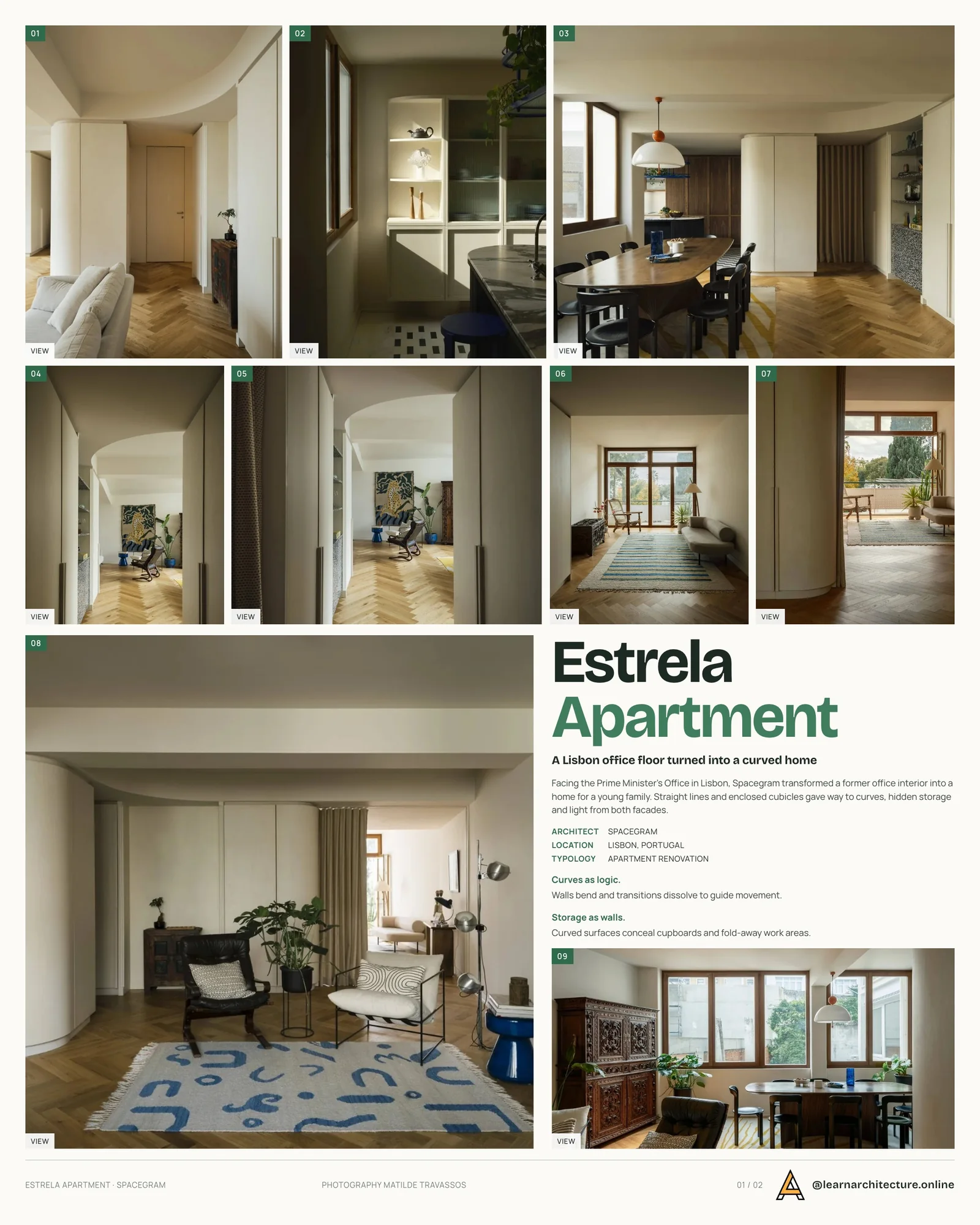
While the address promised prestige and centrality, the interior initially offered the opposite of domestic warmth. Decades of bureaucratic use had left behind rigid layouts, dull finishes, and an atmosphere shaped by formality rather than comfort. Yet beneath peeling paint and grey corridors lay something far more valuable: potential. The project became an exercise in reimagining function and emotion, turning a strictly rational plan into a sensual and adaptable living environment.

From Bureaucratic Grid to Domestic Flow
The original office configuration was defined by straight lines, enclosed cubicles, and hierarchical planning. Spacegram’s response was radical yet precise: to undo rigidity through curvature. Every element that once reinforced stiffness was reworked into something smooth, continuous, and dynamic. Closed rooms were opened, circulation was softened, and sharp corners were replaced by flowing geometries that guide movement rather than constrain it.
Curves became more than an aesthetic choice; they formed the architectural logic of the apartment. Walls bend, volumes unfold, and transitions dissolve, allowing spaces to connect visually while remaining functionally distinct. This approach reshaped the apartment into a sequence of light-filled areas where boundaries feel intuitive rather than imposed.

Storage as Architecture
One of the defining strategies of the project lies in how storage is treated, not as an addition, but as an integral architectural device. Throughout the apartment, curved walls conceal generous storage units, cupboards, and functional elements. These surfaces appear sculptural and continuous, yet they are deeply practical.
This “now-you-see-it, now-you-don’t” logic allows working spaces to emerge or disappear as needed. Home offices can become communal zones, and private areas can be subtly screened without visual heaviness. The result is a home that adapts seamlessly to family life, work routines, and moments of gathering, all without relying on conventional partitions.

Light as a Primary Material
Natural light enters the apartment from both façades, and Spacegram treats it as a core material rather than a secondary condition. Light moves across curved surfaces, revealing depth, texture, and subtle shifts throughout the day. Morning brightness animates communal areas, while evening light settles softly into more intimate zones.
Material choices reinforce this strategy. Raw-sanded birch veneer carpentry, finished with a warm white wash, diffuses light gently and enhances spatial continuity. Inside these volumes, walnut veneer introduces warmth and richness, creating contrast and depth without visual excess. Light does not merely illuminate; it shapes atmosphere, defining how each space is experienced over time.

Stepped Geometry and Spatial Rhythm
Another key gesture in the apartment is its stair-like spatial organization. Rather than a flat, uniform plan, areas are subtly stepped, allowing different functions to coexist while maintaining visual connection. This layered arrangement offers intimacy without enclosure, encouraging fluid movement and spatial dialogue.
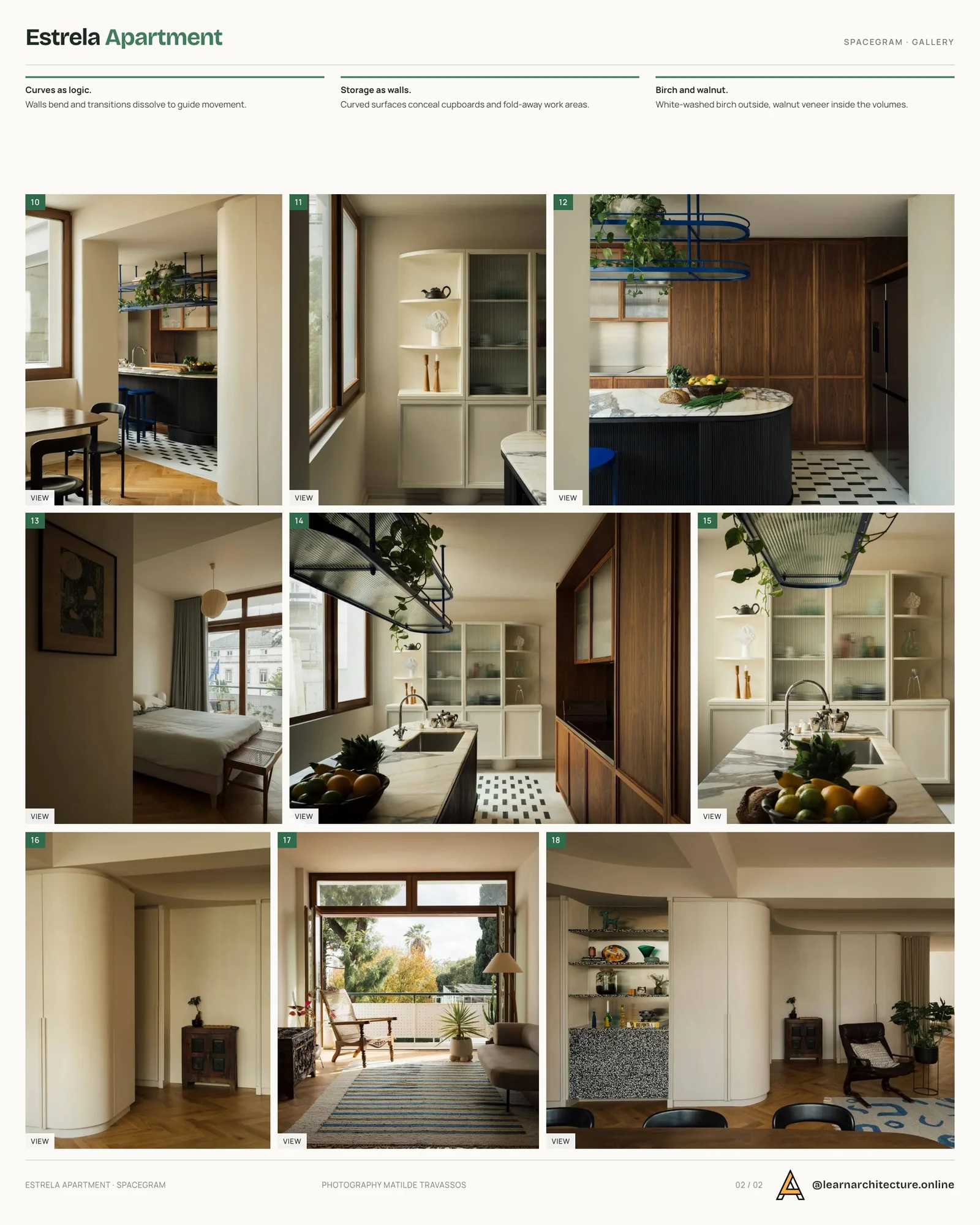
The stepped motif is echoed vertically through wall-mounted elements and shelving, creating a consistent rhythm throughout the apartment. Each “step” is softened by a gentle curve, reinforcing the project’s commitment to movement and tactility. This interplay between geometry and softness is central to Spacegram’s architectural language, where form is always linked to emotion.

Dialogue Between Heritage and Contemporary Design
While the intervention is unmistakably contemporary, it does not erase the memory of the existing building. Instead, the project establishes a quiet dialogue with the past. Subtle geometric references nod to Art Deco influences embedded in Lisbon’s architectural history, grounding the apartment within its urban context.
These references are balanced by the introduction of modern materials: raw aluminium brings a crisp, industrial edge, while dark terrazzo adds weight, texture, and permanence. Together with warm wood finishes, these elements create a controlled tension between softness and precision, tradition and innovation.

A Home That Remembers and Reinvents
The Estrela Apartment: Lucky Star is ultimately a story of transformation, not just of space, but of atmosphere and intent. What was once a neutral, bureaucratic interior has become a personal, adaptable, and expressive home, shaped by curves, light, and thoughtful materiality.
By prioritizing flow over rigidity and emotion over formality, Spacegram delivers an interior that feels both contemporary and timeless. The apartment remembers where it came from while confidently redefining how it is lived in today: a space where architecture, design, and daily life move together in quiet harmony.
Photography: Matilde Travassos


- adaptive living spaces
- Apartment renovation Lisbon
- Art Deco inspired interiors
- Contemporary home renovation
- Contemporary residential architecture
- Curved interior design
- Curved wall design
- Custom storage design
- Estrela Apartment
- Family apartment renovation
- Interior architecture Portugal
- Light-filled interiors
- Lisbon apartment renovation
- Lisbon residential project
- Lucky Star Apartment
- modern apartment design
- Residential interiors Lisbon
- Sculptural interior architecture
- Spacegram
- Spacegram interiors






Leave a comment