


Table of Contents Show
Social Housing Units 2104 by HARQUITECTES demonstrates how architectural responsibility can extend beyond form into material ethics, construction intelligence, and social commitment. Conceived for elderly residents, the project is rooted in a powerful act of transformation: instead of erasing the past, the demolished remains of a former school become the literal building blocks of the new housing. Through a strategy of reuse, structural clarity, and spatial generosity, the building redefines what contemporary social housing can represent: a synthesis of sustainability, dignity, and architectural rigor.
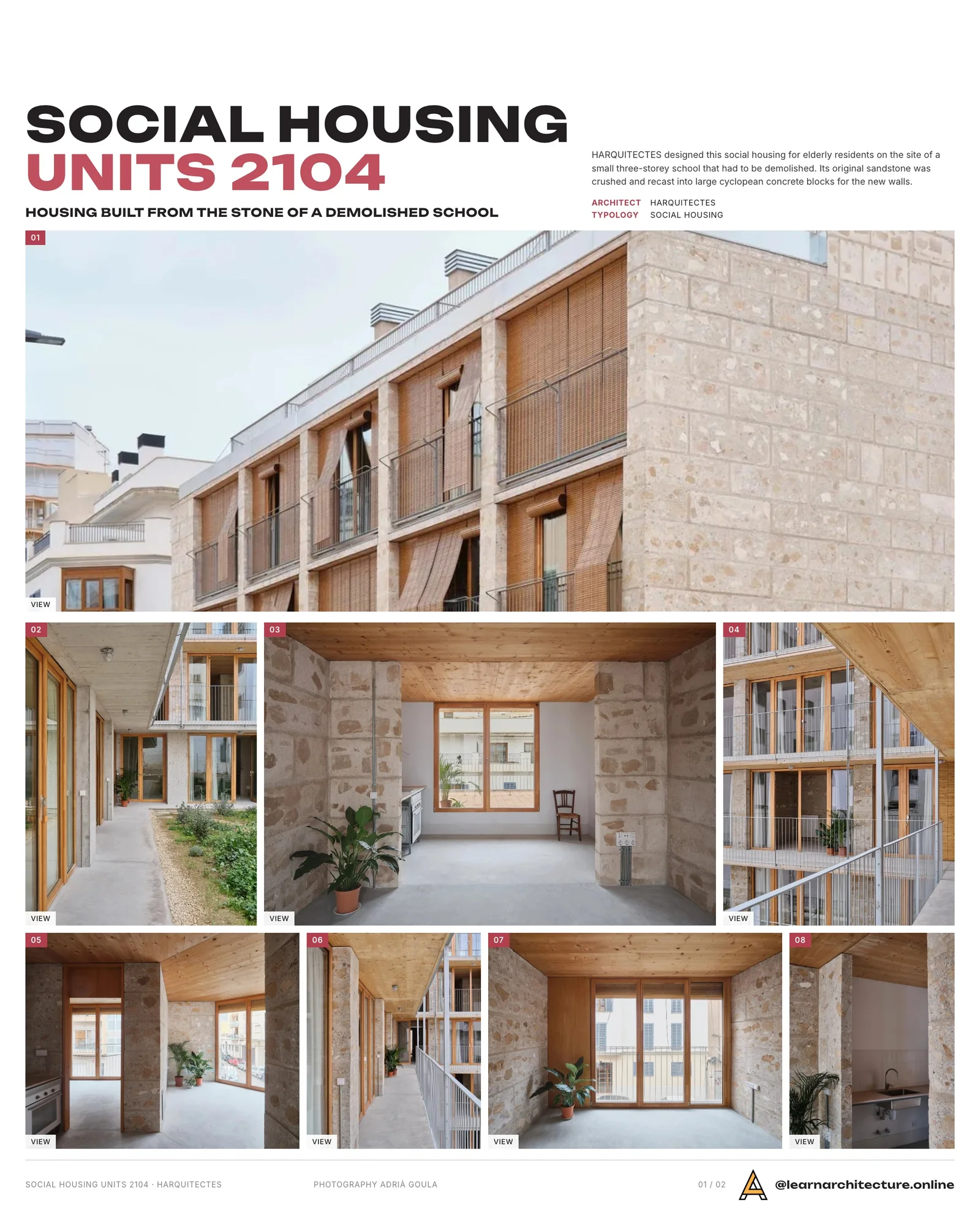

Urban Mining as Architectural Foundation
The project began with the unavoidable demolition of a small three-storey school that no longer met structural or regulatory requirements. Rather than viewing demolition as waste, HARQUITECTES approached the process as an opportunity for urban mining. The site itself became the primary material resource for the new building.
Nearly all debris generated on site was carefully sorted and repurposed. Concrete and ceramic rubble were reused within the foundations and semi-basement structure, while the original sandstone (marès) walls were transformed into an entirely new construction system. This decision was not symbolic but profoundly practical: it reduced waste, minimized transport emissions, shortened construction timelines, and embedded the building deeply within its own material memory.
Through this approach, sustainability is not added later through technology, but integrated at the most fundamental architectural level.

A New Structural System Born from Reused Stone
One of the most distinctive aspects of the project is its custom-developed structural system. The original sandstone was crushed and recomposed into large prefabricated cyclopean concrete blocks. Each block integrates cement, lime, and recycled stone aggregates, allowing fragments of the original school to remain visibly present in the new façade and interior surfaces.
These blocks were produced on site after demolition, cut from large slabs into modular components whose dimensions respond directly to structural logic. Their thickness gradually decreases on upper floors, allowing cross-laminated timber ceilings to sit directly on the walls. This system eliminates unnecessary complexity and accelerates construction while maintaining clarity of load distribution.
The result is a building where structure, material expression, and architectural language are inseparable. What appears on the façade is not cladding, but the real substance of the building.

Architecture Shaped by Construction Logic
Rather than imposing a formal concept first, the architectural organization emerges directly from the construction method. Load-bearing walls run perpendicular to the street, defining both structure and spatial rhythm. These are complemented by thinner partition walls made from the same recycled material, ensuring continuity throughout the building.
This logic produces a legible, honest architecture where the user can intuitively understand how the building stands. The stair and elevator core anchors the plan, while circulation extends toward an interior garden walkway from which each dwelling is accessed. The layout promotes natural ventilation, daylight penetration, and orientation clarity, qualities especially important in housing designed for elderly residents.

Collective Spaces and Residential Dignity
Beyond its technical innovation, the project is deeply attentive to social experience. Each floor includes communal areas such as shared lounges and laundry spaces, reinforcing the idea that housing is not only about private units but also about building community.
The apartments are primarily through-units, benefiting from cross-ventilation and dual orientations. Upper-floor dwellings enjoy expansive terraces, extending living spaces outward and offering residents access to light, air, and views. Even units on the semi-basement and attic floors are designed with proportional generosity, avoiding the spatial marginalization often seen in social housing projects.
This careful balance between economy and quality reflects HARQUITECTES’ broader approach: architecture as an instrument of equality.

The Façade as Structural Narrative
The building’s exterior openly communicates its internal logic. The prefabricated block walls appear as vertical planes whose decreasing thickness across floors reveals the structural hierarchy. Timber ceilings remain legible as horizontal layers, reinforcing the dialogue between materials.
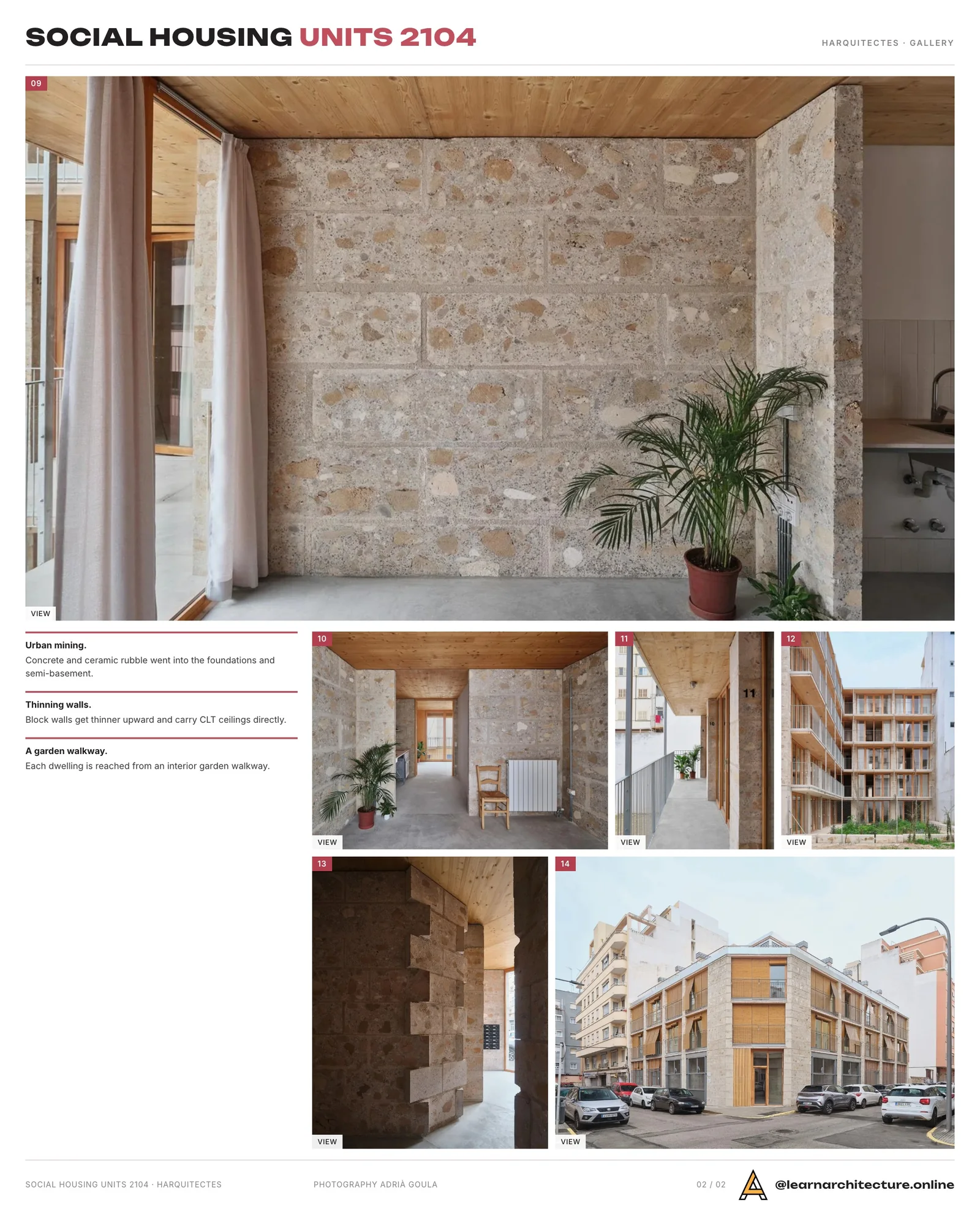
Balconies become another essential architectural element. Each apartment features full-height wooden outdoor spaces equipped with Venetian blinds, providing residents with both protection from sun exposure and control over privacy. These elements introduce warmth into the façade composition while enhancing environmental performance.
The result is a façade that is not decorative but deeply expressive of process, material origin, and inhabitation.

Conclusion
Social Housing Units 2104 is not simply an example of sustainable architecture; it is an architectural manifesto built from debris. By transforming demolition into opportunity, HARQUITECTES delivers a project where ecological responsibility, construction intelligence, and social sensitivity converge. The building proves that social housing can be experimental without losing clarity, innovative without losing humanity, and economical without sacrificing architectural dignity. Through its commitment to reuse, structure-driven design, and collective life, the project establishes a compelling model for the future of ethical residential architecture.
Photography: Adrià Goula


- Architectural Innovation
- Architecture and community
- architecture and sustainability
- circular construction
- Contemporary housing design
- Cyclopean Concrete
- Ethical Architecture
- Experimental Housing
- HARQUITECTES
- Housing for Elderly
- Load Bearing Architecture
- low carbon architecture
- Material Reuse
- Recycled Materials Architecture
- Social housing architecture
- Social Housing Units 2104
- Spanish Architecture
- sustainable housing
- Timber and concrete architecture
- Urban Mining Architecture








Leave a comment