


Table of Contents Show
Yao-Hakka Yard by YXDesigners emerges as a powerful architectural gesture in Ruyuan Yao Autonomous County, an intervention that intertwines heritage, craftsmanship, and contemporary community life. Positioned between a historic Yao migration settlement and a nearby Hakka village, the project adopts its name to symbolize cultural coexistence and mutual respect. Rather than presenting a singular architectural form, the Yard is conceived as a fragmented, open-air museum, assembling reinterpretations of rural building elements sourced from the region’s vanishing vernacular landscapes.
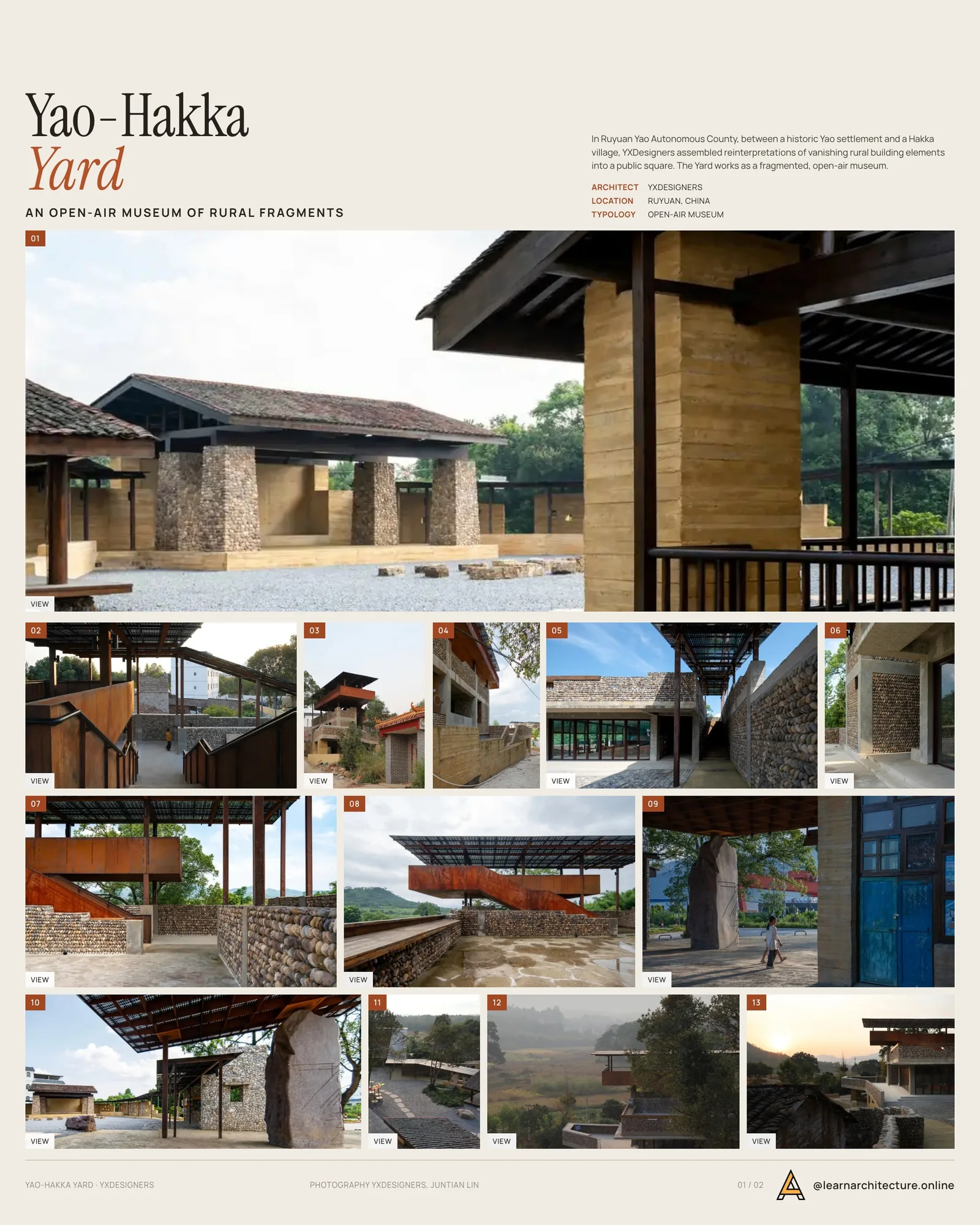
Decades of migration have shifted inhabitants from mountain villages of rammed-earth houses to modern reinforced-concrete settlements. As old structures fall into disrepair, their architectural language risks disappearing. Yao-Hakka Yard responds by gathering echoes of these traditions (wooden tiled stages, rammed-earth textures, narrow openings, stone walls) and recomposing them into a contemporary public square. The result is an architectural field that feels instantly familiar to local villagers yet newly expressive in its curated, narrative form.

Reconstructing Rural Fragments into a Contemporary Whole
YXDesigners approached the site as an opportunity to translate and reinterpret rural typologies rather than imitate them. Dispersed structures, varied material textures, and fragmented geometries allow the Yard to blend seamlessly with the surrounding village silhouettes. Each constructive fragment is designed to honor a specific rural technique, from wooden shingles to river-stone masonry, embedding the past into the present.
A weathered concrete exhibition wall stands as one of the project’s central elements. Pigmented with iron oxide after numerous material trials, the wall achieves the warm, earthy tones characteristic of historical rammed-earth buildings while offering improved structural resilience. The concrete formwork, intentionally crafted with small wooden panels traditionally used in rural road and bridge construction, preserves the tactile imprint of local craft, giving the new material an aged, handmade quality.

A Dialogue Between Old Materials and New Meanings
Sustainability in Yao-Hakka Yard is rooted not only in energy strategies but in cultural stewardship. Recycled rammed-earth blocks, salvaged wooden doors, and restored window frames are woven into the architecture to contrast gently with more contemporary components such as weathering steel and reinforced concrete. These juxtapositions highlight the passage of time while maintaining authenticity and continuity within the rural fabric.
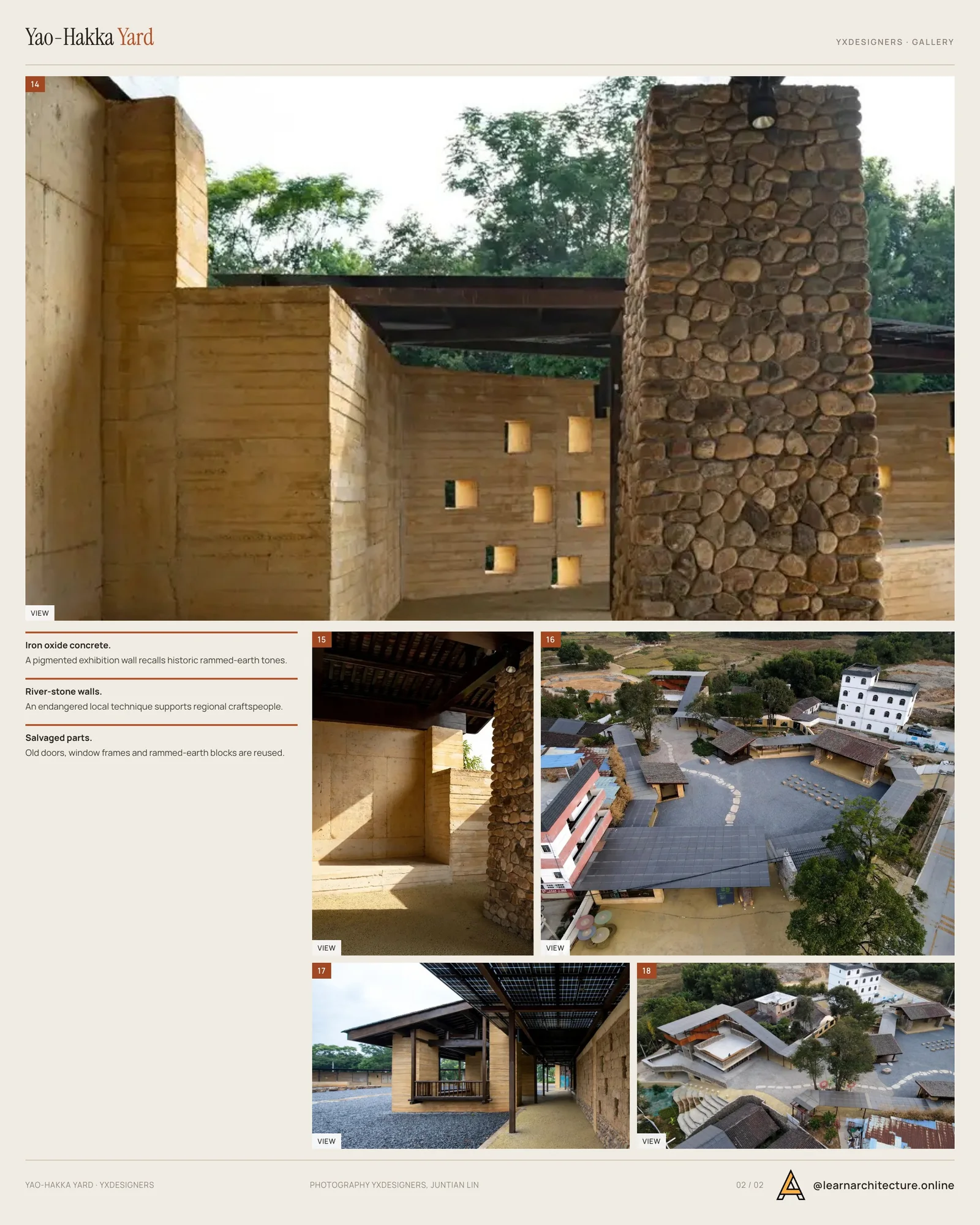
Perhaps most significantly, river-stone construction, an endangered local technique, has been employed throughout the Yard. This decision allowed YXDesigners to support regional craftspeople, preserving skills that might otherwise fade. Through this approach, the Yard becomes both a cultural memorial and an active generator of local employment and pride.
The material palette is intentionally rough, tactile, and rooted in place. Its weather-ready textures ensure that the structures can age gracefully without the intensive maintenance expected in urban contexts. In time, the Yard will gain patina, becoming a living repository of stories shaped by climate, use, and community rituals.

Shaded Networks and Climatic Responsiveness
The Lingnan climate, characterized by intense sun and heavy rain, necessitated thoughtful environmental strategies. A continuous veranda encircles the Yard, creating a resilient shaded loop that connects all program areas: the library, exhibition hall, agricultural products shop, gallery, children’s playground, festival stage, and bicycle station. This covered walkway forms a social spine, enabling year-round gathering and circulation regardless of weather.
Within the library, architectural massing is carefully choreographed to create shadow and coolness. Elevated structures, deep corridors, projecting eaves, and perforated passages transform shade into a spatial resource. The covered gallery surrounding the central square integrates photovoltaic panels, simultaneously generating renewable energy and offering refuge from the subtropical climate. This dual-purpose shading strategy reinforces the project’s environmental and cultural sustainability.

A Yard That Will Grow Old with the Community
Yao-Hakka Yard is designed not as a pristine object but as a place where time is visibly inscribed. Its materials will weather, its stonework will deepen in character, and its wooden elements will shift with the climate. This philosophy aligns with rural values, allowing architecture to age naturally and beautifully, carrying the marks of use and celebration.
Through its hybrid program and narrative assemblage of rural fragments, the Yard becomes a shared civic stage for both Yao and Hakka communities. It offers places to rest, play, learn, shop, exhibit, and gather, cultivating daily interaction while preserving collective memory. In doing so, Yao-Hakka Yard offers a quiet yet profound model for rural revitalization, one grounded in heritage, craft, and cultural reciprocity.
Photography: YXDesigners, Juntian Lin


- Architectural heritage preservation
- Chinese village public space
- Contemporary rural square
- Cultural landscape design
- Guangdong cultural architecture
- Lingnan climate architecture
- Pigmented concrete walls
- Rammed-earth architecture
- Recycled rural materials
- River-stone construction
- Rural community spaces
- Rural revitalization China
- Shaded veranda design
- Sustainable rural architecture
- Traditional craft integration
- Vernacular reinterpretation
- Weathering steel architecture
- Yao and Hakka culture
- Yao-Hakka Yard
- YXDesigners architecture







Leave a comment