


Table of Contents Show
In Jeongna-dong, Samcheok-si, Gangwon-do, a remarkable architectural intervention by Simplex Architecture has transformed a forgotten geological narrative into a compelling museum experience. The Isabu Dokdo Museum, completed in 2025, spans 3,275 square meters and commemorates the historic voyage of Silla general Isabu, who departed from this very location in 512 AD to claim Usanguk, known today as Ulleungdo and Dokdo Islands. This ambitious project goes beyond conventional museum design by literally unearthing the site’s ancient topography, revealing layers of history buried beneath decades of urban development.
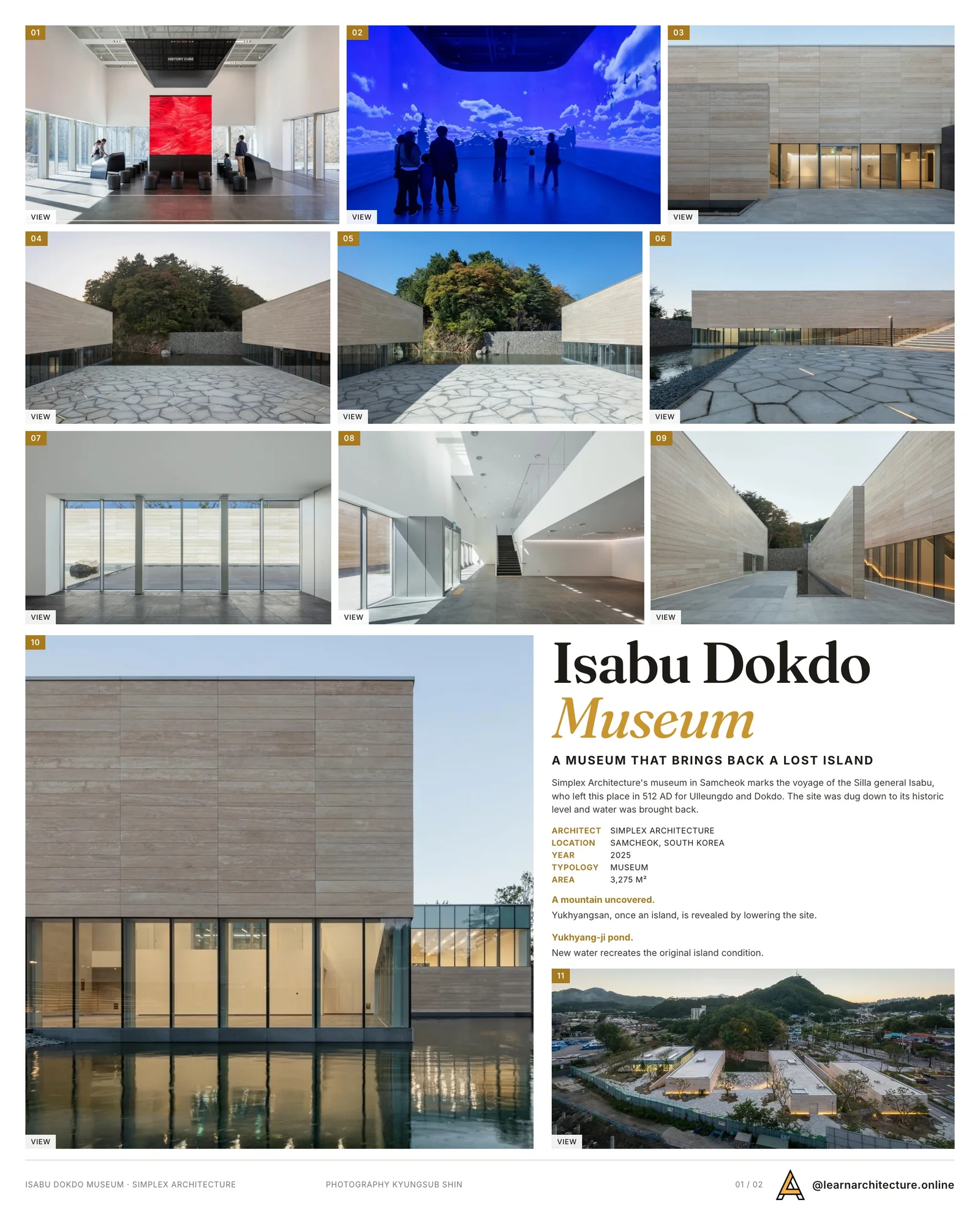
The museum’s conceptual foundation rests on a powerful act of landscape archaeology. Yukhyangsan Mountain, which once stood as an oceanic island during Isabu’s era, had been gradually consumed by land reclamation and urban expansion. Simplex Architecture recognized this lost geographical identity and made the radical decision to excavate the lower reaches of the mountain, lowering the site to its historical altitude and introducing water to recreate the original island condition. This gesture transforms the museum from a simple container of artifacts into an active participant in historical remembrance.

Site Context and Historical Significance
The museum occupies a transitional zone where multiple urban functions converge. Samcheok Port lies to the east, with industrial zones extending to the south and east, while commercial districts border the north and residential neighborhoods occupy the northwest. This complex urban fabric provides both challenges and opportunities for creating a meaningful cultural destination that serves diverse constituencies.
The introduced water body, named Yukhyang-ji pond, directly references Yukhyangsan Mountain while evoking the maritime imagery central to Isabu’s expedition. This design strategy aligns with contemporary approaches to landscape architecture that prioritize ecological and historical authenticity over purely aesthetic considerations. The water feature doesn’t merely ornament the site; it fundamentally reconstitutes the geographical conditions that defined this location’s historical importance.

Architectural Program and Spatial Organization
The museum’s 3,275-square-meter program distributes functions across multiple levels that respond to the excavated topography. The design team, led by Chung Whan Park and Sanghun Song, developed a spatial sequence that guides visitors through progressively intimate encounters with territorial narratives and maritime heritage. Exhibition galleries trace Isabu’s military achievements and explore contemporary territorial issues surrounding Dokdo Island’s sovereignty.
Supporting this primary narrative function are ancillary spaces including a tourist information center, territorial defense memorial hall, and experiential zones where visitors can engage with Dokdo’s unique ecology and geology. A multi-purpose community space extends the museum’s reach beyond exhibition programming, positioning the facility as an active cultural hub for Samcheok residents. This programming strategy reflects evolving museum design methods that emphasize community engagement and multifunctional use over static display.
The design team collaborated extensively with landscape specialists from DSW Landscape Design & Construction Co. and STUDIO201 Landscape Design & Consulting to ensure seamless integration between built and natural environments. This interdisciplinary approach resulted in circulation patterns that blur boundaries between interior exhibition zones and exterior contemplative spaces around the water feature.

Material Expression and Construction Details
Simplex Architecture employed a restrained material palette that emphasizes durability and contextual sensitivity. The museum’s exterior features wood cladding elements that provide warmth and tactility while referencing traditional Korean construction practices. These timber components weather naturally over time, creating a dynamic façade that evolves with seasonal changes and atmospheric conditions.
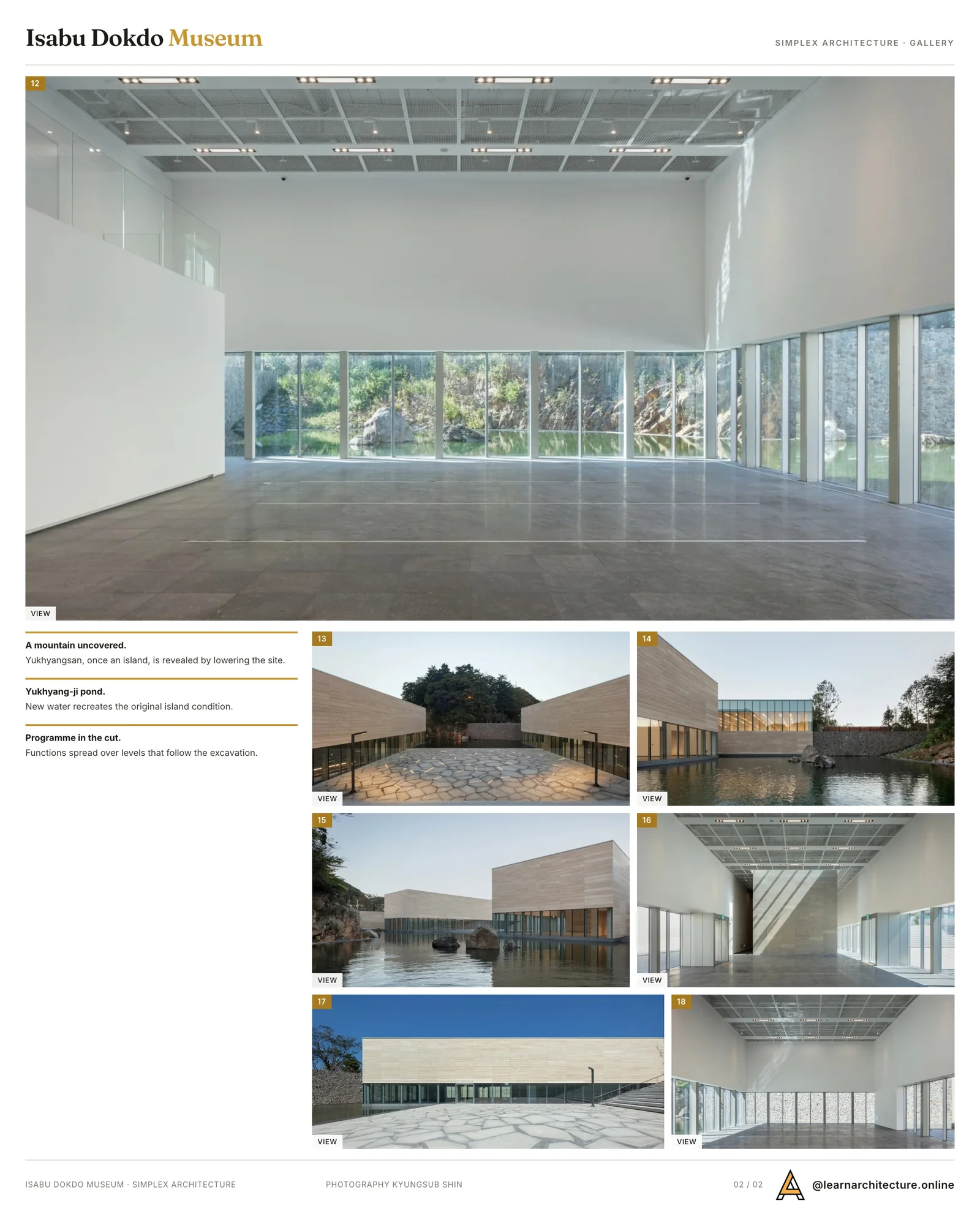
Structural systems remain deliberately exposed in key areas, revealing the tectonic logic that supports exhibition spaces and public gathering zones. This architectural honesty corresponds with design principles championed by leading practitioners who prioritize material authenticity. The building’s relationship to ground plane varies dramatically across the site, with some sections emerging from the excavated terrain while others cantilever over the newly introduced pond.
Glazing strategies balance the need for natural illumination in exhibition spaces against conservation requirements for sensitive artifacts and displays. The architects incorporated carefully positioned openings that frame specific views toward Samcheok Port and the East Sea, reinforcing the museum’s maritime narrative through experiential connection to contemporary coastal conditions.

Landscape Restoration and Ecological Considerations
The excavation and water introduction represent more than symbolic gestures; they constitute genuine ecological interventions that restore habitat diversity to an urbanized site. The pond supports aquatic plant communities while providing stopover habitat for migratory birds traveling along Korea’s eastern coast. Indigenous vegetation gradually colonizes the excavated slopes, establishing ecological succession patterns that will mature over decades.
This approach to site recovery demonstrates how contemporary museum projects can contribute meaningfully to urban ecological networks. Rather than treating landscape as decorative backdrop, Simplex Architecture integrated environmental restoration directly into the project’s conceptual framework. The result is a cultural facility that functions simultaneously as public amenity, educational resource, and ecological infrastructure.
Storm water management systems channel runoff through bioswales and filtration zones before entering the central pond, ensuring water quality while demonstrating sustainable site engineering principles. These technical systems remain visible to visitors, transforming typically concealed infrastructure into pedagogical opportunities that illuminate relationships between built environment and natural systems.

Cultural Impact and Urban Regeneration
Since its completion, the Isabu Dokdo Museum has emerged as a significant cultural anchor for Samcheok, attracting regional visitors and contributing to local economic revitalization. The facility’s diverse programming supports educational initiatives for school groups while offering contemplative spaces for individual visitors seeking deeper understanding of Korea’s maritime heritage and territorial history.
The museum’s design strategy, excavating to reveal rather than building up to conceal, offers an alternative model for cultural institutions in contexts where historical narratives have been literally buried by development pressures. This approach resonates with broader conversations in architectural heritage about how contemporary interventions can make visible histories that modernization has erased.
Photography by Kyungsub Shin captures the museum’s dramatic relationship to its reconstituted landscape, documenting how architectural form, water, and vegetation combine to create spaces that oscillate between contemplation and education. These images reveal subtle seasonal transformations as the site continues maturing into its intended ecological and cultural roles.
The Isabu Dokdo Museum demonstrates how thoughtful architectural intervention can recover lost landscape identities while serving contemporary cultural needs. By excavating Yukhyangsan Mountain’s lower reaches and reintroducing water, Simplex Architecture created not just a museum but a recovered fragment of historical geography. This project stands as testament to architecture’s capacity to make visible the layered temporalities that define every site, transforming forgotten histories into lived experience for future generations. In doing so, it contributes meaningfully to ongoing discussions about how design can honor the past while remaining fully engaged with present realities.
Photography: Kyungsub Shin


- Contemporary Korean architecture
- Cultural heritage architecture
- Exhibition space design
- Gangwon-do architecture
- historical narrative architecture
- Isabu Dokdo Museum
- island-inspired architecture
- landscape integration museum
- museum design innovation
- Samcheok cultural architecture
- Simplex Architecture
- South Korean museum design
- territorial defense memorial
- Water Feature Architecture
- Yukhyangsan Mountain excavation











Leave a comment