


Table of Contents Show
Designed by Herzog & de Meuron, Calder Gardens redefines what a museum can be. Conceived not as a monumental container for art but as a sequence of intimate, unfolding spaces, the project offers a deeply personal and ever-changing encounter with the work of Alexander Calder. From its inception, the ambition was clear: to create a place for being with art, where architecture, landscape, movement, and the city come together in quiet dialogue.
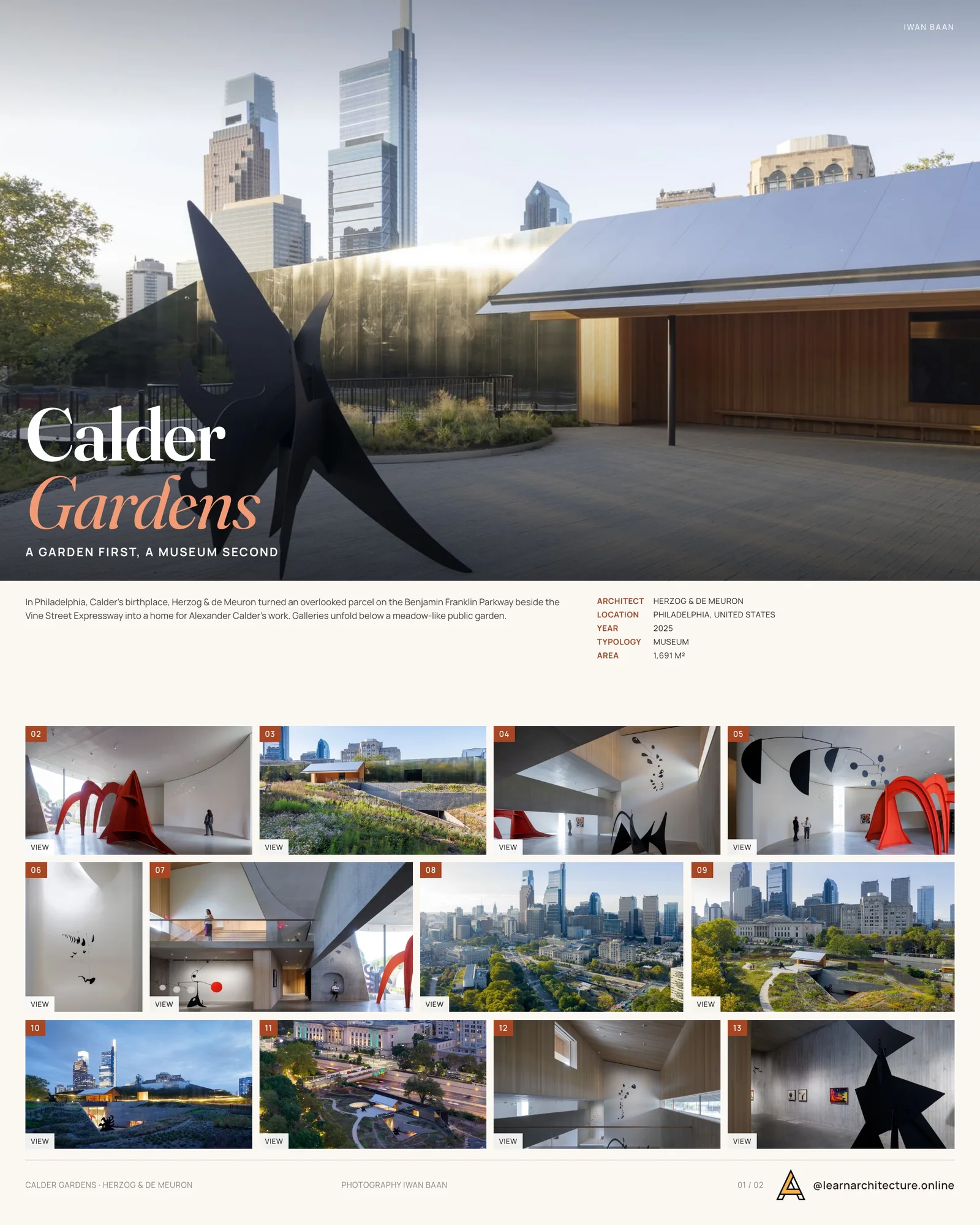
Located in Philadelphia, Calder’s birthplace and a city profoundly shaped by generations of artists from the Calder family, the museum occupies a complex and symbolically charged site at the intersection of the Benjamin Franklin Parkway and the Vine Street Expressway. Here, two contrasting urban legacies collide: the optimism of the 19th-century City Beautiful movement and the infrastructural ruptures of mid-20th-century highway construction. Calder Gardens emerges precisely within this urban scar, transforming a leftover, overlooked parcel into a destination of reflection and discovery.

A Museum That Reveals Itself Slowly
Rather than announcing itself through iconic form, Calder Gardens deliberately avoids monumentality. The architects chose not to mimic the formal qualities of Calder’s work (movement, color, and overt geometry) but instead to create a spatial framework that allows the art to speak across multiple contexts. The project’s public face is not a building but a garden.
Along the Parkway, a tapered metal wall defines the site’s edge, softening traffic noise while framing a meadow-like public landscape. From a distance, the museum remains almost invisible, embedded within greenery. Visitors are gently guided along garden paths toward a single opening in the wall, where a folded metal canopy shelters a wood-lined entrance. Architecture appears gradually, reinforcing the sense that Calder Gardens is discovered rather than confronted.
At the heart of the project lies a powerful yet restrained gesture: a large circular disc that forms a central plaza above and shelters the galleries below. This disc anchors the entire spatial sequence, mediating between sky, garden, and subterranean rooms.

Gardens Carved Into the Ground
Two outdoor spaces are carved into the earth on either side of the disc. To the east, the Sunken Garden is a geometrically pure circular void, an introspective space where a single stabile stands against a densely planted curved wall. To the west, the Vestige Garden adopts an elongated, irregular geometry shaped by traces of Philadelphia’s pre-Parkway urban fabric and existing infrastructural constraints. Together, these gardens bring daylight deep into the building and provide protected outdoor settings for sculpture.
The interplay between excavation and enclosure defines Calder Gardens. Much of the museum unfolds below grade, allowing the surrounding city to recede while heightening awareness of light, texture, and sound. This strategy transforms what could have been a limitation (noise, traffic, and residual land) into the project’s conceptual foundation.

A Sequential Journey Through Art
Entry begins in a modest, almost domestic lobby lined with wood, intentionally contrasting with the grand foyers of nearby institutions like the Philadelphia Museum of Art and the Barnes Foundation. From here, visitors descend into the museum through a carefully choreographed sequence of spaces.
A broad stair leads to the Highway Gallery, which doubles as a small auditorium. A long, low window frames views of the expressway, acknowledging the city beyond while positioning Calder’s mobiles against an unexpected urban backdrop. This mezzanine level allows visitors to experience sculptures from elevated viewpoints, emphasizing movement and suspension.
From here, a rough concrete stair, referred to as the Cuboid, connects to the main gallery level. These transitional spaces are not merely circulation; they are opportunities for display, pause, and reorientation, reinforcing the idea that no space in Calder Gardens is neutral.

Galleries Without Hierarchy
At the core of the museum is the Open Plan Gallery, located beneath the central disc. Daylit from above and laterally connected to the Vestige Garden, this space blends orthogonal and curved geometries, enabling multiple perspectives and arrangements. Adjacent to it, the Apse Gallery, formed by offset curved walls, eliminates corners entirely, focusing attention inward on the artwork.
In contrast, the Curved Gallery offers a fully controlled environment with exposed concrete foundation walls, designed for light-sensitive works and works on paper, including pieces by Calder’s ancestors. The transition between these galleries, from open and luminous to enclosed and introspective, mirrors the diversity of Calder’s artistic output.
Between inside and outside, the Quasi Gallery operates as a covered, cave-like space, mediating between the garden and the interior. These layered conditions allow curators to continually reinterpret the collection, ensuring that no visit to Calder Gardens is ever the same.

Architecture as Quiet Framework
Throughout the project, materials are restrained and tactile: raw concrete, blackened wood, metal, and carefully modulated daylight. This material economy supports what Jacques Herzog describes as a form of “no-design” architecture, an approach where spatial experience takes precedence over formal expression. The building does not compete with Calder’s work; it provides a calm, varied terrain in which art, people, and nature coexist.
Historical traces embedded in the site (offset utilities, former foundations, and infrastructural remnants) are not erased but translated into spatial cues, particularly in the Vestige Garden. In this way, Calder Gardens becomes both an actual garden and a conceptual one, cultivating memory, perception, and time.

A New Cultural Landscape for Philadelphia
Calder Gardens is the result of close collaboration with the Calder Foundation, alongside cultural partners and the city itself. It offers Philadelphians and visitors a place to wander, sit, observe, and return, again and again. More than a museum, it is a landscape of attention, a slow architecture that unfolds step by step.
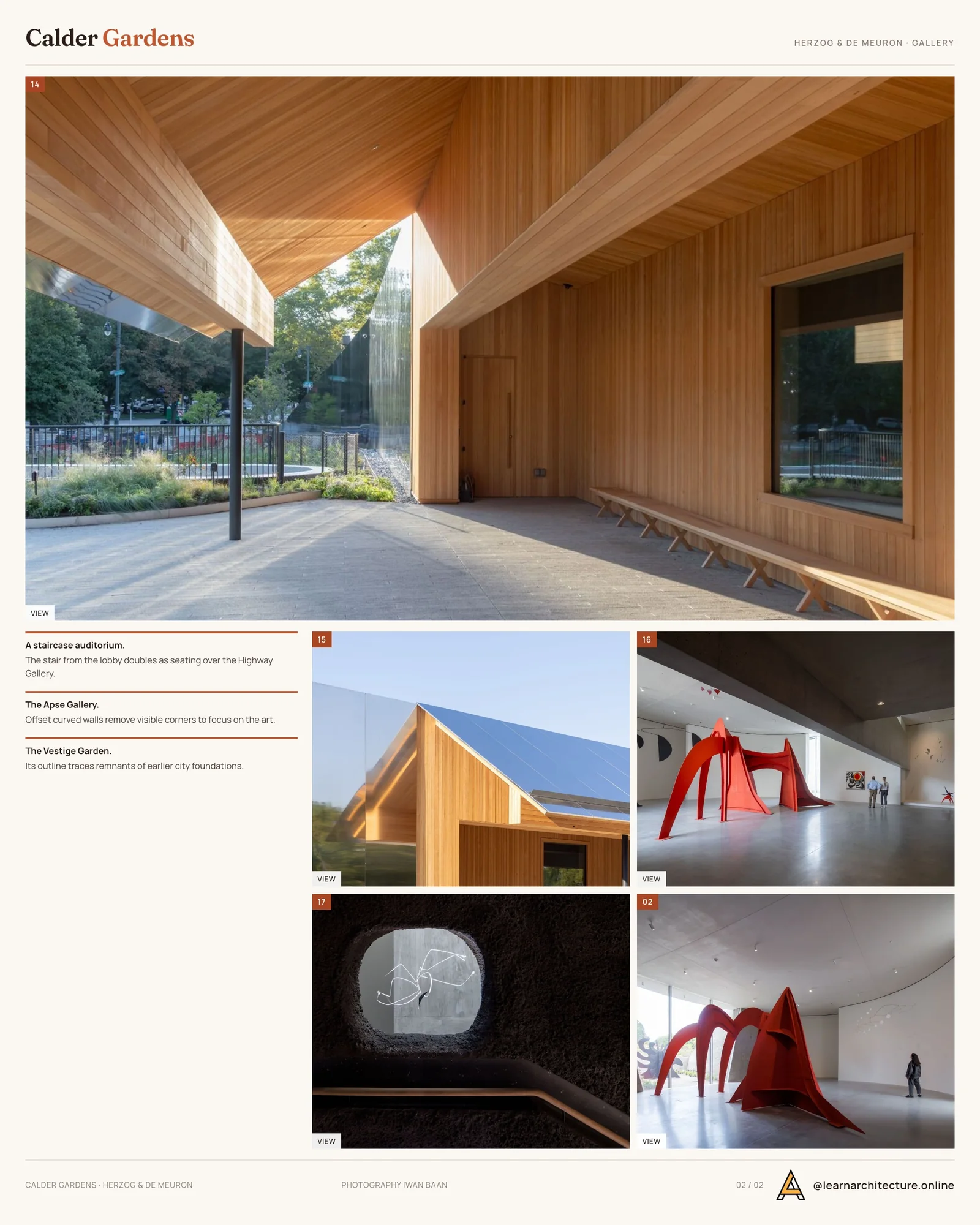
In transforming an urban void into a world of spatial depth and artistic intimacy, Calder Gardens demonstrates how museums can move beyond spectacle toward experience. It is a place where art is not simply viewed, but lived with: quietly, curiously, and over time.
Photography: Iwan Baan
- Alexander Calder
- Architectural promenade
- Art and landscape architecture
- Benjamin Franklin Parkway
- Calder Foundation
- Calder Gardens Museum
- Concrete architecture
- Contemporary museum design
- Cultural architecture Philadelphia
- Experiential gallery design
- Garden-based museum
- Herzog & de Meuron
- Herzog de Meuron museums
- Landscape-integrated architecture
- Minimalist museum architecture
- Modern art museum
- Museum without monumentality
- Philadelphia museum architecture
- Spatial sequence architecture
- Underground museum








Leave a comment