


Table of Contents Show
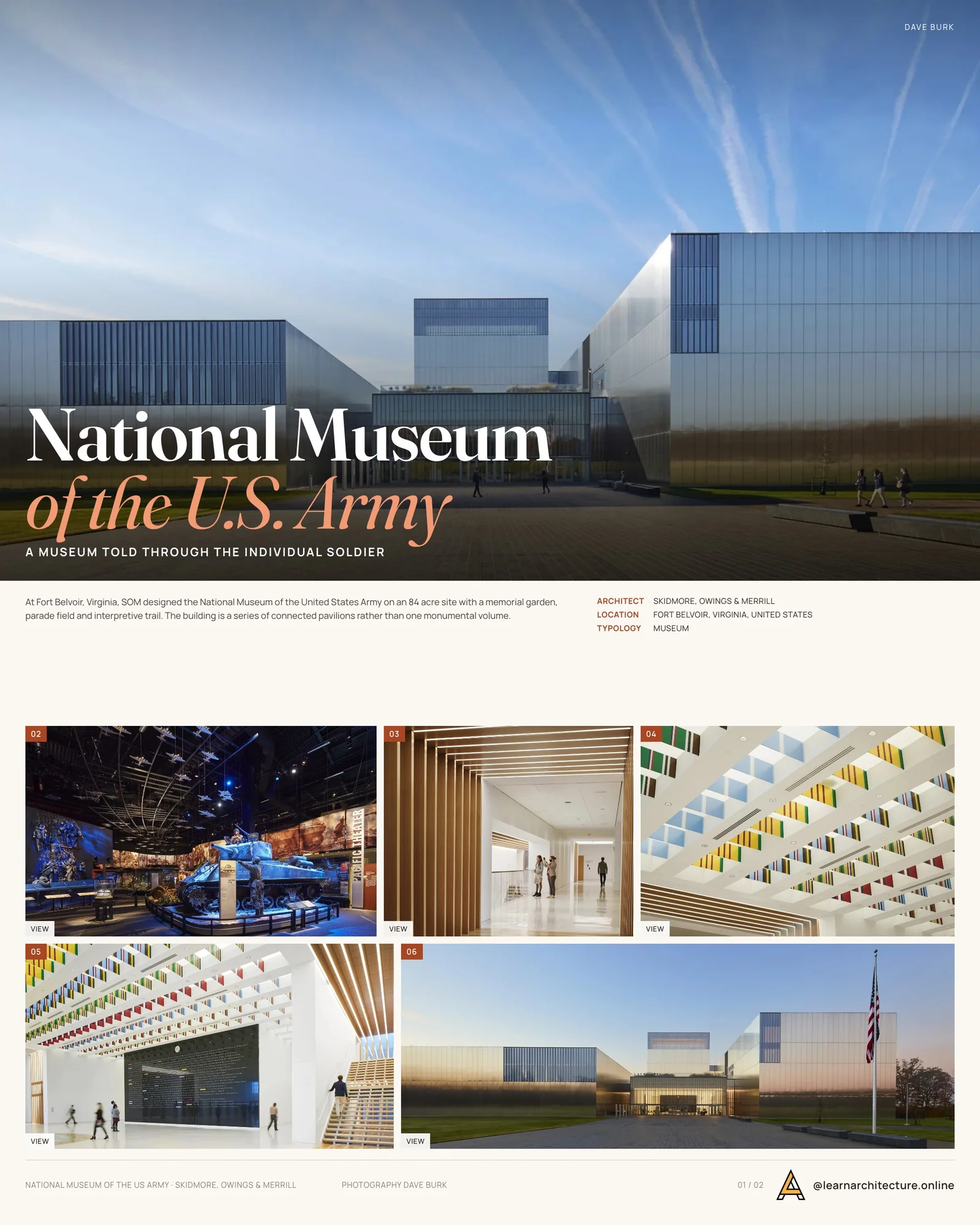
Located within the expansive landscape of Fort Belvoir, Virginia, the National Museum of the United States Army (NMUSA), designed by Skidmore, Owings & Merrill (SOM), redefines how national memory is spatially constructed and experienced. Rather than glorifying conflict, the museum presents a deeply human narrative centered on the individual soldier. Architecture becomes a narrative device, guiding visitors through generations of service, sacrifice, and identity, while positioning the museum as both a cultural landmark and the symbolic public gateway to the U.S. Army.

A Civic Landmark Embedded in Landscape
Set within an 84-acre site just outside Washington, D.C., the museum is conceived as part of a broader civic and commemorative landscape. SOM’s master planning extends beyond the building itself, integrating a memorial garden, parade field, interpretive trail, and ceremonial spaces into a cohesive environment of reflection and public engagement.
The museum rests atop a plateau, using the site’s natural topography to establish a subtle monumentality rather than relying on overt formal gestures. Approaching the building involves a deliberate procession: visitors catch glimpses of the structure through trees across a wide meadow, allowing anticipation to build gradually. This carefully orchestrated arrival reinforces the idea of transition from everyday life into a space of collective memory.

Architectural Language of Order and Discipline
The building is composed as a series of interconnected pavilions, housing exhibition spaces, public functions, and event areas. This fragmented massing avoids the dominance of a single monumental volume and instead creates a campus-like composition that feels both accessible and dignified.
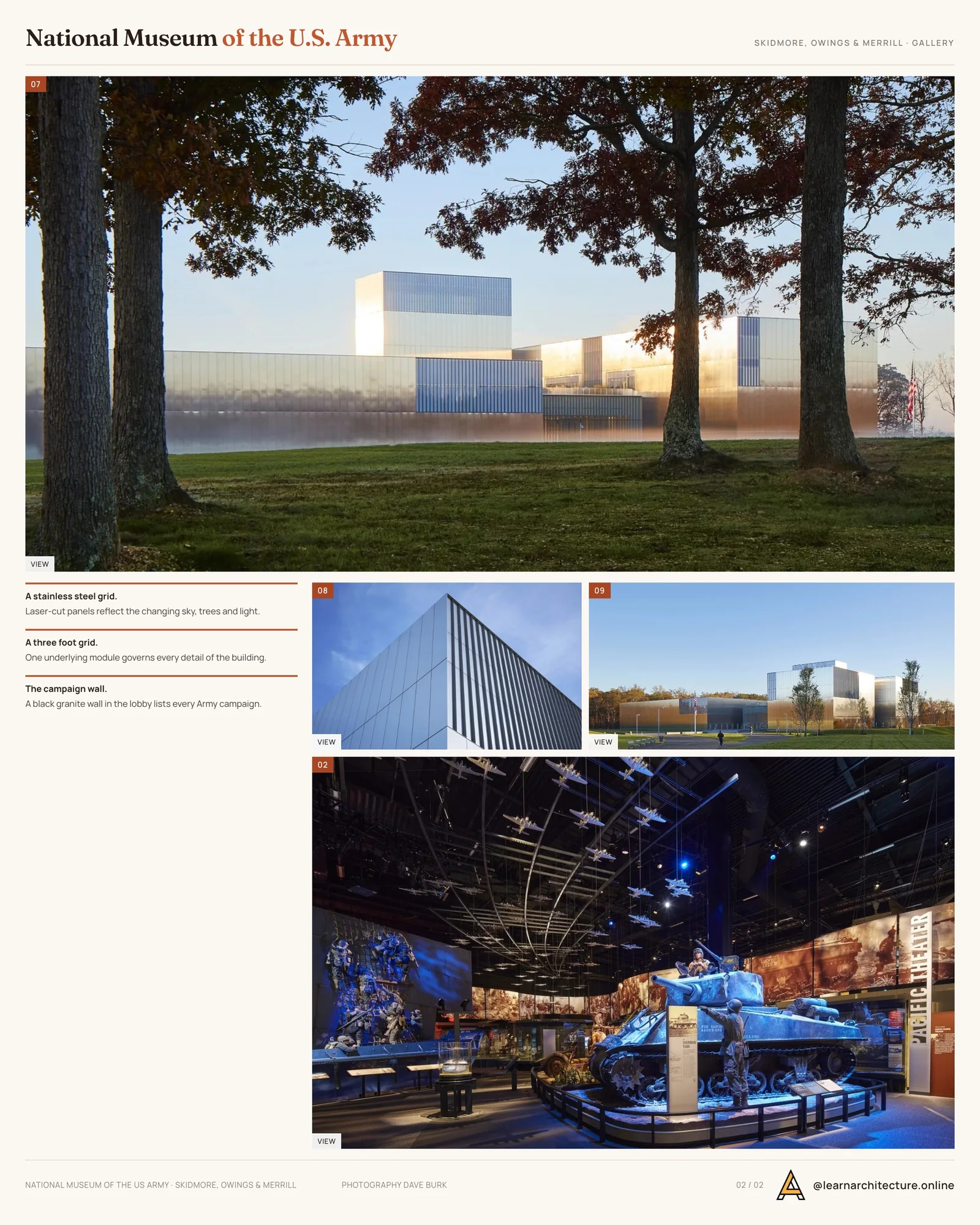
The façade plays a critical symbolic role. Laser-cut stainless steel panels are arranged in a precise grid, expressing discipline, rigor, and clarity: values deeply associated with military structure. At the same time, the reflective surface captures the changing colors of sky, trees, and light, allowing the building to transform across seasons and times of day. This dynamic relationship with nature introduces a softer, more poetic layer to the architecture.
At pavilion corners, recessed glazing alternates with aluminum fins, introducing depth, rhythm, and movement. Every detail is governed by an underlying three-foot grid system, demonstrating SOM’s commitment to precision and architectural coherence.

Architecture as Narrative Experience
Inside, the museum unfolds as a spatial journey rather than a static collection of rooms. Visitors are guided through a carefully sequenced experience that mirrors the evolving story of the Army across time.
The symbolic narrative begins immediately upon entry. Stainless steel pylons etched with individual soldier stories line the approach to the exhibition hall, anchoring the vast institutional narrative in personal experience. The grand lobby serves as both orientation space and civic forum, capable of hosting public events while maintaining emotional gravity.
A black granite wall inscribed with every Army campaign establishes historical continuity, while the terrazzo floor bears the Department of the Army emblem. Above, a striking coffered ceiling composed of translucent glass panels introduces subtle color references to historical campaign streamers, reinforcing the theme of remembrance through architectural expression.
This immersive storytelling strategy ensures that the building itself participates in the museum’s mission. Architecture is not a backdrop, but a medium of interpretation.

Material Warmth and Human Scale
While the exterior communicates strength and precision, the interior palette shifts toward warmth and tactility. Natural stone floors, American white oak, and ash finishes soften the atmosphere, creating environments conducive to contemplation rather than spectacle.
Transitions between pavilions are marked by glass and timber thresholds, offering framed views to the landscape and reinforcing a continuous dialogue between interior and exterior. These moments of visual pause allow visitors to reflect between exhibitions, preventing narrative fatigue and enhancing the emotional pacing of the experience.
On the third floor, the Veterans’ Hall introduces a more intimate yet luminous space. Fully clad in wood and filled with natural light, it functions as both event venue and contemplative chamber. Its connection to the outdoor Medal of Honor Garden deepens the symbolic resonance of this level.

Memorial Architecture and the Medal of Honor Garden
One of the most powerful architectural moments occurs in the Medal of Honor Garden, accessed directly from the Veterans’ Hall. This elevated terrace operates as a space of solemn recognition, inspired by the values of intrepidity, gallantry, and valor.
A ten-foot-tall black granite wall bears the names of every Medal of Honor recipient, transforming the terrace into a collective memorial. The paving continues the interior’s geometric language, with striped granite patterns and embedded symbols reinforcing continuity between architecture, landscape, and meaning.
This space demonstrates SOM’s ability to handle commemorative architecture with restraint. Rather than relying on dramatic gestures, the design achieves emotional depth through proportion, material, and quiet symbolism.

Sustainability Integrated into Institutional Architecture
The museum achieves LEED Silver certification through a range of environmental strategies that support both performance and visitor comfort. High-performance glazing, increased insulation, LED lighting, daylight-responsive controls, and occupancy sensors reduce energy demand while enhancing spatial quality.
A green roof contributes to stormwater management and thermal performance, while also reinforcing the project’s integration with its natural setting. Rather than treating sustainability as an add-on, SOM embeds it within the architectural and operational logic of the building, ensuring longevity and environmental responsibility.

Conclusion
The National Museum of the United States Army stands as a powerful example of architecture shaped by narrative, ethics, and civic purpose. Through disciplined formal language, immersive spatial sequencing, and deep integration with landscape, SOM creates a museum that honors history without resorting to spectacle. By centering the experience on individual soldiers rather than abstract conflict, the building transcends its institutional role and becomes a space of empathy, reflection, and collective memory. It is not only a museum, but a carefully crafted architectural experience that communicates dignity, continuity, and meaning across generations.
Photography: Dave Burk | SOM


- Architectural storytelling
- Architecture and Identity
- architecture and memory
- Architecture and Narrative
- Architecture in Virginia
- Civic architecture
- Contemporary museum design
- cultural architecture
- Institutional architecture
- Landscape and architecture
- LEED certified architecture
- Memorial Architecture
- monumental architecture
- museum architecture
- National Museum of the United States Army
- Public Architecture
- Skidmore Owings & Merrill
- SOM Architects
- Sustainable museum design
- Symbolic Architecture











Leave a comment