


Table of Contents Show
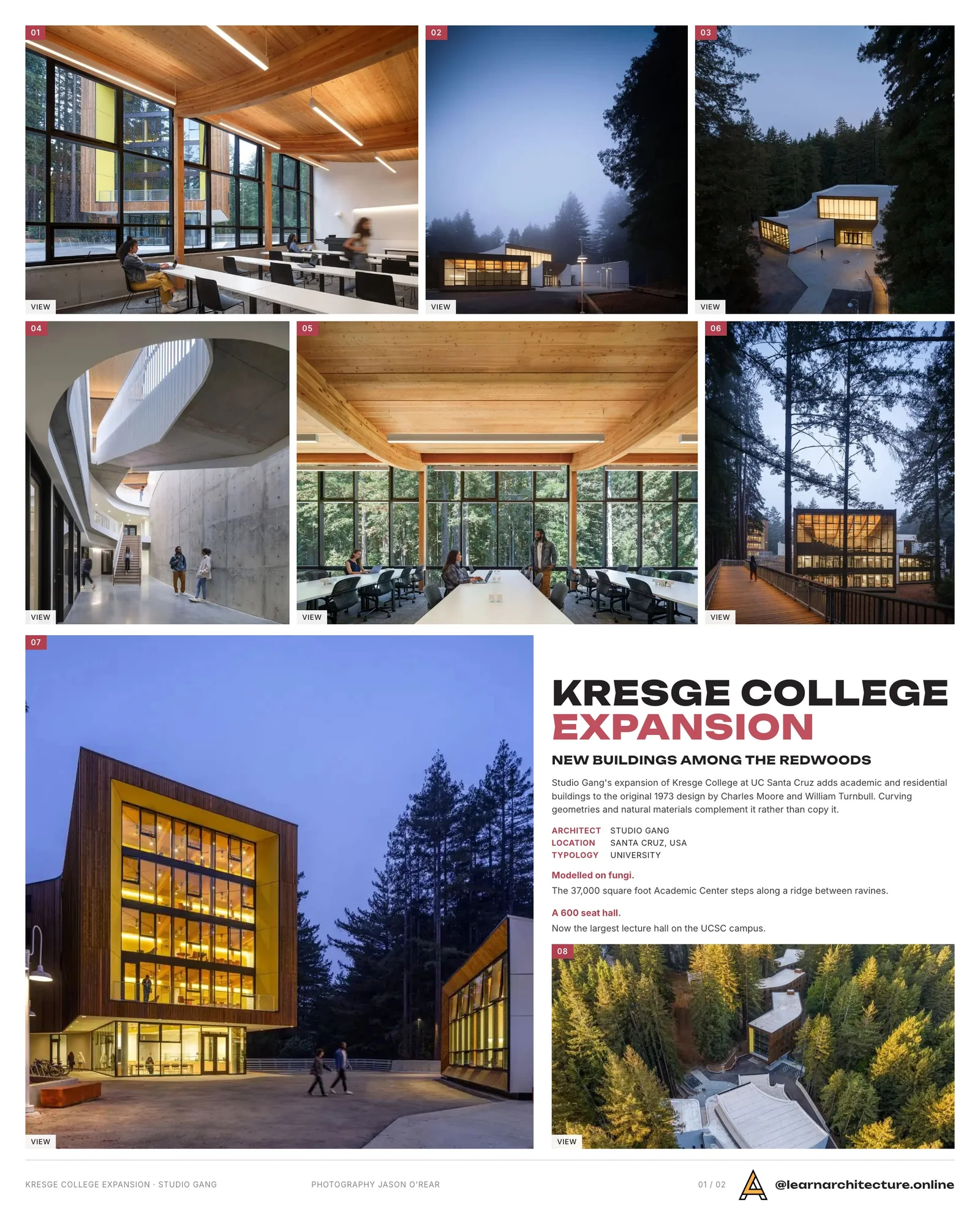
The Kresge College Expansion by Studio Gang enriches one of UC Santa Cruz’s most distinctive architectural ensembles, introducing new forms that converse fluently with the original 1973 design by Charles Moore and William Turnbull. Rooted in the ethos of participatory democracy that shaped the college’s founding, the expansion strengthens the physical, social, and ecological networks of the campus. Rather than replicating the expressive, angular character of Kresge’s historic buildings, Studio Gang embraces a complementary vocabulary, one shaped by curving geometries, porous edges, and the warmth of natural materials. This approach allows the new academic and residential buildings to feel simultaneously contemporary and contextual, extending Kresge’s legacy of experimentation while grounding it in present-day environmental and accessibility priorities.

A Landscape-Responsive Academic Center
At the heart of the expansion is the new 37,000-square-foot Kresge College Academic Center, a building strategically positioned along a ridge between two forested ravines. Its stepped, flared massing, modeled after the branching morphology of polypore fungi, enables the structure to engage multiple levels of the sloping site while maintaining a respectful scale at the pedestrian street above. Large volumes of natural light filter into classrooms, meeting spaces, and the new 600-seat lecture hall, which now stands as the largest of its kind on the UCSC campus. The building’s terraced forms pull the surrounding ecology inward, connecting interiors to the breezes, filtered daylight, and spatial rhythm of the redwood forest. This spatial continuity reinforces the environmental intelligence embedded throughout the project and supports a campus culture shaped by inquiry, gathering, and shared experience.

Mass-Timber Housing Rooted in Ecological Care
Three new residential buildings add over 400 student beds and mark a milestone in California’s adoption of mass-timber construction. Built with cross-laminated timber, these structures demonstrate a commitment to reducing embodied carbon, celebrating renewable materials, and preserving the existing forest canopy. The buildings bend and adapt to the site’s natural clearings, minimizing tree removal and positioning each residence to benefit from the shade and microclimates of the redwood groves. Their ground floors extend the life of the pedestrian street, integrating shared amenities (lounges, social spaces, and a new café) into a continuous layer of communal activity that knits the residences to the historic core of Kresge. Custom bird-safe fritted glass, featuring twelve species native to the site, bridges the relationship between architecture and habitat, acknowledging the biodiversity that defines the UCSC landscape.


Systems of Water, Movement, and Access
A key component of the expansion is the rehabilitation and extension of Kresge’s original runnel system, a network that channels rainwater along pathways, capturing and filtering stormwater for reuse. This ecological infrastructure works in tandem with new circulation routes that reshape the college into a fully accessible environment for the first time in its history. Studio Gang introduced graded pedestrian paths, ramps, and improved entries that connect both the new and original buildings into a unified whole, while a restored ravine bridge offers an elevated crossing framed by redwood canopies and open sky. These gestures respond not only to code but to the foundational values of equity and participation, ensuring that the experiences and opportunities offered at Kresge are open to all members of the university community.

A Community-Led Transformation
Participatory democracy, long embedded in Kresge’s identity, guided the expansion process through extensive engagement with students, faculty, staff, alumni, and Santa Cruz residents. Studio Gang’s collaborative planning phase included town halls, committee discussions, and informal feedback sessions that shaped both program and form. This ongoing dialogue helped clarify community needs, from the desire for more flexible academic spaces to the urgent demand for additional student housing. The expansion therefore emerges not as an imposed architectural gesture, but as a shared project: a new chapter authored with the people who inhabit Kresge daily. This commitment to collaborative authorship supports continuity between the college’s history and its future, ensuring relevance and resilience as the campus evolves.

Looking Forward: Phase Two and Beyond
Construction on the expansion began in 2019, with the new buildings welcoming students in Fall 2023. The project stems from a comprehensive campus plan that Studio Gang developed in the same year, outlining strategies for renewing the original structures and imagining new community anchors such as a future Town Hall. A second phase of work, led by Truebeck Construction and EHDD, is currently underway, furthering the transformation of Kresge College and ensuring that the values of accessibility, ecological stewardship, and community participation continue to shape its growth. The completed expansion stands as a testament to architecture’s ability to honor legacy while embracing change, reuniting the built and natural environments in ways that inspire learning, connection, and shared belonging.
Photography: Jason O’Rear


- Accessible Campus Architecture
- Bird-Safe Fritted Glass Design
- California Timber Construction
- Campus Planning Studio Gang
- Charles Moore & William Turnbull
- Contemporary Campus Housing
- Ecological Stewardship in Architecture
- Kresge College Expansion
- Kresge College Renovation
- Landscape-Responsive Architecture
- Mass-Timber Student Housing
- participatory design process
- Polypore-Inspired Building Form
- Redwood Forest Campus Design
- Studio Gang
- Studio Gang Kresge Project
- Sustainable university architecture
- UC Santa Cruz Architecture
- UCSC Academic Center
- UCSC Lecture Hall Design







Leave a comment