


Table of Contents Show
The new Faculty of Sciences building at Pontificia Universidad Javeriana, designed by taller de arquitectura de bogotá, represents a decisive moment in the evolution of one of Bogotá’s most important university campuses. Positioned along Carrera Séptima, an avenue of strong symbolic and urban significance, the project addresses a complex set of architectural and urban challenges: engaging a major city edge, respecting the presence of a listed historic building, and strengthening internal campus connections.
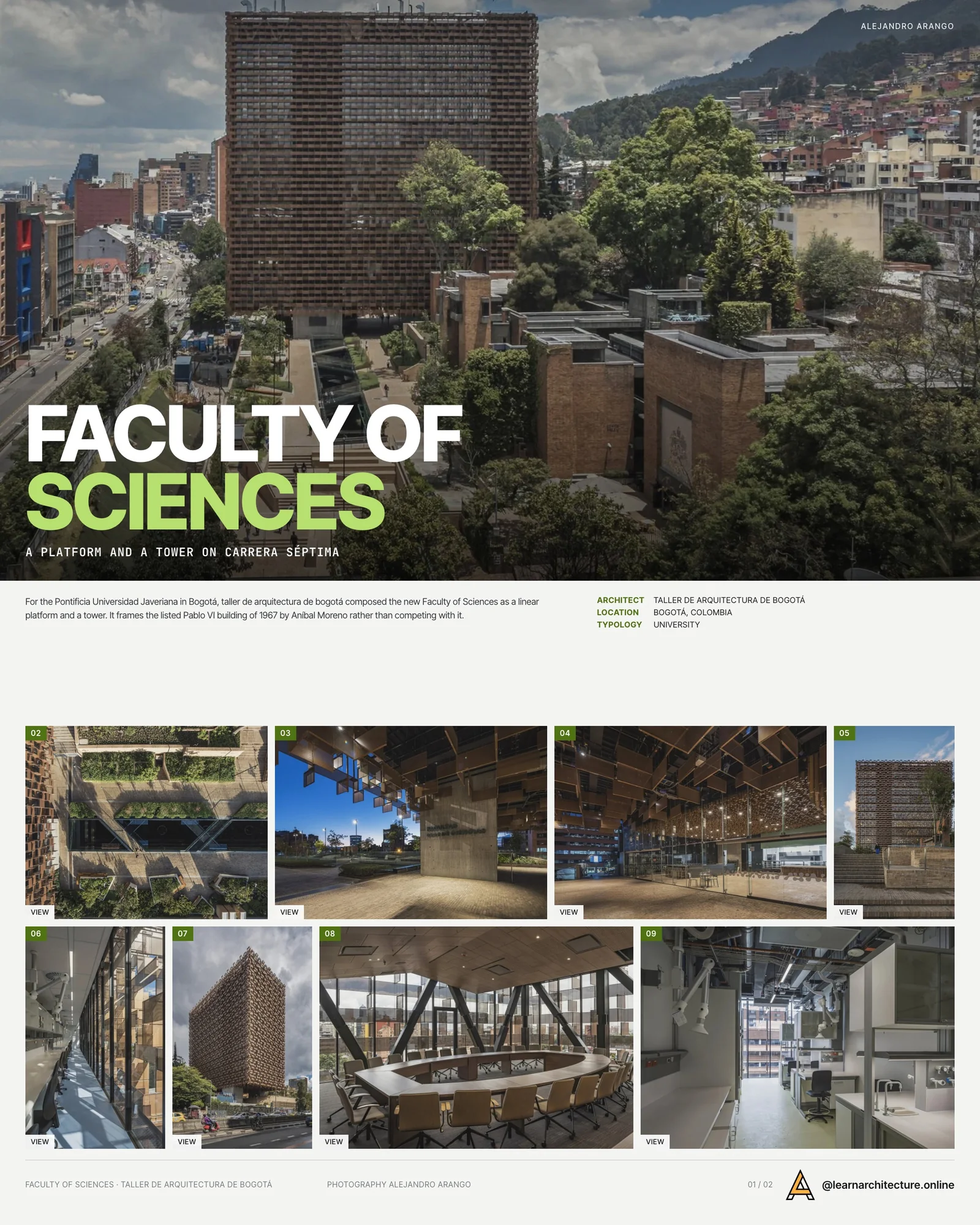
Rather than responding with a singular object, the proposal is conceived as a system of architecture, landscape, and public space, structured through a clear yet powerful composition of platform and tower. This strategy allows the new Faculty of Sciences to assert a contemporary identity while carefully reinforcing the spatial and cultural logic of the existing campus.

Dialogue with History: The Pablo VI Building
A fundamental condition of the project was its relationship with the historic Pablo VI building (1967), designed by architect Aníbal Moreno. As the only listed structure within the university complex, Pablo VI carries both architectural and symbolic weight. The new intervention deliberately avoids competition with this landmark, choosing instead to frame, amplify, and reinterpret its presence.
The platform, extending northward from the historic building, reconfigures its forecourt into an open civic space that enhances pedestrian movement and visual continuity. Brick, the dominant material of Pablo VI, is reintroduced and reinterpreted within the new project, reinforcing material continuity across generations. The tower, meanwhile, is positioned at the northern edge of the site, acting as a visual terminus to the campus axis that begins at the Central Library, rather than confronting the historic structure directly.

The Linear Platform: Human Scale and Urban Activation
The linear platform is the project’s primary interface with Carrera Séptima. By maintaining a restrained height and extended horizontal presence, it establishes a human-scale urban front that transforms the campus edge from a closed boundary into an active academic façade. This base accommodates the Faculty’s laboratory and teaching programs, embedding highly specialized spaces within an accessible and permeable structure.
To ensure optimal environmental quality, the platform integrates two elongated “English courtyards” that run longitudinally through the building. These sunken gardens introduce natural light and cross-ventilation deep into the interior, while also creating moments of visual relief and contact with greenery. Rather than functioning solely as technical solutions, these courtyards become spatial devices that soften the laboratory environment and reinforce a sense of collective academic life.

The Tower: Flexibility, Structure, and Iconicity
Rising above the platform, the tower introduces a new vertical marker for the campus. Its design balances formal clarity with high functional adaptability: an essential requirement for scientific facilities that must evolve alongside technological and pedagogical change.
Structurally, the tower is organized around four robust concrete cores, combined with perimeter Vierendeel trusses. This system minimizes internal columns, maximizing open floor plates and enabling future reconfiguration of laboratories without compromising structural logic. The result is a building prepared for long-term transformation rather than fixed use.
The tower’s façades are wrapped in metal sun-shading panels with variable micro-perforation densities. Responding to each orientation, these panels reduce solar gain while maintaining controlled daylight conditions inside. At the same time, they provide a unified architectural expression, giving the tower a consistent yet dynamic appearance that shifts subtly with light and perspective.

Landscape and Collective Spaces as Connective Tissue
Beyond the buildings themselves, landscape plays a central role in articulating the project. Less than 30% of the site’s area is occupied by built volume, allowing the remainder to function as green and communal space. This strategy reinforces the university’s ambition for a green, walkable campus that prioritizes well-being, encounter, and informal learning.
The most emblematic of these spaces is the walkable roof of the platform, conceived as a large public terrace. From here, students and faculty move fluidly between different areas of the campus, gathering in outdoor spaces designed for rest, exchange, and contemplation. The roofscape becomes both infrastructure and landscape: an elevated ground that stitches together academic life and open space.

Architecture as Campus Infrastructure
Rather than presenting itself as an isolated icon, the Faculty of Sciences building functions as campus infrastructure: spatially, socially, and environmentally. The platform-tower composition allows the project to operate simultaneously at the scale of the street, the campus, and the laboratory bench. It strengthens the university’s relationship with the city while consolidating internal academic networks.
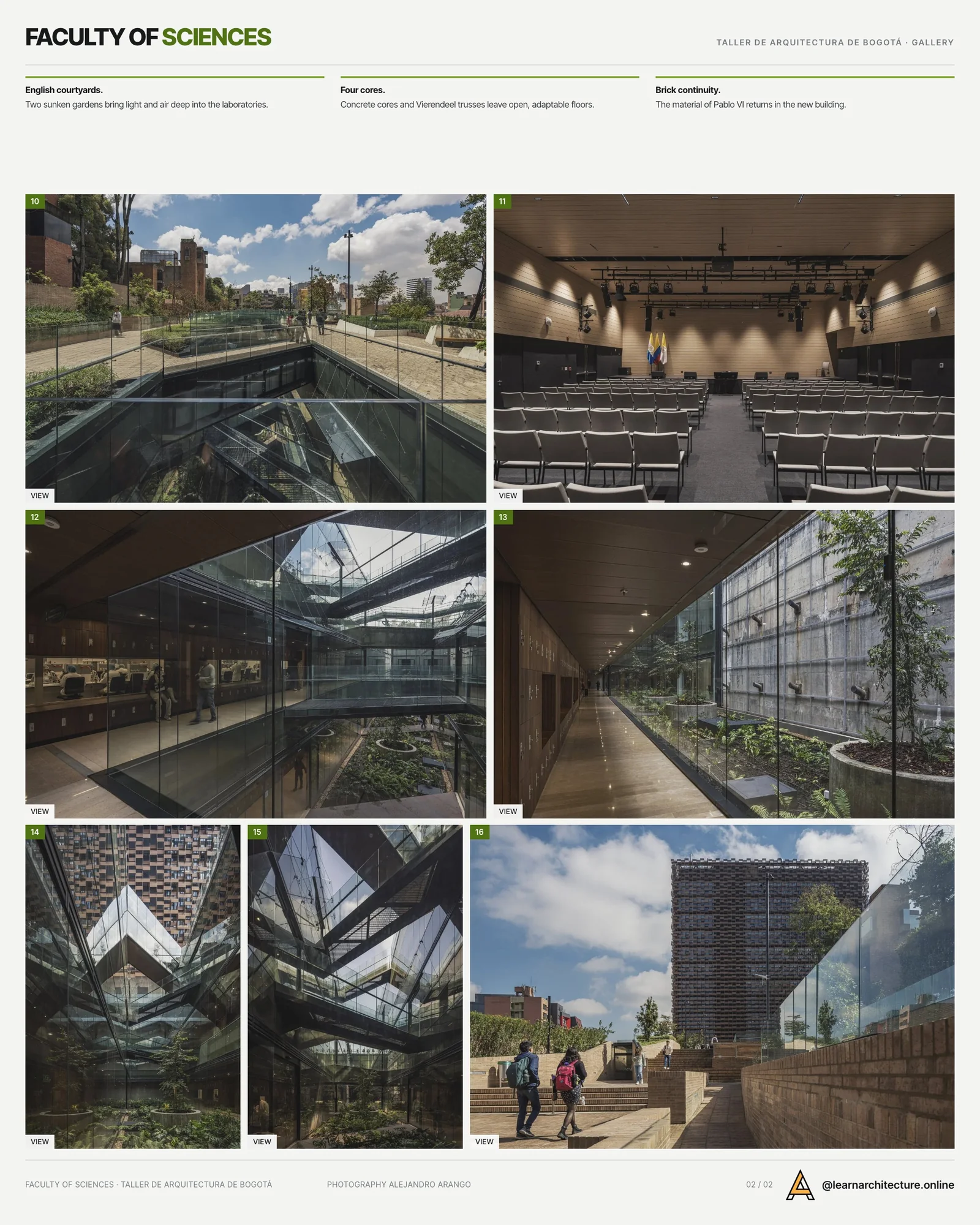
Through structural clarity, environmental intelligence, and a respectful dialogue with history, the project demonstrates how contemporary academic architecture can balance iconicity with restraint, and specialization with openness.

Conclusion: A Framework for Future Knowledge
The Faculty of Sciences at Pontificia Universidad Javeriana is not merely a container for laboratories and classrooms. It is a carefully calibrated framework that supports evolving scientific practices, urban engagement, and collective academic life. By combining a human-scale platform, a flexible and expressive tower, and an expansive landscape strategy, the project redefines how a university building can participate in both city and campus.
It stands as a model for academic architecture in dense urban contexts, one that recognizes that the spaces between buildings, the legacy of history, and the adaptability of structure are as crucial to knowledge production as the rooms where research takes place.
Photography: Alejandro Arango


- Academic laboratory design
- Bogotá campus architecture
- Brick architecture Bogotá
- Campus public space
- Carrera Séptima architecture
- Contemporary university architecture
- Educational architecture Colombia
- Faculty of Sciences architecture
- Flexible laboratory buildings
- Green campus design
- Landscape and architecture
- Modern academic buildings
- Platform and tower architecture
- Pontificia Universidad Javeriana
- Science faculty design
- Structural flexibility architecture
- Sun-shading façade design
- taller de arquitectura de bogotá
- University buildings Colombia
- Urban campus integration






Leave a comment