


Table of Contents Show
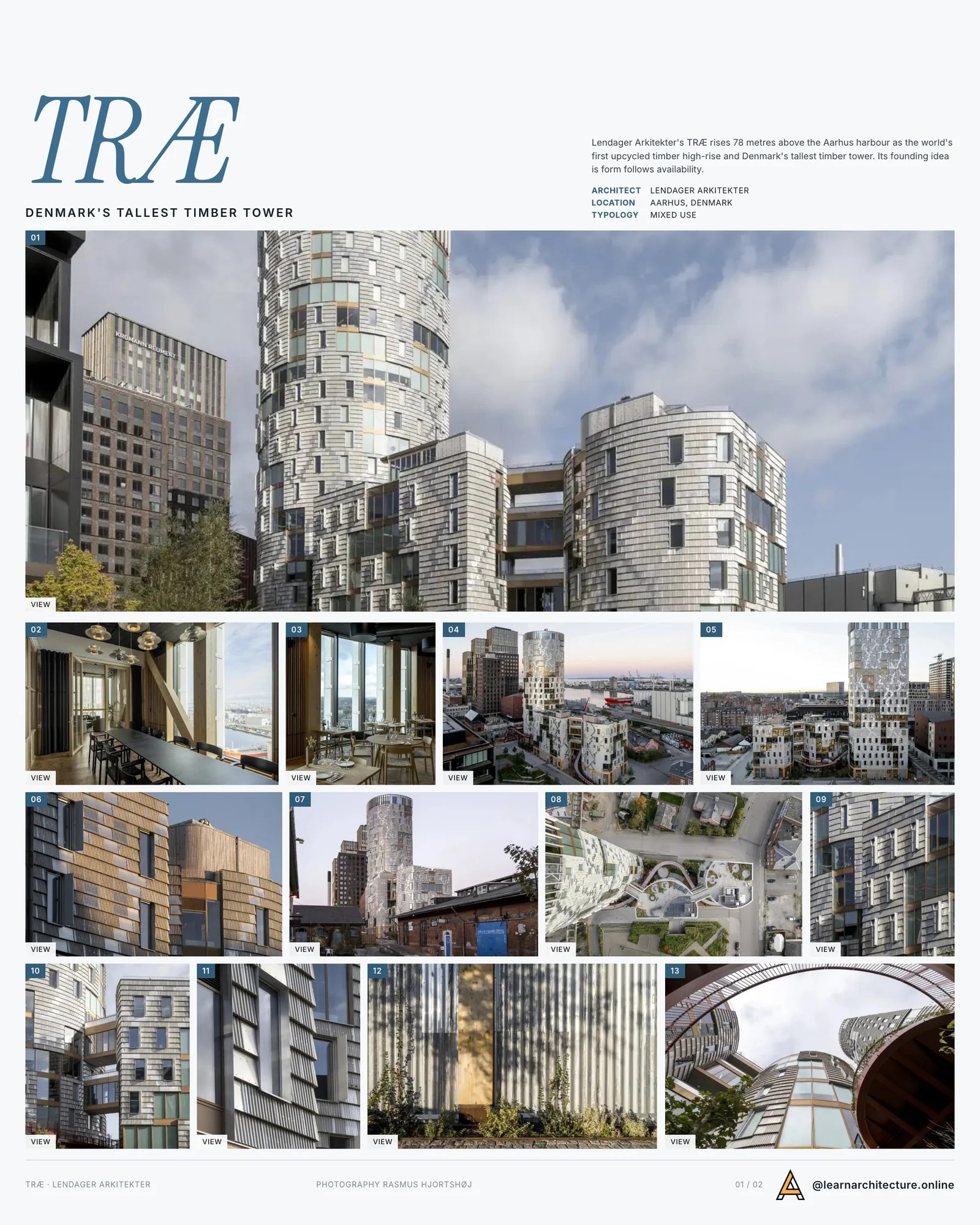
TRÆ, designed by Lendager Arkitekter, stands as the world’s first upcycled timber high-rise and Denmark’s tallest timber tower. Rising 78 meters above the Aarhus harbor, the project is a bold demonstration of how large-scale architecture can merge reused materials, biogenic resources, refined aesthetics, and high performance without sacrificing safety or design integrity. Set in a rugged former industrial zone marked by heavy infrastructure, traces of maritime activity, and pockets of social inequality, the tower was envisioned not only as a building but as a catalyst for urban and environmental transformation.

Contextual Response and Circular Design Principles
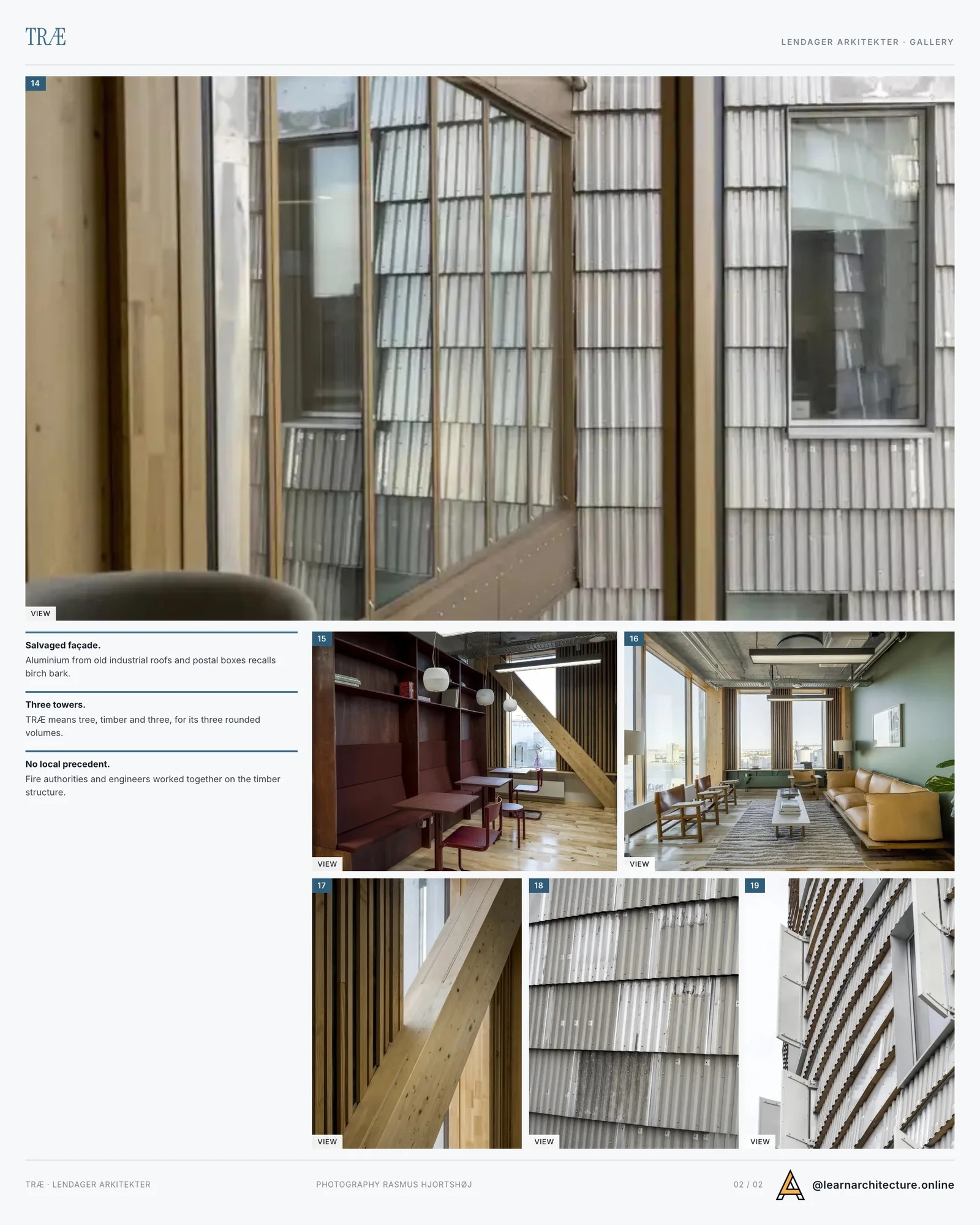
The design embraces the raw character of Aarhus’ industrial waterfront, interpreting its history through materials that carry the patina of previous lifetimes. The project’s conceptual foundation, “form follows availability”, allows the building to reveal the beauty of waste. Salvaged aluminum sheets from abandoned industrial roofs, water-damaged postal boxes, and discarded farm structures form a shimmering, textured façade that recalls the mottled surface of birch bark. This aesthetic imperfection becomes a signature identity, transforming irregularity into architectural value.
The tower’s name, TRÆ, carries layered meaning: tree, timber, and three, referencing its biogenic material base, its ecological ethos, and the trio of sculptural volumes that form its massing. These rounded towers rise from a compact triangular site, their soft geometry maximizing daylight penetration while creating a distinct vertical landmark on the waterfront.

Structural Innovation and Technical Challenges
Pioneering Denmark’s First Timber High-Rise
Constructing Denmark’s tallest timber tower required breaking new ground across engineering and regulatory frameworks. No local precedents existed for a timber structure of this scale, prompting extensive collaboration with fire authorities, structural engineers, and environmental consultants. The building operates within strict safety constraints posed by saline sea air, blast-protection rules, and emissions from nearby power infrastructure. Each challenge fueled new technical solutions, including full-scale fire testing of upcycled elements such as wind turbine blades repurposed as solar shading.

Hybrid Structure for Resilience
The structural system combines glulam columns and CLT floor slabs with strategically placed low-carbon concrete cores for stability and fire protection. This hybrid approach ensures regulatory compliance while preserving the project’s commitment to biobased materials. Nearly all visible interior surfaces are reused, upcycled, or biogenic. Reclaimed wood flooring, repurposed timber panels, recycled PET acoustic treatments, and textile-based finishes collectively establish a warm, tactile atmosphere anchored in sustainability.

Material Narratives and Ecological Performance
Upcycled and Bio-Based Materiality
The façade’s timber cassettes support salvaged aluminum sheets, while old wind turbine blades form sculptural solar shading elements. Mature trees transplanted from municipal sites populate the landscape, reinforcing the project’s “tree” identity and giving the site an immediate sense of rootedness.
Carbon Reduction at Scale
Life Cycle Assessments show that TRÆ reduces embodied carbon by 30 to 50% compared to a conventional concrete high-rise. Its circular strategies (material reuse, minimized waste, biogenic sourcing, and low-carbon construction techniques) deliver measurable ecological impact. By proving that carbon reduction can be achieved at high-rise scale, the project sets new benchmarks for European sustainability standards and global construction practices.

Social Integration and Community Value
A Building for People, Not Just Performance
Beyond its technical achievements, TRÆ embeds social sustainability. A restaurant operated by a social initiative activates the ground level, and a serpentine pedestrian bridge connects the site to the city’s elevated highline, reinforcing public access. Local homeless communities participate in daily upkeep, while volunteer programs offer meals and support for families in need. These gestures transform the development into a living social ecosystem.
The Living Lab Floors
Three dedicated “Living Lab” levels showcase experimental assemblies of biogenic and upcycled materials. They function as research spaces, enabling architects, students, users, and industry partners to test new approaches to circular construction. This ongoing exploration strengthens the project’s impact beyond its immediate physical footprint.

A New Symbol for Aarhus and Future Architecture
TRÆ is more than a pioneering timber high-rise; it is a manifesto for the future of sustainable building. Its textured aluminum façade shimmers with the history of its salvaged materials, while the warm interiors reflect a shift toward regenerative design. As the Aarhus Architecture Awards 2025 jury remarked, TRÆ is “an energetic reckoning with well-tested solutions,” inviting the architectural discipline to rethink assumptions and embrace innovation.
By turning waste into architectural value, combining environmental performance with social engagement, and proving that circular principles can scale to metropolitan contexts, TRÆ points toward a new paradigm. It stands not only as a workplace or landmark, but as a powerful statement: architecture can, and must, lead the transition to a more sustainable, equitable, and inspiring built environment.
Photography: Rasmus Hjortshøj


- Aarhus waterfront architecture
- Adaptive Reuse in Architecture
- biogenic materials
- carbon reduction strategies
- circular construction
- CLT and glulam structure
- Danish contemporary architecture
- Denmark timber high-rise
- eco-friendly high-rise design
- façade made from upcycled materials
- Lendager Arkitekter
- Lendager Arkitekter circular design
- Nordic sustainable architecture
- recycled aluminum façade
- Regenerative architecture
- sustainable high-rise design
- timber construction innovation
- timber tower architecture
- TRÆ High-Rise Building
- upcycled architecture





Leave a comment