


Table of Contents Show
Art deco reshaped the urban skyline during the 1920s and 1930s, turning skyscrapers into vertical works of art. Born from the 1925 Exposition Internationale des Arts Décoratifs et Industriels Modernes in Paris, the style celebrated geometry, bold materials, and upward momentum. Architectural movements before it looked backward for inspiration; art deco looked up. The result was a generation of buildings that still command attention across continents.
What made these art deco buildings so different from their predecessors? They rejected the classical columns and Gothic tracery of earlier towers. Instead, architects used setbacks, chevron patterns, sunburst motifs, and gleaming metals to express speed, progress, and prosperity. Seven landmarks, spread across three countries, tell that story best: the towers that defined the style, the Chicago competition that helped launch it, and a Mexico City palace that carried it indoors.

Chrysler Building: New York’s Art Deco Crown Jewel
The Chrysler Building art deco design remains the benchmark against which every other tower in the style is measured. Completed in May 1930 at 319 meters, William Van Alen’s masterpiece for automobile magnate Walter P. Chrysler briefly held the title of the world’s tallest structure, according to Britannica. Its stainless steel sunburst crown, assembled secretly inside the building and raised in just 90 minutes, outwitted the competing architects at 40 Wall Street.
Every detail ties back to the Chrysler automobile brand. Eagle gargoyles at the 61st floor echo 1929 hood ornaments; hubcap replicas and winged radiator caps adorn lower setbacks. The lobby features red African granite walls, an Edward Trumbull ceiling mural celebrating the machine age, and geometric elevator doors inlaid with rare woods. In a 2005 Skyscraper Museum poll of 100 architects, historians, and critics, the Chrysler Building ranked first among 25 of New York’s most notable towers.

Empire State Building: Art Deco on a Record-Breaking Scale
The Empire State Building art deco identity sometimes gets overshadowed by its sheer size. Designed by Shreve, Lamb & Harmon and completed in April 1931, the tower reached 381 meters (443 meters including antenna) and held the tallest-building title for nearly four decades, until 1970. According to the American Society of Civil Engineers, it is recognized as one of the Seven Wonders of the Modern World.
Its limestone and granite facade follows New York’s 1916 Zoning Resolution, creating a stepped silhouette that narrows as it rises. The lobby contains a 24-karat gold and aluminum leaf ceiling mural, and the Fifth Avenue entrance wall displays a relief image of the building itself with radiating light beams. Where the Chrysler Building is intimate and ornamental, the Empire State Building channels art deco through massing and proportion. It proves that the style worked equally well at monumental scale.
Rockefeller Center: Art Deco as an Urban Vision
Rockefeller Center art deco ambitions went beyond a single tower. Developed between 1930 and 1939 by the Rockefeller family, this 22-acre complex in midtown Manhattan was the largest private development project of its time. The lead architect, Raymond Hood of the firm Raymond Hood, Godley & Fouilhoux, designed the centerpiece, 30 Rockefeller Plaza (originally the RCA Building), as a 70-story slab with streamlined vertical piers.
The complex weaves art deco into every surface. Lee Lawrie’s Wisdom bas-relief over the main entrance, José Maria Sert’s lobby murals, bronze elevator doors, and Paul Manship’s gilded Prometheus fountain all share the style’s geometric confidence. Rockefeller Center demonstrated that urban planning could be art deco too, connecting plazas, underground shopping concourses, and rooftop gardens into a single coordinated environment. The American Institute of Architects has consistently ranked it among America’s most admired built works.

Tribune Tower and the Competition That Launched Art Deco Skyscrapers
The Tribune Tower art deco connection is indirect but pivotal. The built tower at 435 North Michigan Avenue in Chicago, completed in 1925, is actually a neo-Gothic design by John Mead Howells and Raymond Hood. What matters for art deco history, however, is the competition that produced it. The 1922 Chicago Tribune Tower competition attracted 263 entries from around the world, and the second-place design by Finnish architect Eliel Saarinen changed everything.
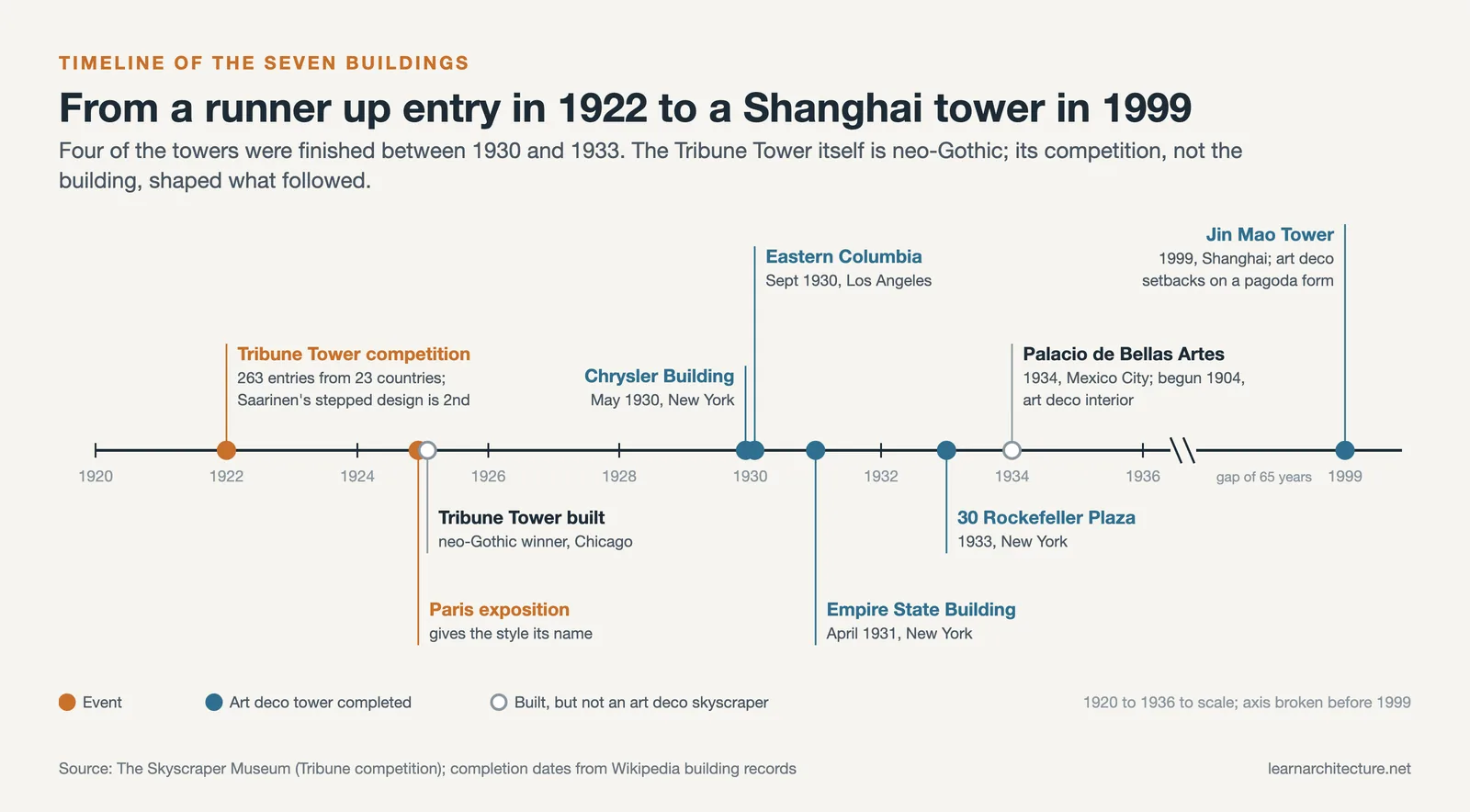
Saarinen’s unbuilt proposal featured a radically modern stepped tower with vertical emphasis and no historical ornament. Architects across America took notice. As the Art Deco Society of New York notes on ArtDeco.org, many critics have traced the modernistic features of Hood’s own American Radiator Building (1924) to Saarinen’s runner-up design, although the Society points out that several of them already appear in Hood’s Tribune entry. The design showed that tall buildings did not need classical or Gothic dress to appear powerful. You can trace a clear line from Saarinen’s drawing to the Chrysler Building’s soaring crown.
Key Art Deco Landmarks at a Glance
The following table compares the seven landmarks covered in this article across location, height, year of completion, and architect. Tribune Tower is included for the competition behind it rather than its own neo-Gothic design, and the Palacio de Bellas Artes for its Art Deco interior.
| Building | Location | Year | Height | Architect |
|---|---|---|---|---|
| Chrysler Building | New York, USA | 1930 | 319 m (1,046 ft) | William Van Alen |
| Empire State Building | New York, USA | 1931 | 381 m (1,250 ft) | Shreve, Lamb & Harmon |
| 30 Rockefeller Plaza | New York, USA | 1933 | 259 m (850 ft) | Raymond Hood et al. |
| Tribune Tower | Chicago, USA | 1925 | 141 m (462 ft) | Howells & Hood |
| Palacio de Bellas Artes | Mexico City, Mexico | 1934 | 45 m (148 ft) | Adamo Boari / Federico Mariscal |
| Eastern Columbia Building | Los Angeles, USA | 1930 | 80 m (264 ft) | Claud Beelman |
| Jin Mao Tower | Shanghai, China | 1999 | 421 m (1,380 ft) | Skidmore, Owings & Merrill |
Palacio de Bellas Artes: Where Art Nouveau Meets Art Deco in Mexico City
The Palacio de Bellas Artes art deco interior is one of the most dramatic in the Western Hemisphere, yet the building itself began life as something else entirely. Italian architect Adamo Boari started construction in 1904 in a lavish Art Nouveau style. The Mexican Revolution and World War I halted work for years. When Mexican architect Federico Mariscal completed the palace in 1934, he chose art deco for the interior, creating a striking dialogue between two eras.
The result is a building with a white Carrara marble exterior full of organic, flowing forms, and an interior filled with zigzag patterns, geometric lighting fixtures, and polished marble floors in warm amber and red tones. Murals by Diego Rivera, David Alfaro Siqueiros, and José Clemente Orozco hang within art deco frames and surroundings. The Palacio proves that art deco buildings in the world were not limited to American skyscrapers. As documented by UNESCO, the palace was declared an artistic monument by the Mexican government in 1987.

Eastern Columbia Building: Los Angeles Art Deco in Turquoise and Gold
The Eastern Columbia Building art deco facade is impossible to miss on Broadway in downtown Los Angeles. Completed in 1930, architect Claud Beelman wrapped the 13-story structure in glossy turquoise terra cotta tiles trimmed with gold accents and geometric ornamentation. A four-sided clock tower tops the building, and the main entrance features a dramatic two-story sunburst in glazed terra cotta above the doorway.
Originally built as a commercial headquarters for the Eastern and Columbia outfitting companies, the building was converted to residential lofts in 2006. Its vibrant color palette sets it apart from the limestone-and-steel palette of New York’s art deco buildings. The Eastern Columbia Building shows how the style adapted to regional tastes and climates; Los Angeles designers embraced color and ceramic surfaces that responded to the Southern California sun. The building is listed on the National Register of Historic Places.
Jin Mao Tower: Art Deco Reborn in 21st-Century Shanghai
The Jin Mao Tower art deco influence is a surprise to many who assume the style ended with the Great Depression. Completed in 1999, this 88-story, 421-meter skyscraper in Shanghai’s Lujiazui financial district was designed by the Chicago firm Skidmore, Owings & Merrill (SOM). Lead designer Adrian Smith fused traditional Chinese pagoda proportions with art deco vertical lines and stepped massing, creating a tower that looks distinctly Chinese to locals and distinctly art deco to Western visitors.
The building rises in 16 tiered segments, with each setback echoing both pagoda rooflines and the stepped profiles of 1930s New York towers. Its stainless steel, aluminum, and glass curtain wall creates geometric patterns reminiscent of Art Deco grillwork found along Shanghai’s historic Bund waterfront. Inside, the Grand Hyatt Shanghai hotel occupies the upper floors, and its 33-story circular atrium spirals upward like a golden vortex. The number 8, auspicious in Chinese culture, recurs throughout: 88 floors, an octagonal core, and eight super-columns. The Jin Mao Tower stands as proof that art deco’s vocabulary of geometry, verticality, and luxury materials remains powerful enough to anchor a modern skyline. For more on how historical styles influence contemporary skyscraper design, the tower is an essential case study.

What Made Art Deco Architecture So Enduring?
These seven landmarks span seven decades, three countries, and wildly different programs, from corporate headquarters to a national palace of fine arts. Yet they share a common DNA: strong vertical lines, geometric ornament, premium materials used with confidence, and an unshakeable belief that buildings should express optimism. The art deco building, at its best, is architecture that refuses to be quiet.
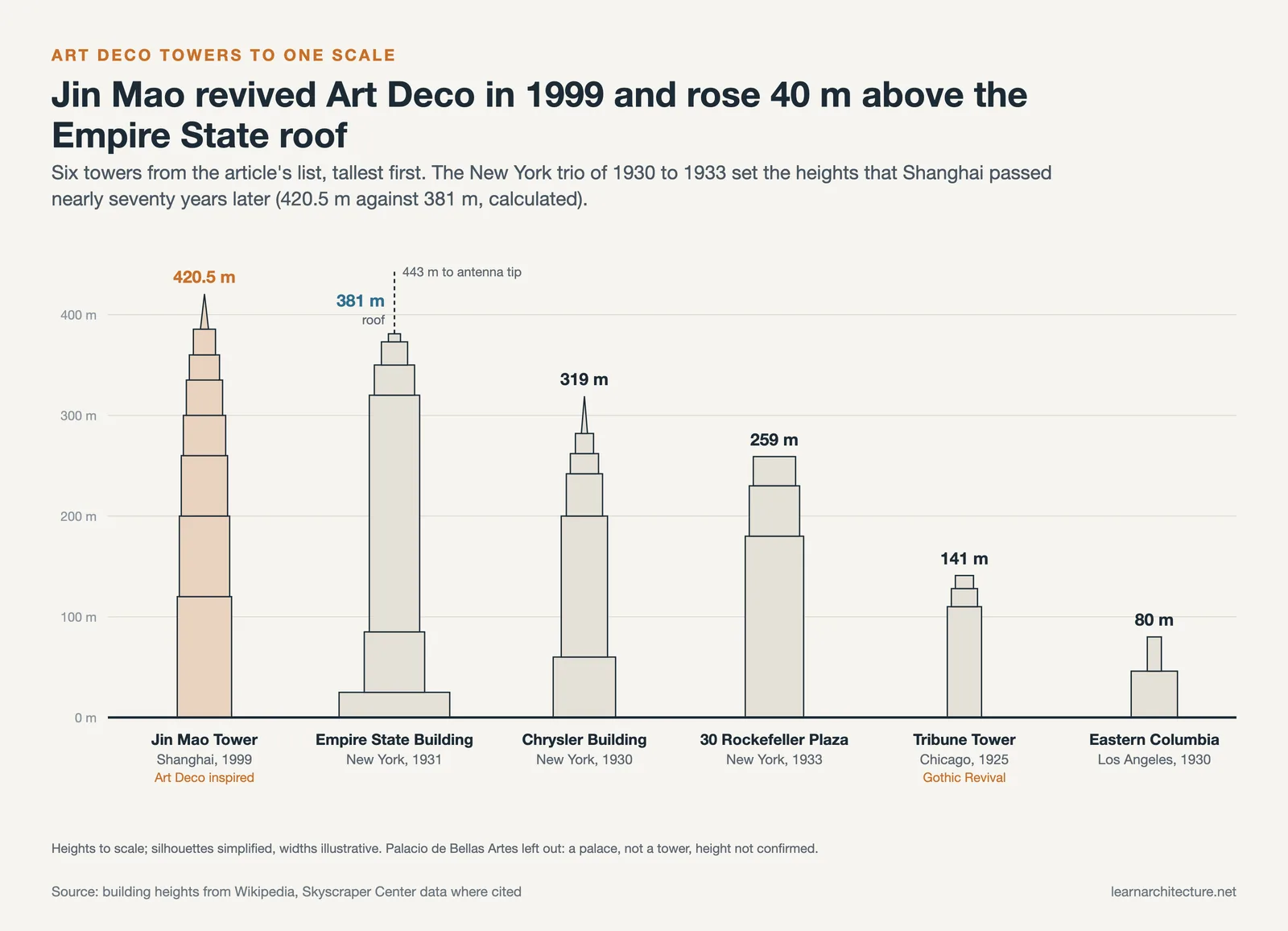
New York’s 1916 Zoning Resolution inadvertently shaped the style by requiring setbacks that admitted light to the street. Architects turned that legal constraint into a design feature, sculpting towers that stepped back like ziggurats. Materials mattered too: Nirosta stainless steel on the Chrysler Building, turquoise terra cotta on the Eastern Columbia, Carrara marble at the Palacio de Bellas Artes. Each surface choice reinforced the building’s identity.
The lesson for contemporary practice is worth noting. Art deco succeeded because it merged structural innovation with genuine craftsmanship. The buildings on this list were not decorated boxes; their ornament grew from their structure. That principle, ornamentation as an expression of construction logic rather than an afterthought, continues to inform architects working on high-profile projects today. Whether you are studying modern architecture or planning a facade restoration, the art deco skyscrapers remain a masterclass in how ambition and detail can coexist at scale.









Leave a comment