


Table of Contents Show
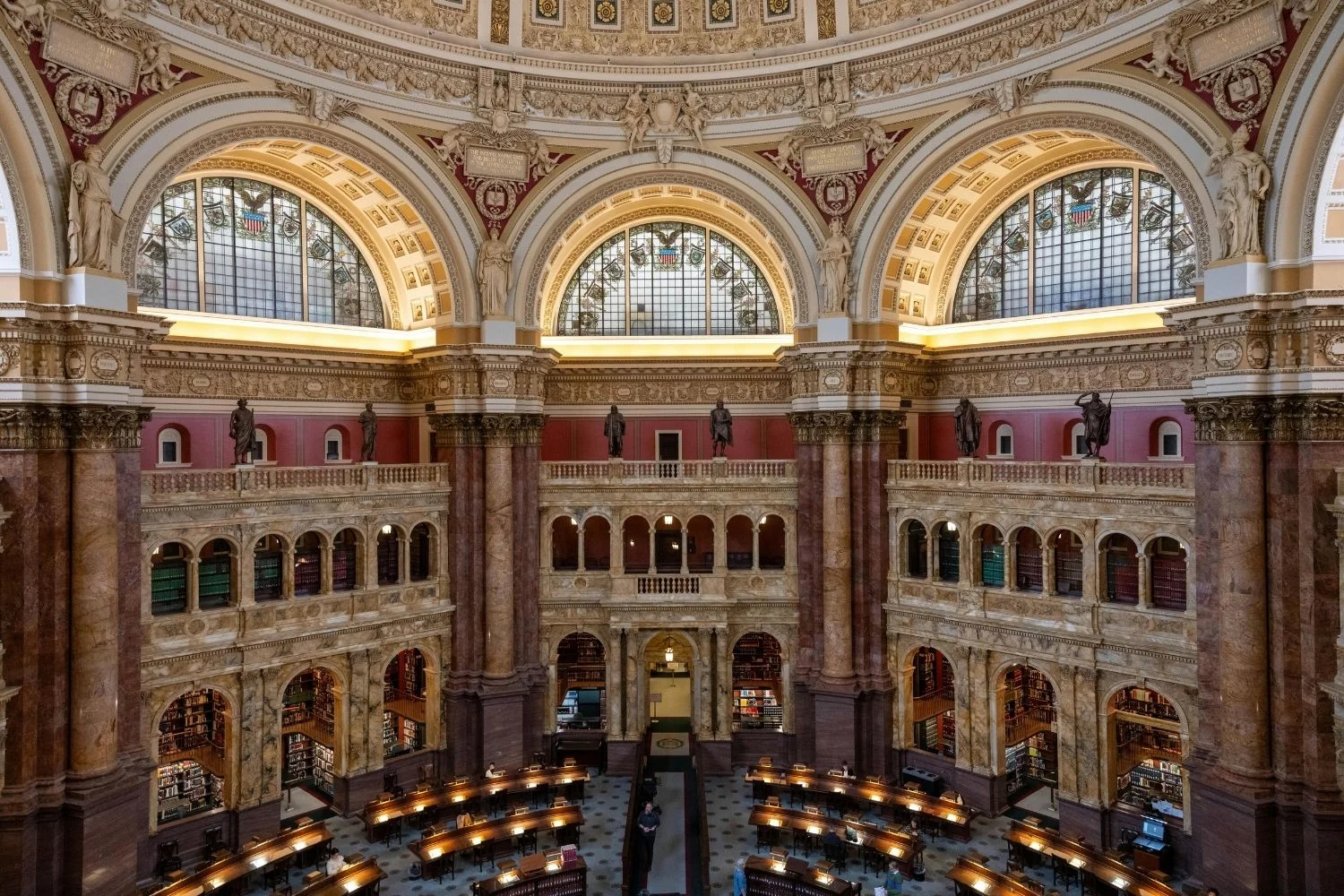
To build a library that endures, architects must solve a particular set of problems: how to handle vast quantities of books and people simultaneously, how to bring in natural light without damaging collections, and how to create a space that feels both public and quiet. These 10 library buildings around the world demonstrate what happens when those problems are solved with genuine ambition. Each one offers specific design strategies worth studying, whether you are a student, a practitioner, or simply someone interested in what great civic architecture looks like.
What Makes a Library Building Architecturally Exceptional?
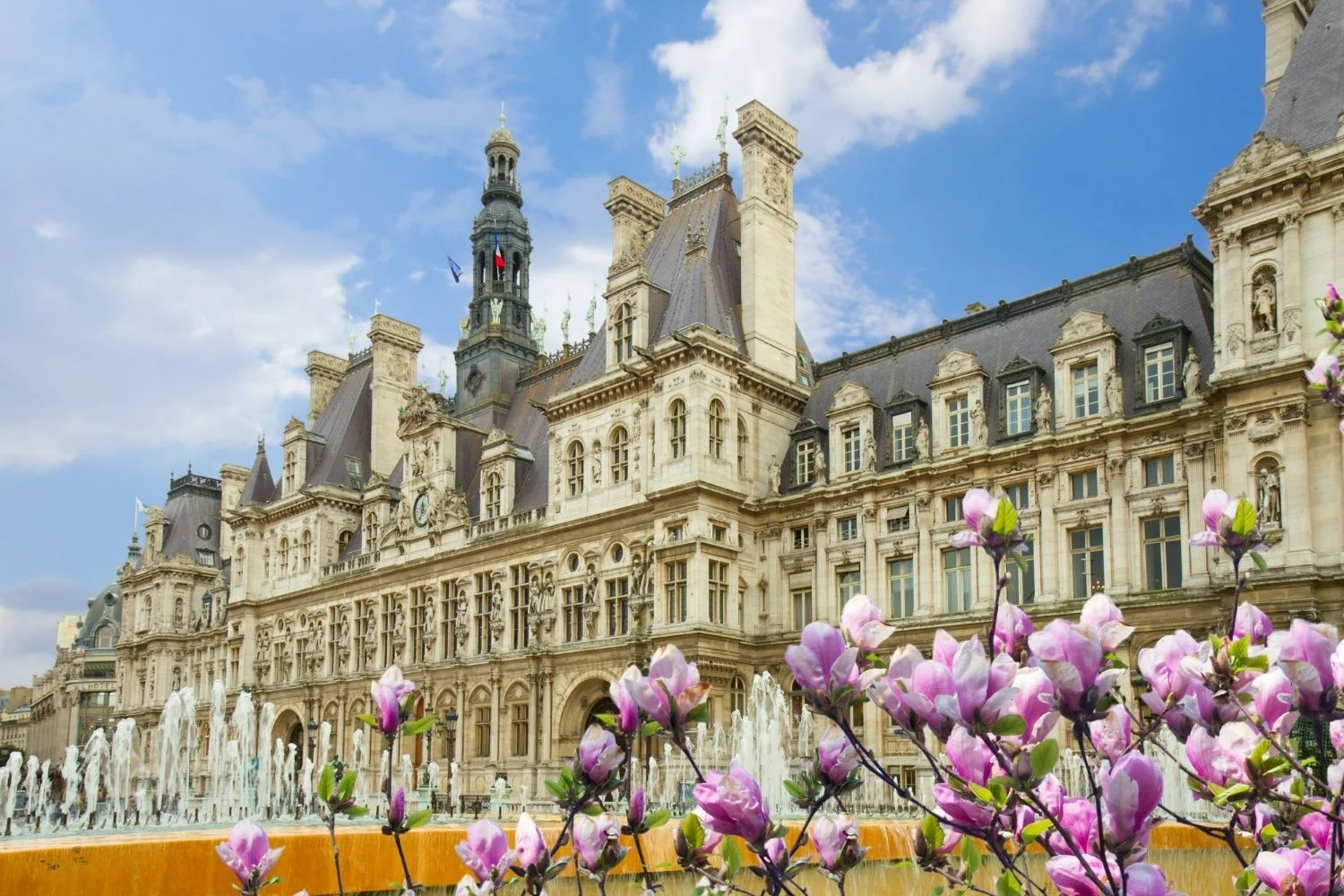
A library is one of the most demanding building types in architecture. Unlike a museum or a concert hall, it must work at multiple scales simultaneously: the intimate scale of a reading chair, the mid-scale of a reading room, and the civic scale of a public institution. The best library designs around the world succeed at all three.
Light is the central challenge. Book collections require protection from direct UV exposure, yet readers need natural light to feel comfortable and alert. The most successful library buildings resolve this through filtered skylights, north-facing clerestories, and deep-set windows that illuminate interiors without causing glare or heat gain. Acoustics present an equally layered challenge. Open-plan reading rooms need to absorb ambient noise while remaining animated enough to avoid the oppressive silence that drives people away.
Structural decisions also shape the library experience. Long-span column-free floors allow collections and seating to shift freely over time. This flexibility matters because libraries are living institutions; their spatial needs change as digital collections grow and community programs expand. When architects build library spaces with adaptability in mind, buildings stay relevant across generations rather than becoming obsolete within decades.
💡 Pro Tip
When specifying glazing for library reading rooms, target visible light transmittance (VLT) values between 50% and 65% with a UV transmission below 1%. This range brings in enough daylight for comfortable reading while keeping UV levels well below the 75 microwatts per lumen limit that accelerates paper degradation in open-stack areas.
10 Most Stunning Library Buildings Around the World
The following buildings span five continents and six decades of design. What connects them is not a shared style but a shared seriousness about the problem of building a library that people genuinely want to use.
1. Seattle Central Library, USA (2004)
Rem Koolhaas and Joshua Prince-Ramus of OMA designed Seattle Central Library as a series of stacked, offset platforms that organise different library functions by floor. The Books Spiral, a continuous ramp that shelves the entire non-fiction collection in uninterrupted Dewey Decimal order across four levels, is the defining spatial move. Readers can walk the collection end-to-end without retracing their steps or changing floors via elevator. The exterior is a glass-and-steel mesh skin stretched across an irregular geometric form, giving the building its immediately recognisable silhouette.
The structural logic follows the program. Each platform houses a specific activity: children’s reading, quiet study, group collaboration, and staff operations are physically separated, which reduces acoustic conflict without creating a labyrinthine plan. At about 33,700 square metres (363,000 sq ft) across 11 floors, the building demonstrates that you can build a library at civic scale without losing the intimate quality that reading rooms require.
🏗️ Real-World Example
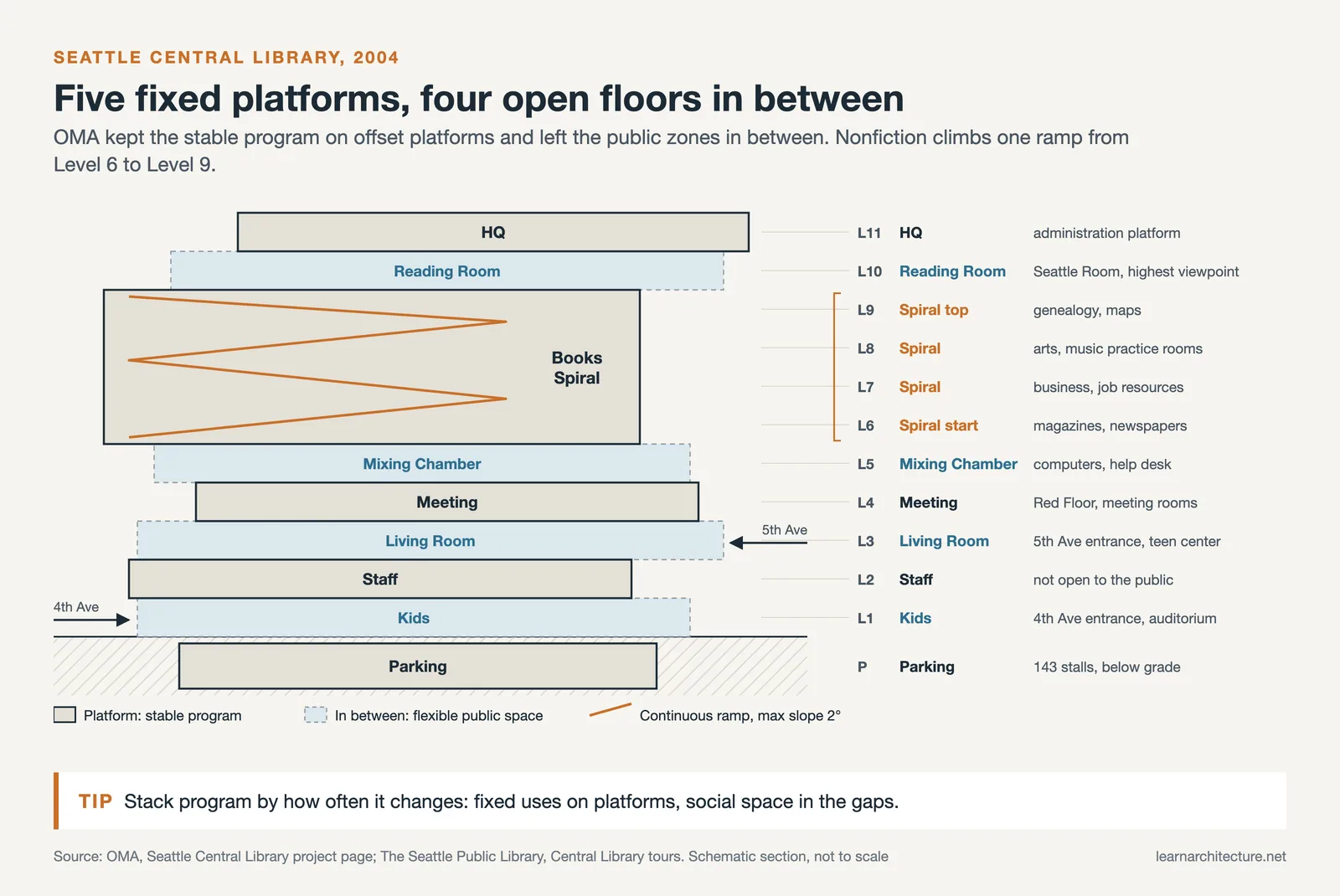
Seattle Central Library (Seattle, 2004): The Books Spiral keeps the non-fiction collection in continuous Dewey Decimal order across four floors on a gently sloping ramp, so the collection can grow without being split across separate floors. In its first year the building drew more than 8,000 visitors a day, double the average of the previous Central Library, and it cost $165.5 million.
2. Bibliothèque Nationale de France, Paris (1995)

Dominique Perrault’s design for the Bibliothèque Nationale de France (BNF) in Paris places four L-shaped glass towers at the corners of a raised wooden platform, surrounding a sunken courtyard of mature pine trees transplanted from a Normandy forest. The towers are shaped like open books standing upright. The reading rooms sit below grade, arranged around the courtyard, which provides natural light and a sense of enclosure without direct sun exposure.
The project was controversial on completion, primarily because the glass towers made the books visible from the exterior, exposing them to the very light that damages paper. Perrault placed fixed wooden shutters behind the glass of each tower to solve this, though critics argued the problem should have been addressed in the initial brief. That tension between symbolic ambition and technical performance remains one of the most discussed case studies in library design education. For a broader look at how architectural styles balance form and function, this building offers a clear example of the tradeoffs involved.
3. Biblioteca Vasconcelos, Mexico City (2006)
Alberto Kalach designed Biblioteca Vasconcelos as a botanical garden and library combined. The building stretches 270 metres in length and organises books in suspended steel mezzanines that hang from a structural roof frame, creating a visible section through the entire collection from any point in the interior. The central void runs the full length of the building, with a giant suspended whale skeleton by artist Gabriel Orozco installed at its centre.
The integration of botanical gardens directly into the library program (trees planted at ground level reach through multiple floors) makes this one of the most ambitious examples of biophilic design in a public library. Natural ventilation is partially achieved through the botanical mass, reducing reliance on mechanical cooling in Mexico City’s temperate climate. The building cost approximately 98 million USD and receives around 3,000 visitors daily (CONACULTA, 2023).
4. Deichman Bjørvika, Oslo (2020)
Atelier Oslo and Lundhagem designed the new main library of Oslo as a five-storey building that opens directly onto the waterfront at Bjørvika. The building’s stepped facade creates a series of outdoor terraces overlooking the Oslo Fjord. Inside, the program is arranged around a large central atrium with open galleries on three sides, allowing visitors to see all activity levels from the ground floor.
The library is deliberately porous. Three primary routes pass through the building, connecting the city grid to the waterfront, so non-library users pass through constantly. This decision reflects a contemporary approach to public buildings: the library as civic infrastructure rather than a sealed institution. The building has become the most visited cultural institution in Norway since opening, recording over 1.4 million visits in its first year (Deichman Annual Report, 2021).
📌 Did You Know?
Deichman Bjørvika in Oslo holds roughly 450,000 physical items but was designed with the explicit assumption that the physical collection would shrink over time as digital borrowing grows. The architects left approximately 30% of the floor area as flexible, undesignated space so the building can evolve without structural modification, an approach increasingly adopted in contemporary library design worldwide.
5. Tianjin Binhai Library, China (2017)
MVRDV designed Tianjin Binhai Library as a sphere of light surrounded by terraced bookshelves that cover every surface from floor to ceiling. The central atrium is dominated by a luminous globe (actually a multi-purpose auditorium), which gives the space its immediately iconic character. The white terraced shelving wraps all internal surfaces, creating a continuous topography that functions simultaneously as seating, display, and storage.
The project was completed in ten months from design completion to opening, an exceptionally compressed timeline for a building of 33,700 square metres. That speed came with constraints: many of the shelves near ceiling level are purely decorative, housing printed covers rather than accessible books, a fact that drew criticism after opening. Nevertheless, Tianjin Binhai Library demonstrates how a single strong spatial idea (the sphere in the cave) can generate an architecture that resonates far beyond the building’s local context.
6. Stuttgart City Library, Germany (2011)
Yi Architects designed Stuttgart City Library as a pure cube: a square plan building with a symmetrical exterior of glass blocks and an interior organised around a central atrium that rises the full height of the building. The interior is painted entirely white. Natural light enters through a skylight above the atrium and diffuses downward through open gallery levels, creating an even, almost shadowless illumination throughout the reading floors.
The building’s formal austerity is deliberate. By stripping away all ornamental variation, the architecture focuses attention entirely on the spatial experience of the central void and on the books themselves. The perimeter floors that surround the atrium contain reading alcoves set into the facade, each with a view outward to the city and inward to the atrium simultaneously. For architects interested in how spatial sequence shapes movement through a building, Stuttgart City Library is one of the clearest contemporary demonstrations of what a strong architectural concept can produce when applied consistently.
7. Alexandria Library (Bibliotheca Alexandrina), Egypt (2002)
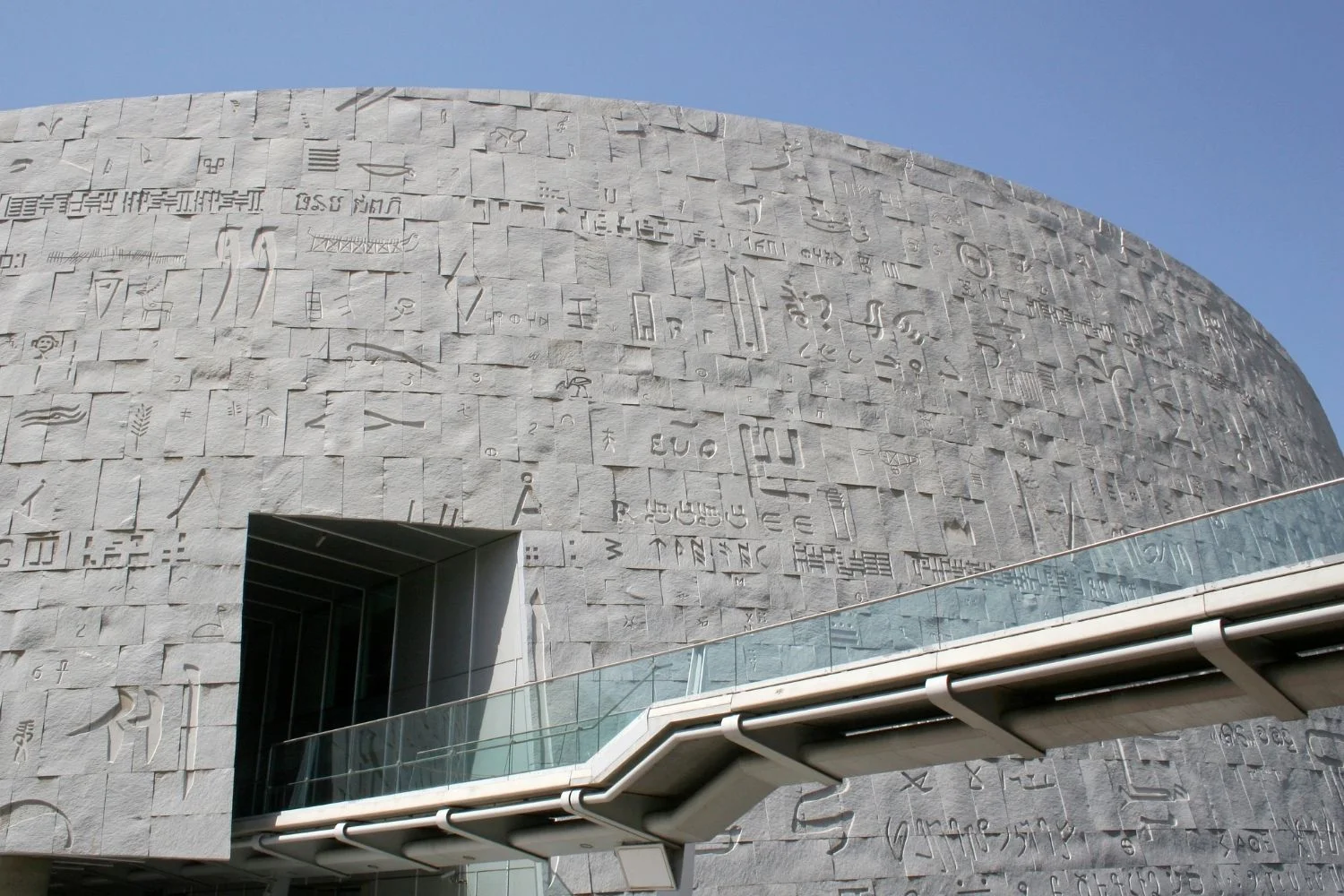
Snøhetta designed the new Library of Alexandria as a tilted disc rising from the ground on the Mediterranean shore, a direct reference to the solar disc of ancient Egyptian cosmology. The circular reading room inside is the largest in the world, covering 20,000 square metres across eleven cascading floor levels. The roof is a glass and aluminium grille tilted toward the north to capture diffuse light while excluding direct sun from the south.
The exterior wall is clad in Aswan granite carved with characters from 120 different human writing systems, a literal representation of the library’s ambition to serve as a repository of global knowledge. The project cost approximately 220 million USD, funded by UNESCO and the Egyptian government, and was designed through an international competition won by Snøhetta in 1989. It remains the reference project for any architect considering how to integrate cultural symbolism into civic architecture without reducing the building to illustration.
🎓 Expert Insight
“Libraries are not about books. They are about access to knowledge, and architecture should make that access feel like a right, not a privilege.”
Snøhetta, project statement for Bibliotheca Alexandrina
This framing captures why the most celebrated library buildings around the world are consistently open, generous, and spatially accessible. The architecture of access is not just symbolic; it translates directly into spatial decisions about entry sequences, sightlines, and the relationship between public and collection areas.
8. Kanazawa Umimirai Library, Japan (2011)
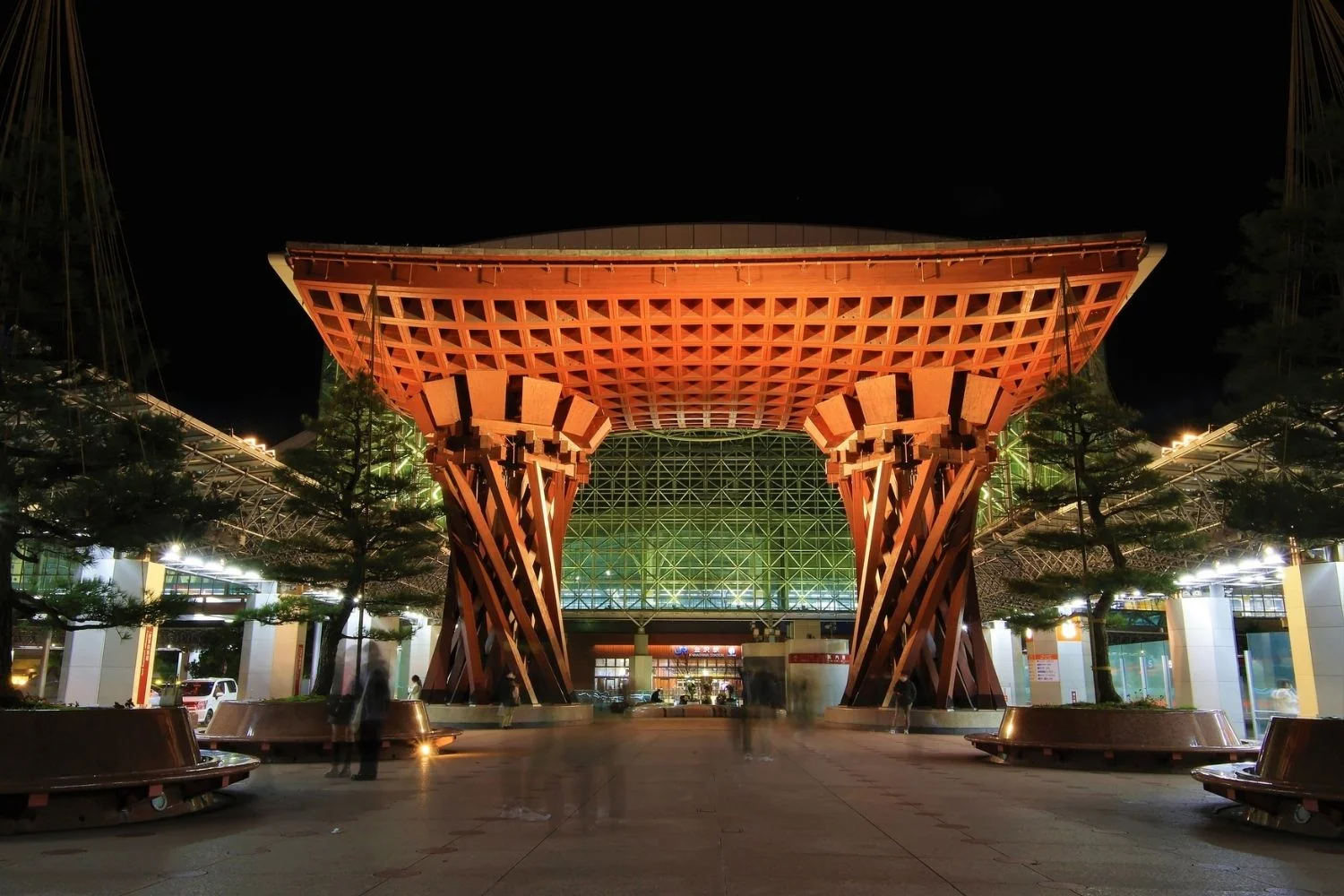
Coelacanth K&H designed Kanazawa Umimirai Library as a compact rectangular volume pierced by 6,000 circular windows of varying diameter. The windows are filled with translucent glass that transmits diffuse light while blocking views out, creating an interior that glows evenly across all wall surfaces without any direct solar penetration. The result is a library interior that reads as luminous from within and as sculptural from without, particularly at night when the pattern of illuminated circles becomes the entire exterior expression.
The structural system uses load-bearing concrete walls, so no columns interrupt the interior floor plan. The collection and seating can be arranged freely across a single open floor. This combination of structural flexibility and controlled natural light makes Kanazawa Umimirai one of the most technically accomplished library buildings of its generation. It received the Good Design Award (Japan) in 2011 and has been widely studied in academic programs focused on daylighting strategy.
9. Qatar National Library, Doha (2018)
Rem Koolhaas and OMA designed the Qatar National Library as a diamond-shaped open plan building with a central void that descends below ground to reveal a Heritage Library containing rare manuscripts and ancient texts. The above-grade floors are a single continuous inclined surface (bookshelves on the sloped walls, reading areas on the flat zones) without internal partitions separating collections by category. The spatial message is explicit: all knowledge is part of a single continuous field.
The building’s relationship to its hot-arid climate is resolved through a double-skin facade and a central HVAC strategy that treats the building as a single conditioned volume rather than a series of individual zones. The Heritage Library below grade is separately climate-controlled to museum conservation standards, with temperature and humidity maintained at 18°C and 45% RH respectively (Qatar National Library, 2019). For architecture students studying how program can drive spatial form, the Qatar National Library is among the most directly legible recent examples of what it means to build a library where concept and structure are genuinely inseparable.
10. Vennesla Library, Norway (2012)
Helen and Hard Architects designed Vennesla Library as a small municipal library in a town of 13,000 people in southern Norway. The building’s interior is organised around 27 timber ribs that span the full width of the hall, each one curving upward from floor to wall to ceiling and containing integrated bookshelves, lighting channels, and acoustic panelling. The ribs are fabricated from cross-laminated timber and create a reading environment that feels simultaneously structural and intimate.
Vennesla demonstrates that ambitious library architecture is not reserved for major metropolitan institutions. The building has received consistent recognition, including the Norwegian Steel Prize and the Civic Trust Award, not for its scale but for the quality of its spatial idea applied to a modest community brief. Its per-square-metre construction cost was competitive with standard Norwegian municipal projects, proving that good design does not require exceptional budget when the concept is strong enough.
💡 Pro Tip
When you build a library on a constrained budget, concentrate the design investment in the primary reading room rather than distributing it evenly across the building. Vennesla and Stuttgart City Library both demonstrate that a single spatially powerful move (repeated timber ribs or a pure white atrium) delivers far more architectural impact than moderate quality applied everywhere.
What These Famous Library Designs Have in Common

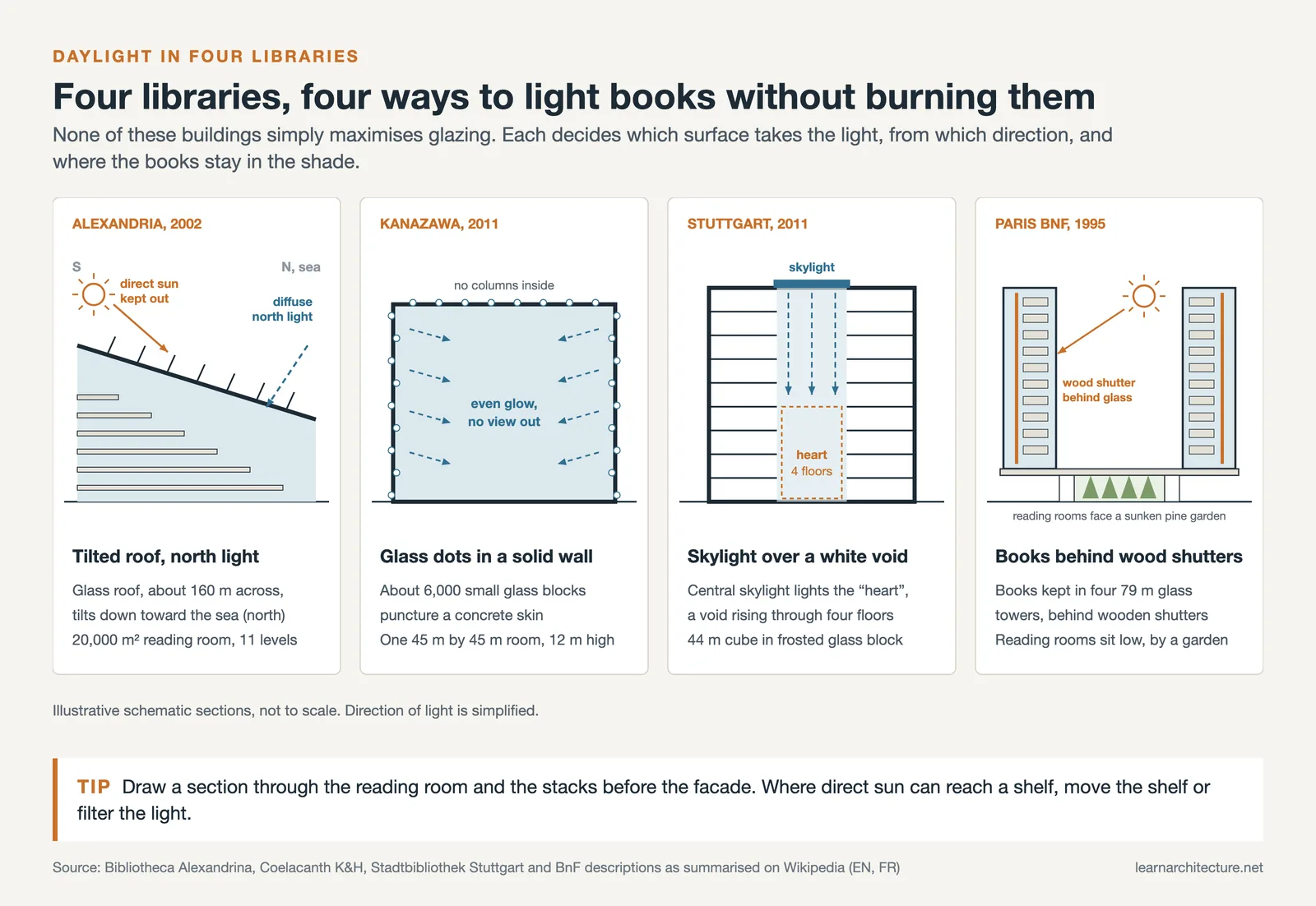
Across all ten buildings, several patterns recur. Natural light is managed with precision rather than abundance. In every case, the architects made deliberate decisions about which surfaces to illuminate, from which direction, and at what intensity. None of these buildings simply maximise glazing and rely on blinds to compensate.
Structure and program are aligned rather than separated. The most memorable of these library buildings (Seattle’s Books Spiral, Vennesla’s timber ribs, Tianjin’s terraced globe) derive their spatial character directly from the structural decisions that make them buildable. The architecture does not sit on top of the engineering; the two are the same thing.
All ten buildings treat the library as civic infrastructure with a public duty that extends beyond the collection. Whether through direct routes (Oslo), botanical integration (Mexico City), or the sheer scale of the reading room (Alexandria), each building makes a spatial argument that knowledge should feel available rather than withheld. That argument is made through architecture, not through policy.
For anyone beginning to think about how to build library spaces that will last, the most useful starting point is to study the structural and environmental strategies of these buildings directly. The history of institutional architecture shows that the buildings which endure are those where the spatial concept and the structural system are resolved together rather than in sequence. These ten libraries are among the best contemporary evidence for that principle.
How to Build a Library: Key Design Principles from These Buildings
Building a library involves a set of decisions that compound quickly. The brief sets the collection size and the anticipated visitor numbers, but those figures do not determine the architecture. The following principles, drawn from the ten buildings above, apply regardless of scale or budget.
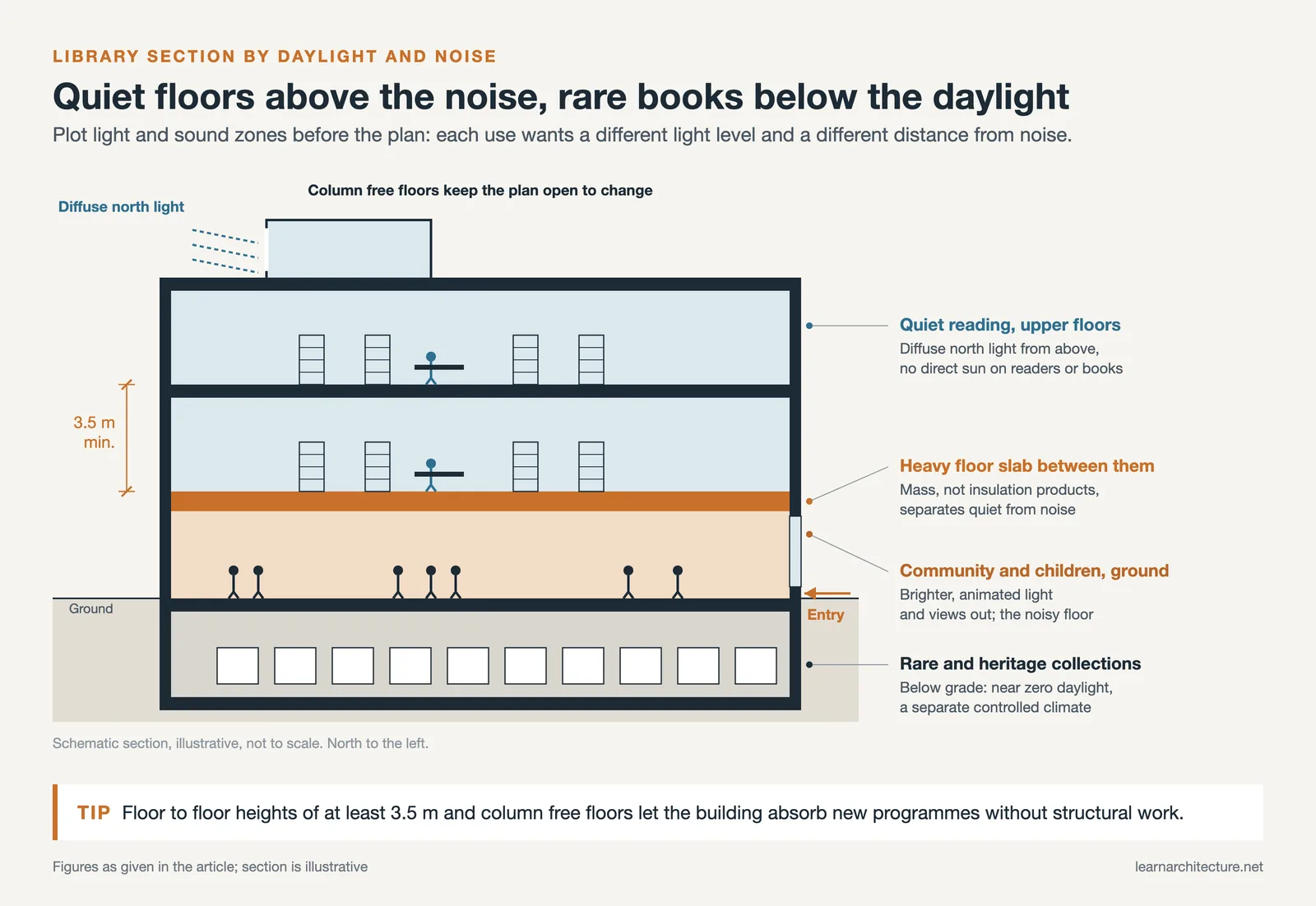
Organise by daylight zone first. Every room in a library has a different daylight requirement. Heritage and rare materials storage needs near-zero natural light. Quiet reading works best with diffuse northern light. Children’s areas and community spaces benefit from brighter, more animated light with views outward. Plotting these zones before the floor plan begins prevents later conflicts that are expensive to resolve.
Design for change. Collections shrink and shift as digital access grows. Buildings library spaces with column-free floors, generous floor-to-floor heights of at least 3.5 metres, and distributed power and data infrastructure allow the building to respond to programmatic change without structural alteration. Oslo’s Deichman and Seattle Central Library both demonstrate this approach.
Separate acoustic zones structurally. The most effective acoustic separation in library buildings comes from mass, not insulation products. Stacking quiet reading above noisy ground-floor activity, as in Stuttgart and Oslo, achieves separation through the floor slab itself. Surface treatment adds refinement but cannot substitute for floor-to-floor acoustic separation where program adjacencies are genuinely incompatible.
Treat the entrance sequence as a design problem. The experience of arriving in a library, transitioning from street noise to reading-room quiet, shapes whether people feel welcome or intimidated. Stuttgart’s compressed entry that opens into the full-height atrium, and Alexandria’s descent below grade into the great reading room, are both examples of entry sequences designed to produce a specific psychological shift. That shift is not decorative. It is the beginning of the spatial argument the library makes about what it is and who it is for.
For students researching landmark buildings that defined architectural eras, or those tracing the evolution of architectural styles across history, library buildings offer a particularly direct lens. Few building types carry the same combination of civic ambition, technical constraint, and spatial challenge. The ten buildings covered here represent the strongest current answers to what it means to build a library that genuinely serves the people who use it.
⚠️ Common Mistake to Avoid
A frequent error when briefing a library project is specifying collection capacity by volume count alone, without accounting for collection growth rate and the shift toward digital holdings. Libraries that were designed in the 1990s for 500,000 physical volumes now hold 150,000, and the surplus floor space was never designed to accommodate the community programming, maker spaces, and digital access zones that replaced those books. When you build a library today, design for the program of 2040, not the collection of 2025.
✅ Key Takeaways
- The best library buildings around the world resolve natural light, acoustics, and structural flexibility as a single integrated design problem rather than three separate technical issues.
- Column-free floor plans and generous floor-to-floor heights are the most practical investments for long-term adaptability as collections shift toward digital formats.
- A single strong spatial concept (a continuous ramp, a glowing sphere, 27 timber ribs) produces more lasting architectural impact than moderate quality distributed across the whole building.
- Treating the library as civic infrastructure means designing entry sequences, routes, and thresholds that make the institution feel accessible to everyone, not only to established users.
- Small-scale libraries like Vennesla demonstrate that the design principles used in major metropolitan projects scale down effectively when the structural and environmental strategies are applied with the same rigour.
Further reading: library architecture projects on ArchDaily | library buildings on Dezeen | IFLA library buildings guidelines | Snøhetta: Bibliotheca Alexandrina project page | OMA: Seattle Central Library project page









Leave a comment