


Table of Contents Show
Architecture school is one of the most demanding academic experiences you can choose. The workload is heavy, the hours are long, and the critiques can feel brutal. But with the right habits and mindset, you can get through it without losing your sanity or your passion for design. These tips cover everything from time management and studio culture to mental health and portfolio building, so you are prepared for what actually happens inside architecture school.

Why Is Architecture School So Hard?
Architecture school sits at the intersection of art, science, technology, and professional practice. Unlike most degree programs, it asks you to develop creative vision and technical precision at the same time, often under punishing deadlines. Studio culture encourages students to push designs past their comfort zone, which is intellectually exciting but physically exhausting. Add in theory courses, structural systems, materials science, and software training, and the workload becomes genuinely relentless.
Understanding why it is hard is the first step to managing it. The pressure is not arbitrary. Architecture school is designed to mirror the intensity of practice, where deadlines, client demands, and design challenges all arrive at once. The students who make it through are not necessarily the most talented. They are usually the most organized, the most resilient, and the most willing to ask for help. ArchDaily’s Architecture School Survival Guide puts it well: the most basic principles of studio survival are often the ones programs leave for students to discover the hard way.
📌 Did You Know?
According to the National Council of Architectural Registration Boards (NCARB), architecture programs in the United States typically span five years for a B.Arch or two to three additional years for an M.Arch.

1. Master Time Management Before Everything Else
No other skill will serve you more reliably throughout architecture school than the ability to manage your time. Projects in studio do not follow a linear path: you will be sketching, modeling, researching, and revising simultaneously. Students who wait until a week before a deadline to start serious work almost always produce weaker projects and suffer more stress than those who start from day one.
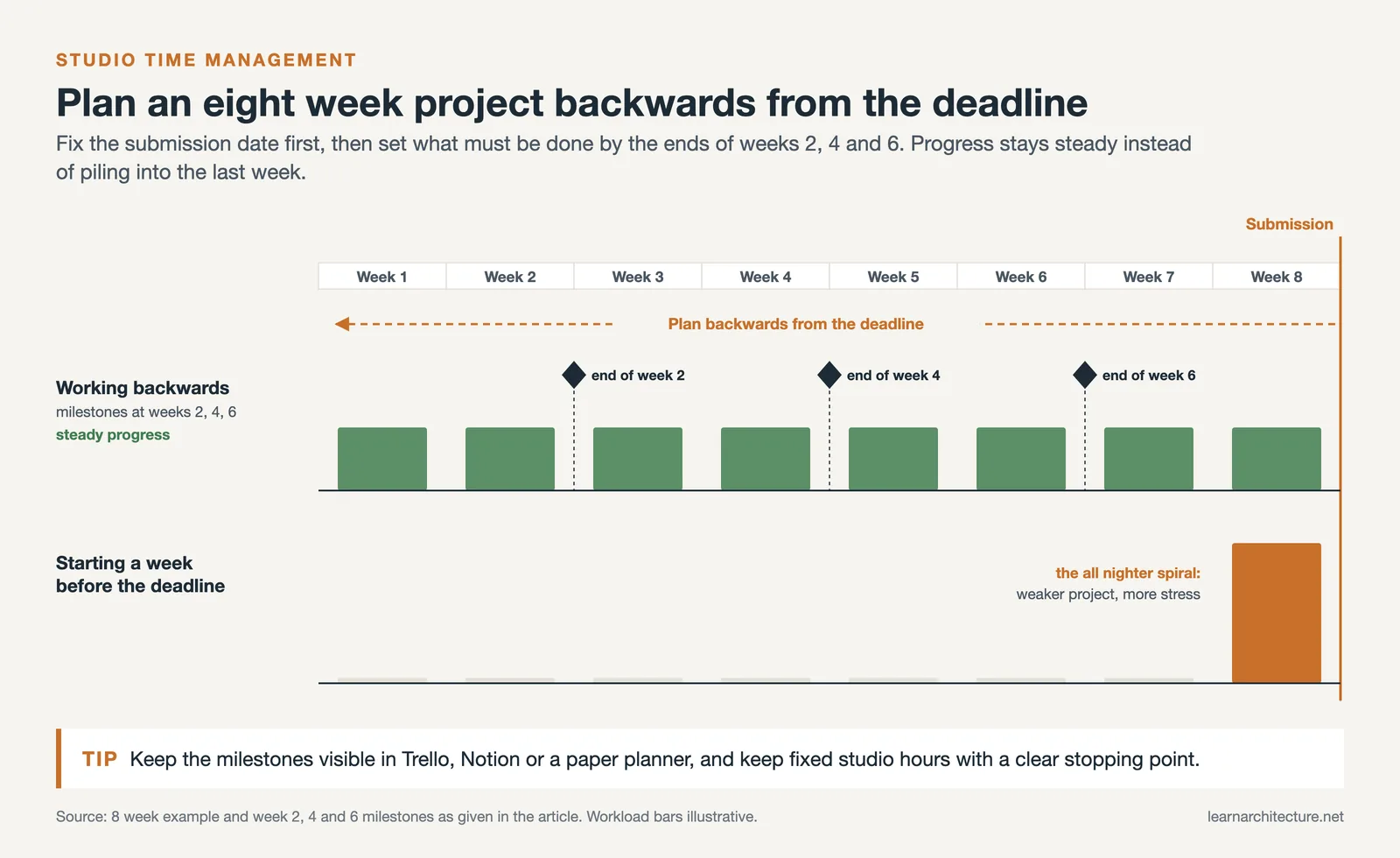
Break every project into smaller milestones and assign dates to each. A useful approach is to work backwards from the submission deadline. If a studio project is due in eight weeks, identify what you need to have completed by weeks two, four, and six. This keeps progress steady and avoids the all-nighter spiral that architecture school is infamous for. Tools like Trello, Notion, or even a basic paper planner can help you keep these milestones visible. For a broader look at how to apply these habits across your full degree, the architecture education tips guide covers time management, software skills, and hands-on experience strategies in depth.
💡 Pro Tip
Treat your studio hours the same way you would treat a job. Arrive at the studio at a fixed time, set a clear stopping point, and resist the urge to bring the work home every night. Consistent studio hours are far more productive than sporadic all-nighters, and they protect your energy for the long haul.
2. Understand What Top Architecture Schools Actually Value
Whether you are already enrolled or still deciding where to apply, it pays to understand what differentiates top architecture schools from one another. Architecture school rankings like those published by QS World University Rankings place programs such as the Yale School of Architecture, MIT, ETH Zurich, and University College London near the top globally. But rankings only tell part of the story.
When evaluating good architecture schools, look beyond reputation to studio culture, faculty research interests, and the professional networks graduates enter. The Yale School of Architecture is known for its rigorous intellectual environment and strong connections to New York practice. The Manchester School of Architecture operates as a joint venture between the University of Manchester and Manchester Metropolitan University, offering a distinct urban and socially conscious approach to design. If you are wondering how to apply for Manchester School of Architecture, the process requires a portfolio submission alongside academic transcripts, and the program places particular weight on evidence of independent design thinking rather than technical polish alone. New school of architecture programs have also emerged that prioritize sustainability, computation, and community engagement, reflecting how the profession has shifted in recent years.

3. Build Your Portfolio From Day One
Most first-year students think of the portfolio as something to assemble at the end of their degree. That is a mistake. Your portfolio is a living document that should grow alongside your skills, and the best students treat every project as a potential portfolio piece from the moment they begin it.
Document your process, not just your final output. Include early concept sketches, site analysis diagrams, physical model photographs, and development drawings alongside polished renders. This kind of process documentation shows reviewers how you think, which is ultimately more valuable than technical finish. Employers and graduate admissions committees at the best schools for architecture want to see a designer who can identify a problem and work through it systematically. For a detailed breakdown, the guide to projects to include in an architecture student portfolio covers the essential types of work reviewers look for at every stage of education.
⚠️ Common Mistake to Avoid
Many students fill their portfolio almost entirely with high-quality renders. This signals to reviewers that you are skilled at visualization software but tells them very little about your design thinking. A portfolio that shows messy early sketches alongside refined final drawings is almost always more compelling than one that only shows polished outputs.
4. How to Handle a Critique Without Falling Apart
The design critique, or “crit,” is a defining feature of architecture school and one of the experiences students find hardest to prepare for emotionally. Your work is pinned to a wall and reviewed by professors, visiting practitioners, and sometimes peers. Comments can be direct and occasionally harsh. Learning to receive this feedback without internalizing it as a personal attack is a skill you will use for the rest of your career.
The key shift is to separate yourself from your project. Your design is a proposal, not a declaration of your worth as a person or a designer. Every piece of criticism, including the most pointed ones, contains information you can use to make the project better. Listen actively, take notes, and ask clarifying questions when you do not understand a comment. Designers who engage openly with critique develop faster than those who become defensive. A student commentary on the NCARB blog puts it simply: take the critique into consideration, but have confidence in what you have created.
5. Read 101 Things I Learned in Architecture School
Matthew Frederick’s book 101 Things I Learned in Architecture School has become something of a rite of passage for students around the world. It is not a textbook. It is a collection of short, illustrated lessons covering design principles, drawing techniques, studio habits, and ways of seeing the built environment that most programs never teach directly. Each lesson fits on a single spread, making it easy to pick up and put down between studio sessions. Pairing it with resources like the guide to architectural sketching techniques gives you a strong foundation in both conceptual thinking and practical drawing skills early in your program.
The reason students return to it repeatedly is that many lessons only click once you have experienced the problem they describe. A tip about how to draw a convincing shadow or how to organize a floor plan hierarchy reads differently once you have genuinely struggled with those things. Keep a copy at your studio desk throughout your program.
🎓 Expert Insight
“You don’t go to school to learn how to do something, you go to learn how to learn.”
Bob Borson, architect and author at Life of an Architect
This reframe is particularly useful for students who feel overwhelmed by how much they do not yet know. Architecture school is not about mastering a fixed body of content. It is about developing the problem-solving instincts and learning habits that will carry you through a career that changes constantly.

6. Prioritize Sleep Over the All-Nighter Myth
The all-nighter is deeply embedded in architecture school mythology. Students compare how many consecutive hours they spent in studio the way athletes compare training mileage. But the evidence on sleep deprivation is unambiguous: working past exhaustion degrades decision-making, reduces creativity, and slows the kind of spatial reasoning that design requires. Sleep is not a luxury you earn after the project is done. It is part of the process.
This does not mean you will never stay late. You will. But building a schedule that accounts for adequate rest most nights means you arrive at critical moments, such as the day before a deadline, with capacity in reserve. Students who protect their sleep throughout a semester consistently produce stronger final work than those who run themselves into the ground in the final week. If you need more motivation to commit to a structured routine, the comprehensive overview of architectural internships makes a strong case: firms consistently report that well-rested students who arrive prepared outperform those who arrived sleep-deprived and unprepared on day one.
7. Develop Your Software Skills Strategically
Architecture school will expose you to a wide range of software, from drafting tools like AutoCAD to BIM platforms like Revit and ArchiCAD to visualization tools like SketchUp, Rhino, and Lumion. It is tempting to chase every new tool as it appears, but a more strategic approach is to develop genuine competence in two or three programs before branching out.
For most students, a practical starting point is a 2D drafting tool for technical drawings, a 3D modeling tool for design exploration, and a rendering or presentation tool for communication. The comparison between ArchiCAD vs SketchUp is a common decision point for students weighing BIM literacy against speed and simplicity. Understanding when each tool is appropriate matters more than being exceptional at any single one. A broader overview of options is available in the guide to the best 3D architectural design software.

8. Pursue Internships During Your Degree
Many students treat internships as something to chase after graduation. In practice, securing work experience during your degree, even in short stints over summer breaks, gives you a significant advantage when you finish. Internships expose you to real project timelines, client communication, and professional drawing standards that studio work cannot fully replicate.
They also build the network connections that often lead directly to jobs. Architecture is a relationship-driven profession, and the firms where students intern frequently hire from their own intern cohort when positions open. The step-by-step guide to securing an architectural internship covers how to approach applications, build a portfolio for professional submission, and make the most of the time once you are inside a firm.
💡 Pro Tip
Do not limit your search to design-focused roles. Construction site placements, engineering office work, and time spent with material manufacturers all count as professional exposure and tend to make technical drawings noticeably stronger. Students who come back from varied placements draw more buildable details than those who only ever work in design studios.
9. Build Relationships Inside the Studio
The people around you in studio are more than classmates. They are your future professional network, your sounding board when a project is not working, and often the closest friendships you will carry out of your degree. Architecture programs form unusually tight cohorts because the experience is so intense and shared.
Talk about your work with peers regularly. Explaining a design decision out loud often reveals whether the reasoning is actually sound. Ask classmates what they think is not working in a model or a plan, even when the feedback stings. The student who engages openly with the people around them develops faster than the one who works in isolation and only presents polished results. Beyond the studio, joining student chapters of professional organizations such as the American Institute of Architects (AIA) or the Royal Institute of British Architects (RIBA) connects you to the profession before you graduate.

10. Protect Your Mental Health Throughout the Program
Architecture school takes a genuine toll on mental health. The combination of chronic sleep deprivation, public critique, financial pressure, and the kind of identity investment students make in their design work creates conditions where anxiety and burnout are common. Acknowledging this is not a weakness. It is honest, and acting on it early matters.
Protect your mental health by maintaining at least one activity outside of school, whether that is exercise, cooking, music, or a sport. Build relationships with people who have no connection to architecture. Seek help from your university’s counseling services early if you are struggling, rather than waiting until you are at a breaking point. The architecture students who make it through the full program with their passion for design intact are almost always those who found ways to sustain themselves outside the studio, not just inside it.
✅ Key Takeaways
- Time management is the single most important skill in architecture school. Start projects immediately and build milestones backwards from the deadline.
- Your portfolio should document your design process from early sketches through final output, not just polished renders.
- Design critiques are professional rehearsals, not personal judgments. Separating your identity from your project helps you get the most value from feedback.
- Sleep consistently. All-nighters damage the creativity and spatial reasoning that architecture school demands most.
- Internships during your degree, even short ones, significantly improve both your employability and your technical drawing quality.
- Protect your mental health by maintaining activities and relationships outside architecture school throughout your entire program.
Frequently Asked Questions About Surviving Architecture School
What is the hardest part of architecture school?
Most students cite the combination of sustained workload and public critique as the hardest elements. Architecture school requires you to produce creative work under tight deadlines and then defend it in front of peers and professionals. Learning to manage both the volume of work and the emotional exposure of critique is the central challenge, and the skills it builds transfer directly into professional practice.
How do I choose between the best schools for architecture?
Architecture school rankings are a useful starting point, but studio culture, faculty specializations, and the professional networks graduates enter matter at least as much as ranking position. Research where recent graduates are working, what kinds of projects the faculty produce, and whether the program’s values align with your own interests in sustainability, computation, community design, or urban practice.
How to apply for Manchester School of Architecture?
Undergraduate applications go through UCAS, while postgraduate applications are submitted directly through the university portal. The portfolio is central to the process and should demonstrate independent design thinking alongside drawing ability. Check the school’s official admissions page for current entry requirements, as criteria can change between cycles.
Is 101 Things I Learned in Architecture School worth reading?
Yes, and more than once. Matthew Frederick’s book covers design principles, drawing habits, and ways of thinking about space that most studio courses never address directly. Many students find that lessons they skimmed early in their degree become immediately applicable once they have encountered the specific problem those lessons describe. Keep a copy at your desk and revisit it throughout your program.
What tips do students from top architecture schools share most?
Students at competitive programs consistently emphasize starting work early, engaging openly with critique, building peer relationships in studio, and pursuing professional experience during their degree rather than after it. They also stress staying curious about architecture beyond the studio through site visits, reading, and exposure to built work across as many typologies and contexts as possible.















Leave a comment