


Table of Contents Show
Le Corbusier’s urban experiment in India produced Chandigarh, a city laid out on a rectilinear grid of self-contained sectors, a hierarchy of seven road types, and a monumental civic core at its northern edge. Commissioned after the 1947 Partition stripped Punjab of its capital Lahore, the city became the most complete built expression of the architect’s Ville Radieuse theories anywhere in the world.
Why Chandigarh Became Le Corbusier’s Great Indian Commission
The story of Le Corbusier’s urban experiment in India begins with a political problem, not an architectural one. When British India was partitioned in August 1947, the historic capital of Punjab, Lahore, ended up inside the new state of Pakistan. The Indian state of East Punjab was left without an administrative centre, and Prime Minister Jawaharlal Nehru refused to accept a provincial retrofit. He wanted something that declared the future.
The first commission, in 1949, went to the American planner Albert Mayer and the Polish-born architect Matthew Nowicki. Their scheme proposed a fan-shaped city with curving roads and neighbourhood units drawn from Garden City thinking. Nowicki died in a plane crash in 1950, Mayer withdrew, and Punjab’s engineers travelled to Europe in search of a replacement. On Mayer’s own recommendation, they asked Le Corbusier, who accepted in 1951 on the condition that his cousin Pierre Jeanneret join him as resident architect. The British couple Maxwell Fry and Jane Drew completed the senior team.
Nehru saw Chandigarh as a statement of intent. He called it a “new city, a symbol of India’s freedom” and wanted architecture that broke with everything associated with colonial Delhi. For Le Corbusier, then close to seventy, it was the chance to finally test his theories at full scale on open land.
💡 Pro Tip
When studying Chandigarh as a student project, always read Le Corbusier’s plan against Mayer and Nowicki’s earlier fan-shaped scheme. The shift from curves to a rigid grid is where most of the architectural argument happens, and drawing both layouts side by side teaches you more about urban reasoning than reading any textbook chapter.
The City as a Living Organism: Le Corbusier’s Master Plan
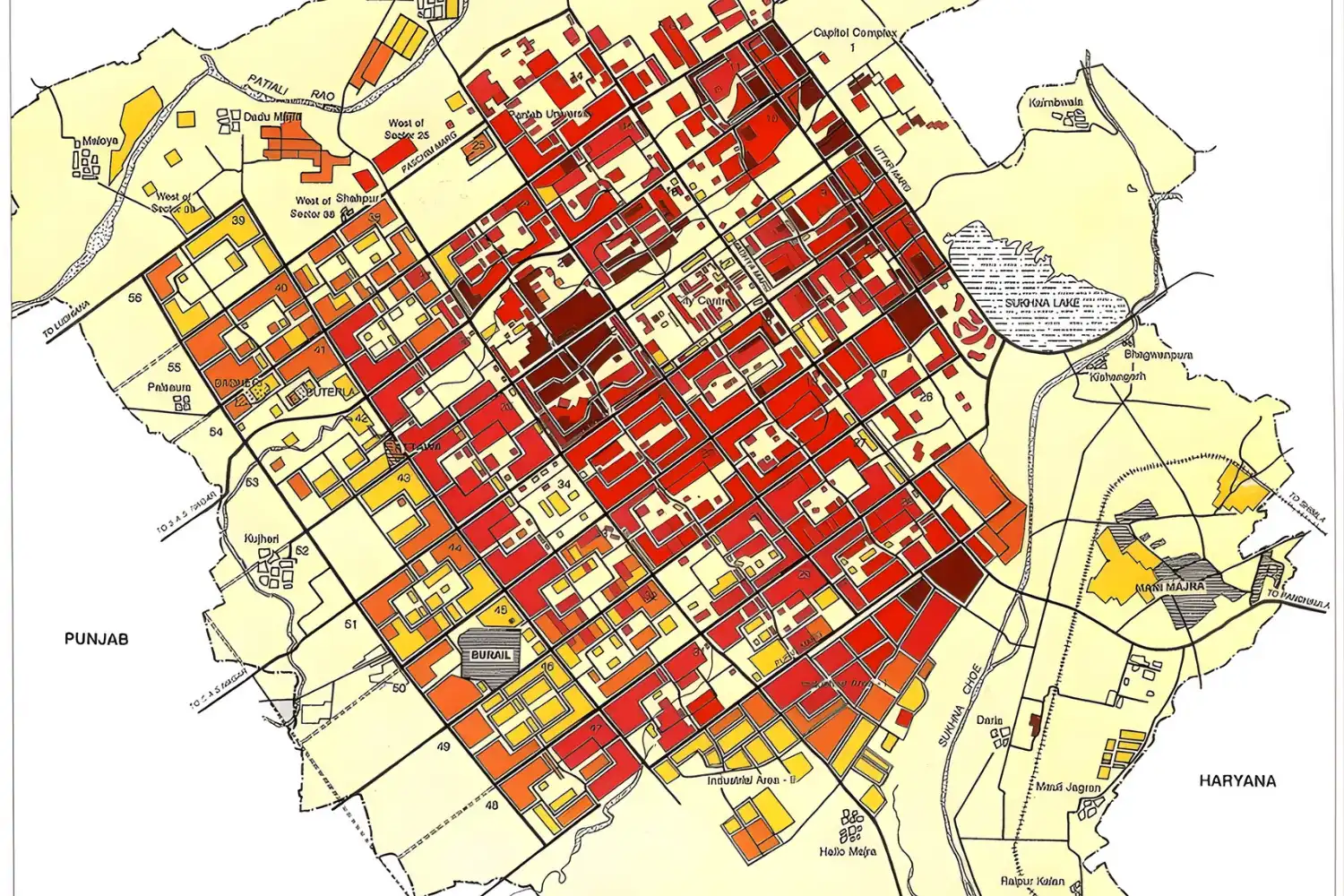
Le Corbusier described his city through the metaphor of a human body, and the analogy genuinely guided the plan. The Capitol Complex at the north formed the head. The commercial centre in Sector 17 was the heart. Large continuous parks, including the Leisure Valley, functioned as the lungs. Educational and cultural institutions were the intellect, the industrial zone sat as the viscera at the city’s edge, and the road network served as the circulatory system binding everything together.
Instead of starting from scratch, Le Corbusier reworked the Mayer and Nowicki layout into a disciplined rectilinear grid. According to ArchDaily’s classics study of the master plan, the new layout compressed the area from roughly 6,908 to 5,380 acres, raising density by about 20% while retaining generous green space. The first phase covered Sectors 1 to 30, designed at low density for roughly 150,000 residents; the second phase added Sectors 31 to 47 at higher density, aiming for a total population of around 500,000.
The primary planning unit of the city is the sector, measuring approximately 800 by 1,200 metres. Each sector is conceived as a self-contained neighbourhood with housing, schools, shops, health services, places of worship, and internal parks, all reachable on foot. The idea is borrowed from the Neighbourhood Unit concept but scaled to Le Corbusier’s preferred proportions.
What Is the 7V Road System?
The 7V system, or Les Sept Voies de Circulation, is the hierarchical road network that organises movement in Chandigarh. It ranges from V1 regional highways down to V7 pedestrian paths, with later additions for cycle routes. Each road type is designed for one speed and one kind of user, which is why traffic in Chandigarh remains easier to manage than in most other Indian cities of comparable size.
The hierarchy works in practice like this: V1 roads connect Chandigarh to other cities, V2 roads link the main city sectors, V3 roads form the fast grid between sectors, V4 roads act as slow shopping streets inside a sector, V5 roads distribute traffic within the sector, V6 roads access individual houses, and V7 paths are reserved for pedestrians moving through the continuous green strips that run north to south through every sector. Because the motor car was central to Le Corbusier’s urbanism, the whole layout is engineered around keeping fast and slow movement strictly separated. If you are interested in how these circulation principles translate to plan drawings, our guide on creating bubble diagrams explains how to represent movement and functional zoning at an early design stage.
The Capitol Complex: Monumental Architecture at the City’s Head
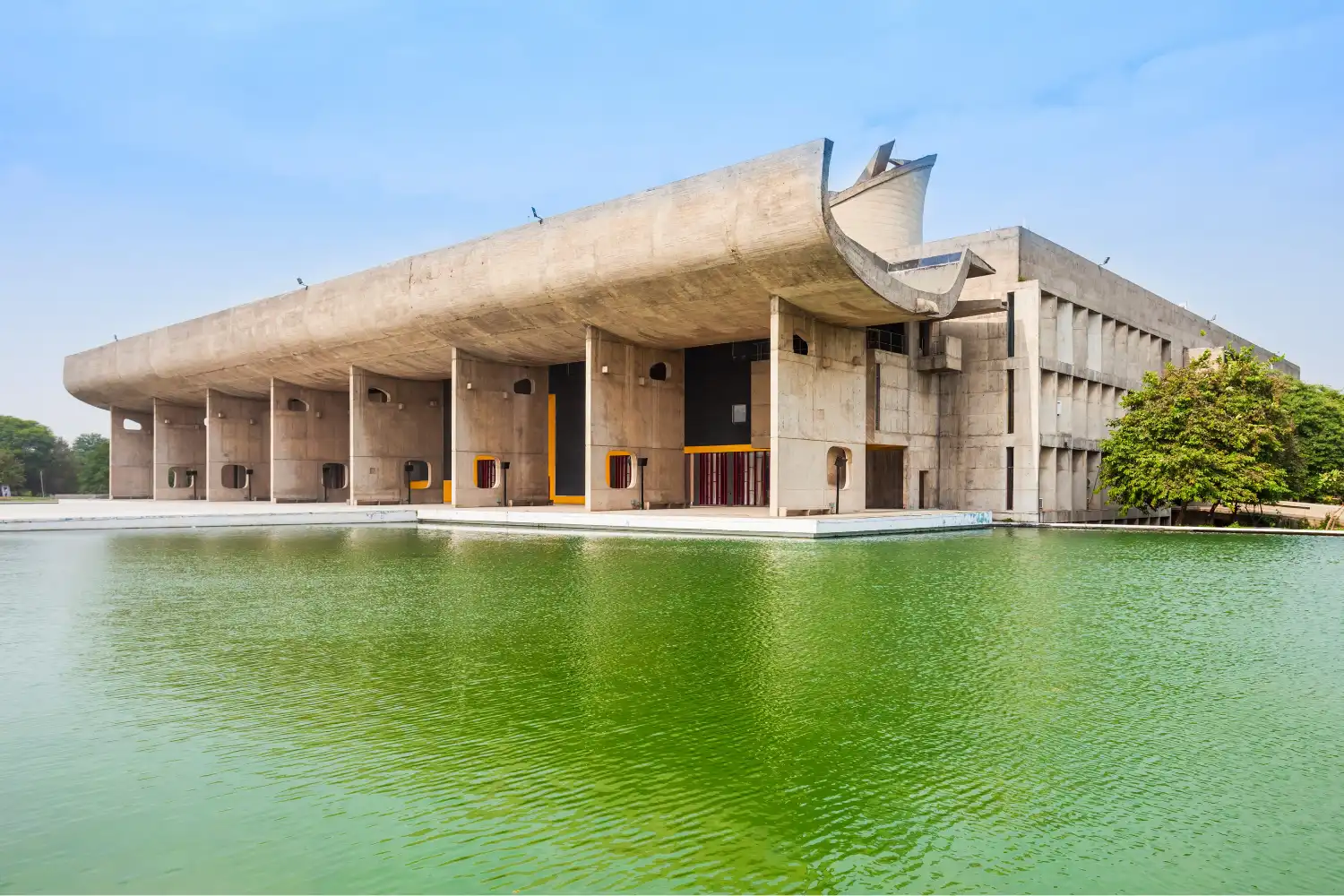
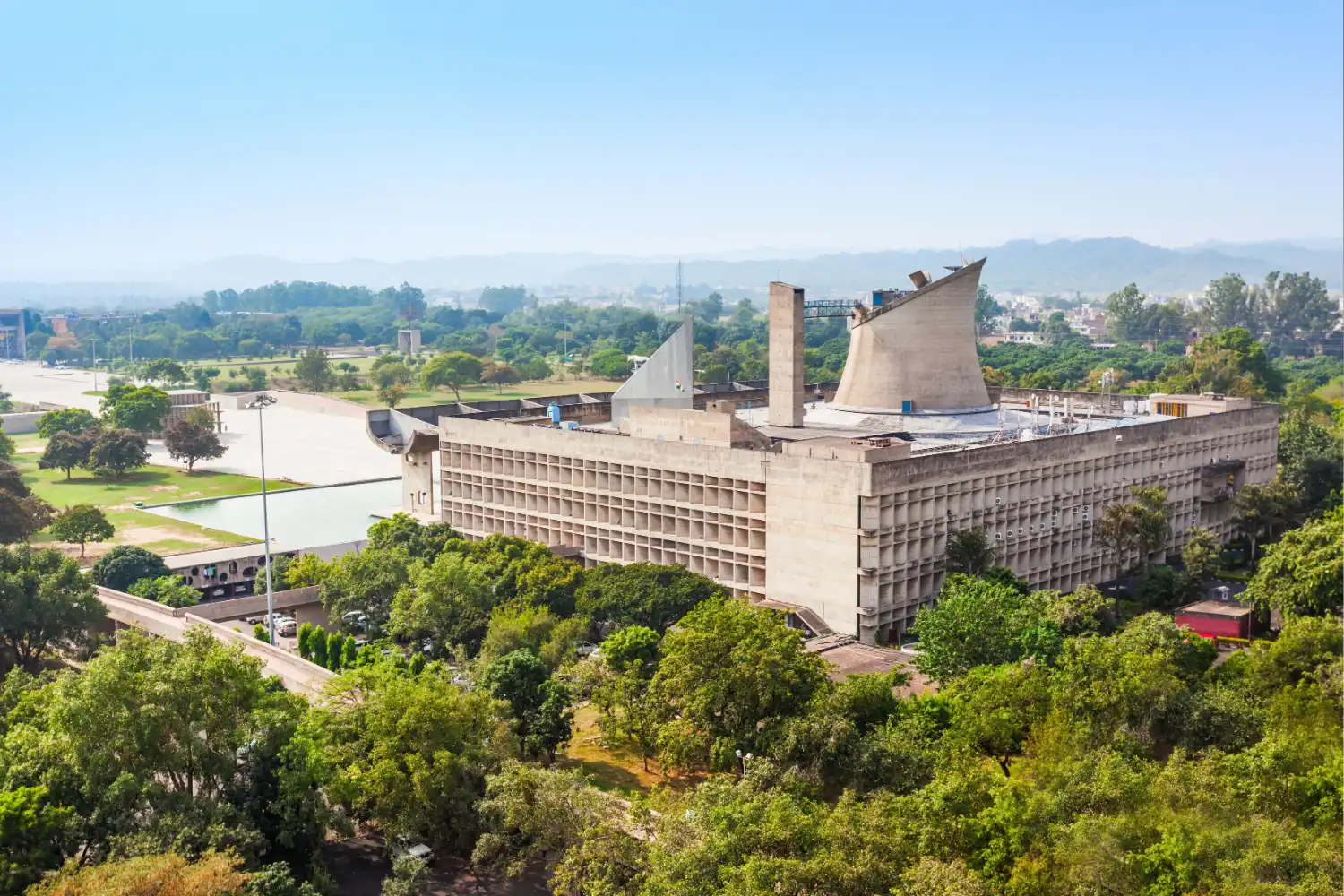
The Capitol Complex is the part of Chandigarh that most people think of first, and it is where Le Corbusier’s personal authorship is strongest. Set against the Shivalik Hills at the northern edge of the city, it holds the three main government buildings, the Palace of Assembly, the Secretariat, and the High Court, together with four monuments: the Open Hand, the Geometric Hill, the Tower of Shadows, and the Martyrs’ Memorial. The Chandigarh District administration describes the Capitol as one of the most monumental architectural compositions of modern architecture, arising out of a unique geo-political and cultural setting.
Disagreements between Le Corbusier and the rest of the team changed the relationship between the Capitol and the city. His original 1951 drawings show the Secretariat on a clear line of sight with the rest of Chandigarh, framed by the Himalayas. After he lost the argument about higher-density housing modelled on Unité d’Habitation, he effectively isolated the Capitol by inserting artificial hills between it and the urban grid. He verified through a series of sections that pedestrians could no longer see one from the other and reportedly ordered a path over the mounds removed on the grounds that “the city must never be seen.”
🎓 Expert Insight
“The Complexe du Capitole de Chandigarh is a masterpiece of monumental and sculptural architecture celebrating the independence of a nation opening out simultaneously towards freedom and modernity.”
Fondation Le Corbusier, World Heritage dossier
This description sums up why the Capitol matters beyond its architectural details. The buildings were designed to carry political meaning, and that intent shapes everything from the scale of the esplanade to the openness of the Assembly entrance.
The Three Buildings of the Capitol
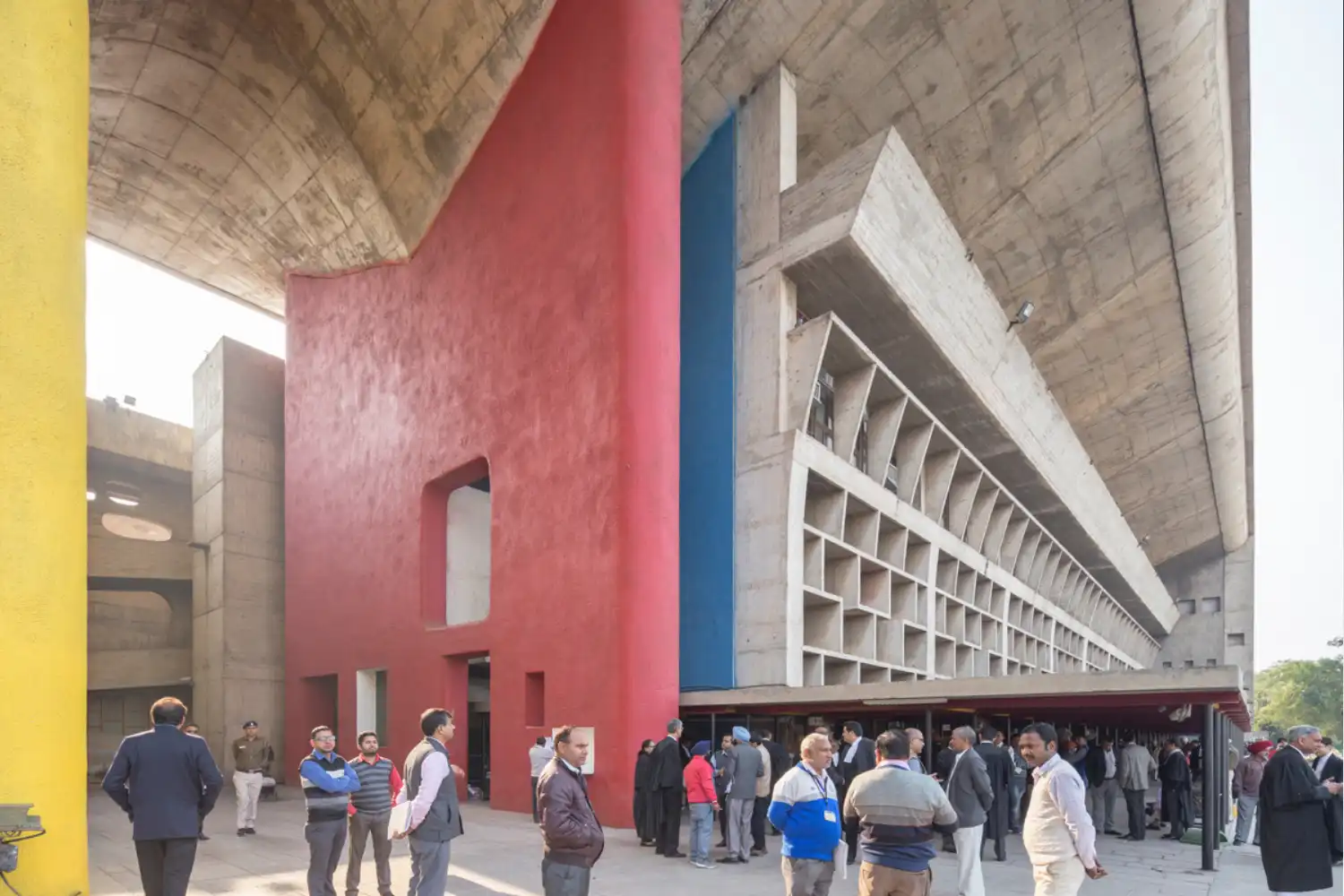
The Secretariat is the largest structure, a long slab housing about 4,000 civil servants. Its rhythmic concrete façade breaks what could have been a monotonous mass into distinct ministerial blocks, and the roofline steps and shifts to give the building visual life. The Assembly is the most sculptural of the three, combining a hyperbolic drum that rises above the chamber with a pyramidal tower and a concrete portico that catches deep shadows. Inside, a large mural anchors the main foyer. The High Court sits across the esplanade, its long parasol roof floating on deep piers, with primary-colour panels marking the entrance piers and a sun-shading geometry tuned to the Punjabi climate. The raw-concrete language used here is a central case in our guide to the world’s most iconic brutalist buildings, which places Chandigarh alongside Unité d’Habitation and Habitat 67.
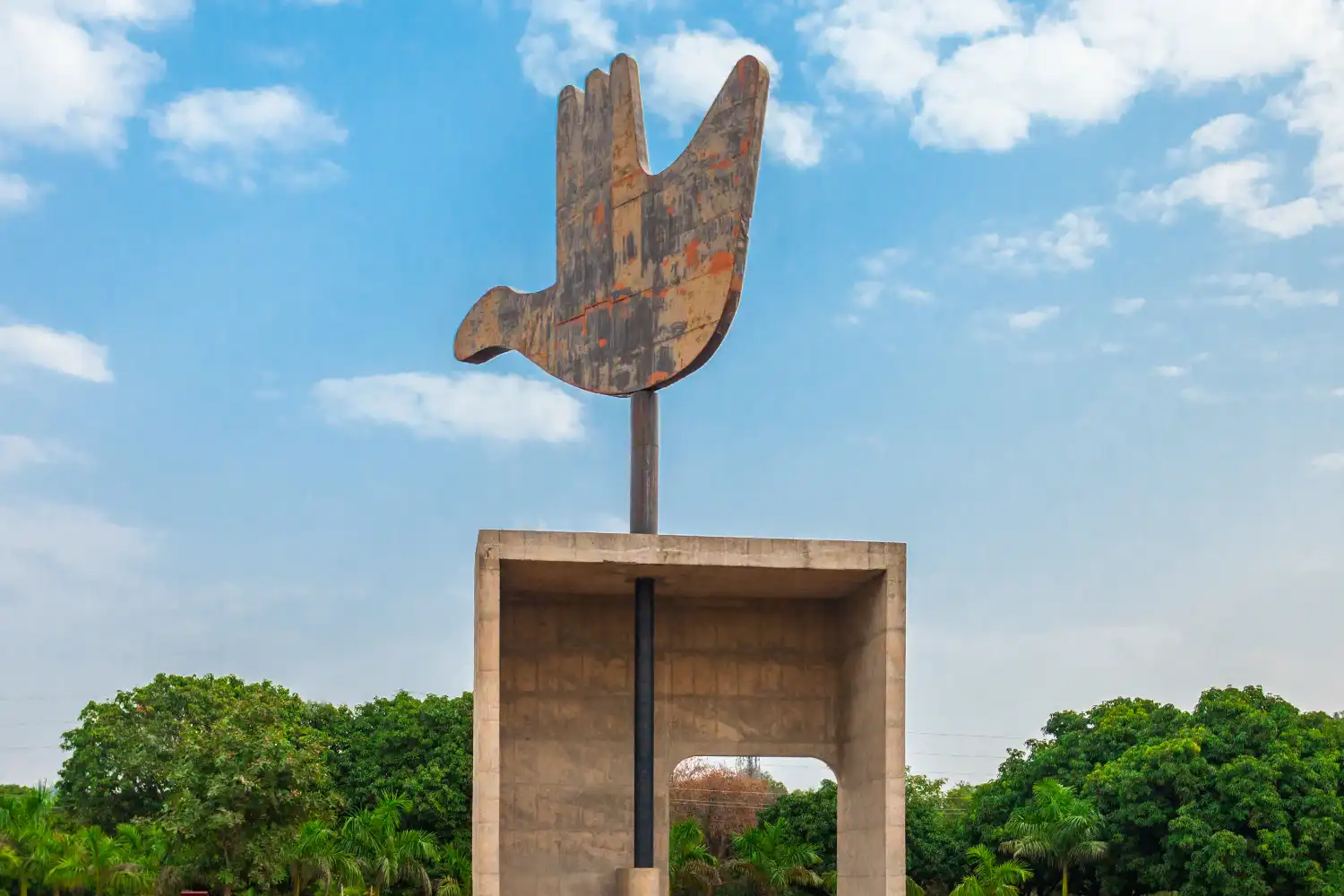
The Open Hand Monument, often treated as the official emblem of the city, completes the group. Le Corbusier conceived it as a symbol of “open to give, open to receive,” mounted on a rotating bearing so it turns with the wind.
📐 Technical Note
The Capitol buildings use reinforced concrete in its raw, unfinished state, known in French as béton brut. Formwork marks, grain of the timber shuttering, and local aggregate are deliberately left visible on external surfaces. According to the Fondation Le Corbusier, outer surfaces were not coated but painted in parts using Le Corbusier’s own colour range, a choice meant to preserve material authenticity while tuning the buildings to the light of northern India.
UNESCO Recognition: A World Heritage Listing in 2016
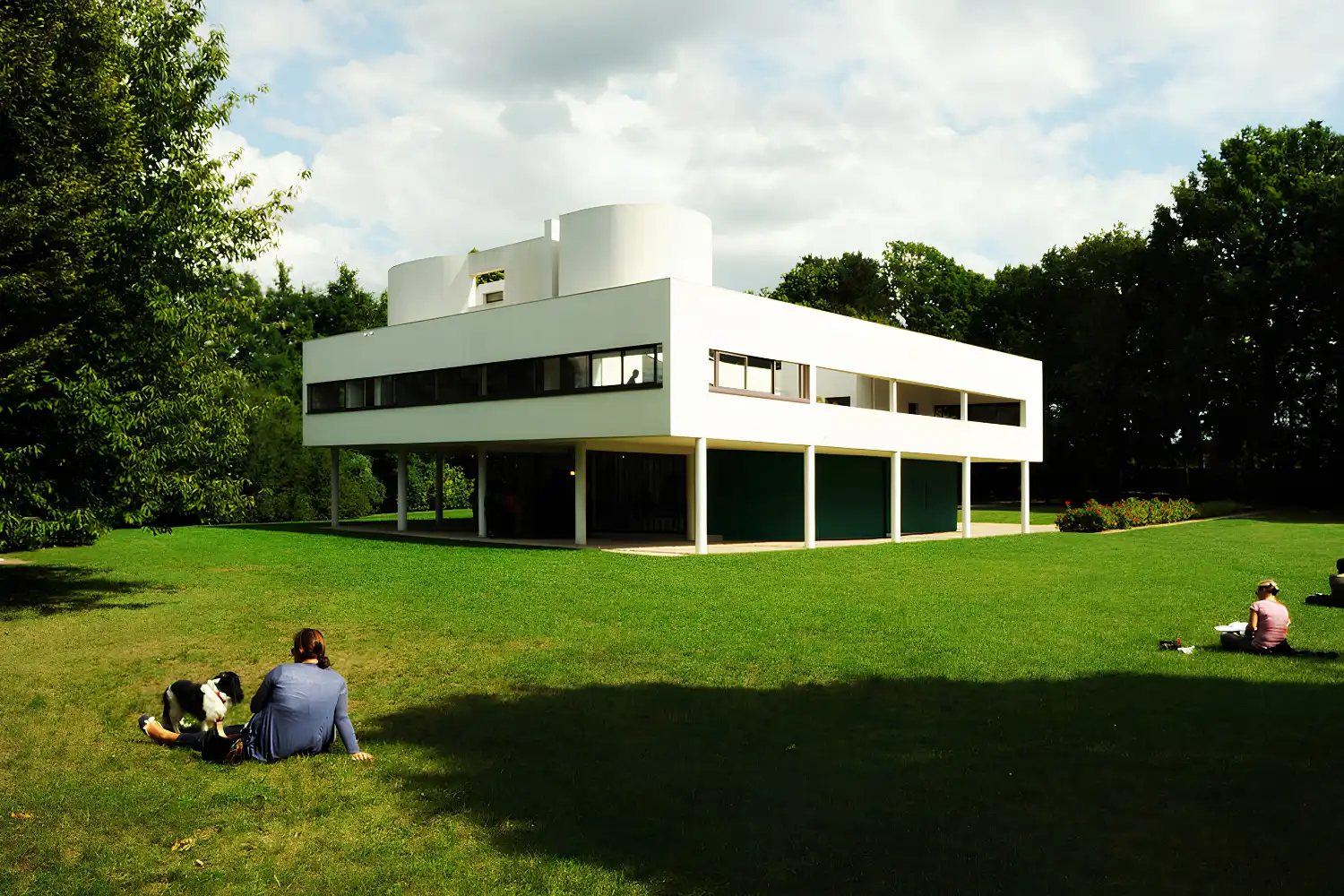
In July 2016, during its 40th session in Istanbul, the UNESCO World Heritage Committee inscribed the Capitol Complex under the transnational listing The Architectural Work of Le Corbusier, an Outstanding Contribution to the Modern Movement. The UNESCO listing covers 17 sites across seven countries, including Villa Savoye, Unité d’Habitation in Marseille, the National Museum of Western Art in Tokyo, and the House of Dr Curutchet in La Plata.
The committee cited the Capitol Complex as “the focal point” of Chandigarh’s plan and the most complete built expression of the Ville Radieuse idea. The Fondation Le Corbusier has warned that unapproved additions, including a long-proposed governor’s palace and a museum, could undermine the site’s authenticity. Within India, the complex is separately protected as a site of national importance under the Ancient Monuments and Archaeological Sites and Remains Act, giving it both international and national heritage status.
📌 Did You Know?
Chandigarh’s current population is roughly three times the figure the original plan was designed for, according to ArchDaily’s analysis of the master plan. The city has long since expanded beyond Le Corbusier’s intended boundaries, which is one reason the preserved first 30 sectors feel so different in density from the newer outlying areas.
Who Actually Designed Chandigarh?
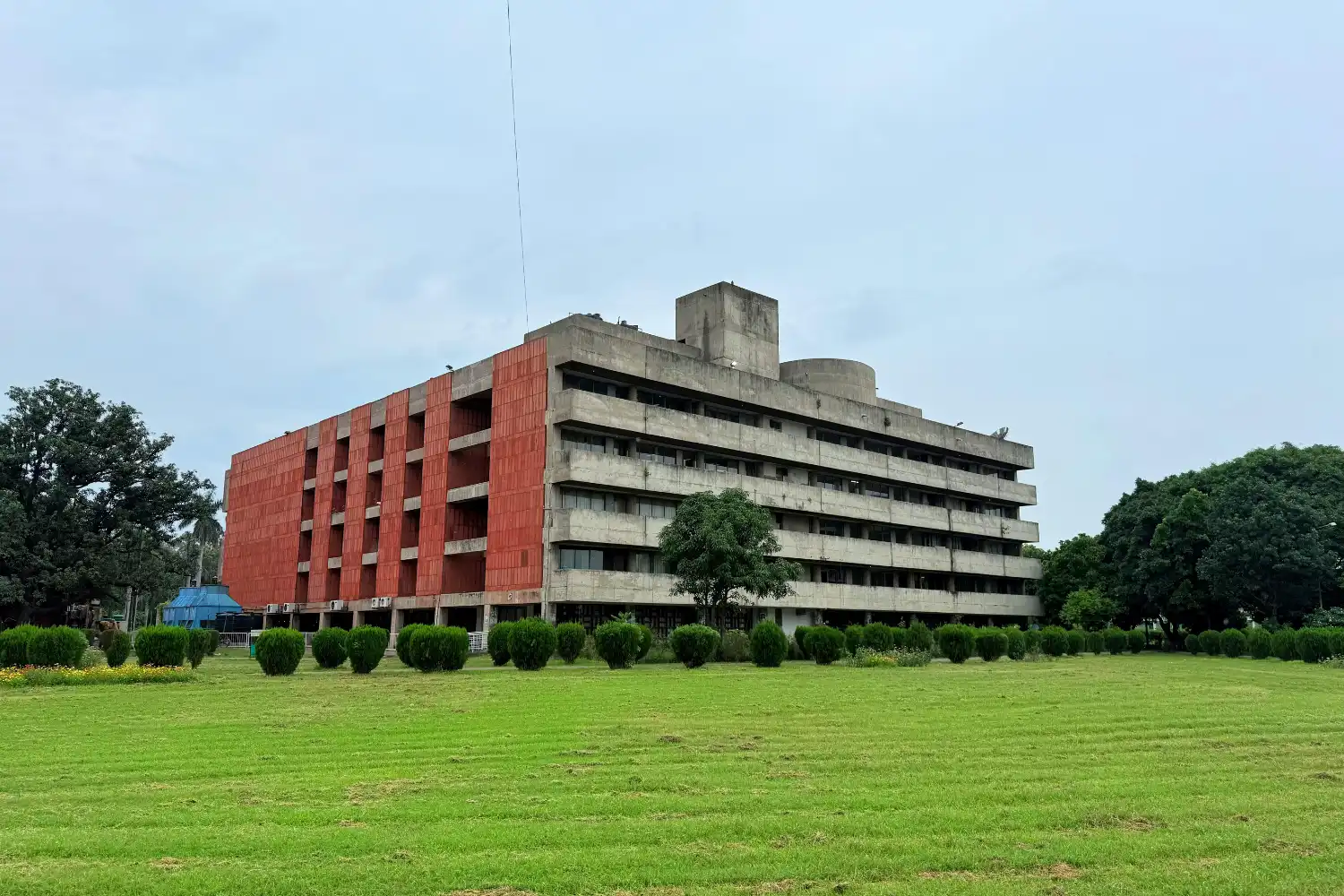
Le Corbusier gets the headline credit, but the city was built by a much larger team, and the work of Indian architects often gets flattened out of international accounts. Pierre Jeanneret, who lived in Chandigarh for most of the construction period, took over as site architect and later became the city’s architect-adviser. Jane Drew and Maxwell Fry worked on the team for about three years before leaving. In 1965, following Le Corbusier’s death, M.N. Sharma became the first Indian Chief Architect of the project.
The wider team also included Aditya Prakash, Balkrishna Doshi, and Urmila Eulie Chowdhury, who is often cited as the first trained female architect in India. Most of the housing, the markets, the schools, and the everyday fabric of Chandigarh that Corbusier paid less attention to was designed by Jeanneret, Drew, Fry, and this Indian cohort. If you want to understand how such large projects are coordinated across multiple designers, our reading on structural grids in architectural design covers the frameworks that make collaborative planning work at city scale.
Criticisms and Complications: What Chandigarh Gets Wrong
Chandigarh is not a universally admired project, and the critique is usually interesting. King Charles III, then Prince of Wales, called the Capitol “an inhuman image of government” in his 2010 book Harmony. Critics argue the scale of the esplanade is unrelated to daily use, that the reflecting pools are frequently neglected, and that the separation of the Capitol from the rest of the city turns what should be a civic space into a ceremonial one. An Architizer essay on the Capitol Complex today frames the deeper tension well: the site is both a “living monument” and a fully functional administrative hub, and the two roles pull the architecture in different directions.
More broadly, the sector model has been criticised for designing informal economic activity out of the plan. Indian cities rely on street-level commerce, mixed-use frontages, and porous boundaries between home and work, none of which fit easily into Le Corbusier’s rigid zoning. Seen from that angle, Le Corbusier’s urban experiment in India did not fail so much as it refused to adapt to the country it was built in. The planned population has been exceeded by a large margin, and growth has pushed density into parts of the city the plan never anticipated.
⚠️ Common Mistake to Avoid
Do not describe Chandigarh as “Le Corbusier’s city” as if he designed everything in it. He led the master plan and the Capitol Complex, but the housing grammar, the typical sector market, and most of the domestic architecture were worked out by Pierre Jeanneret, Jane Drew, Maxwell Fry, and a large team of Indian architects. Attributing the whole city to one author misreads how it was actually built.
Chandigarh’s Place in Modernism and Brutalism
Chandigarh sits at a pivot point in twentieth-century architecture. On one side it continues Le Corbusier’s prewar Purist line, with its pilotis, free façades, and roof gardens. On the other, the raw concrete of the Capitol and the monumental scale of the plan fed directly into the brutalist movement that spread through postwar Britain, North America, and South Asia. The Assembly and the High Court are frequently grouped with Louis Kahn’s National Assembly in Dhaka as the two great South Asian civic commissions of the period, and they share a language of mass, shadow, and climate-responsive form.
The city also refined Le Corbusier’s proportional thinking. His Modulor system, which scales architectural dimensions to the human body, had been theorised earlier and used at Unité d’Habitation in Marseille, but Chandigarh let him apply it at a civic scale. The relationship between monumental and human measures, tested across the Capitol esplanade and through the sector housing, is explored in our article on how architects use the golden ratio in design.
Visiting and Reading the City Today
The first 30 sectors remain the most intact part of Le Corbusier’s plan and the easiest place to read the city’s logic. The Capitol Complex is now subject to restricted access for security reasons, and guided tours are the usual way to see the Assembly and the High Court at close range. Sector 17 still works as the commercial heart, though retail has evolved far beyond the 1950s vision. The Rock Garden by Nek Chand, built informally over decades using construction waste, sits on the edge of the Capitol precinct and is worth seeing as a counterweight to Corbusier’s rational order.
A key conservation body, the Chandigarh Heritage Conservation Committee, reviews alterations in the historic sectors, and UNESCO’s 2016 inscription has tightened the review process further. Small changes that once passed without comment, signage, balcony glazing, air-conditioning units visible on protected façades, now face formal scrutiny. For the official position on protected elements and how the Capitol’s authenticity is defined, the Fondation Le Corbusier dossier on the Capitol is the primary reference.
💡 Pro Tip
If you visit Chandigarh to study it, plan at least two days. Spend the first inside a single sector, walking the V4 shopping street and the V7 pedestrian spine end to end to feel the 7V hierarchy in person. Use the second day for the Capitol Complex and the City Museum, which holds original Le Corbusier drawings and Jeanneret furniture that give the architecture its human scale again.
✅ Key Takeaways
- Chandigarh was commissioned after the 1947 Partition to replace Lahore as the capital of East Punjab, and was taken over by Le Corbusier in 1951 after the earlier Mayer and Nowicki scheme was abandoned.
- The master plan organises the city as a living organism, with the Capitol Complex as the head, Sector 17 as the heart, and the 7V road hierarchy as the circulatory system.
- Each sector is a self-contained neighbourhood of roughly 800 by 1,200 metres, designed for walkability and functional mix on Le Corbusier’s rectilinear grid.
- The Capitol Complex, containing the Assembly, Secretariat, and High Court, is the most fully realised built expression of Ville Radieuse and was inscribed as a UNESCO World Heritage Site in 2016.
- Chandigarh was designed by a team, not one architect: Pierre Jeanneret, Jane Drew, Maxwell Fry, and a large cohort of Indian architects including M.N. Sharma, Balkrishna Doshi, Aditya Prakash, and Urmila Eulie Chowdhury shaped most of the built fabric.
Final Thoughts
More than seventy years after its foundation stone was laid, Chandigarh still works as a piece of urbanism. Its sectors are liveable, its road hierarchy holds up under pressure its designers never imagined, and its civic buildings remain among the most ambitious ever built in concrete. At the same time, the city carries honest scars: overreach in scale, a weak understanding of Indian street life, and the paternalism of a European architect redesigning a subcontinent he barely knew. Reading Chandigarh carefully, with both its achievements and its failures visible, is one of the best exercises an architecture student can do, and it remains the most useful case study of Le Corbusier’s architecture applied to a full city.










Leave a comment