


Table of Contents Show
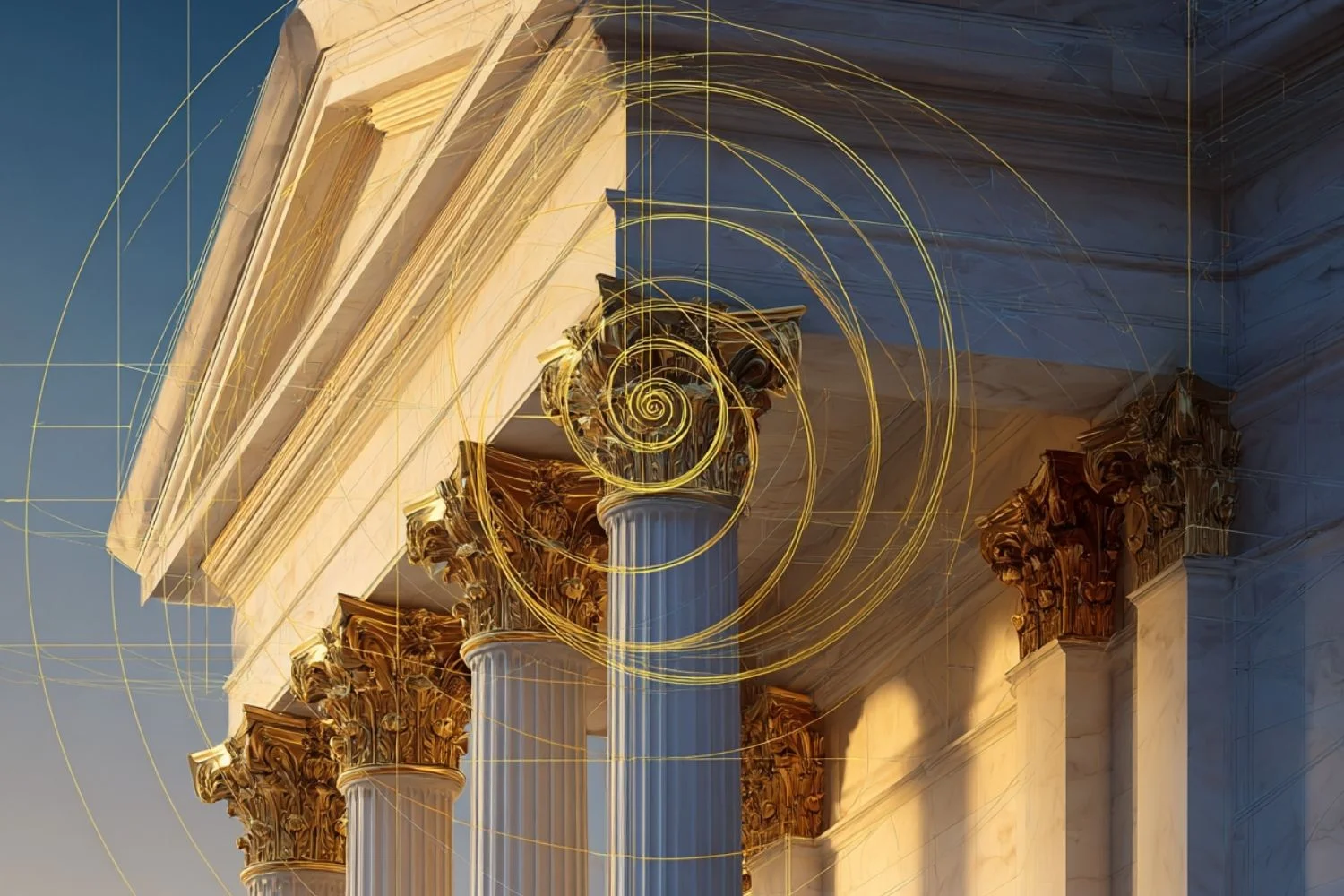
Architecture and the golden ratio are connected through a simple proportion, roughly 1:1.618, that architects have used for more than 2,000 years to create buildings that feel visually balanced. From the columns of the Parthenon to the facade divisions of modern towers, this ratio provides a mathematical foundation for design decisions that might otherwise be left to guesswork.
You have probably noticed that some buildings feel “right” the moment you see them. The windows sit where your eye expects them, the entrance is neither too large nor too small, and the overall shape seems stable without being heavy. In many cases, these proportions trace back to a single number: phi (Φ), approximately 1.618. This number, also called the golden mean ratio in architecture, connects mathematics, nature, and built form in a way that has fascinated designers since antiquity.
What Is the Golden Ratio and Why Does It Matter in Architecture?

The golden ratio describes a specific relationship between two quantities. When a line is divided so that the longer segment divided by the shorter one equals the total length divided by the longer segment, the result is approximately 1.618. This irrational number, represented by the Greek letter phi (Φ), appears frequently in geometry, plant growth, and the spiral patterns of shells. Its connection to the golden ratio in architecture lies in proportion: when building elements follow this ratio, the result tends to feel balanced and visually coherent to most observers.
The golden ratio is closely tied to the Fibonacci sequence (0, 1, 1, 2, 3, 5, 8, 13, 21, 34…), where each number is the sum of the two before it. As the sequence progresses, the ratio between consecutive numbers gets closer to 1.618. For architects, Fibonacci pairs like 5:8 or 8:13 offer practical whole-number approximations that can guide column spacing, window placement, and room dimensions.
📐 Technical Note
The golden ratio is expressed algebraically as (1 + √5) / 2 ≈ 1.6180339887. In practical architectural applications, ratios of 1:1.6 or 5:8 are commonly used as working approximations. The golden rectangle, where the long side is 1.618 times the short side, can be subdivided infinitely into a square and a smaller golden rectangle, producing the characteristic golden spiral.
The Golden Ratio in Ancient Architecture
The earliest known examples of the golden ratio of architecture appear in structures built thousands of years before the concept was formally defined. While scholars debate whether ancient builders used this proportion intentionally or arrived at it through trial and visual judgment, the mathematical evidence in several landmark structures is difficult to dismiss.
The Great Pyramid of Giza
The Great Pyramid, built around 2560 BCE, has a base-to-height relationship that closely approximates the golden ratio. The slope angle of the pyramid’s faces (about 51.83 degrees) produces a slant height to half-base ratio near 1.618. Whether Egyptian builders knew of phi as a formal concept remains an open question among historians, but the precision of the pyramid’s geometry suggests a proportional system was at work. The base length of 230.4 meters and original height of 146.5 meters produce ratios that repeatedly approach phi.
The Parthenon, Athens
The Parthenon (447-432 BCE) is one of the most frequently cited examples of the golden ratio in architecture. The width-to-height ratio of the facade, including the pediment, approximates 1.618. Greek architects Iktinos and Kallikrates designed the temple with subtle optical refinements, including columns that lean slightly inward and a stylobate that curves upward at the center. These corrections suggest a deep understanding of visual perception and proportional relationships. You can read more about these Greek and Roman architectural innovations and how they shaped building design for centuries.
⚠️ Common Mistake to Avoid
Many sources claim that the Parthenon was deliberately designed using the golden ratio. While the building’s proportions do approximate phi, no surviving ancient Greek text confirms that Iktinos or Kallikrates intended this. The earliest written discussion of the golden ratio as a mathematical concept comes from Euclid’s Elements (c. 300 BCE), roughly 130 years after the Parthenon was completed. The proportions are real, but attributing conscious intent is speculative.
Golden Ratio Architecture in the Renaissance and Beyond

The Renaissance marked a turning point for the golden ratio and architecture. Architects of the 15th and 16th centuries actively studied classical Greek and Roman proportional systems and applied them to new buildings. Leon Battista Alberti, who wrote De Re Aedificatoria (1452), drew heavily on Vitruvius and argued that mathematical harmony should govern all aspects of a building’s design. His churches and palaces in Florence and Mantua reflect these principles.
Andrea Palladio took this further in the 16th century, publishing I Quattro Libri dell’Architettura (1570), which codified proportional systems for room dimensions, facade layouts, and column spacing. Many of Palladio’s recommended room proportions (such as rooms with width-to-length ratios of 3:5 or 5:8) approximate the golden ratio. The influence of these European architectural styles persisted for centuries, with Palladian windows and facades appearing across England, colonial America, and beyond.
Gothic cathedrals, including Notre-Dame de Paris (begun 1163), also display golden ratio proportions in their facade layouts. The cathedral’s west front can be divided into sections whose height-to-width ratios approximate phi. Rose windows, pointed arches, and the vertical divisions of the facade all participate in a proportional system that, while not exclusively based on the golden ratio, reflects similar mathematical thinking about visual harmony.
🎓 Expert Insight
“Architecture is the learned game, correct and magnificent, of forms assembled in the light.” — Le Corbusier
Le Corbusier’s view of architecture as a game of forms reflects his lifelong pursuit of proportional systems. His Modulor, discussed below, was a direct attempt to create a universal standard for architectural dimensions based on the golden ratio and human measurements.
Le Corbusier’s Modulor: The Golden Ratio as a Design System
The most deliberate and documented application of the golden ratio in modern architecture came from Le Corbusier. Between 1942 and 1948, he developed the Modulor, a proportional system that combined the golden ratio, Fibonacci numbers, and the dimensions of a 1.83-meter-tall man with arm raised (2.26 meters total). The system generated two interrelated scales of measurements (the “red” and “blue” series) that Le Corbusier used to size everything from room heights to window widths.
Le Corbusier applied the Modulor in several major projects. The Unité d’Habitation in Marseille (1952) uses Modulor dimensions for its apartment layouts, brise-soleil panels, and structural grid. The Chapel of Notre-Dame du Haut at Ronchamp (1955) incorporates Modulor proportions in its wall thicknesses and window openings. Even the concrete panels on the monastery of Sainte Marie de La Tourette (1960) follow Modulor spacing, creating a rhythm across the facade that the composer and engineer Iannis Xenakis helped develop.
💡 Pro Tip
If you want to test golden ratio proportions in your own designs, start with a simple Fibonacci pair. Set a room’s width to 5 meters and its length to 8 meters (ratio 1:1.6). Then apply the same thinking to window placement: divide a wall into segments using Fibonacci intervals (e.g., 3 and 5 units from each end). This gives you a proportional framework without rigid adherence to an exact decimal.
Modern Examples of the Golden Ratio in Architecture
Contemporary architects continue to draw on the golden ratio, sometimes explicitly and sometimes as an underlying proportional guide. Several notable 20th and 21st century buildings demonstrate how golden ratio architecture examples extend well beyond ancient temples.
United Nations Headquarters, New York (1952)
The Secretariat Building at the UN Headquarters in New York, designed by an international team led by Oscar Niemeyer and Le Corbusier (among others), uses golden ratio proportions in its facade. The building’s window grid and overall height-to-width relationship reflect phi-based divisions that contribute to its clean, balanced appearance on the East River skyline.
The CN Tower, Toronto (1976)
The CN Tower’s observation deck sits at 342 meters, while the total height reaches 553.3 meters. The ratio of total height to observation deck height is approximately 1.618. Whether this was an intentional application of the golden ratio or a coincidence of engineering requirements, the result is a structure whose proportions feel naturally balanced when viewed from ground level.
Apple Park, Cupertino (2017)
Norman Foster’s circular headquarters for Apple uses curved glass panels and a ring-shaped plan that echoes natural forms. While Apple has not publicly confirmed golden ratio use, architectural analysts have noted that the proportions of the building’s cross-section and the relationship between its inner courtyard and outer ring approximate phi. The building demonstrates how modern architects can absorb classical proportional thinking without explicitly referencing it.
🏗️ Real-World Example
Stahl House (Case Study House #22), Los Angeles (1960): Pierre Koenig’s famous steel-and-glass residence uses a floor plan and facade proportions that closely follow the golden rectangle. The house’s 2,200-square-foot open plan creates a sense of spaciousness that photographs much larger than its actual size, partly because the proportional relationships between walls, windows, and overhangs guide the viewer’s eye across the space without visual interruption.
How Does the Golden Ratio Shape Facade Design?
Facade design is where the golden ratio in architecture becomes most visible. Architects use the 1:1.618 proportion to determine the vertical and horizontal divisions of a building’s front face. A common approach is to divide a facade’s total height into golden sections, placing the primary horizontal break (such as a cornice line, floor transition, or material change) at the point where the upper portion relates to the lower in a golden ratio. This produces a visual “break” that feels natural rather than arbitrary.
Window proportions also benefit from this approach. A window whose height is 1.618 times its width will read as a golden rectangle. When multiple windows on a facade follow this proportion and are spaced at golden intervals, the overall pattern creates a visual rhythm that the eye follows comfortably. You can see how scale and proportion in architecture work together to shape human perception of buildings.
💡 Pro Tip
When working on facade compositions, overlay a golden spiral on your elevation drawing as a check. The spiral does not need to dictate every element, but if your key focal points (entrance, main window group, signage zone) fall along or near the spiral’s path, the facade is likely to feel more visually cohesive. This technique works especially well for asymmetrical facades where achieving balance without formal symmetry is the goal.
The Golden Ratio vs. the Fibonacci Sequence in Building Design

Architects sometimes use the terms “golden ratio” and “Fibonacci sequence” interchangeably, but they are different concepts with a shared mathematical connection. The golden ratio is a single irrational number (1.618…). The Fibonacci sequence is an infinite series of whole numbers. They overlap because the ratio between consecutive Fibonacci numbers gets closer to phi as the numbers increase: 5/3 = 1.667, 8/5 = 1.6, 13/8 = 1.625, 21/13 = 1.615, and so on.
In practice, Fibonacci numbers are often more useful for architects than the exact golden ratio because they are whole numbers. A column grid spaced at 3, 5, and 8 meters uses Fibonacci intervals and produces proportional relationships that approximate phi without requiring fractional dimensions. The golden ratio’s effect on architectural aesthetics works whether you use the exact decimal or its Fibonacci approximations.
Comparison of the Golden Ratio and Fibonacci Sequence in Architecture
The following table clarifies the key differences between these two related concepts:
| Feature | Golden Ratio (Phi) | Fibonacci Sequence |
|---|---|---|
| Type | Single irrational number (1.618…) | Infinite series of whole numbers |
| Practical use | Exact proportional relationships | Whole-number approximations for spacing and dimensions |
| Common application | Facade ratios, window proportions, room dimensions | Column grids, structural bays, modular layouts |
| Historical origin | Euclid’s Elements, c. 300 BCE | Leonardo of Pisa (Fibonacci), 1202 CE |
| Relationship | Approached by Fibonacci ratios at higher values | Generates ratios that converge toward 1.618 |
Why the Golden Ratio Still Matters for Architects Today
Some critics argue that the golden ratio’s importance in architecture is overstated, pointing out that many supposed examples are approximate rather than exact, and that human perception of beauty involves far more than a single proportion. A 2018 study published in Nature noted that beauty perception is influenced by cultural background and personal experience, and cannot be reduced to one mathematical formula.
Still, the practical value of architecture and the golden ratio remains clear for working designers. The ratio provides a starting point for dimensional decisions that avoids arbitrariness. When an architect needs to divide a wall, size a window, or set the proportions of a courtyard, phi offers a tested framework. The ratio does not replace site analysis, structural calculation, or design judgment, but it gives every proportional choice a mathematical basis that has been validated across cultures and centuries.
Leading architecture schools continue to teach golden ratio principles as part of design fundamentals. The ratio appears in studio projects, proportion exercises, and analysis of historical buildings. For students studying why history matters in modern design, the golden ratio offers a direct thread connecting ancient Greek temples to contemporary practice. Understanding how famous architects embraced the golden ratio helps clarify why certain proportional decisions work better than others.
📌 Did You Know?
The term “golden ratio” was not widely used until the 19th century. The German mathematician Martin Ohm is generally credited with first calling it “der goldene Schnitt” (the golden section) in his 1835 textbook. For more than 2,000 years before that, mathematicians referred to it simply as “division in extreme and mean ratio,” following Euclid’s original terminology from around 300 BCE.
✅ Key Takeaways
- The golden ratio (approximately 1:1.618) has been present in architecture for over 4,500 years, from the Great Pyramid of Giza to modern office buildings.
- Ancient Greek and Renaissance architects used golden proportions to achieve visual balance in facades, floor plans, and structural grids.
- Le Corbusier’s Modulor system (1942-1948) was the most systematic modern attempt to apply the golden ratio to architecture, combining it with human body measurements and Fibonacci numbers.
- The Fibonacci sequence offers practical whole-number approximations (3:5, 5:8, 8:13) that architects can apply directly to column spacing, room dimensions, and window layouts.
- While the golden ratio is not a guarantee of beauty, it provides a tested proportional framework that reduces arbitrary dimension choices and connects contemporary design to a long tradition of mathematical thinking in architecture.
Final Thoughts
The golden ratio is not a magic formula that automatically produces beautiful buildings. It is a proportional tool, one of many, that helps architects make informed decisions about the relationships between parts of a structure. Its staying power comes from the fact that it works: buildings proportioned near 1:1.618 consistently register as balanced and harmonious to a wide range of observers. Whether you are designing a facade, planning a room layout, or studying the proportions of a classical temple, the golden ratio offers a reference point that connects your work to thousands of years of architectural practice.
















Leave a comment