


Table of Contents Show
Structural grid systems in architecture are frameworks of intersecting lines that define where columns, beams, and load-bearing elements sit within a building. These grids organize a structure’s skeleton into repeating bays, distribute gravity and lateral loads to the foundation, and give architects a predictable geometry for planning floor layouts, MEP routing, and facade modules.
Every building you walk through sits on some version of a structural grid, whether the architect made it visible or buried it behind finishes. The grid is the first decision that locks in column positions, span lengths, and floor-to-floor heights. Get it right and every downstream discipline, from mechanical engineers to interior designers, works faster. Get it wrong and you spend the rest of the project fighting around misplaced columns and awkward clearances. This guide breaks down the types of structural grids used in architecture, how spacing decisions are made, and what separates a good grid from one that causes problems on site.
What Is a Structural Grid in Architecture?

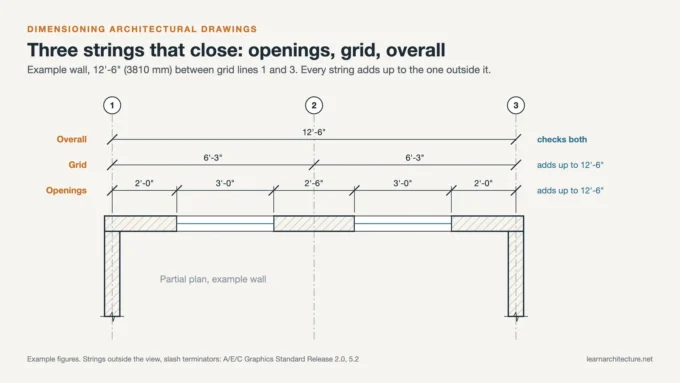
A structural grid is a two-dimensional pattern of lines, usually orthogonal, that marks the centerlines of a building’s primary vertical supports. Each intersection on the grid represents a column or pier location. The spaces between these lines, called bays, define the repeating unit of the structure. Architects label grid lines with numbers in one direction and letters in the other, so every column gets a unique coordinate like “A3” or “D7.” This labeling system appears on structural drawings, architectural plans, and coordination documents throughout the project. Our free structural grid generator draws a labelled grid like this with bubbles and bay dimensions, ready to export as DXF.
The grid does two things at once. Structurally, it maps the load path from roof to foundation by positioning columns at intervals that match the spanning capacity of the beams and slabs above. Architecturally, it sets up the spatial rhythm of the building: room widths, corridor positions, window spacing, and partition locations all reference the grid. In steel and concrete frame construction, the grid is the organizing principle that ties the entire project together.
💡 Pro Tip
When setting up your structural grid in early schematic design, run the column layout past the MEP engineer before finalizing. A 300 mm shift in one grid line can open enough ceiling space for a duct run that would otherwise require a dropped soffit or a floor-to-floor height increase, both of which add cost.
Types of Structural Grids in Architecture
Not every building uses the same grid geometry. The choice depends on the program, structural system, site shape, and the architect’s spatial intentions. Below are the main types of structural grid systems in architecture and where each one works best.
Rectangular (Orthogonal) Grids
The rectangular grid is the most common type. It consists of two sets of parallel lines crossing at right angles, producing rectangular bays. Column spacing can be equal in both directions (a square grid) or different along each axis. Office buildings, hospitals, parking structures, and warehouses almost always use rectangular grids because they align with standard beam lengths, curtain wall modules, and interior partition systems. A typical office building might use a 9 m x 9 m or 8.4 m x 8.4 m bay, while a parking garage often places columns at 7.2 m to 8.1 m centres (three 2.4 m stalls) across a clear span of about 16 m. The predictability of the rectangular grid also speeds up construction: formwork, rebar cages, and steel connections repeat from bay to bay, reducing fabrication cost and erection time.
Modular Grid Systems
A modular grid system in architecture takes the rectangular grid a step further by tying every dimension, both structural and architectural, to a base module. The most widely used base module is 600 mm (roughly 2 feet), sometimes called the “planning module.” Column centerlines, partition positions, ceiling tile layouts, and facade panels all land on multiples of this module. The result is a building where components fit together with minimal cutting, trimming, or custom fabrication. Modular coordination became standard practice in the mid-20th century and remains the basis of structural grid planning in commercial architecture today.
Radial and Circular Grids
Radial grids arrange columns along concentric rings and radiating spokes. The resulting bays are trapezoidal or wedge-shaped rather than rectangular. You see radial grids in arenas, airport terminals, rotundas, and circular towers. The Roman Colosseum’s structural system is an early and dramatic example: 80 radial walls act as spokes connected by concentric ring corridors, distributing crowd loads evenly around the elliptical plan. Modern examples include terminal buildings at airports like Charles de Gaulle Terminal 1 and the Apple Park ring building in Cupertino.
Irregular and Free-Form Grids
Irregular grids abandon uniform spacing. Column positions shift to respond to site boundaries, program needs, or design intent. A museum might push columns to the perimeter to open up gallery spaces, while a mixed-use tower could shift grid lines at a transfer level where residential floors sit above a retail podium. Irregular grids demand more engineering effort because each bay has different spans and load conditions, but they give architects freedom to shape spatial sequences that a uniform grid would constrain. Toyo Ito’s Sendai Mediatheque is a well-known case: its 13 tube-columns are positioned irregularly across the floor plate, producing an open, column-free feeling despite supporting seven stories of program.
🎓 Expert Insight
Khan’s classification of structural systems for high-rise buildings, published in 1969, directly tied grid geometry to building height and efficiency, and his framework is still referenced in tall building design today.
How Structural Grid Spacing Is Determined
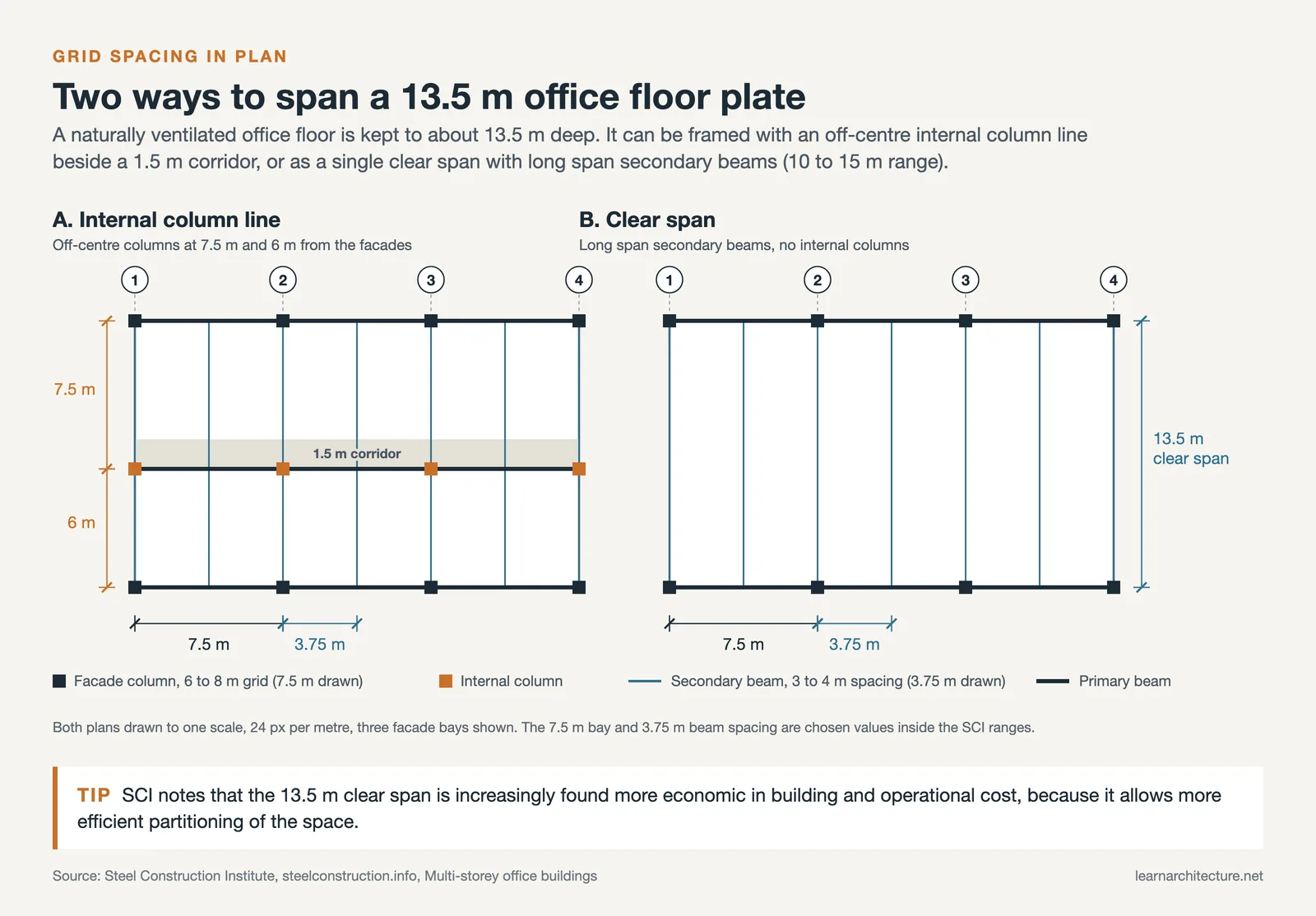
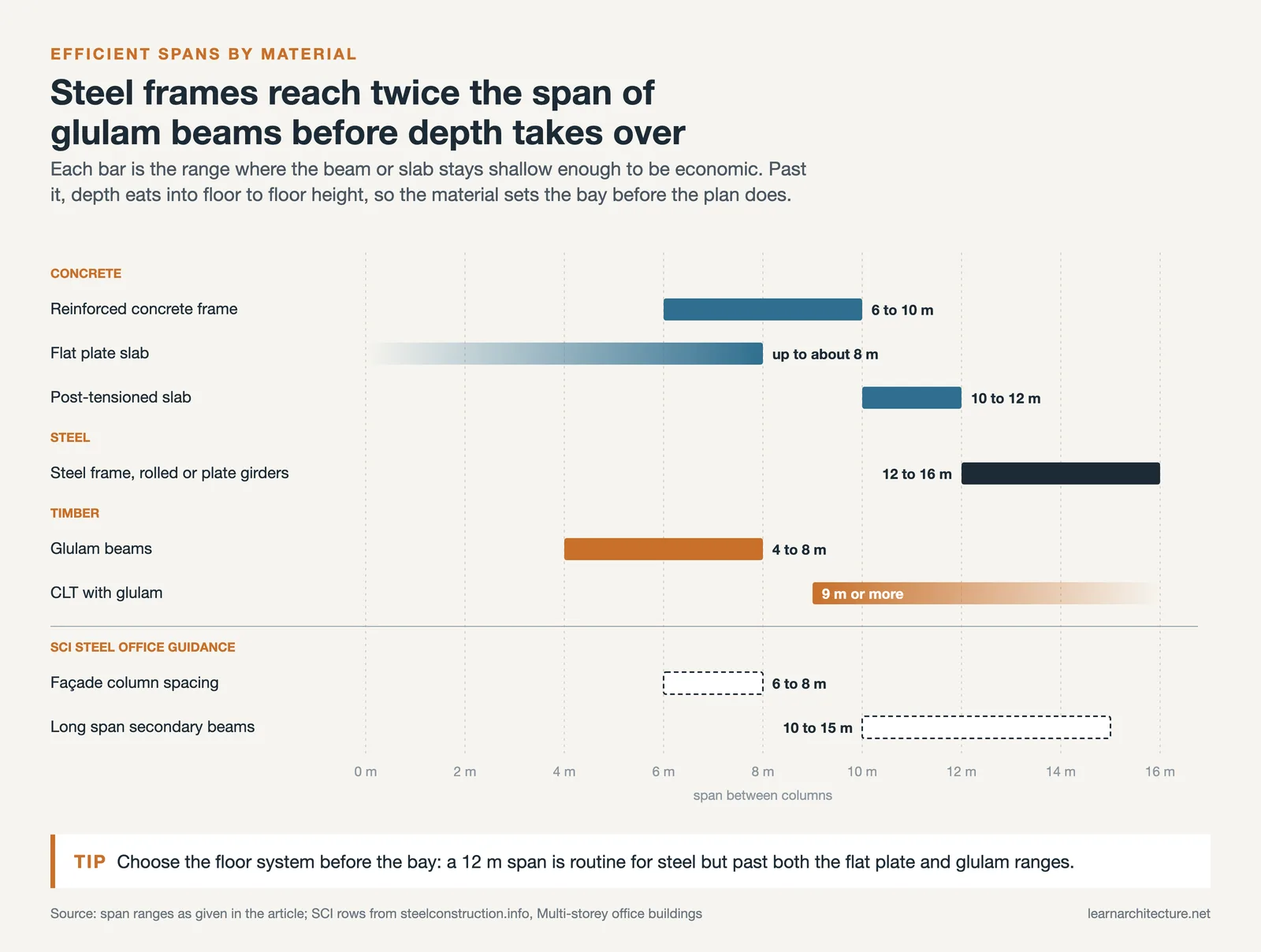
Grid spacing is not a guess. It comes from the intersection of structural capacity, architectural program, and construction economics. The distance between columns, referred to as the span, must be short enough for the beams and slabs to carry loads without excessive depth, but long enough to keep floor plans flexible and minimize the number of columns cluttering usable space.
For reinforced concrete frames, common bay sizes range from 6 m to 10 m in each direction. Steel frames can push wider, often reaching 12 m to 16 m spans with standard rolled sections or plate girders. Timber structures typically stay shorter, in the 4 m to 8 m range for glulam beams, though mass timber systems like CLT with glulam can reach 9 m or more. The slab system also influences the grid: a flat plate concrete slab works efficiently up to about 8 m spans, while a post-tensioned slab can handle 10 m to 12 m before the slab depth becomes impractical.
Program requirements shape the grid as well. A parking garage needs bays that fit standard car dimensions (stalls typically 2.4 m to 2.5 m wide and 4.8 m long, so a bay of about 15.6 m to 16 m covers a 6 m aisle with cars on both sides). An office building targets column-free zones of 9 m to 12 m from the core to the facade for open-plan flexibility. A hospital requires grid modules that align with patient room widths (usually 3.6 m to 4.2 m per room) while still allowing larger surgical suites and imaging rooms on the same grid.
📐 Technical Note
According to the Steel Construction Institute (SCI) design guidance, typical office building grids use facade columns on a 6 m to 8 m grid (to coordinate with cladding modules) and long-span secondary beams of 10 m to 15 m for internal spans. Planning grids are normally based on multiples of 300 mm, but more typically on multiples of 0.6 m, 1.2 m or 1.5 m.
How Structural Grids Distribute Loads
A structural grid is really a map of the building’s load path. Gravity loads, the weight of the structure itself plus everything on the floors, travel from slabs to beams, from beams to columns, and from columns down through the foundations into the ground. The grid determines how those loads split at each level.
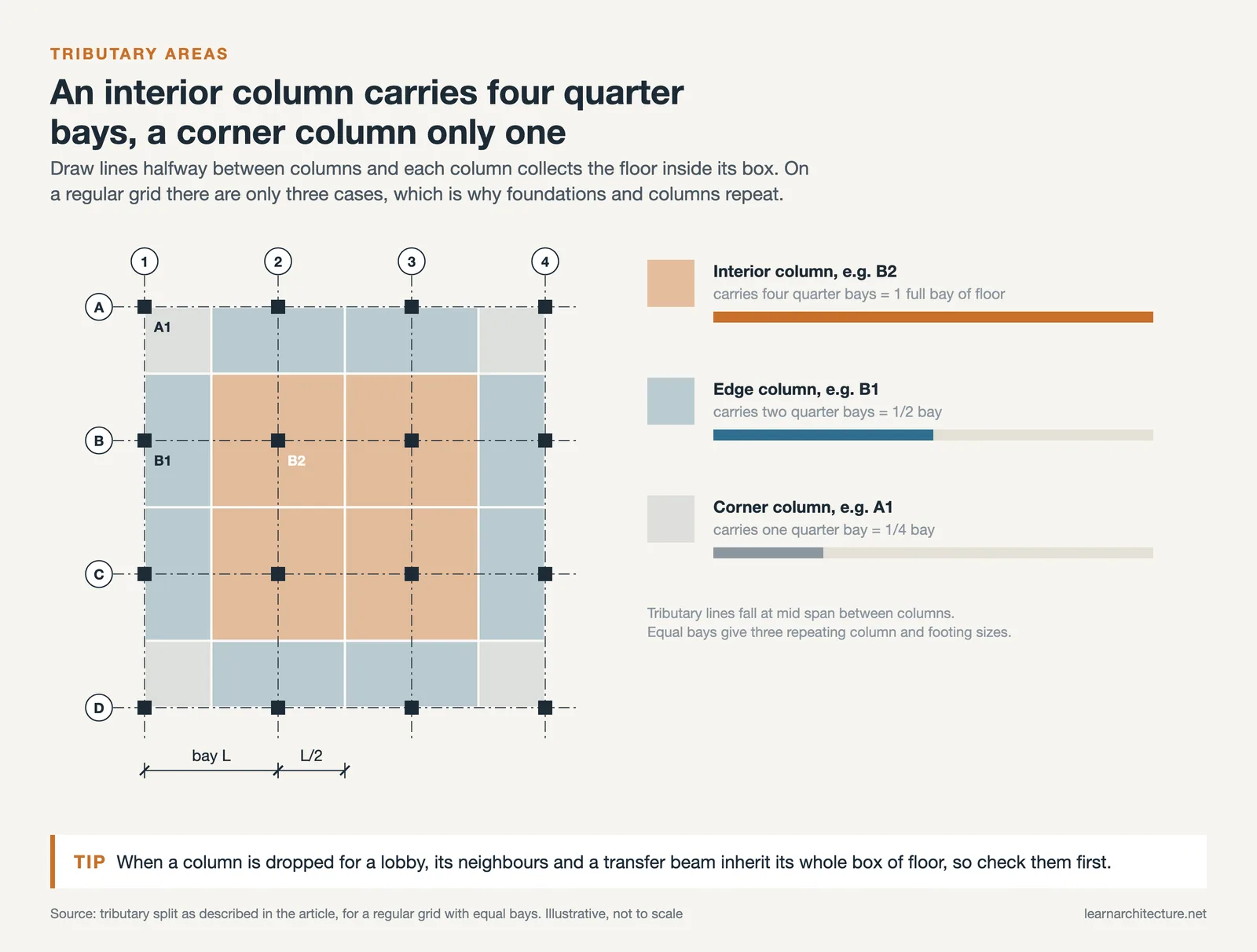
In a regular grid, each interior column carries the tributary load from the four quarter-bays that surround it. Edge columns carry half-bays, and corner columns carry quarter-bays. This even distribution is one of the main advantages of a regular grid: foundation sizes repeat, column sizes are consistent across a floor, and the structural engineer can optimize a few typical conditions rather than designing dozens of unique members.
Lateral loads from wind and seismic forces also interact with the grid. In a moment-frame system, the grid lines themselves become the frames that resist lateral movement: beams and columns along each grid line form rigid connections that prevent the building from swaying. In a braced-frame system, diagonal braces are inserted within selected bays of the grid. In either case, the grid geometry determines where lateral resistance is concentrated, and this affects which bays can have openings, atriums, or double-height spaces.
What Happens When the Grid Is Interrupted?
Real buildings rarely maintain a perfect grid from ground to roof. Lobbies, atriums, loading docks, and retail frontages often require columns to be removed at lower floors. When this happens, engineers introduce transfer structures: deep beams, trusses, or thick slabs that redirect loads from the columns above to new support points below. Transfer structures are expensive, heavy, and deep, so minimizing grid interruptions saves both money and headroom. The general rule is that every removed column doubles the span of the transfer beam and roughly quadruples its cost compared to a standard beam in the same grid.
⚠️ Common Mistake to Avoid
A frequent error in early design is treating the structural grid as purely an engineering concern and ignoring it during architectural space planning. When the grid is set without input from the architect, columns end up in the middle of rooms, blocking corridors, or misaligned with facade mullions. The grid should be a collaborative decision between architect and structural engineer from the first schematic sketch.
Column Grid Architecture: Aligning Structure with Space

Column grid architecture refers to the practice of using the column layout as both a structural and spatial organizing tool. Rather than treating columns as obstacles to hide, many architects express the grid openly. Mies van der Rohe’s Crown Hall at IIT Chicago is a textbook example: four steel plate girders span the full width of the building, supported by exterior columns on a visible grid, leaving the interior entirely column-free. The grid is the architecture.
In more typical buildings, column placement directly shapes room sizes and corridor widths. A residential tower with a 7.2 m x 7.2 m structural grid can accommodate two apartments per bay with a shared corridor column, yielding unit widths of 3.6 m, which matches standard bedroom and living room proportions. Shifting to a 7.5 m grid adds 150 mm to each unit, a small change on paper but enough to fit a wider closet or a more comfortable bathroom layout.
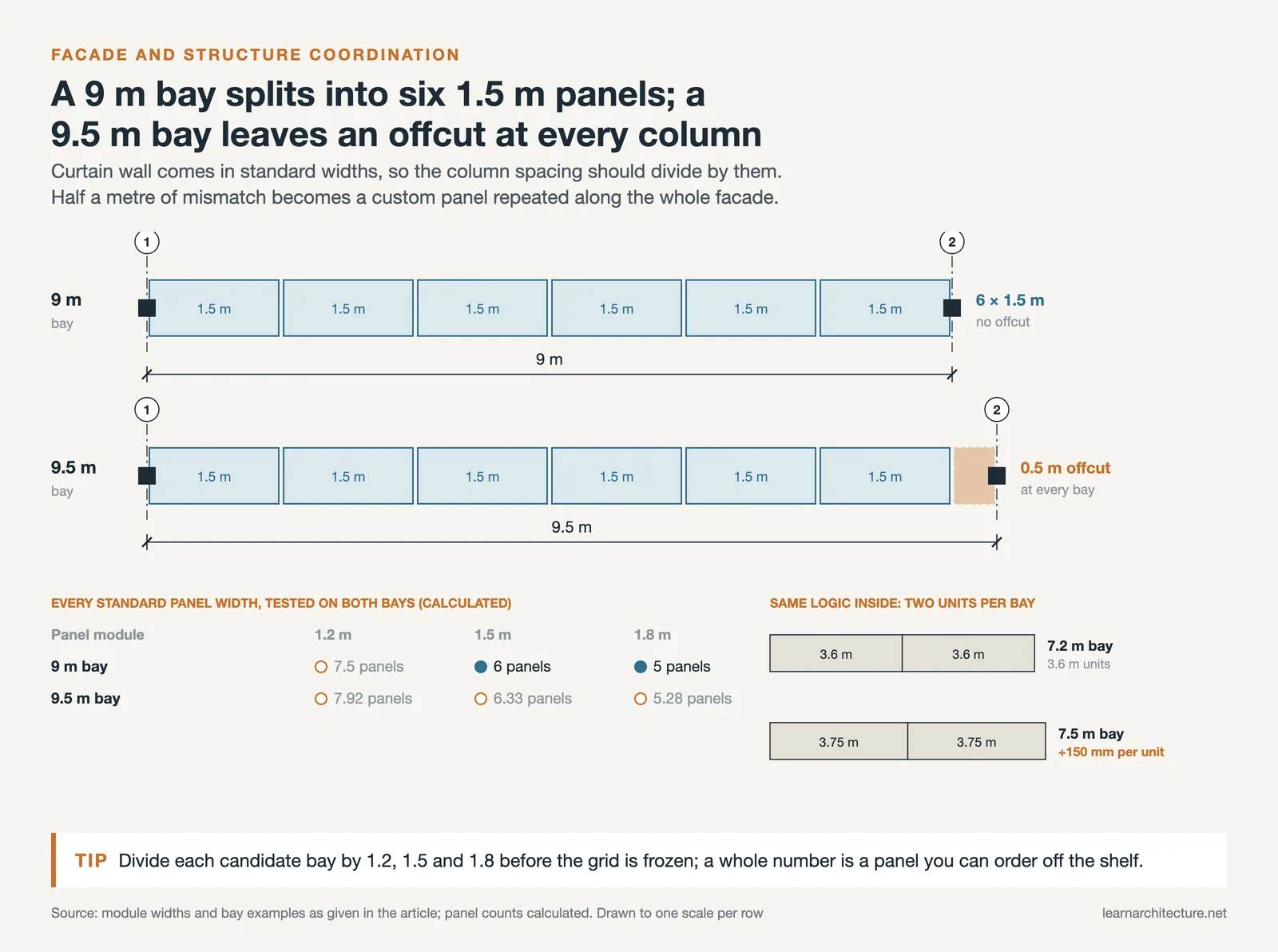
Facade design also follows the grid. Curtain wall systems are manufactured in standard widths (1.2 m, 1.5 m, 1.8 m modules), so the structural grid should divide evenly into these dimensions. A 9 m bay splits cleanly into six 1.5 m curtain wall panels. A 9.5 m bay does not, requiring custom panel widths or awkward infill pieces at each column. This kind of mismatch drives up facade cost and installation time. Experienced architects check facade and structural coordination early to avoid these conflicts.
🏗️ Real-World Example
Commerzbank Tower (Frankfurt, 1997): Designed by Foster + Partners, this 259 m office tower uses a triangular structural grid of three-story-high Vierendeel frames arranged around a central atrium. The triangular plan with 60 m sides and an 18 m column-free office depth per wing was specifically chosen so that every desk sits within 7.5 m of a window, eliminating the need for permanent artificial lighting during daylight hours.
Designing a Structural Grid: Step-by-Step Decisions
Setting up a structural grid is an iterative process, but the sequence of decisions follows a consistent logic that experienced design teams repeat across projects.
Start with the program. List the largest clear-span rooms the building needs, such as conference halls, trading floors, or gymnasiums. These spaces set the maximum bay size because they cannot have columns inside them. Next, check the site. Property lines, setbacks, and party wall conditions may fix one or more grid lines at the building’s edges. If the site is irregularly shaped, the grid may need to rotate or taper to maximize usable floor area.
Then work with the structural system. Choose a material (steel, concrete, timber, or hybrid) and a floor system (flat slab, composite deck, CLT panels). Each combination has an efficient span range that narrows down the list of viable bay sizes. Run preliminary sizing calculations or use span-to-depth rules of thumb: for a composite steel floor, the beam depth is roughly span/20, so a 10 m bay needs beams about 500 mm deep, which consumes floor-to-floor height.
Finally, coordinate with the building systems. HVAC ducts, plumbing risers, electrical conduits, and fire sprinkler mains all need to thread between beams. If the structural grid produces deep beams in both directions (as in a two-way concrete frame), duct routing becomes difficult and may force ceiling heights down. A one-way spanning system with secondary beams in only one direction leaves clear zones for ductwork in the perpendicular direction.
💡 Pro Tip
Before committing to a grid, sketch the worst-case floor plan, not the best-case one. Place the grid over the floor with the tightest program requirements (the one with the most rooms, the narrowest corridors, or the largest mechanical rooms). If it works there, it will work everywhere else in the building.
Try it: type the bay spacings in each direction and choose a floor system, and the generator below draws a labelled, dimensioned grid and flags bays outside the typical span range.
Loading structural grid generator…
Comparison of Common Grid Spacings by Building Type
The following table summarizes typical structural grid dimensions for different building types, based on common practice in steel and concrete frame construction.
| Building Type | Typical Bay Size | Common Structure | Key Driver |
|---|---|---|---|
| Office (commercial) | 9 m x 9 m to 12 m x 12 m | Steel composite or PT concrete | Open-plan flexibility |
| Residential tower | 6 m x 7.2 m to 8.4 m x 8.4 m | RC flat plate or flat slab | Unit width and room proportions |
| Parking structure | 7.2 m x 15.6 m to 8.1 m x 16.5 m | PT concrete or precast | Car stall dimensions and aisle width |
| Hospital | 7.2 m x 8.4 m to 9 m x 9 m | RC frame or steel | Patient room width, equipment rooms |
| Warehouse / industrial | 12 m x 24 m to 18 m x 36 m | Steel portal frame or truss | Fork truck clearance, racking layout |
| School / university | 7.2 m x 7.2 m to 9 m x 9 m | RC or steel composite | Classroom size and corridor width |
Why Grid Discipline Matters for Construction

A consistent grid speeds up construction in ways that are hard to see on paper but obvious on site. When bays repeat, formwork systems can be reused from one pour to the next without modification. Steel connections standardize, so fabricators produce fewer unique details. Precast elements come in uniform sizes, reducing mold costs. Even scaffolding and temporary shoring benefit from a regular grid because the setup repeats identically across the floor plate.
Grid discipline also reduces errors. When every column is on a predictable centerline, survey teams set out points faster and catch misplacements earlier. Subcontractors who install cladding, mechanical systems, and interior partitions use the grid as their primary reference, so a well-documented grid simplifies coordination and cuts the number of RFIs (requests for information) during construction. For a broader look at how structural decisions shape the overall design concept, regular bays and efficient spans save both carbon and cost.
📌 Did You Know?
The Empire State Building, completed in 1931, used a structural grid with a standard bay size of approximately 7.6 m x 7.6 m (25 ft x 25 ft). This consistent grid allowed the steel erection crew to install an average of 4.5 floors of steelwork per week during peak construction, a pace that has rarely been matched even with modern equipment.
Structural Grid Design for Flexibility and Future Adaptation
Buildings outlive their first tenants. An office becomes a school; a factory converts to apartments. The structural grid either enables or prevents these transformations. Grids with larger, more regular bays give future designers more options because they can subdivide an open bay into smaller rooms but cannot easily remove a column that sits in the wrong spot.
This is why many developers and institutional clients now request “long-life, loose-fit” grids: spacings wide enough to accommodate multiple future uses. A 9 m x 9 m bay works for offices, classrooms, and residential units. A 7.2 m x 7.2 m bay works for residential and small offices but limits future conversion to open-plan workplaces. The choice depends on the building’s expected lifespan, the likelihood of use changes, and the additional structural cost of wider spans. For more on how design concepts connect structure to long-term performance, the relationship between grid choice and building adaptability is a central consideration.
Prefabricated and modular construction also depends heavily on grid coordination. When building components are manufactured off-site and assembled on-site, every element must fit the grid precisely. Dimensional tolerance in modular construction is measured in millimeters, not centimeters, so the grid must account for connection gaps, thermal movement, and installation sequences from the start.
✅ Key Takeaways
- A structural grid defines column positions, bay sizes, and load paths, and should be set collaboratively between architect and engineer from day one.
- Rectangular grids are the most common; radial and irregular grids serve specific programs but require more engineering effort and cost.
- Grid spacing depends on the structural material’s efficient span range, the building’s program requirements, and coordination with MEP and facade systems.
- Consistent grids reduce construction cost and time by enabling repetition of formwork, connections, and precast elements across the floor plate.
- Wider, more regular bays improve a building’s capacity for future use changes, following the “long-life, loose-fit” principle.
How Column Placement Works Within the Grid
Columns are the vertical members that carry loads from the grid nodes down to the foundations. Their placement follows a simple rule: every grid intersection is a potential column location, but not every intersection needs one. Designers remove columns where large open spaces are required and add transfer beams or trusses above to redirect loads to the remaining columns.
In practice, column placement starts during schematic design. The architect proposes a floor plan, and the structural engineer tests whether the proposed room layout can work within a regular grid. If a column falls in the middle of a hotel lobby or a lecture hall, the grid is adjusted, or a long-span solution is introduced at that location. This back-and-forth between architectural intent and structural logic is one of the most collaborative aspects of building design. For more on how these spatial decisions are documented, the architectural site plan guide covers how structural information feeds into plan documentation.
💡 Pro Tip
When setting up your structural grid in BIM software like Revit or ArchiCAD, lock the grid lines before placing any structural elements. Moving a grid line after columns and beams are already modeled forces every connected element to update, often creating conflicts with MEP routing and architectural partitions that were coordinated to the original positions.
Grid Spacing and Its Effect on Structural Depth
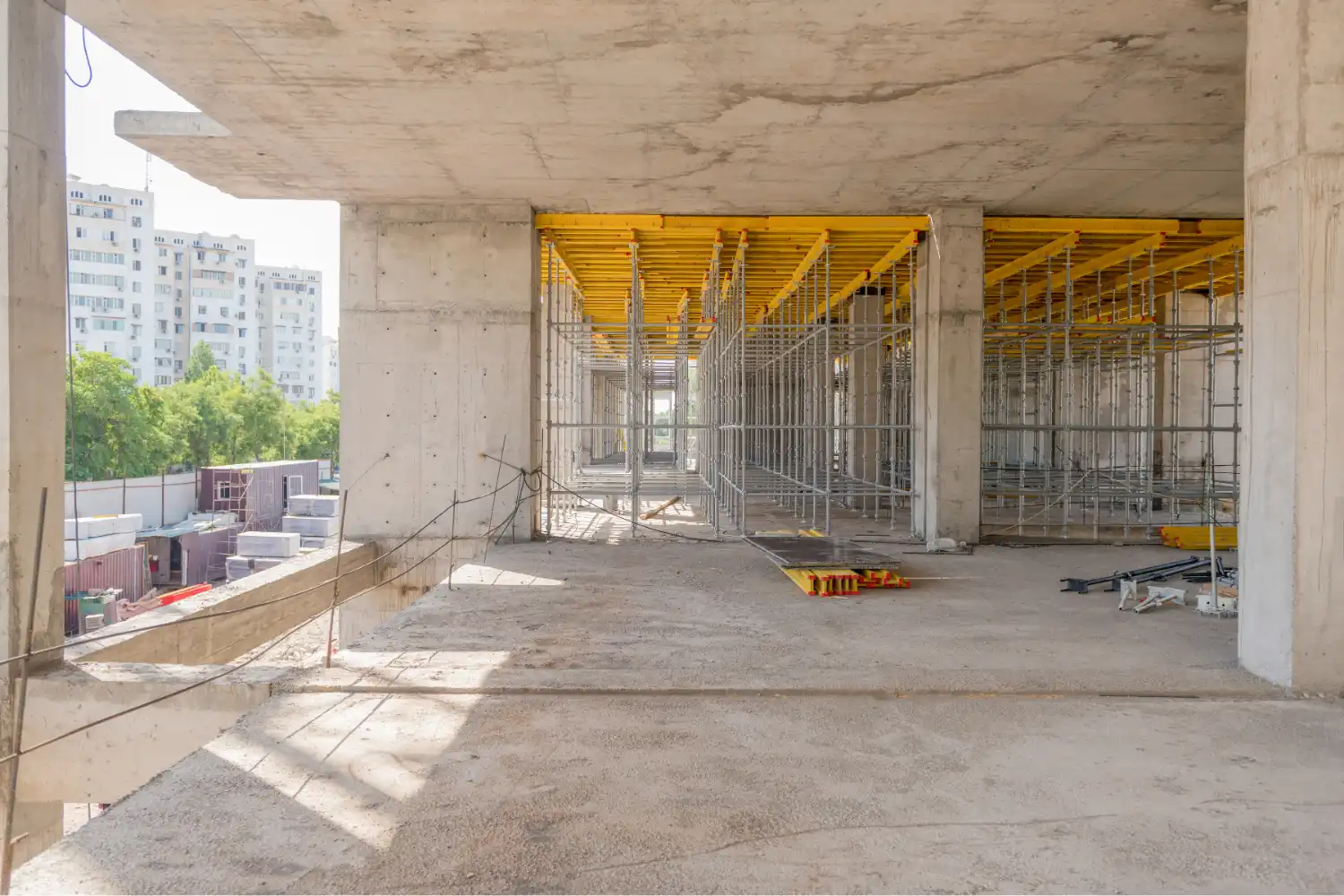
Longer spans require deeper beams. A reinforced concrete beam spanning 6 m might have a depth of around 400 mm, while the same beam spanning 10 m could need 650 mm or more. This depth increase has a cascading effect: deeper beams raise the floor-to-floor height, which adds cladding area, increases the length of mechanical risers, and ultimately grows the building’s total volume. In a 20-story building, adding just 100 mm per floor means an extra 2 meters of total height.
Steel structures handle longer spans more efficiently because steel has a higher strength-to-weight ratio than concrete. Cellular or castellated steel beams can span 12 to 15 m with relatively shallow depths by allowing mechanical ducts to pass through openings in the web. Post-tensioned concrete slabs offer another option, reducing slab thickness and enabling column-free spans of 10 to 12 m without deep beams at all. The choice depends on budget, local material availability, and the building’s fire-resistance requirements.
Grid spacing also influences foundation design. Wider grids concentrate more load per column, which means larger pad footings, deeper piles, or more robust pile caps below ground. On sites with poor soil conditions, the structural engineer may recommend tighter grid spacing to distribute loads more evenly, even if the architect would prefer wider bays above.
⚠️ Common Mistake to Avoid
A frequent error in early design stages is setting grid dimensions based only on room layout without checking structural feasibility. A 14 m column-free span sounds ideal for an open-plan office, but if the project uses flat-slab reinforced concrete, that span will demand a slab thickness of 350 mm or more, pushing floor-to-floor heights beyond what the building envelope and zoning allow. Always verify span limits with your structural engineer before finalizing the grid.
Final Thoughts
Structural grid systems in architecture are not abstract geometry exercises. They are the first and most consequential design decision in any framed building, setting the rules that every wall, duct, window, and room must follow. A grid that aligns structure with program, construction logic, and future flexibility produces a building that works well today and adapts well tomorrow. The best grids are invisible to occupants but unmistakable to anyone who studies the floor plan: clear, consistent, and exactly where they need to be.
For further reading on how grids and structural frameworks connect to broader architectural concept diagrams, the relationship between structural logic and design communication is a subject worth studying in depth. Additional resources on structural grid design are available from the Steel Construction Institute’s concept design guide, the American Institute of Architects (AIA), and the Royal Institute of British Architects (RIBA).















Leave a comment