


Table of Contents Show
The CCTV headquarters is a 473,000 m² skyscraper in Beijing, China, designed by Rem Koolhaas and Ole Scheeren of OMA. Rather than competing for height, the building forms a continuous three-dimensional loop, connecting two leaning towers through a 75-metre cantilevered bridge. Completed in 2012, it was named the 2013 Best Tall Building Worldwide by the Council on Tall Buildings and Urban Habitat.
What Is the CCTV Headquarters Building and Why Does It Matter?
Rising from Beijing’s Central Business District, the CCTV headquarters stands as one of the most discussed works of architecture built in the 21st century. It was commissioned by China Central Television and won by OMA through an international competition in 2002. The jury included architect Arata Isozaki and critic Charles Jencks, and OMA’s proposal stood apart from competing firms like KPF, SOM, and Dominique Perrault, all of which submitted conventional tower designs.
Koolhaas had publicly declared his desire to challenge the skyscraper typology. In his 2003 book Content, he argued that the skyscraper had become corrupted by repetition. The CCTV project gave him the opportunity to act on that position at an enormous scale. Instead of a single tower soaring upward, OMA proposed a loop: two towers leaning toward each other, connected at the base by an underground production platform and at the top by a dramatic cantilever. The result was a building that looked different from every angle, resisting any single, stable image.
The CCTV headquarters building covers 473,000 m² of floor space, houses approximately 10,000 workers, and consolidates the entire television production process (studios, broadcasting, news operations, administration, and post-production) into one interconnected volume. That programmatic logic was central to the design: OMA had observed, through earlier work with Universal Studios, that media companies often suffer from internal fragmentation. The loop was their architectural answer to that problem.
📌 Did You Know?
The two sections of the CCTV headquarters building were joined to complete the loop on December 26, 2007, a process that had to be timed precisely in the early morning, when the steel in both towers had cooled to the same temperature, to prevent locking in structural differentials. The cantilever connecting them at the top projects 75 metres horizontally, making it one of the most technically demanding structural joints in modern construction history.
CCTV Headquarters Design Concept: The Loop Against the Tower
The design concept behind the CCTV headquarters architecture is often described as a rejection of verticality for its own sake. Koolhaas wanted to replace the conventional two-dimensional tower (a single floor plan repeated hundreds of times) with a three-dimensional experience of movement and continuity. Visitors and staff circulate through the building along a path that passes through offices, studios, and public areas, then crosses the cantilever at the top via a public loop that offers panoramic views of the Beijing skyline and, on clear days, toward the Forbidden City.
This circulation logic was not merely spatial. OMA argued that bringing all parts of the television production process into physical proximity would generate new forms of collaboration. A journalist passing a production studio, or a director walking through a news floor, would have a different relationship to their colleagues than they would in a conventional separated-floor arrangement. The loop enforced encounter.
The CCTV headquarters concept also drew on what Koolhaas described as the Chinese cultural tradition of collectivism. Rather than separating staff into two distinct towers, the looped form connected them into a single organization. That symbolic reading was important to the client, who saw the building as a representation of the unity of the state broadcaster. Whether that interpretation was genuine or convenient has been debated, but it shaped how OMA presented the project throughout the design and construction process.
💡 Pro Tip
When studying the CCTV headquarters design for academic or professional purposes, look at the building from multiple vantage points; the structure changes form dramatically depending on the angle and distance. OMA designed it to resist a single, fixed image, so satellite views, street-level perspectives, and interior circulation diagrams all reveal different aspects of the concept. Reading the OMA project description alongside Cecil Balmond’s engineering notes from Arup gives you both the theoretical and technical layers simultaneously.
CCTV Headquarters Architecture: Structure, Facade, and Engineering

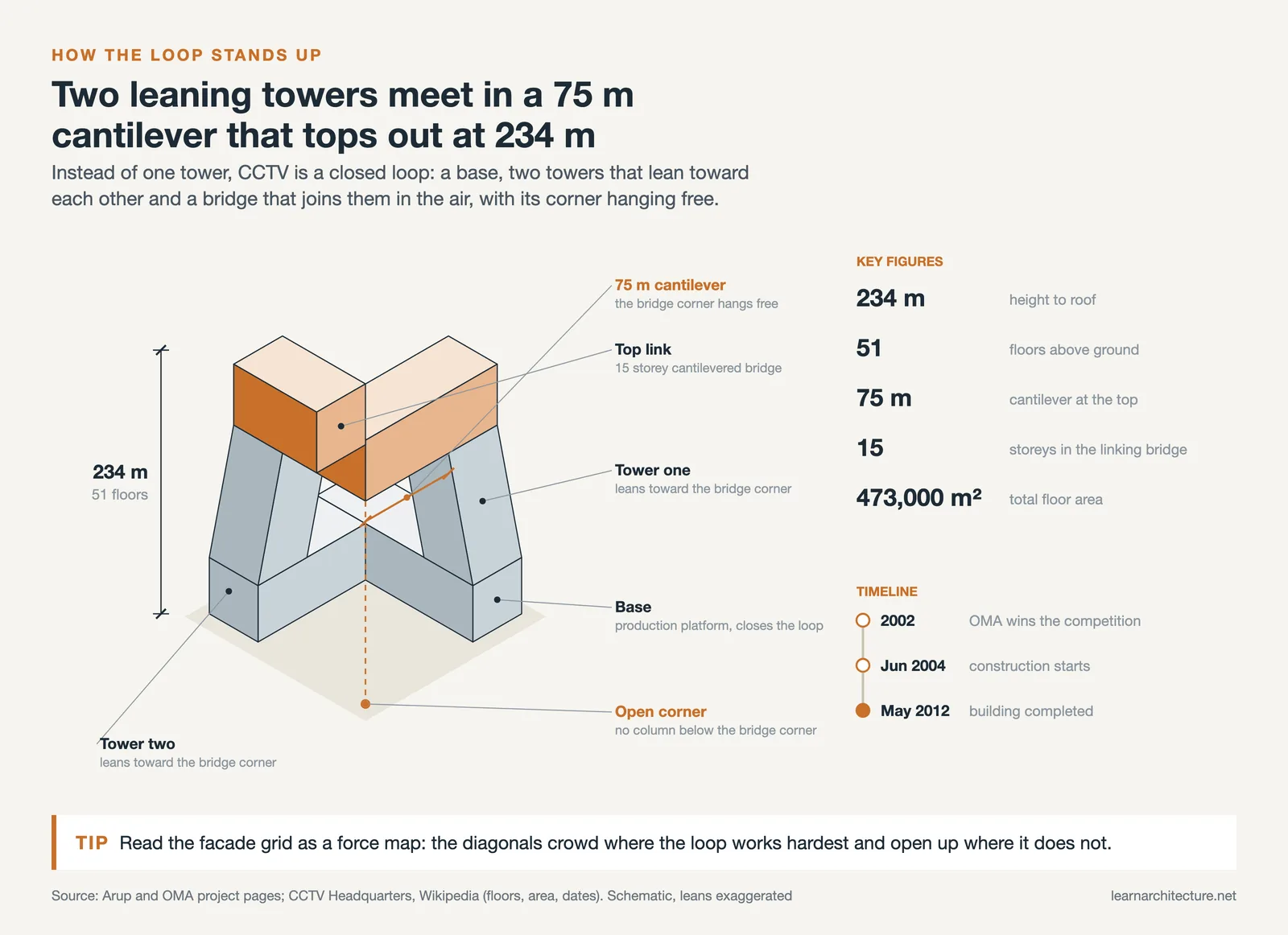
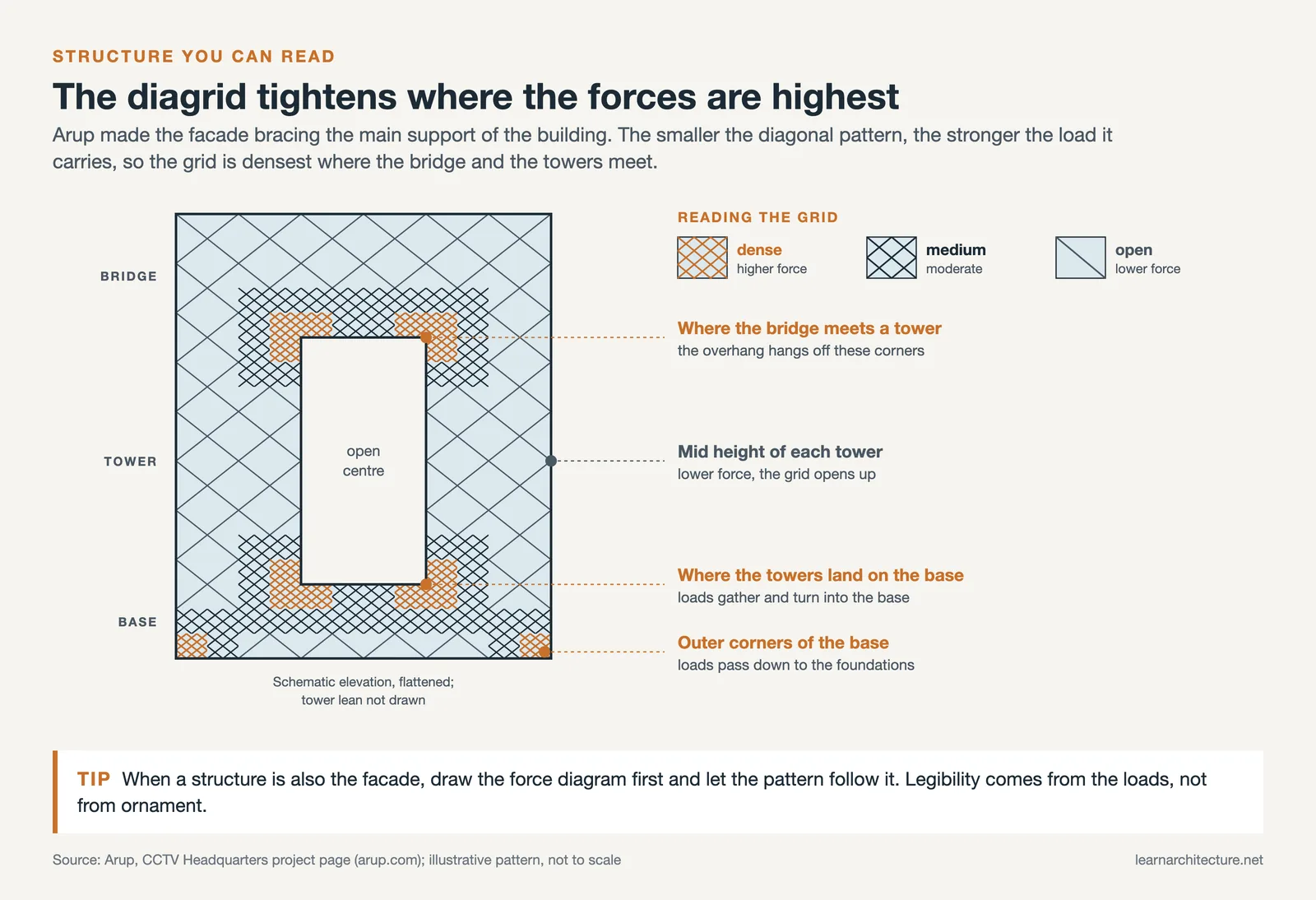
The structural system of the CCTV headquarters Beijing is among its most studied aspects. The building’s loop form created forces that a conventional steel frame could not accommodate. To address this, Arup engineer Cecil Balmond developed an exoskeleton: a triangulated web of diagonal, horizontal, and vertical steel members that wraps the entire facade. This diagonal grid is not decorative. It responds directly to the structural loads within the building, becoming denser in areas of higher stress and more open where forces are lower. The facade is, in the most literal sense, a map of the forces running through the structure.
Both towers lean from the vertical in different directions, and they meet at the cantilevered overhang at the top. This overhang, called “the bridge” internally, connects the 51st floors of the two towers. Walking across it requires passing over a section of glass floor through which you can look straight down 37 stories. The experience was intended to be vertiginous; it was designed that way.
Because the site sits in a seismic zone, the building also had to meet strict earthquake resistance requirements. According to the engineering team at Arup, the structure was designed through seismic simulation to resist earthquakes of intensity 8 on the Chinese scale. This added significant complexity to an already unconventional structural system.
📐 Technical Note
The CCTV headquarters building stands 234 metres (768 ft) tall across 51 floors, with a total floor area of 473,000 m². The 75-metre cantilever connecting the two towers at the top was assembled and joined in a single operation timed to within a few hours, requiring the steel to contract to the same temperature in both towers to prevent differential stress locking. The diagonal exoskeleton is densest in high-stress zones near the base and the cantilever and opens up in areas of lower load, making structural intensity directly visible on the exterior surface.
The facade cladding is fritted glass, chosen in part because it reduces solar heat gain inside the building, but also because its grey, semi-transparent quality blends into Beijing’s frequently overcast sky. Scheeren noted that the fritting, combined with the irregular diagonal pattern of the external bracing, makes the building’s scale difficult to read from a distance: you cannot count floors easily, which contributes to the disorienting quality the architects were after. In certain light conditions, the 234-metre structure seems to flatten and almost disappear against the skyline.
Who Designed the CCTV Headquarters?
The CCTV headquarters architect team was led by Rem Koolhaas and Ole Scheeren of OMA, the Rotterdam-based Office for Metropolitan Architecture. Koolhaas co-founded OMA in 1975 alongside Elia Zenghelis, Zoe Zenghelis, and Madelon Vriesendorp. By 2002, OMA had completed major projects in Europe and the United States, but the CCTV commission was their first large-scale building in China.
Ole Scheeren directed the Beijing office and led the project’s on-site execution. He remained at OMA until 2010, two years before the building’s official opening. David Gianotten took over as the OMA partner responsible for the project in its later stages. Project manager Dongmei Yao coordinated the vast on-site team, which at its peak included over 100 OMA architects working across Rotterdam and Beijing. The executive architect and engineering institute was ECADI, the East China Architectural Design and Research Institute, whose involvement was required by Chinese regulations and whose local knowledge proved essential in navigating the approval process with the Chinese Ministry of Construction.
Cecil Balmond at Arup was the structural engineer responsible for the exoskeleton system, and he worked closely with OMA from the earliest design phases. The collaboration between an experimental architectural practice and a technically ambitious engineering team was unusual at that scale, and both parties have credited it as essential to what the building achieved.
🎓 Expert Insight
“It singlehandedly paved the way from the height-obsessed, set-back skyscraper of the past to the sculptural and spatial skyscraper of the present, at the scale of the urban skyline.”
Council on Tall Buildings and Urban Habitat (CTBUH), 2013 Award Citation
This was the same year Koolhaas accepted the Best Tall Building Worldwide award, an irony he acknowledged openly, given that he had spent years arguing that skyscrapers had become architecturally exhausted. His response was characteristically direct: he said the campaign had been “completely unsuccessful” but that he was glad to be part of a community trying to make tall buildings more interesting.
CCTV Headquarters OMA: From Competition to Completion

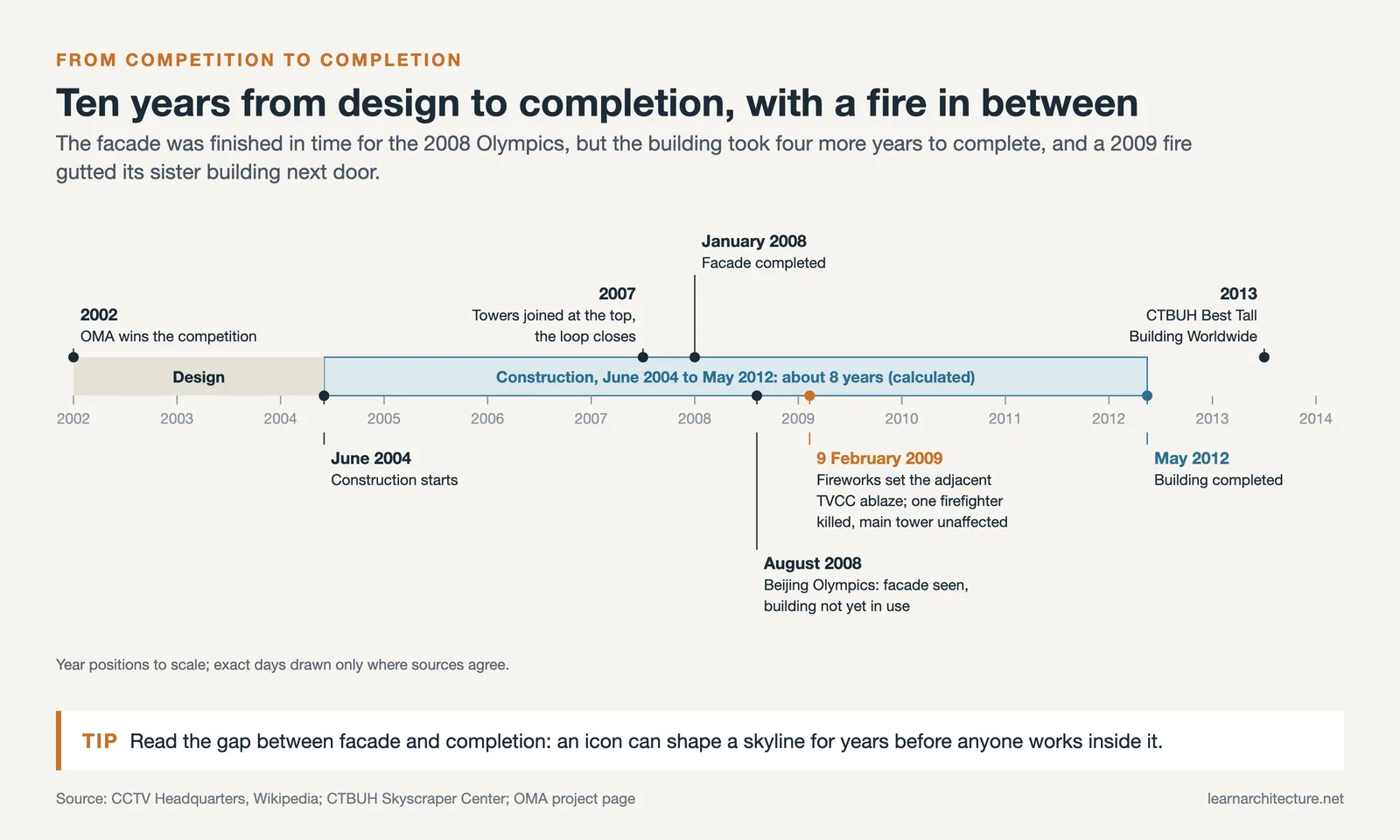
OMA won the CCTV competition in 2002. Construction began in June 2004. The facade was completed in January 2008, in time for the facade to be visible during the Beijing Olympics, even though the building itself was not yet operational. Staff began moving in during 2012, and the official inauguration took place in June 2013, nearly a decade after groundbreaking.
The timeline was complicated by a significant setback. On February 9, 2009, the Television Cultural Center (TVCC), an adjacent building that was part of the same OMA-designed complex, caught fire. The fire was ignited by fireworks during the Lantern Festival. The TVCC, which was designed to house a broadcasting theater, a hotel, and cultural facilities, was badly damaged. One firefighter was killed, and the director of the project was imprisoned, along with 19 others. The fire delayed the broader complex and cast a shadow over the project’s final years of construction.
The main CCTV headquarters building was unaffected by the fire and proceeded to completion. When it finally opened, it had already spent several years shaping Beijing’s skyline from the outside, and it had already become a recognizable icon, for better or worse, of China’s construction boom in the 2000s.
For further reading on how landmark buildings reshape urban form and public space, the adaptive architecture principles discussed on this platform offer useful context on how programmatic decisions drive spatial innovation. Understanding the elements that make architecture significant across time is also explored in our article on core elements of architecture.
Controversy and Legacy: How the CCTV Headquarters Changed the Conversation
The CCTV headquarters Beijing China was not universally praised, even among architects. When the design was first revealed in 2003, the cantilevered overhang provoked concern in a city prone to earthquakes. Tsinghua University professor Wu Liangyong, leading a research team studying the 2008 Olympic buildings, publicly criticized the trend of foreign architects being given prestigious Chinese commissions. His remarks, reported in The New Yorker, reflected a broader unease about the relationship between international starchitecture and China’s state institutions.
A more significant political challenge came in 2014, when Chinese president Xi Jinping announced that China wanted “no more weird architecture.” The CCTV building was directly referenced in a two-hour speech as an example of the kind of bombastic foreign-designed structure China should move away from. Koolhaas responded sharply, defending the building as structurally and conceptually serious. In 2016, China’s State Council issued formal guidance forbidding “oversized, xenocentric and weird” buildings in favor of structures that are “suitable, economic, green and pleasing to the eye.”
Despite this political friction, the building’s critical reputation has been consistently high. The CTBUH’s 2013 award was not a minor honorific. The jury’s citation noted that the building had fundamentally shifted the conversation about what a tall building could be, away from the simple pursuit of height and toward questions of form, program, and urban engagement.
💡 Pro Tip
When analyzing the CCTV headquarters in a design thesis or case study, resist the temptation to treat the political controversy as separate from the architecture. The building was commissioned by a state broadcaster, designed to represent institutional unity, built in an authoritarian context, and later criticized by the head of state. All of that is part of the architectural argument. Koolhaas has always been explicit that architecture cannot be politically neutral, and CCTV is probably his most direct test of that position.
CCTV Headquarters in Beijing China: Urban Context and Skyline Impact

The site of the CCTV headquarters in Beijing sits within the Chaoyang district’s Central Business District, on a 20-hectare plot at the intersection of the Third Ring Road East and Guanghua Road. When OMA won the commission, the area was being developed as one of approximately 300 new towers planned for the new CBD. The presence of so many conventional towers made OMA’s loop even more striking as an urban object.
The building occupies a position visible from a wide arc of the city. Its form (two leaning towers and a connecting bridge) is readable from a distance in a way that most conventional skyscrapers are not. This legibility was intentional. OMA wanted the building to function as a three-dimensional icon, one that conveyed its identity from multiple directions simultaneously, rather than being simply a tall rectangle with a distinctive crown.
The public loop inside the building also connected the CCTV headquarters to the life of the city in a way that a conventional corporate headquarters usually does not. Visitors could enter the building, pass through the production floors, walk across the glass floor of the cantilever, and look out over the entire Beijing skyline. That gesture, making a media company’s production process legible to the public, was, in theory, a democratic one. Whether it remained so in practice under a state broadcaster is a question the building itself cannot answer.
🏗️ Real-World Example
Taipei Performing Arts Center (Taipei, 2022): Also designed by OMA, this building uses a similar programmatic logic to CCTV, consolidating multiple performance spaces (a 1,500-seat Grand Theater, an 800-seat Proscenium Playhouse, and a flexible Globe Theater) into a single interconnected volume rather than distributing them across separate structures. Like CCTV, the building’s form is generated by its program rather than by formal preference, resulting in an object that looks radically different from every angle. It demonstrates that OMA’s approach to CCTV was not a one-off experiment but a consistent architectural position.
What Lessons Does the CCTV Headquarters Offer Architects Today?
The CCTV headquarters OMA project offers several durable lessons that remain relevant to architectural students and practitioners. The first is about structural legibility: the building shows that it is possible to make the forces at work inside a structure visible on its exterior, without resorting to superficial patterning. The diagonal grid is structural, not ornamental, and that distinction matters both technically and aesthetically.
The second lesson is about program as generator. OMA did not begin with a form and then fill it with rooms. They began with an analysis of how a television company actually works (the relationships between production, broadcasting, news, and administration) and then designed a spatial structure that would physically embody those relationships. The loop was the result, not the premise. That approach, using program analysis to generate unprecedented form, is something architectural schools teach but few large buildings demonstrate at that scale.
The third lesson concerns the politics of architectural ambition. Koolhaas accepted a commission from a state broadcaster in an authoritarian country, worked within Chinese planning requirements, collaborated with local institutions, and produced a building that critics consider among the most significant of the century. He has also been criticized for it by people who argue that such work legitimizes authoritarian clients. That debate is not resolved, but it is live, and the CCTV building sits at its center in a way that makes it impossible to study the project without confronting it.
For architects exploring how contemporary design interacts with broader urban contexts, the history of landmark buildings and their urban legacy offers a useful comparative frame.
✅ Key Takeaways
- The CCTV headquarters in Beijing China was designed by Rem Koolhaas and Ole Scheeren of OMA, completed in 2012, and won the CTBUH’s Best Tall Building Worldwide award in 2013.
- The building’s loop form consolidates all television production operations into a single interconnected volume, using program analysis rather than formal preference as the design generator.
- The structural exoskeleton, engineered by Cecil Balmond at Arup, makes the building’s internal forces visible on its facade through a variable-density diagonal grid.
- The 75-metre cantilever connecting the two towers was assembled in a precisely timed overnight operation, requiring both towers to reach the same steel temperature to avoid differential stress.
- The building’s legacy includes both architectural influence (shifting tall building design toward sculptural and programmatic complexity) and political controversy over the role of foreign architects in authoritarian contexts.
For more on the structural and spatial ideas that inform contemporary architecture, the OMA project page for CCTV headquarters provides the firm’s own account of the design process. The Council on Tall Buildings and Urban Habitat maintains detailed records of the building’s structural and engineering credentials. Dezeen’s extended coverage of the CCTV headquarters as a 21st-century landmark provides the most thorough critical overview available online. For the structural engineering perspective, Arup’s project portfolio and Architectural Record’s 2012 feature on the building’s completion remain essential reading. The MoMA exhibition on the project, documented at moma.org, also offers a detailed account of OMA’s design methodology for the building.
- beijing cctv headquarters
- cctv headquarters
- cctv headquarters architect
- cctv headquarters architecture
- cctv headquarters beijing
- cctv headquarters beijing china
- cctv headquarters building
- cctv headquarters china
- cctv headquarters concept
- cctv headquarters design
- cctv headquarters in beijing
- cctv headquarters oma








Leave a comment