


Table of Contents Show
Cities don’t sit still, and neither should our buildings. As climate swings harder, energy markets fluctuate, and space needs shift by the hour, adaptive architecture, buildings that respond to change, moves from niche to necessary. In this piece, we explore what “adaptive” actually means today, which strategies work, the enabling tech and materials, real-world case studies, and how we design, measure, and manage truly responsive places.
What Adaptive Architecture Means Today
From Passive Strategies To Dynamic Systems
We’ve long relied on passive design, orientation, thermal mass, cross-ventilation, to moderate comfort. Those foundations still matter. But the difference today is speed and range: weather events are more extreme, occupancy is less predictable, and energy systems are interactive. So we pair passive bones with dynamic systems that learn and react in real time. Think facades that tune solar gain by the minute, floors that reconfigure without demolition, and controls that buy or sell energy based on grid signals.

Types Of Change: Climate, Use, Energy, And Risk
- Climate: hotter heatwaves, bigger storms, wildfire smoke. Buildings must adapt minute-to-minute (shading, ventilation mode) and decade-to-decade (floodable ground floors, elevating equipment).
- Use: hybrid work and evolving programs demand flexible layouts, movable partitions, and services that plug-and-play.
- Energy: volatile prices and carbon constraints reward demand response, on-site storage, and microgrids.
- Risk: seismic, cyber, and supply chain shocks call for redundancy, graceful degradation, and quick recovery.
Core Strategies And Typologies
Climate-Responsive Envelopes And Shading
Adaptive envelopes modulate light, heat, and air. Examples include operable louvers, electrochromic glazing, ventilated double skins, and responsive overhangs. The goal is to keep comfort steady while slashing loads, not just on design day but across volatile weather patterns.

Kinetic And Morphing Structures
Kinetic components, deployable canopies, transformable roofs, movable bridges, extend use and protection. Morphing structures use mechanisms or smart materials to adjust stiffness, span, or aperture, helping buildings ride out winds or open up for daylight when conditions are calm.
Reconfigurable Interiors And Modular Programs
We design grids, MEP spines, and kit-of-parts walls so spaces can pivot from meeting rooms to labs to housing with minimal waste. Raised floors, demountable partitions, and standardized connections keep churn low and reuse high.
Energy Symbiosis: Storage, Demand Response, And Microgrids
Adaptive buildings act like good citizens in a clean grid. Batteries shave peaks and back up critical loads: thermal storage shifts cooling to off-peak hours: automated demand response curtails nonessential loads in seconds. Add PV, heat pumps, and a controller, and a site-level microgrid can island safely during outages.
Enabling Technologies And Materials
Sensors, Controls, And Digital Twins
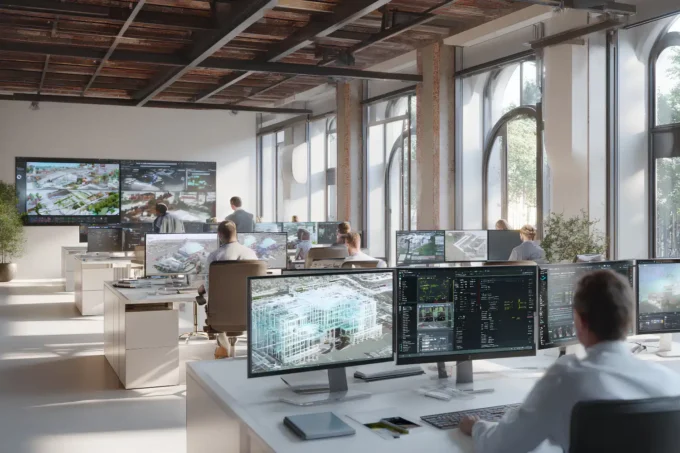
We start with reliable sensing, temperature, CO₂/IAQ, irradiance, occupancy, then fuse it in a building management system layered with analytics. A digital twin mirrors the asset, letting us test scenarios, forecast faults, and tune performance without breaking anything in the real world.

Actuators, Mechanisms, And Fail-Safe Design
Motors, hydraulics, and smart actuators move shades, vents, and panels. We engineer for fail-safe states, shades default to safe positions, vents open for smoke control, and manual overrides exist for firefighters and facilities teams. Low-friction mechanisms, accessible bearings, and standard parts keep maintenance sane.
Smart Materials: Shape Memory, Electrochromics, And Hygroscopic Systems
- Shape memory alloys change form with temperature, enabling passive vents or dampers.
- Electrochromic glass varies tint to control glare and heat without blinds.
- Hygroscopic wood composites curl or flatten with humidity, creating self-actuating apertures, no wires attached.
Biobased And Living Systems
Biobased insulation, mycelium composites, and timber hybrids cut embodied carbon while offering repairable, replaceable components. Living walls and algae bioreactors can filter air or produce biomass, but we design for maintenance access and water stewardship from day one.
Case Studies And Lessons Learned
Al Bahar Towers: Mashrabiya Facade For Solar Control
In Abu Dhabi, Al Bahar Towers uses a kinetic mashrabiya screen that opens and closes to track the sun. Result: deep glare reduction, meaningful cooling load cuts, and a distinctive identity rooted in regional craft. Lesson: culturally resonant precedents can inform high-performance solutions.

Mediatheque In Sendai: Structural Flexibility And Seismic Resilience
Toyo Ito’s Sendai Mediatheque employs hollow tube “columns” that distribute loads and allow flexible floor plates. During the 2011 earthquake, the building sustained damage but remained standing and repairable. Lesson: redundancy and ductility matter: adaptable structure supports both program change and shock absorption.
The Edge, Amsterdam: Data-Driven Occupant Comfort And Energy Optimization
Often cited as ultra-smart, The Edge couples dense sensing with occupant apps and an efficient envelope. Hot-desking, granular controls, and analytics helped achieve top-tier energy performance ratings. Lesson: data alone isn’t the point, closing the loop between insight and automated action is what saves energy and improves comfort.
Designing For Adaptivity: Process And Metrics
Scenario Planning And Trigger Points
We map plausible futures, more heat, fewer staff on-site, higher flood risk, and set trigger points: when sea level or peak temps hit X, we deploy Y (e.g., add shade modules, raise plant, convert parking to storage). This avoids overbuilding while keeping options open.
Modeling, Prototyping, And Commissioning
We pair climate files with parametric models and controls co-simulation. Then we prototype: mock-up a facade bay, test actuators, run fault injection. Commissioning isn’t a ceremony: it’s iterative, with seasonal re-tuning and occupant feedback.

Performance Metrics: Comfort, Resilience, Carbon, And Cost
We track PMV/PPD and adaptive comfort bands, daylight autonomy and glare, outage ride-through hours, embodied plus operational carbon, and total cost of ownership. A good adaptive building stays within comfort targets most of the year without heroics, rides out grid events gracefully, and pays back with lower peaks and longer service life.
Challenges And The Road Ahead
Reliability, Maintenance, And Lifecycle Stewardship
Moving parts add failure modes. We mitigate with standardization, access panels, condition-based maintenance, and spare-part strategies. Contracts should fund mid-life refreshes and software updates, not just initial fit-out.

Security, Privacy, And Ethical Use Of Data
More sensors mean more responsibility. We anonymize occupancy data, segment networks, and carry out least-privilege access. Transparent policies build trust. If data doesn’t serve comfort, safety, or efficiency, we don’t collect it.
Regulatory Hurdles And Procurement Models
Codes often lag innovation. We document equivalencies, run third-party peer reviews, and pilot. Progressive procurement, outcome-based specs, performance guarantees, and integrated teams, encourages long-horizon value over low-bid short-termism.
AI-Augmented Operation And Circular Upgradability
AI helps forecast loads, detect faults, and choreograph systems across weather, tariffs, and occupancy. But we design for graceful handoff when algorithms fail. Circularity matters too: modular facades, replaceable components, and material passports keep future upgrades easy and waste low.
Conclusion
Adaptive architecture, buildings that respond to change, isn’t a gadget race: it’s a mindset. We start with robust passive design, then layer intelligent systems that can flex with climate, use, energy, and risk. If we get the basics right, clear scenarios, testable prototypes, honest metrics, and responsible data, our buildings will feel calm in a noisy world. And they’ll be ready for whatever tomorrow throws at them.
- adaptive architecture
- architectural adaptability
- automated building systems
- climate-responsive architecture
- dynamic architecture
- eco-friendly building design
- energy-efficient architecture
- flexible building design
- future-ready architecture
- green building technology
- Innovative Building Design
- integrated building technology
- intelligent building design
- modern architectural solutions
- modular architectural systems
- resilient urban design
- responsive buildings
- Smart Building Solutions
- Sustainable Architecture
- technological architecture









Leave a comment