


Table of Contents Show
China Fuxi Mountain is home to one of the most striking cliffside walkways in the world, a white stone staircase that rises sharply into the sky above Henan Province and has earned the nickname “Stairway to Heaven.” Set on the edge of a mountain cliff, the structure blends ancient spiritual tradition with an almost surreal visual impact that has made it a global phenomenon.

What Is the Fuxi Mountain Sky Ladder (Stairway to Heaven)?
The Stairway to Heaven at Fuxi Mountain in China is a cliffside stone staircase built along the steep face of Fuxi Mountain in Henan Province, near Zhengzhou. Viewed from below, the narrow white steps appear to vanish into the clouds, an effect that has made the sky stairway of Fuxi Mountain one of the most photographed and shared architectural images to emerge from China in recent years.
Unlike most mountain walkways, this staircase has no guardrails on either side along large sections of its route. That absence is central to both its visual drama and its reputation as one of China’s most demanding climbs. The stairs are cut from white stone, which creates a striking contrast against the green mountain slopes and, on misty days, the staircase seems to disappear entirely into low cloud cover.
💡 Pro Tip
If you plan to climb the Fuxi Mountain stairs in China, start early in the morning on a weekday. The steps become extremely congested by mid-morning, especially on Chinese public holidays and during the Qixi Festival. Arriving before 8 AM gives you a significantly clearer path and far better photography conditions with soft morning light falling across the cliff face.
The site is often called by multiple names, including the Sky Ladder, the Love Ladder, and the Heavenly Stairs. Each name reflects a different aspect of its identity: its architectural spectacle, its romantic mythology, and its Taoist spiritual associations. Visitors seeking to understand Fuxi Mountain in China should know that these names all refer to the same structure, though the full mountain trail system is a separate and far longer route.
For those interested in how landscape design integrates with cultural heritage, the landscape projects section at Learn Architecture features other examples of built structures that respond to natural terrain in equally dramatic ways.

The Architecture of the Fuxi Mountain China Stairs
From an architectural standpoint, the china fuxi mountain stairs present a fascinating case study in how built infrastructure can merge with a natural landscape to produce something that reads as both man-made and mythological. The steps are cut from local white stone and follow the natural contour of the cliff, which means the staircase does not impose a geometric order on the mountain but instead traces its existing lines.
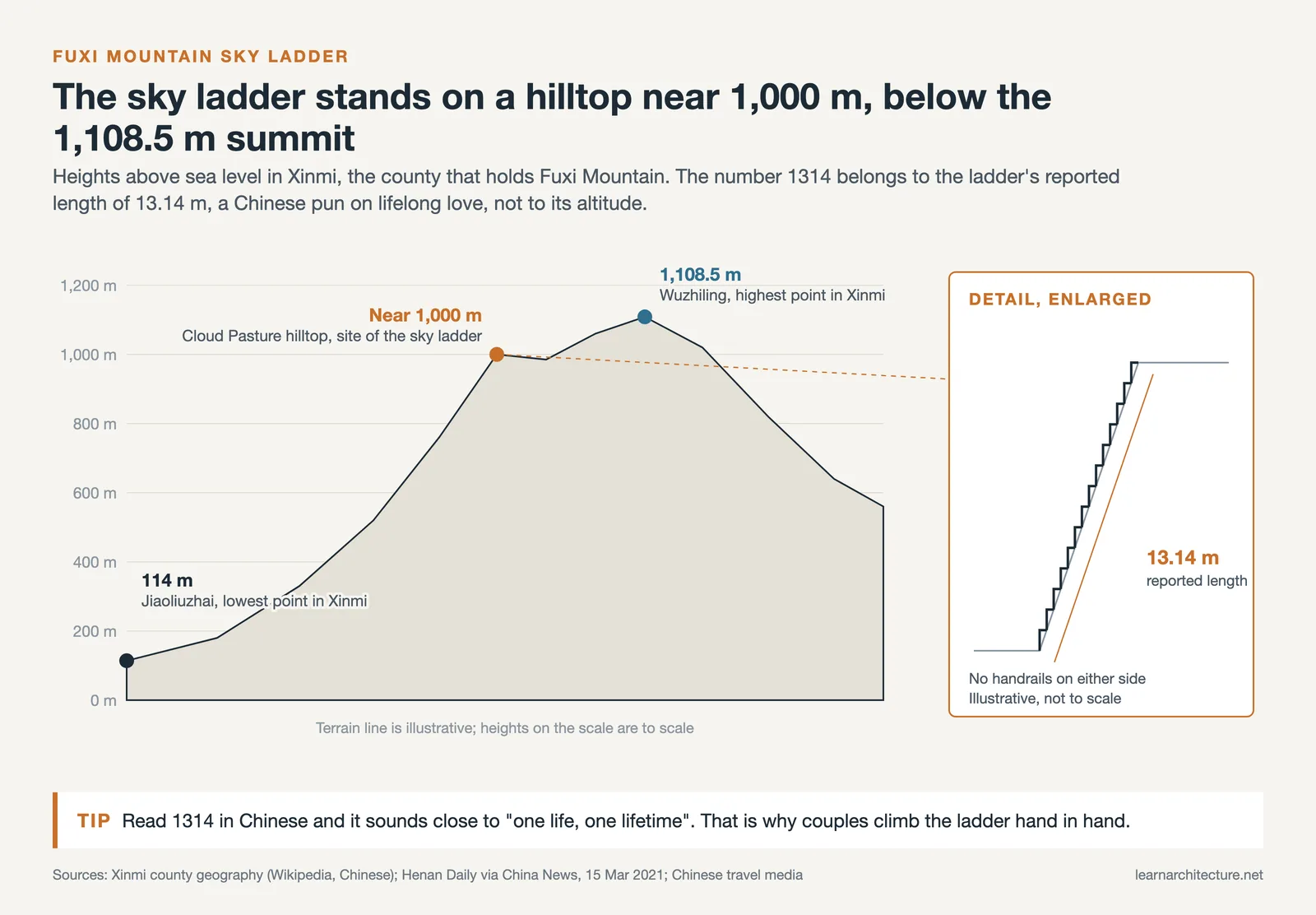
The structure stands on a hilltop close to 1,000 meters above sea level, below the 1,108.5 meter summit of Wuzhiling, the highest point in Xinmi. The figure 1,314 often quoted online is not its altitude: the ladder is reported to be 13.14 meters long, a number that sounds like “one life, one lifetime” in Chinese. The incline is steep throughout, but the angle increases dramatically near the summit, where the steps become nearly vertical in appearance from a distance. This visual effect, a result of the cliff’s natural pitch combined with the narrow width of each step, is what gives the fuxi mountain stairway china its iconic “stairway to nowhere” quality when seen in photographs.
📌 Did You Know?
The Fuxi Mountain area is also home to a horseshoe-shaped glass skywalk, opened in 2018, that loops out above a green valley, with the canyon floor about 360 meters (1,181 feet) below according to Xinhua and CNN Travel. This separate structure, distinct from the stone stairway, is considered one of China’s most vertiginous tourist attractions and was featured in a 2018 CNN Travel roundup of China’s scariest outdoor attractions. The two structures together make Fuxi Mountain’s scenic area one of the most architecturally ambitious mountain destinations in Henan Province.
Widely shared online figures claim that the wider fuxi mountain stairway china trail system covers about 15 kilometers and 12,000 steps, but no official or press source confirms these numbers. The steps are uneven in places, a characteristic of their construction method. This irregularity, rather than being a flaw, is part of what gives the staircase its texture and authenticity as a built environment rooted in a specific landscape.
Spiritual and Cultural Significance
Fuxi Mountain takes its name from Fuxi, one of the most significant figures in Chinese mythology. Fuxi is credited with teaching early humans the fundamentals of fishing, hunting, cooking, and marriage, and is also associated with the creation of the Eight Trigrams (Ba Gua), which form the foundation of the I Ching. The mountain has long been regarded as his sacred territory.
Within Taoist tradition, henan china fuxi mountain stairs carry deep spiritual weight. Taoists believe that climbing the mountain brings good fortune, improved health, and longevity. For centuries, access to the upper sections of the mountain was restricted, reinforcing its sacred character. That changed in recent decades as the site was opened for public tourism, transforming a pilgrimage route into a destination that now attracts visitors from across China and internationally.
The stairway also carries a romantic dimension. Its nickname “Love Ladder” plays on its reported 13.14 meter length, a number that sounds like “one life, one lifetime” in Chinese, and couples climb the stairs side by side as a test of trust, courage, and commitment.

How Does the Fuxi Mountain Stairway Compare to Other Chinese Cliffside Structures?
China has developed a remarkable collection of high-altitude walkways, glass bridges, and cliffside paths over the past two decades. Understanding where the sky stairway fuxi mountain china fits within that broader context helps clarify what makes it architecturally and experientially distinct.
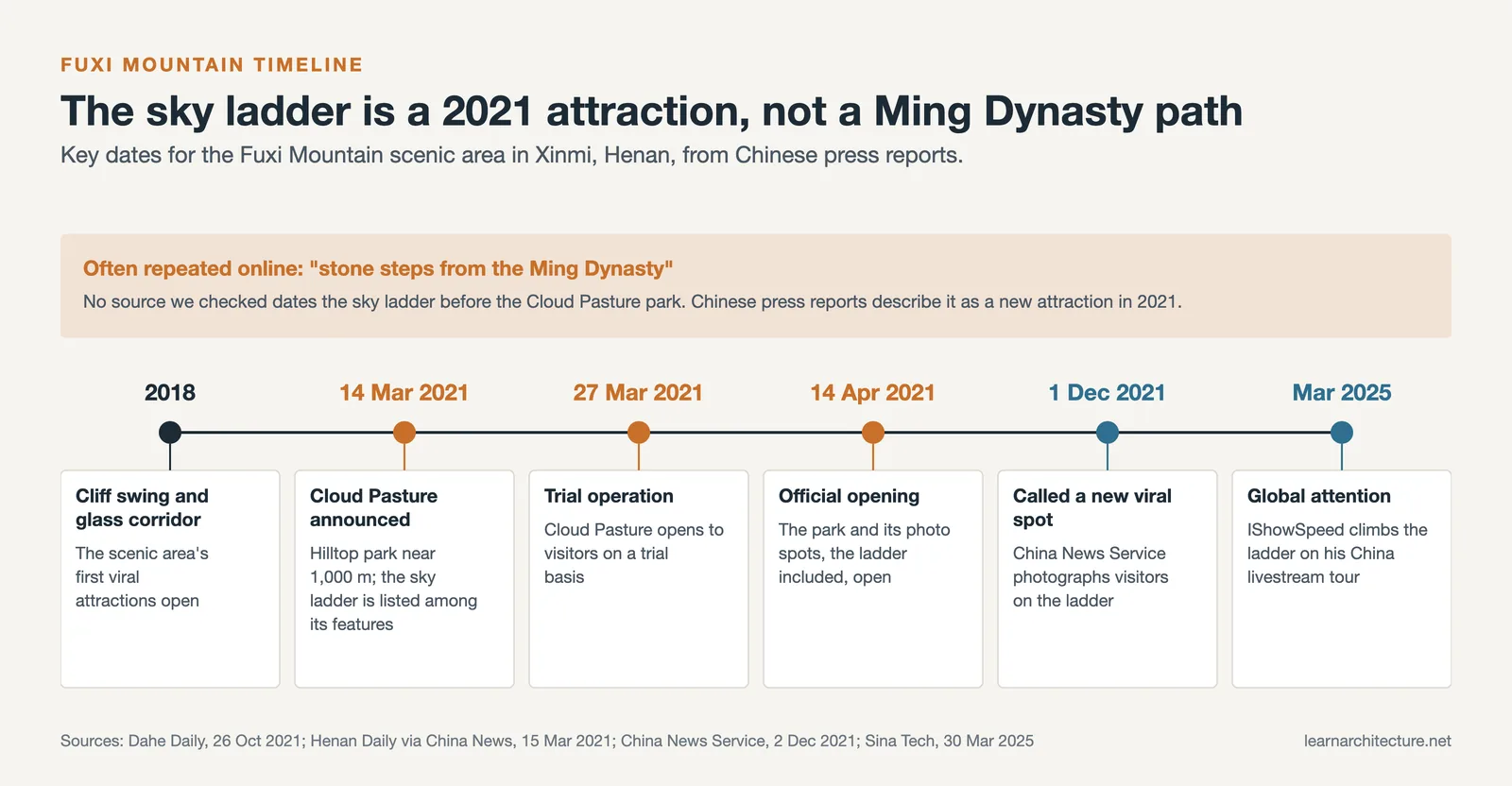
Most of China’s modern cliffside attractions, such as the Coiling Dragon Cliff Walk on Tianmen Mountain or the Hongyagu Glass Bridge in Hebei, were built specifically as tourist infrastructure using contemporary materials like tempered glass and steel. The Fuxi Mountain stairway is different in character. The sky ladder itself is recent: it was built as one of the features of the hilltop Cloud Pasture park, which opened in April 2021. Its layered significance comes from the mountain it stands on, named after the mythological Fuxi, rather than from the age of its steps.
The absence of railings, while it makes the stairway more demanding and more visually dramatic, also distinguishes it from engineered modern attractions where safety barriers are standard. At Fuxi Mountain, the relationship between the climber and the landscape is more direct and unmediated.
Exploring how architecture can respond to natural terrain at this scale has parallels in contemporary landscape architecture as well. The landscape architecture resources at Learn Architecture cover how designers today approach similar challenges of integrating built paths and structures within challenging natural environments.
⚠️ Common Mistake to Avoid
Many visitors and online sources confuse two distinct features at Fuxi Mountain: the wider mountain trail system, whose 12,000 step and 15 kilometer figures shared online remain unconfirmed, and the specific “Stairway to Heaven” walkway, which is a shorter, steeper cliffside section that becomes nearly vertical near the summit. Photographs circulating online almost always show the dramatic vertical section only, which can create a misleading impression of the full trail. If you plan to visit, research which specific section you intend to climb and plan your time accordingly.
What to Expect When Visiting Fuxi Mountain China
The stairway to heaven fuxi mountain china is located near Zhengzhou, the capital of Henan Province, and can be reached in approximately one hour by car from the city center. The site sits within a broader scenic area that includes several old temples, a waterfall, and the separate glass skywalk structure mentioned earlier.
The best seasons to visit are spring (April to May) and autumn (September to October). Spring brings wildflowers across the mountain slopes, while autumn offers clear skies and cooler temperatures well suited to climbing. Summer visits are possible but bring both heat and significantly larger crowds, particularly during Chinese national holidays and the Qixi Festival, which falls on the seventh day of the seventh lunar month.
Proper footwear is essential. The steps are uneven, and the incline is steep enough that standard flat-soled shoes or sandals create a genuine slip risk. Hiking boots or non-slip walking shoes are strongly recommended. Visitors with a fear of heights should assess the exposed sections carefully, as certain parts of the climb offer no barrier between the climber and the cliff edge.
💡 Pro Tip
Photographers visiting the china stairs fuxi mountain site consistently report that the most effective shots are taken from below looking upward, or from a slight distance along the cliff that allows the full verticality of the staircase to read against the sky. Getting too close limits the sense of scale. A wide-angle or standard lens works better than telephoto for capturing the stairway’s relationship to the broader cliff face and surrounding landscape.
Rest areas and basic refreshment points are available at intervals along the route, and informational signage exists in both Chinese and English at certain key points. The overall climb, depending on fitness level and how much time is spent at viewpoints, typically takes between two and four hours for the main trail.
Architectural Legacy and Tourism Impact
The rise of fuxi mountain china as a global tourist attraction reflects a wider trend in China’s approach to heritage sites and landscape tourism. In the past two decades, significant investment has gone into making formerly inaccessible sacred or natural sites available to a broad public. This process has brought economic activity to rural mountain communities but has also introduced tensions around overcrowding, commercialization, and the preservation of the spiritual atmosphere that gives these sites their original meaning.
At Fuxi Mountain, visitor numbers have grown substantially. Large crowds on peak days make it difficult to move at a comfortable pace or photograph the staircase without other visitors in the frame. Small shops selling souvenirs and food have appeared at various points along the route. Whether this commercialization enhances or diminishes the experience is a matter of perspective, but it is a reality that shapes what contemporary visitors encounter.
From a landscape architecture standpoint, the challenge of integrating modern visitor infrastructure into a site of this historical and spiritual weight is significant. The question of how much intervention is appropriate before the site’s character is altered is one that professionals working on heritage landscape projects encounter repeatedly. For related reading on how nature and built environments interact within contemporary design thinking, see the discussion of biomimicry in architecture at Learn Architecture, which explores how built forms can respond to and draw meaning from natural systems.
✅ Key Takeaways
- The Fuxi Mountain Stairway to Heaven is a white stone cliffside staircase in Henan Province, China, set within the hilltop Cloud Pasture park in Xinmi.
- The specific “Stairway to Heaven” walkway is a shorter, dramatically steep section near the summit that creates the near-vertical visual effect seen in viral photographs.
- The site carries deep Taoist spiritual significance, with Fuxi Mountain regarded as sacred territory connected to the mythological figure Fuxi, a foundational figure in Chinese cultural history.
- The stairway is historically distinct from China’s modern glass-and-steel cliffside attractions; the sky ladder opened in 2021 as part of the hilltop Cloud Pasture park.
- Visiting is best done in spring or autumn, on weekdays, starting early in the morning to avoid crowds and secure the most rewarding photography conditions.
For more examples of outstanding landscape projects that integrate built structures with challenging natural terrain, the landscape projects section at Learn Architecture presents work from around the world that shares this fundamental design challenge.
External Resources
For further information on the mythology of Fuxi and the cultural context of sacred mountain sites in China, the following authoritative sources provide additional depth:
- Encyclopaedia Britannica: Fuxi: overview of the mythological figure after whom the mountain is named
- UNESCO World Heritage List: for context on China’s broader landscape heritage recognition
- China Highlights: Henan Province: practical travel information for the region
- ArchDaily: for broader coverage of landscape and architectural projects from China and globally
- china fuxi mountain
- china fuxi mountain stairs
- china stairs fuxi mountain
- fuxi mountain china
- fuxi mountain china sky stairway
- fuxi mountain china stairs
- fuxi mountain in china
- fuxi mountain stairs in china
- fuxi mountain stairway china
- henan china fuxi mountain stairs
- sky stairway fuxi mountain china
- stairway to heaven fuxi mountain china









Leave a comment