


Table of Contents Show
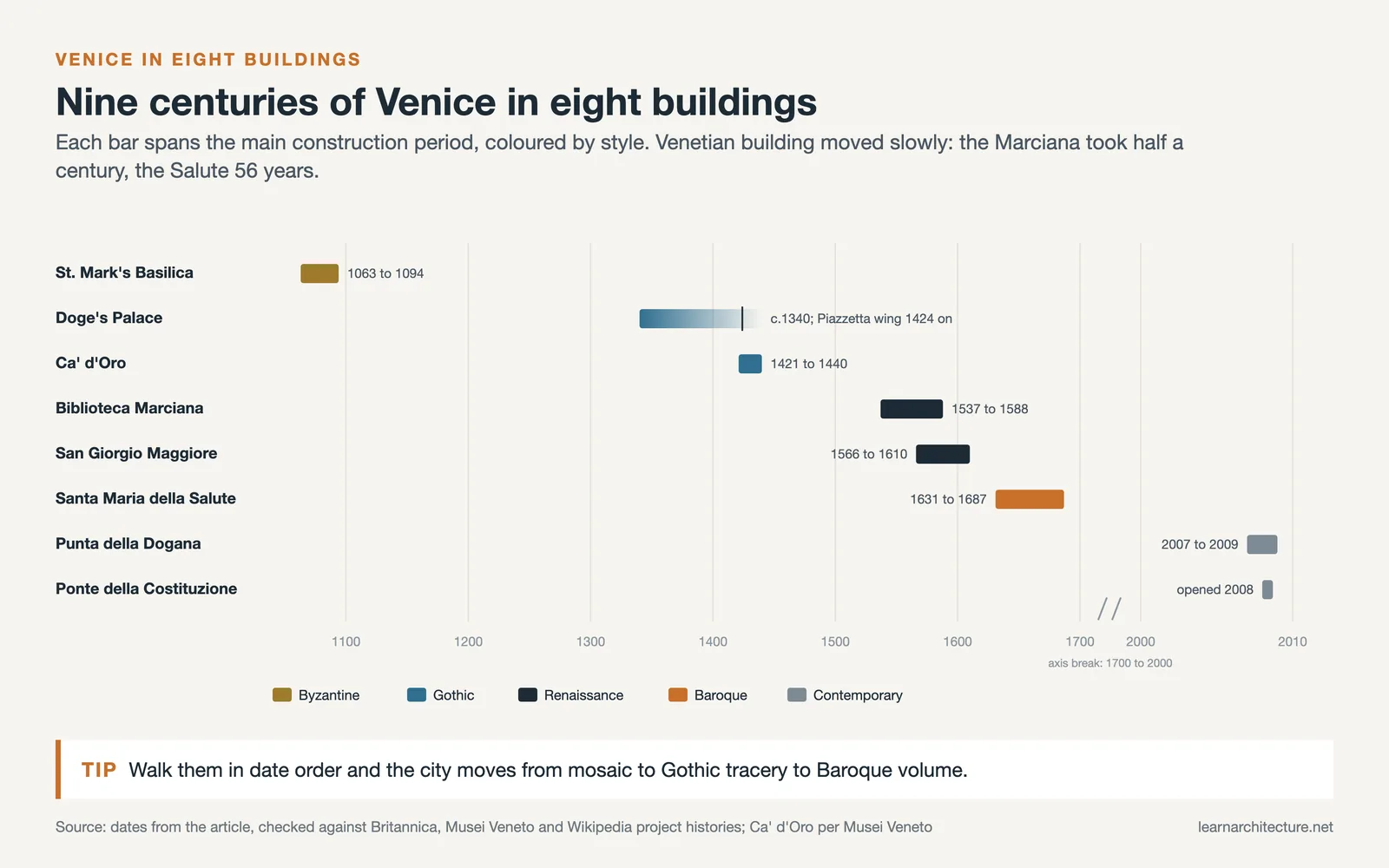
Venice architecture is a layered record of a city that traded with the Byzantine Empire, ruled the Mediterranean, and never stopped building. Across its 118 islands, Gothic palaces, Renaissance churches, and bold contemporary interventions sit side by side, often separated by nothing more than a narrow canal. This guide covers 8 essential buildings that capture the full range of what Venetian architecture has to offer.

What Makes Venice Architecture Unique?
The architecture of Venice Italy developed under conditions found nowhere else in Europe. The city sits on a marshy lagoon, which meant every building had to be raised on thousands of wooden piles driven deep into the mud. This structural constraint produced an architecture that prioritized lighter facades, open loggias, and decorative tracery over the heavy load-bearing walls typical of mainland Gothic construction.
The result is a style that feels almost weightless. Venetian Gothic architecture is defined by its pointed ogee arches, quatrefoil openings, and elaborate stonework that holds up entire facades while appearing almost ornamental. This is precisely the paradox John Ruskin described in The Stones of Venice (1851-1853): buildings that look too delicate to stand, yet have endured for six centuries.
Venice’s position as a trading hub also shaped its aesthetic. Byzantine mosaics, Islamic geometric ornament, and Ottoman arched forms all found their way into the city’s buildings because Venetian merchants brought these influences home. The architecture of Venice Italy is, in this sense, a direct map of its commercial reach.
💡 Pro Tip
When studying Venetian Gothic facades, pay attention to how the tracery panels on the upper floors support genuine structural loads rather than serving purely decorative purposes. This is the key technical difference between Venetian Gothic and its Northern European counterparts, where tracery typically filled window openings without bearing weight. It explains why Venetian palaces can have such open, colonnaded fronts while remaining structurally stable.
📌 Did You Know?
Venice is built on an estimated 177,000 wooden piles, many of them made from alder and oak sourced from the forests of Slovenia and Croatia. Submerged in the anaerobic lagoon sediment, these piles have essentially petrified over centuries through a process of mineral replacement, making them harder than the original wood. Some foundations supporting major Venetian buildings are over 1,000 years old and still structurally sound.

1. St. Mark’s Basilica: The Byzantine Heart of the City
No building defines the architecture of Venice more completely than the Basilica di San Marco. Construction on the current structure began in 1063, modeled on the Church of the Holy Apostles in Constantinople, and the basilica was consecrated in 1094. Its floor plan (a Greek cross covered by five large domes) was unusual for Western European ecclesiastical architecture of the period and signals Venice’s deep orientation toward the Byzantine world.
The exterior accumulates centuries of additions. The five west-facing portals are framed by polychrome marble columns, most dating from the 6th to the 11th centuries, sourced from across the Mediterranean as spoils of trade and conquest. The mosaics covering approximately 8,000 square meters of the interior incorporate gold glass tesserae that produce a shimmering, luminous effect that was deliberately intended to evoke the heavenly Jerusalem.
The basilica became the seat of the Patriarch of Venice only in 1807, after serving for nearly a thousand years as the private chapel of the Doge. This status as a ducal chapel rather than a public cathedral explains much about its character: it was built to impress visiting dignitaries and display the wealth of the Venetian state, not simply to serve as a place of worship. For students of architectural styles, the basilica is one of the most complete surviving examples of Italo-Byzantine design.
2. Doge’s Palace: Gothic Architecture Venice at Its Peak
The Palazzo Ducale is the defining civic monument of Venice city architecture and the most celebrated example of Gothic architecture in Venice. The current structure was begun around 1340, with the south wing facing the lagoon completed first, followed by the Piazzetta wing from 1424 onward. What makes the building so architecturally remarkable is its apparent inversion of structural logic: the heavier upper floors (solid walls with large window openings) rest on two layers of open arcades below, as if the mass of the building were suspended rather than grounded.
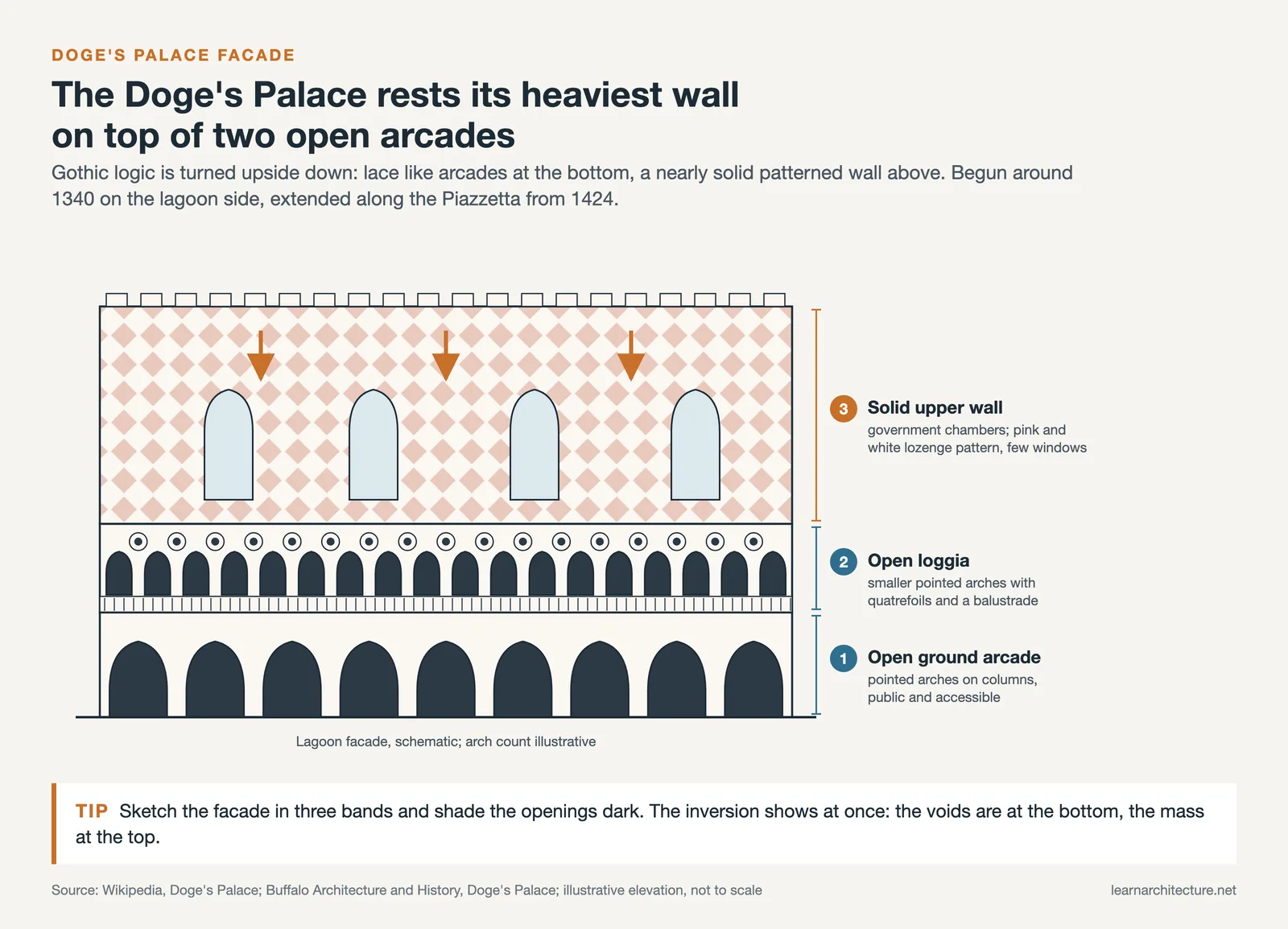
This visual inversion was deliberate. The open loggias at ground and first-floor level communicated accessibility and civic openness. The solid upper wall carried the government chambers and apartments, decorated with Istrian stone and pink-and-white diamond patterning that was partly derived from Mamluk mosque facades in Cairo, a visible trace of Venice’s trade with the Islamic world.
The interior contains some of the most ambitious painting commissions of the Venetian Renaissance, including Tintoretto’s Paradise in the Hall of the Great Council, one of the largest oil paintings on canvas ever made at around 22 by 7 meters. The palace also served as a prison, and the enclosed Bridge of Sighs connects the palace’s interrogation rooms to the New Prisons across the Rio di Palazzo. For a broader context on how the Doge’s Palace fits within the history of architectural styles, the Venetian Gothic represents a singular regional adaptation that influenced palace design across Northern Europe.
🎓 Expert Insight
“The Doge’s Palace is really the great work of the world. Other works may equal it in some respects, but in all respects together, there is nothing like it.”
John Ruskin, The Stones of Venice, Vol. II (1853)
Ruskin’s assessment, written after his extended stay in Venice in the early 1850s, remains influential in how architects and historians understand the building’s significance. His detailed documentation of the palace’s carved capitals and Gothic tracery directly shaped the Gothic Revival movement in Victorian Britain.

3. Ca’ d’Oro: The Most Ornate Venetian Gothic Palace
Built between 1421 and 1440 for the patrician Marino Contarini, the Ca’ d’Oro (House of Gold) takes its name from the gilded, ultramarine, and vermillion pigments that once covered its facade. Today those pigments are long gone, but the stone tracery of the upper loggias remains one of the finest examples of Venetian Gothic craftsmanship anywhere in the city.
The facade is asymmetric, a feature common to Venetian Gothic palaces that reflects the irregular plot shapes dictated by the Grand Canal’s curves. The left side is an open loggia of closely spaced pointed arches; the right side is largely solid wall punctuated by smaller windows. This asymmetry is not a flaw but a design choice, responding to the internal organization of the piano nobile apartments behind. Architects studying European architectural history often cite the Ca’ d’Oro as the moment Venetian Gothic palace design reached its most refined expression.
The building now houses the Galleria Giorgio Franchetti, which includes a significant collection of Venetian Renaissance painting and sculpture. The courtyard, with its restored polychrome marble well-head by Bartolomeo Bon, gives a good sense of how the interior of a Venetian palazzo was organized around water access at the ground level.
4. Santa Maria della Salute: Baroque Arrival at the Lagoon’s Edge
When a plague killed roughly a third of Venice’s population between 1630 and 1631, the Senate vowed to build a church in thanksgiving. The commission went to the young architect Baldassare Longhena, and the result, the Basilica di Santa Maria della Salute, became the most important Baroque building in Venice and one of the defining images of the city’s skyline.
Longhena’s design placed an octagonal drum at the center, topped with a large dome visible from across the lagoon, and flanked it with a semicircular apse and two small bell towers. The exterior is animated by large scroll buttresses (called “orecchioni” or big ears) that mask the transition between the octagonal drum and the lower ambulatory roof. These scrolls have no structural function; they are purely visual devices to give the building mass and movement when seen from the water.
Construction took 50 years. Longhena supervised much of it himself, and the foundations required over one million wooden piles. The church was consecrated in 1687, five years after Longhena’s death. It sits at the entrance to the Grand Canal near the Punta della Dogana, which means it frames the approach to Venice from the sea, a deliberately theatrical piece of urban planning.

5. Biblioteca Nazionale Marciana: Renaissance Architecture in Venice
The Libreria Marciana, designed by Jacopo Sansovino and begun in 1537, represents the arrival of High Renaissance classicism on the south side of the Piazzetta di San Marco. Sansovino had trained in Rome under Bramante’s circle, and his design for the library brought Roman orders (Doric below, Ionic above) to a Venetian setting for the first time at civic scale.
Andrea Palladio, in his Four Books of Architecture, called it “the richest and most ornate building constructed since antiquity.” That assessment reflects how significant the building felt to contemporaries: it introduced a systematic vocabulary of classical columns, entablatures, and arched bays that would influence Renaissance architecture in Venice and across the Veneto for the next two centuries.
The library now houses one of the most important collections of Greek and Latin manuscripts in the world, including the Grimani Breviary and the Fra Mauro world map. The reading room on the upper floor, decorated with ceiling paintings by Titian and Veronese, is among the finest interiors of the Italian Renaissance.
💡 Pro Tip
When studying the Libreria Marciana, compare the Doric and Ionic orders Sansovino used on the two floors with how those same orders appear on the facing Mint (Zecca) building, also by Sansovino. The Zecca uses a heavier, more rustic Doric throughout, deliberately signaling a building for commerce and security rather than scholarship. Reading these two facades together shows how Renaissance architects used the classical orders as a language for communicating a building’s civic function.
6. San Giorgio Maggiore: Palladio’s Island Masterpiece
Andrea Palladio designed the church of San Giorgio Maggiore on the island of the same name beginning in 1566, completing the facade design before his death in 1580. The project was finished by Vincenzo Scamozzi in 1610. Together, Palladio’s two Venetian churches, San Giorgio Maggiore and Il Redentore on the Giudecca, represent the fullest expression of Palladian classicism applied to sacred architecture.
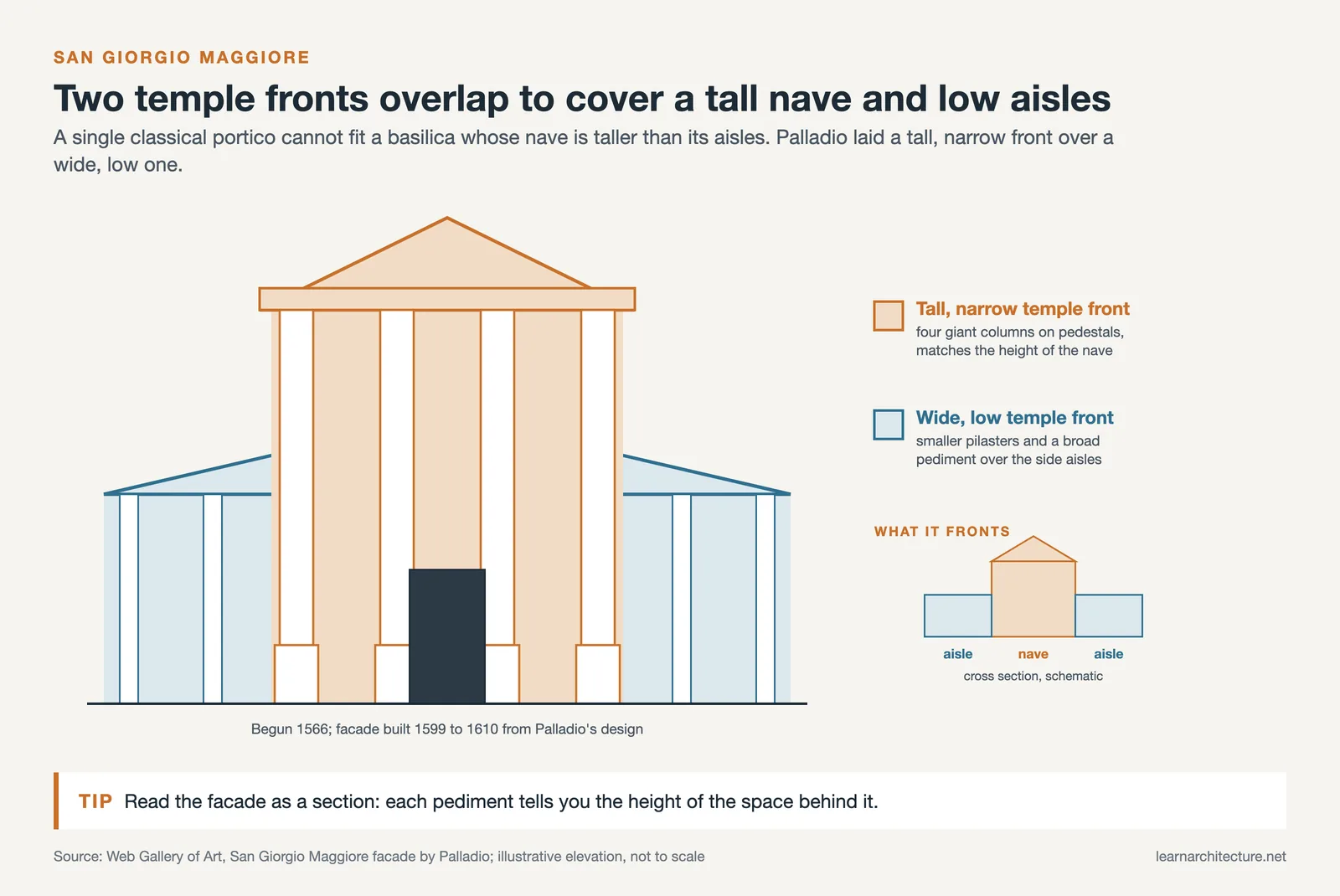
The design solves an old problem in Renaissance church facades: how to apply a classical temple front to a building whose nave is taller than its side aisles, producing two different height levels on the facade. Palladio’s solution was to overlay two interpenetrating temple fronts (a wide, low one corresponding to the aisles, and a taller, narrower one corresponding to the nave), creating a visual rhythm of columns at different scales that reads coherently from across the water.
The church is worth visiting for both the architecture and its position. From the campanile (rebuilt after the original collapsed in 1773), the views of the Venice city skyline (the Doge’s Palace, the Campanile of San Marco, Santa Maria della Salute) give the best spatial understanding of how the city’s major famous Venice architecture monuments relate to each other. As a study in landmark buildings that defined architectural eras, San Giorgio Maggiore sits among the most influential church designs of the 16th century.

7. Punta della Dogana: Tadao Ando’s Contemporary Intervention
The Punta della Dogana was Venice’s customs house from the 17th century until it fell into disuse in the 1980s. The building sits at the dramatic confluence of the Grand Canal and the Giudecca Canal, at almost the exact geographic center of the historic city. In 2007, the French collector François Pinault commissioned Tadao Ando to convert it into a contemporary art museum, and the project opened in 2009.
Ando’s approach was restrained and precise. Rather than adding a contemporary architectural statement on top of the historic building, he inserted a series of raw concrete volumes, including a freestanding concrete cube at the entrance, into the existing brick shell. The contrast between the warm 17th-century brick exterior and the smooth grey concrete interior creates a deliberate tension that focuses attention on the art and on the views across the water.
The project is instructive for architecture students because it demonstrates how a contemporary architect can work within a historic fabric without either imitating it or ignoring it. Ando’s concrete is unmistakably contemporary in its precision and material quality, but its scale and placement respond directly to the existing structure. The Punta della Dogana is now one of the most visited examples of contemporary venice architecture in the city.
🏗️ Real-World Example
Fondaco dei Tedeschi (Venice, renovated 2016): OMA, led by Rem Koolhaas, converted this 13th-century trading post on the Grand Canal into a luxury department store for DFS Group. The project involved inserting a new internal atrium, a rooftop terrace, and contemporary circulation within the historic shell, while leaving the 16th-century frescoes on the interior walls intact. The intervention demonstrates a different approach to adaptive reuse than Ando’s: rather than inserting a clearly contemporary material (concrete), OMA worked largely with light, space, and retail programming to transform the building’s function while respecting its fabric.
8. Ponte della Costituzione: Santiago Calatrava’s Fourth Bridge
Venice has four bridges crossing the Grand Canal. The first three (Ponte degli Scalzi, Rialto Bridge, and Ponte dell’Accademia) are older crossings, although the current Scalzi (1934) and Accademia (1933) bridges replaced 19th century metal bridges. The fourth is the Ponte della Costituzione, designed by Santiago Calatrava and completed in 2008, connecting the Santa Lucia train station to the Piazzale Roma bus terminal.
Calatrava’s design is a single-arch steel-and-glass bridge with a gentle, curved profile that rises to 9.3 meters above the water at its apex. The glass underfloor panels allow light to pass through, and the overall form draws on Calatrava’s signature engineering vocabulary of biomimetic curves and expressed structural members. Critics have raised practical concerns (the glass steps were initially slippery when wet, and the bridge has limited accessibility for wheelchair users), but as a piece of structural form-making, it is among the most resolved works of its type in Italy.
The bridge sits within a particularly contested urban site, directly adjacent to two major transit hubs and in full view of the 17th-century facade of the Scalzi church. Studying how Calatrava navigated the planning and heritage constraints of Venice gives a clear picture of the challenges facing any architect introducing new contemporary architecture into a UNESCO World Heritage-listed city. The broader context for understanding Venice’s position among Europe’s great historic urban centers is worth exploring further.
⚠️ Common Mistake to Avoid
Many visitors to Venice treat the city’s famous architecture as exclusively Gothic or medieval. In fact, Venice contains significant examples of Byzantine, Renaissance, Baroque, and contemporary architecture, all within walking distance of each other. Limiting your visit to St. Mark’s Square means missing the Baroque drama of Santa Maria della Salute, the Palladian precision of San Giorgio Maggiore, and the contemporary interventions of Ando and Calatrava. A more complete visit to Venice city architecture requires crossing the Grand Canal and spending time in the Dorsoduro and Giudecca districts.

How to Plan a Visit Around Venice Architecture
The eight buildings in this guide are spread across the historic center and can be covered in two full days. On the first day, concentrate on the San Marco district: the Basilica, the Doge’s Palace, and the Libreria Marciana are all within the same piazza complex and can be visited in sequence. The Ca’ d’Oro is accessible by vaporetto from the San Marco stop (Line 1 along the Grand Canal), and the Rialto Bridge is a short walk from there.
On the second day, cross to the Dorsoduro sestiere. Santa Maria della Salute and the Punta della Dogana occupy the same promontory and can be visited together in the morning. From there, take a vaporetto to the island of San Giorgio Maggiore. In the afternoon, return to the train station end of the city to see the Ponte della Costituzione. The walk from the bridge back toward the Rialto also passes several notable Gothic and Renaissance palaces along the Strada Nova.
For a deeper grounding in the European context for what you are seeing, the article on iconic architectural styles of Europe provides useful background on Gothic, Renaissance, and Baroque development across the continent.
✅ Key Takeaways
- Venice architecture developed under unique constraints (unstable lagoon ground, maritime trade connections, and political competition) that produced a style found nowhere else in Europe.
- Venetian Gothic is technically distinctive because its tracery panels bear structural loads rather than simply filling openings, allowing facades to be far more open than in Northern European Gothic.
- Byzantine, Islamic, and later Renaissance and Baroque influences are all visible across the city, reflecting Venice’s position as a Mediterranean trading power for over a millennium.
- The city continues to attract significant contemporary architectural interventions (Ando, OMA, Calatrava, Chipperfield), raising ongoing questions about how to introduce new architecture into a UNESCO-listed urban fabric.
- A full understanding of venice architecture requires visiting buildings across multiple sestieri, not just the San Marco complex.
Frequently Asked Questions About Venice Architecture
What architectural style is Venice most known for?
Venice is most associated with Venetian Gothic architecture, a regional variant that combines the pointed arches and tracery of Gothic with Byzantine and Islamic ornamental influences. The Doge’s Palace and Ca’ d’Oro are the most cited examples. However, the city also contains important Byzantine, Renaissance, Baroque, and contemporary buildings, making it one of the most architecturally layered cities in the world.
How does gothic architecture in Venice differ from the rest of Europe?
Gothic architecture in Venice differs primarily in its structural approach. Because the lagoon soil could not support heavy vaulted ceilings, Venetian architects developed facades where open tracery panels bore the weight of the floors above, rather than using the flying buttresses and thick walls typical of French and English Gothic cathedrals. This produced buildings that appear lighter and more decorative than Northern European Gothic, with open colonnaded loggias at ground level and elaborate stonework on the upper floors.
Is Venice a UNESCO World Heritage Site?
Yes. Venice and its Lagoon were inscribed as a UNESCO World Heritage Site in 1987, recognized for their outstanding universal value as a unique urban environment built entirely on water, with an architectural heritage spanning Byzantine, Gothic, Renaissance, and Baroque periods. The designation applies to the historic center and the lagoon as a whole, which places significant constraints on new construction and major alterations to existing buildings.
For further reading on how Renaissance and Baroque styles developed across Italy and Europe, see the guide to European architectural history and the overview of diverse architectural styles across history.














Leave a comment