


Table of Contents Show
Frank gehry architecture stands apart from virtually everything else built in the late 20th and early 21st centuries. Over a six-decade career, Gehry produced sculptural, titanium-clad, and deliberately asymmetrical buildings that blurred the line between structure and art. This guide examines eight of his most significant works, explaining what makes each one architecturally distinctive and why the architecture of Frank Gehry continues to influence designers worldwide. Frank Gehry passed away on December 5, 2025, at the age of 96, leaving behind one of the most recognizable bodies of work in architectural history.
What Is Frank Gehry’s Architectural Style?

Frank gehry architecture style is most often described as deconstructivist, a strand of postmodern architecture that deliberately fragments form, rejects symmetry, and challenges the viewer’s expectations of what a building should look like. Gehry himself consistently resisted being labeled, arguing that his buildings were rooted in emotion, context, and the lived experience of people inside them rather than adherence to any movement or school.
Several defining characteristics run through his work. He favored unconventional cladding materials, particularly titanium, corrugated stainless steel, and chain-link fencing. His forms appear to be in motion, with curved, billowing surfaces that shift appearance depending on light and viewing angle. And from 1993 onward, he was one of the first architects to embrace CATIA software, a digital modeling platform originally developed for the aerospace industry, which allowed his office to translate complex curved geometries into precise construction documents.
💡 Pro Tip
When studying frank gehry architecture style, pay close attention to how the exterior cladding material changes the reading of the same form. The Guggenheim Bilbao in titanium and the Walt Disney Concert Hall in stainless steel use similar curvilinear geometries, but titanium’s warm, slightly golden reflectivity produces a very different atmospheric quality than the cooler, mirror-like finish of brushed stainless steel. Gehry made this material distinction deliberately based on each project’s climate and urban context.
Before digital tools, Gehry developed forms through rapid hand sketches and physical study models, a process he maintained throughout his career even as his office relied increasingly on computational geometry for engineering. This combination of intuitive sketching and digital precision is central to understanding how frank o gehry architecture achieves its apparently spontaneous quality while remaining buildable at scale.
For broader context on how Gehry fits within the larger story of 20th-century design movements, the overview of styles in architecture across history traces the evolution from classical through deconstructivist approaches. A complementary perspective is available in the article on architects who shaped parametric design, which places Gehry alongside figures like Zaha Hadid and Santiago Calatrava.
⚠️ Common Mistake to Avoid
Many students of architecture describe Gehry’s buildings as purely deconstructivist and leave it there. The more accurate framing is that while the visual language often aligns with deconstructivism, Gehry’s stated philosophy was always about human experience and emotional engagement rather than theoretical fragmentation. He rejected the deconstructivist label on multiple occasions and argued that buildings should feel welcoming rather than alienating. Understanding this distinction changes how you analyze his spaces, particularly his interior courtyards and public plazas, which are consistently designed for comfort and orientation.
1. Gehry Residence, Santa Monica (1978)
The renovation of his own home in Santa Monica is where frank gehry architecture as a recognizable language begins. Gehry purchased a modest Dutch Colonial bungalow built in 1920 and wrapped it in corrugated steel, chain-link fencing, and raw timber, leaving the original structure partially visible underneath. He exposed floor joists, angled a kitchen skylight, and created a visual collision between the suburban vernacular and industrial materials.
The neighbors were largely hostile to the result, and the architectural establishment took time to understand what Gehry was doing. In retrospect, the Santa Monica residence established the core moves that would define the next four decades of his career: using cheap, unconventional materials with genuine spatial intelligence, making the process of construction visible rather than concealed, and treating context as something to engage with rather than defer to.
2. Vitra Design Museum, Weil am Rhein (1989)

The Vitra Design Museum in Germany was Gehry’s first completed building in Europe and marked a significant step in the architecture by Frank Gehry becoming internationally recognized. The building serves the Vitra furniture campus and combines exhibition spaces, a production hall, and a gatehouse in a composition of intersecting white-plastered volumes with titanium-zinc cladding on certain surfaces.
Crucially, this project was completed before Gehry adopted CATIA software, making it the last major work executed entirely through conventional hand drafting and physical modeling. The angular, overlapping forms demonstrate that the essential qualities of frank gehry famous architecture, its sense of movement, its collisions of volume, its sculptural rooflines, were present before digital tools, not produced by them.
3. Guggenheim Museum Bilbao, Spain (1997)
The Guggenheim Bilbao is the work most people associate with architecture frank gehry and arguably the single building most responsible for reshaping public conversation about what contemporary architecture could accomplish for a city. Commissioned by the regional Basque government to revitalize a declining industrial waterfront, the museum opened in 1997 and drew international attention immediately.
The building is clad in 33,000 titanium panels, each slightly curved to catch and shift light across the day. Limestone and glass complete the exterior palette. The interior centers on a large, light-filled atrium that Gehry nicknamed “The Flower” for its shape, with interconnected gallery spaces radiating outward. Total floor area is approximately 24,000 square meters, accommodating both permanent collection galleries and large-scale temporary exhibitions.
📌 Did You Know?
In its first three years, almost 4 million tourists visited the Guggenheim Bilbao, helping to generate about €500 million in economic activity, and the regional council estimated that the resulting tax income of about €100 million more than paid for the building. This phenomenon became known in architectural and urban planning literature as the “Bilbao Effect,” and cities worldwide began commissioning landmark cultural buildings in hopes of replicating it.
For students comparing Gehry’s approach to other major cultural institutions of the period, the article on Renzo Piano’s architecture offers a useful contrast, showing how a contemporaneous architect approached museum design with equal ambition but very different formal and material priorities.
4. Walt Disney Concert Hall, Los Angeles (2003)

The Walt Disney Concert Hall took twelve years from design through completion, partly due to funding shortfalls at various stages, but the finished building is widely regarded as one of Gehry’s most accomplished works. The exterior consists of sweeping stainless steel panels that Gehry described as inspired by his lifelong passion for sailing; the curved metal surfaces billow outward like sails in a harbor wind.
Acoustics were designed with the input of Yasuhisa Toyota and have consistently been rated among the finest of any concert venue in the world. The interior seats 2,265 people in a vineyard-style layout, with the audience surrounding the stage on multiple levels rather than facing it from a single frontal orientation. Douglas fir paneling and curved wooden organ pipes visible behind the stage give the hall a warmth that contrasts with the industrial metallic exterior.
One well-documented early problem: the original roof panels were so highly polished that reflected sunlight created dangerous heat zones on surrounding sidewalks and glare for drivers on nearby streets. Sections of the roof had to be sanded down to a matte finish within a year of opening. This episode is often cited in professional practice discussions as an example of the gap between design intent and real-world performance assessment.
🎓 Expert Insight
“Architecture should speak of its time and place, but yearn for timelessness.”
Frank Gehry
This statement captures exactly what makes the Walt Disney Concert Hall work as an urban building. Its stainless steel forms are unmistakably of the digital fabrication era, yet the decision to anchor it to a civic purpose, housing Los Angeles’s oldest cultural institution, gives it a gravity that purely formal experiments lack. The building earns its place on Grand Avenue because it serves the city, not just the architect’s portfolio.
5. Dancing House, Prague (1996)
The Dancing House, known in Czech as Tančící dům, was designed by Gehry in collaboration with Croatian-Czech architect Vlado Milunić on a prominent riverside site in central Prague. The building consists of two towers: one a relatively conventional stone-clad rectilinear form, the other a curvilinear glass structure that narrows toward its base, creating the visual effect of a dancing couple. Gehry suggested the nickname “Fred and Ginger,” a reference to Fred Astaire and Ginger Rogers.
The project generated controversy in Prague for its departure from the Baroque, Gothic, and Art Nouveau buildings lining the Vltava River. Over time it became one of the city’s most visited and photographed structures, a pattern repeated with nearly every major work in frank gehry’s architecture: initial controversy followed by eventual civic affection. The building now houses offices and a rooftop restaurant.
6. Ray and Maria Stata Center, MIT (2004)
Commissioned by the Massachusetts Institute of Technology to house computer science, linguistics, and philosophy departments, the Stata Center is among the more functionally complex projects in frank gehry style architecture. The building is a collection of asymmetrical towers clad in brick, aluminum, and painted steel, each leaning at different angles and connected by interior corridors that Gehry designed to encourage chance encounters between researchers from different disciplines.
The project faced well-publicized legal disputes after completion when MIT alleged construction defects including drainage problems and cracking masonry. These claims were ultimately settled out of court. The Stata Center case is frequently discussed in architectural education as a study in the relationship between formal ambition and technical execution, particularly for complex geometries that push against conventional building envelope detailing.
💡 Pro Tip
When researching the architecture of frank gehry at an academic level, the Stata Center case provides one of the most instructive real-world examples of how deconstructivist formal strategies interact with waterproofing and drainage requirements. Complex geometries create unpredictable water paths across facades and roofs. On projects with highly irregular surfaces, it is worth engaging a specialist building envelope consultant from early schematic design, not after construction documents are complete.
7. Fondation Louis Vuitton, Paris (2014)

Located in the Bois de Boulogne on Paris’s western edge, the Fondation Louis Vuitton was commissioned by LVMH chairman Bernard Arnault after visiting the Guggenheim Bilbao in the early 2000s. Gehry described the building as a vessel, and the form is organized around twelve large curved glass “sails” that wrap around a solid masonry core containing eleven gallery spaces and a concert hall seating up to 1,000 people.
The glass technology used here was among the most advanced of its kind at the time of construction. Each sail panel was custom-fabricated to a specific curvature, and the transparent quality of the sails allows the structure beneath them to remain visible, giving the building a layered transparency that changes completely in different weather and light conditions. The project is often cited as evidence of Gehry’s continued formal and technical evolution late in his career rather than a consolidation of an established formula.
🏗️ Real-World Example
Jay Pritzker Pavilion, Chicago (2004): This outdoor concert venue in Millennium Park illustrates how frank gehry architecture translates to public infrastructure rather than institutional building. The stage canopy’s steel ribbons rise to a height of 40 meters and frame the Chicago skyline from the lawn seating area. A distributed speaker system mounted on a steel trellis extending 85 meters over the audience lawn delivers concert-quality acoustics to 11,000 people seated outdoors, a technically demanding outcome achieved by treating the open-air environment as a programmable acoustic space rather than an uncontrollable one.
8. New York by Gehry (8 Spruce Street) (2011)

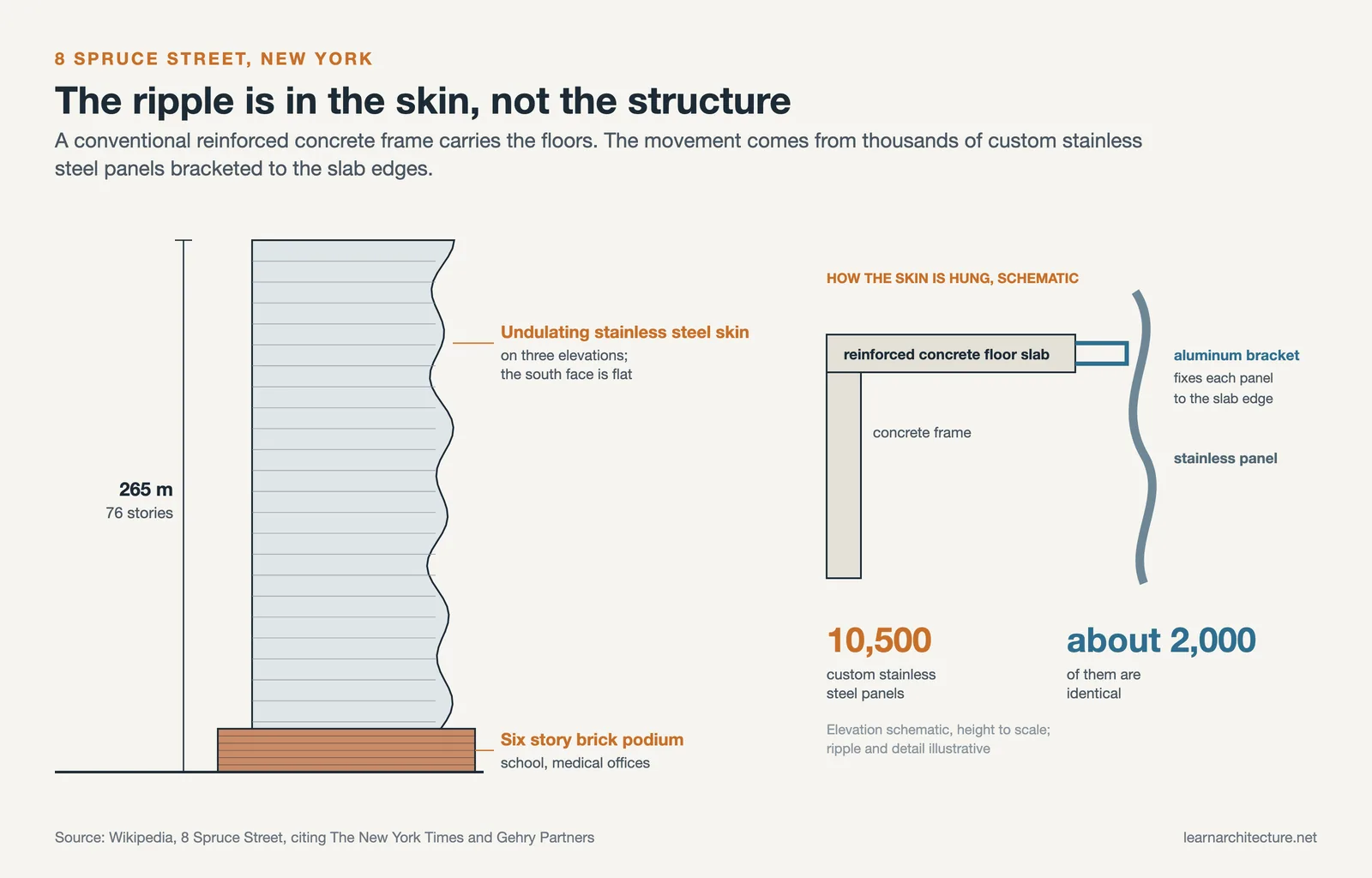
At 76 stories and 265 meters, 8 Spruce Street in Manhattan’s Financial District was the tallest residential building in the Western Hemisphere at the time of its completion. The tower’s exterior is clad in stainless steel panels that ripple and undulate from floor to floor, creating a facade that appears to flex as the eye moves upward. The lowest six stories form a more conventional brick-clad podium to align with the scale of the surrounding streets.
The project demonstrates that architecture by Frank Gehry is not limited to cultural or civic programs. The technical challenge here was integrating the undulating steel facade with a conventional reinforced concrete residential floor plate, where unit layouts and mechanical systems demanded consistency that the exterior deliberately undermined visually. The solution kept the reinforced concrete frame conventional and fixed the stainless steel panels to the slab edges with aluminum brackets, so the movement lives entirely in the skin.
For context on how Gehry’s influence reaches other contemporary architects working with similar formal ambitions, the guide to famous architects who transformed modern architecture places his career within a broader comparative frame. Those interested in the awards and recognition that architecture of this caliber receives will find additional detail in the article on the most famous architects and the awards they won.
How Frank Gehry Used Technology to Build the Unbuildable
One of the most important and least discussed aspects of frank gehry famous architecture is the role that software played in making it financially viable. Before CATIA, buildings with complex double-curved surfaces required enormous manual drafting effort and were prone to costly construction errors because fabricators lacked precise dimensional data. Gehry’s office began using CATIA in the early 1990s, initially on the Guggenheim Bilbao, and later developed it into a proprietary system through a spin-off company called Gehry Technologies.
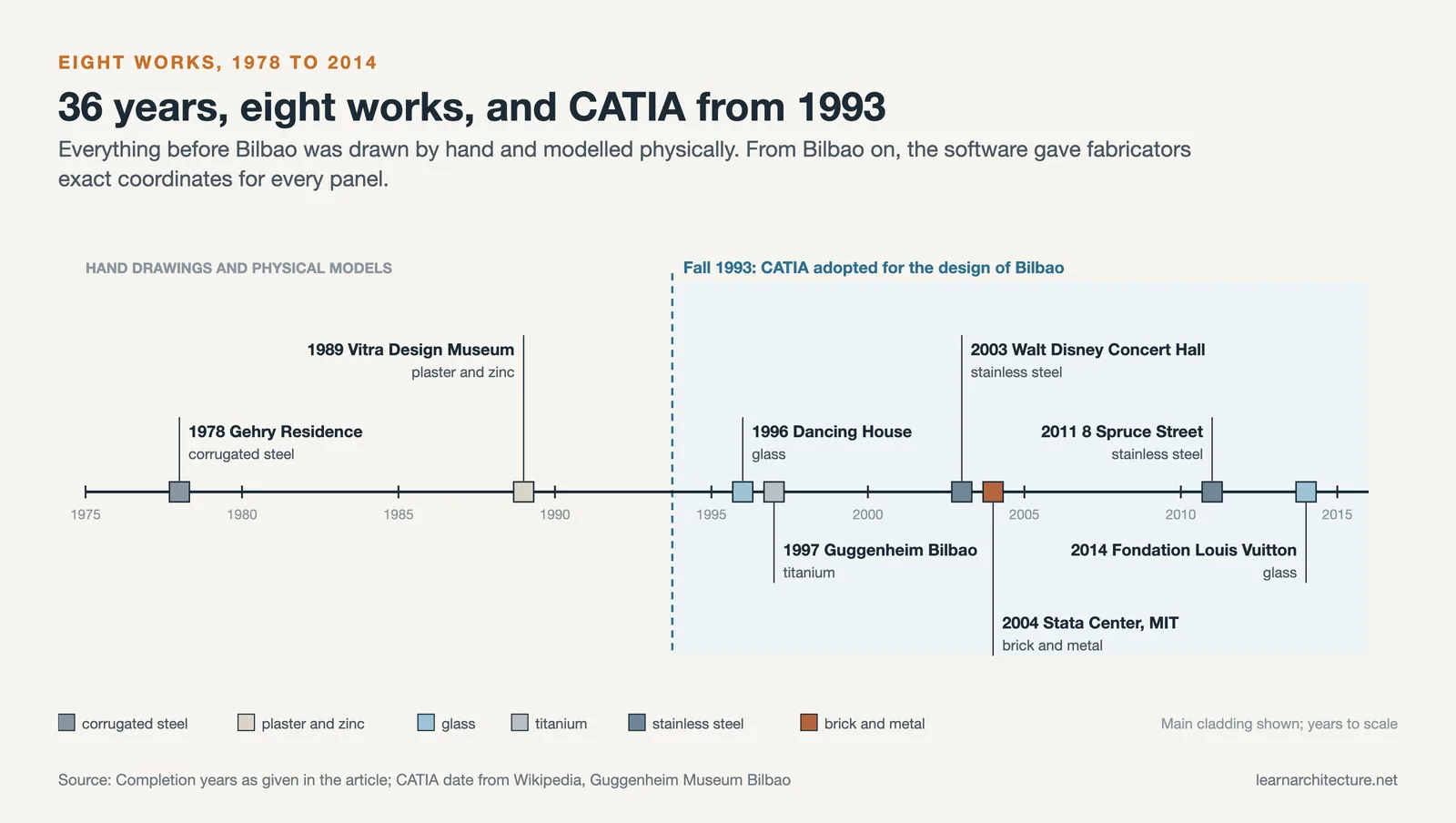
The software allowed his team to generate exact coordinates for every panel, structural element, and connection point in a building whose form defied conventional orthographic description. Subcontractors could fabricate off-site to tolerances measured in millimeters. This is why the Guggenheim Bilbao was completed on budget despite its unprecedented formal complexity, a fact that surprised many in the industry who had assumed such buildings would inevitably run over.
This digital workflow influenced the entire profession. The broader application of computational geometry and parametric modeling across contemporary practice owes a significant debt to what Gehry’s office demonstrated was possible on buildings of civic scale. For a technical overview of how digital tools function in architectural practice today, the resource on contemporary architectural design approaches provides useful background.
What Distinguished Frank Gehry’s Approach to Materials?

Across his career, Gehry returned repeatedly to materials that most architects avoided or dismissed as insufficiently refined. Corrugated galvanized steel, chain-link fencing, raw plywood, and unfinished concrete all appeared in early projects as a deliberate reaction against the smooth, polished surfaces of mainstream modernism. He saw these materials as honest and democratic, connected to the everyday industrial landscape rather than the elevated world of professional architecture.
As commissions grew in scale and ambition, the palette shifted. Titanium became his signature cladding material after the Vitra Design Museum, used to greatest effect at the Guggenheim Bilbao. Stainless steel followed for the Walt Disney Concert Hall and 8 Spruce Street. Both materials share an important quality: they are highly reflective, meaning the building’s appearance changes continuously throughout the day as light conditions shift. This gives frank gehry’s architecture a kinetic quality that photographs rarely fully capture.
For a comparative perspective on how different architects approach material selection as a primary design decision, the article on the role of shapes and materials in architecture examines these choices across a wider range of contemporary practitioners. The overview of seven key architectural styles in history also provides useful context for understanding how Gehry’s material approach related to broader stylistic movements of the postmodern period.
✅ Key Takeaways
- Frank gehry architecture style is most accurately described as deconstructivist in its visual language, but Gehry’s own stated philosophy centered on human emotion and experiential design rather than theoretical fragmentation.
- His adoption of CATIA software in the early 1990s was a turning point not just for his practice but for the profession, demonstrating that complex curved geometries could be built on schedule and on budget at civic scale.
- Titanium and stainless steel became his signature cladding materials because their reflectivity makes the buildings appear to change continuously with shifting light conditions.
- The “Bilbao Effect,” born from the Guggenheim Museum Bilbao, established a model for using landmark architecture as an instrument of urban and economic regeneration that cities have attempted to replicate worldwide.
- Gehry’s formal language was developed through hand sketching and physical models from the beginning of his career, well before digital fabrication tools, meaning the essential qualities of his architecture are rooted in spatial intuition rather than computational generation.
- Frank Gehry passed away on December 5, 2025, at age 96, with several projects still under construction at the time of his death.
Frank Gehry’s Lasting Influence on Contemporary Architecture
The architecture of frank gehry changed what clients, cities, and the public believed buildings could look like. Before Bilbao, curvilinear, formally complex structures were largely confined to the pages of architectural journals; after it, they became viable propositions for civic commissions around the world. The generation of architects who came of professional age in the late 1990s and 2000s, many of whom worked with parametric tools that Gehry helped legitimize, operate in a landscape he fundamentally reshaped.
His influence also extended to how architecture is communicated to non-specialist audiences. The Guggenheim Bilbao, the Walt Disney Concert Hall, and the Fondation Louis Vuitton are among the small number of recent buildings that have genuinely entered popular culture rather than remaining of interest only to professionals. This public recognition, rare for any architect, reflects the emotional directness that Gehry consistently pursued: buildings that make people feel something before they understand anything about architectural theory.
For further context on Gehry’s place among the architects who most significantly shaped the contemporary profession, the comparative study of Peter Zumthor’s architecture illustrates how a contemporaneous figure pursued equally distinctive work through entirely opposite formal and material strategies. Both architects demonstrate that the most lasting architectural contributions tend to emerge from a coherent personal position sustained over decades, regardless of stylistic category.
Further Reading and Primary Sources
For primary documentation on Gehry’s projects and working methods, the Guggenheim Foundation’s official project pages provide authoritative construction and programmatic data. The Chicago Architecture Center’s Gehry overview offers a concise career biography with verified dates and project information. For detailed academic analysis of Gehry’s formal methodology, the ArchDaily Frank Gehry archive aggregates critical coverage of individual buildings with drawings and photographs. The Google Arts and Culture virtual tour provides visual access to ten key buildings. For biographical context, Wikipedia’s Frank Gehry entry cites primary sources across all major projects and career phases.
- architecture by frank gehry
- architecture frank gehry
- architecture of frank gehry
- frank gehry architectural style
- frank gehry architecture
- frank gehry architecture style
- frank gehry famous architecture
- frank gehry style architecture
- frank gehry style of architecture
- frank gehry's architecture
- frank o gehry architecture










Leave a comment