


Table of Contents Show
Organic vs parametric design represents one of architecture’s most compelling philosophical divides. Organic architecture treats nature as a guiding principle, shaping buildings that grow from their sites and respond to the human body. Parametric design uses mathematical algorithms to generate and optimize form, allowing architects to explore thousands of variations through computational logic. Both approaches challenge conventional building, but they start from fundamentally different premises.

What Is Organic Architecture?
Organic architecture is a design philosophy rooted in the idea that buildings should emerge from their environment rather than be imposed on it. The term was coined by Frank Lloyd Wright, who believed that “form and function are one”, a direct response to Louis Sullivan’s earlier “form follows function.” For Wright, this wasn’t a stylistic preference but an ethical stance: a building that ignored its site, its materials, and its occupants was simply a failure.
The principles of Frank Lloyd Wright’s organic architecture center on continuity between the built and natural world. This means using materials found or suited to the site, designing to the human scale, and creating spaces where interior and exterior flow into each other. Fallingwater (1939), cantilevered over a Pennsylvania waterfall, is the canonical example. Every horizontal slab mirrors the rock ledges beneath. The sound of the stream enters every room. Wright did not so much place a house on the land as grow it from it.
🏗️ Real-World Example
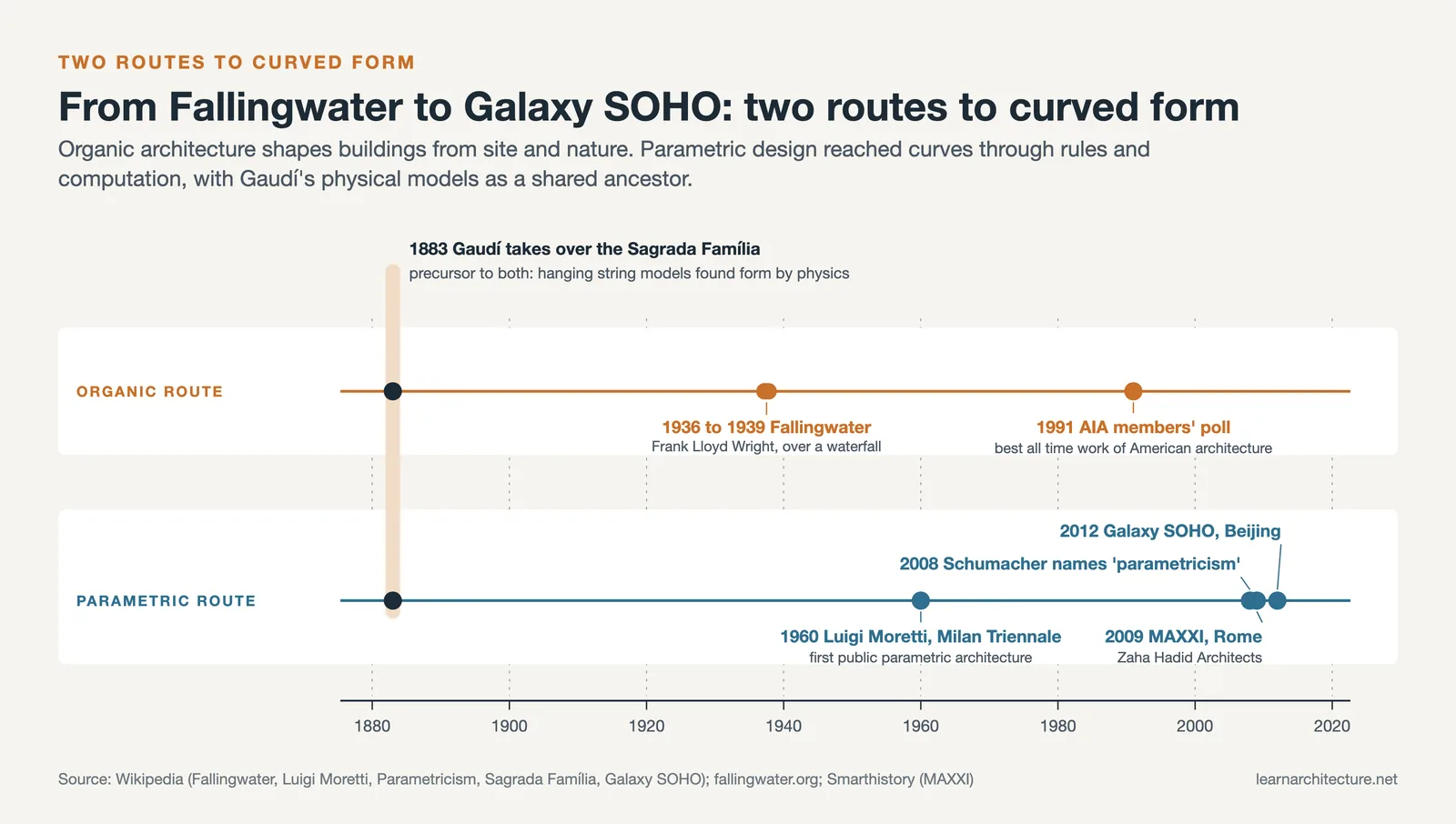
Fallingwater (Bear Run, Pennsylvania, 1939): Designed by Frank Lloyd Wright for the Kaufmann family, Fallingwater sits directly above a natural waterfall rather than beside it, a deliberate choice Wright made to bind the structure to moving water and stone outcroppings. The reinforced concrete cantilevers extend up to 18 feet beyond their supports, a structural risk Wright insisted on to achieve visual weightlessness. In a 1991 poll of American Institute of Architects members, it was named the best all-time work of American architecture.
Other practitioners of organic architecture include Alvar Aalto, whose undulating brick and wood interiors at Viipuri Library and Villa Mairea respond to Finnish light and landscape, and Bruce Goff, who pushed organic principles toward highly individual, almost sculptural building forms. More recently, architects like Ken Yeang and biophilic design practitioners have extended organic thinking into green urbanism and ecological building.

Core Principles of Organic Architecture
While organic architecture varies across practitioners, several principles appear consistently. Buildings should derive their character from the nature of the site, responding to topography, climate, and local materials. Spaces should flow rather than be subdivided into rigid boxes. The human figure sets the scale. Materials should express their own inherent qualities: wood should look like wood, stone like stone. Ornamentation, when it appears, grows from the structure itself rather than being applied as a surface treatment.
This last point is worth emphasizing because it is often misunderstood. Organic architecture is not the same as buildings shaped to look like leaves or shells. The “organic” refers to an integrated wholeness, not a visual metaphor for nature. Wright’s geometric Prairie houses, with their strong horizontal lines and overhanging eaves, are no less organic for lacking curved forms.
⚠️ Common Mistake to Avoid
Many students and clients conflate organic architecture with buildings that look like natural objects: curved roofs imitating waves, facades shaped like tree bark. This is a misreading. As Wright stated, organic architecture refers to integrated wholeness, not visual mimicry. A rigidly rectilinear Prairie house is fully “organic” in Wright’s sense if its form, materials, and spatial sequence grow from site conditions and human use. The confusion leads designers to prioritize biomorphic aesthetics over the underlying principle of contextual integration.
What Is Parametric Design Architecture?
Parametric design architecture is a computational methodology in which architectural form is generated through algorithms and variable inputs rather than fixed manual drawing. Architects define a set of parameters (structural loads, solar angles, facade density, circulation distances) and the software produces geometries that satisfy those conditions simultaneously. Adjusting one parameter updates the entire model. This is what makes parametric design architecture fundamentally different from CAD: it is relational, not static.
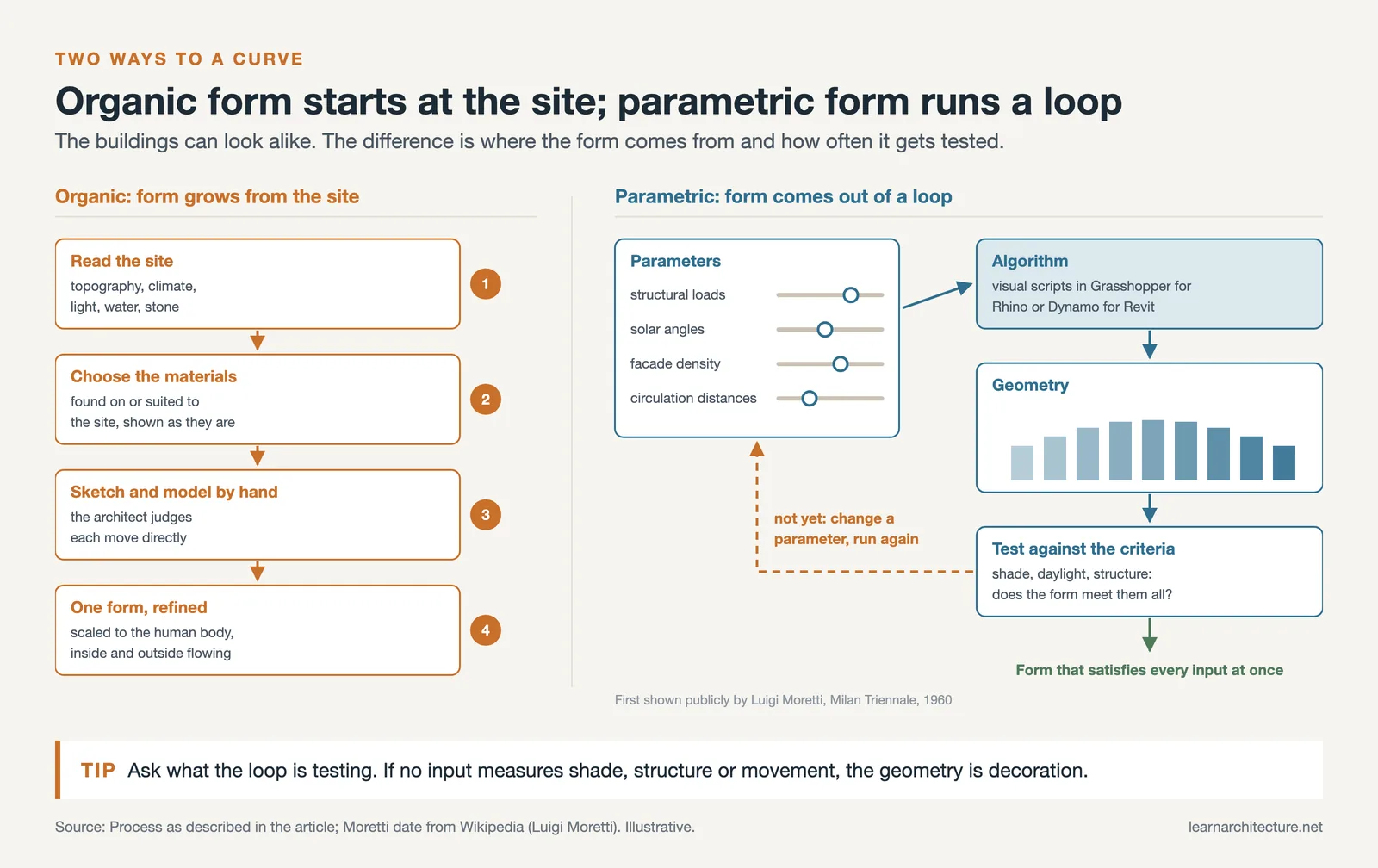
The term “parametric architecture” was first used publicly by Italian architect Luigi Moretti, who displayed a stadium model driven by 19 measurable parameters at a 1960 Milan exhibition. The computational tools that would make parametric design widely accessible came decades later. Today, platforms like Grasshopper for Rhino and Dynamo for Revit allow architects to build visual scripting systems without writing code, lowering the barrier to parametric working significantly.
🎓 Expert Insight
“Parametricism is the great new style after modernism. It permeates all avant-garde architecture and is about the design of complex, continuously differentiated environments.”
Patrik Schumacher, Principal, Zaha Hadid Architects
Schumacher coined the term “parametricism” in 2008 to describe this computational design movement as a full architectural style, not merely a software workflow. Whether one accepts that framing or not, his argument draws attention to how parametric tools have changed not just how architects draw but how they think about spatial complexity and differentiation.
Zaha Hadid Architects became the most globally recognized practice to build its output on parametric methods. Projects like the MAXXI National Museum of the 21st Century Arts in Rome (2009) and the Galaxy SOHO in Beijing (2012) feature continuous curved surfaces, flowing interiors with no visible corners, and structural systems that would be impossible to design or document without parametric software. These buildings did not originate from a sketch of a natural form; they emerged from algorithmic processes that generated and refined their geometry through multiple computational iterations.

How Parametric Architecture Examples Differ from Organic Forms
A common question when comparing organic vs computational design is whether the resulting buildings look similar. They sometimes do: both approaches can produce curved, flowing forms. But the origin of those forms differs sharply. An organic architect like Aalto arrived at his curves through a tactile, intuitive engagement with material and site. A parametric architect arrives at curves through algorithmic optimization, often running hundreds of iterations before settling on a form that satisfies multiple performance criteria at once.
This distinction matters practically. A parametric facade might be designed so that its geometry responds to solar angles across the building’s entire surface, providing maximum shade in summer and maximum light penetration in winter, all while achieving a specific structural efficiency ratio. No human working intuitively could optimize across that many variables simultaneously. That is precisely the argument for parametric tools in complex, performance-driven projects.
💡 Pro Tip
When reviewing student work or competition entries that invoke parametric design, check whether the algorithm is actually driving meaningful outcomes (structural efficiency, environmental performance, spatial quality) or whether it is simply generating visual complexity for its own sake. A parametric process that only produces novel geometry without solving a real design problem is, as critics of the style often note, decoration by algorithm. The best parametric work shows a clear link between the computational inputs and the spatial or structural benefits delivered by the output.
Organic Architecture vs Parametric Design: A Direct Comparison
The following table summarizes the key differences between organic architecture and parametric design across philosophy, process, tools, and notable examples.

Organic Architecture vs Parametric Design Comparison
Both approaches produce nature-influenced forms, but through fundamentally different processes:
| Aspect | Organic Architecture | Parametric Design |
|---|---|---|
| Core Principle | Harmony between building, site, and human inhabitation | Form generated through algorithms and variable inputs |
| Design Process | Intuitive, material-led, site-responsive | Computational, iterative, rule-based |
| Key Tools | Drawing, physical models, site observation | Grasshopper, Dynamo, Rhino, Revit scripting |
| Relationship to Nature | Nature as philosophical guide and material source | Nature as structural model and optimization reference |
| Leading Practitioners | Wright, Aalto, Goff, Soleri | Zaha Hadid, Bjarke Ingels, Calatrava, Fuksas |
| Scalability | Works best at human-scale buildings; can be harder to scale up | Highly scalable; well-suited to complex large-scale projects |
| Typical Outcome | Buildings deeply rooted in place and material | Buildings with complex geometry and optimized performance |
Can Organic and Parametric Design Overlap?
The boundaries are less fixed than the comparison table implies. Some of the most interesting contemporary architecture explores the overlap between organic sensibility and computational methods. Kengo Kuma’s work, for instance, draws on organic principles of material honesty and site integration but uses digital fabrication to achieve structural precision that hand-drawing could never deliver. BIG (Bjarke Ingels Group) frequently uses parametric tools to optimize building performance while maintaining a commitment to livable, human-scale spaces.
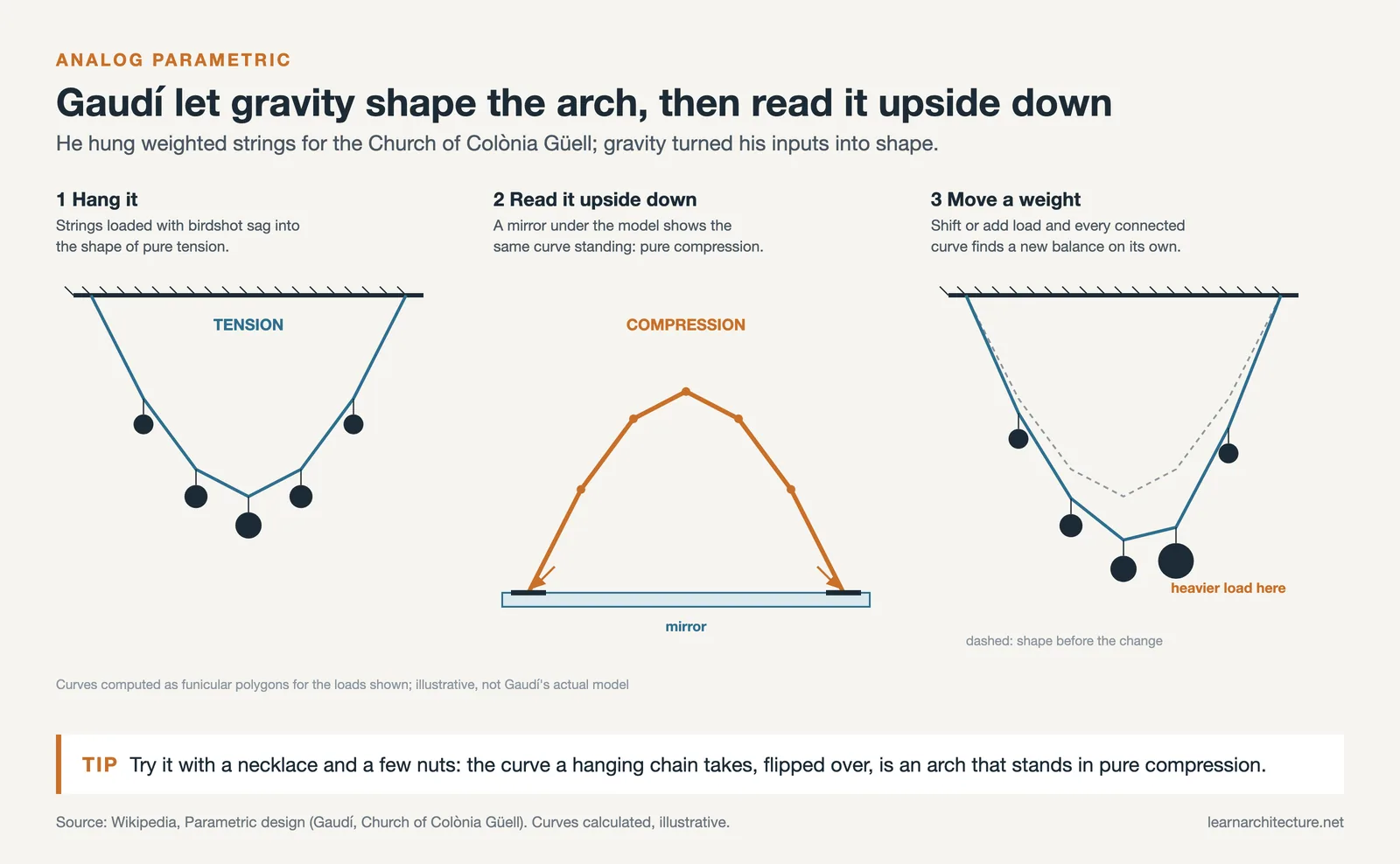
Gaudi himself is often cited as an early precursor to parametric thinking. His inverted chain models at the Sagrada Familia effectively used gravity as an analog algorithm to find structurally optimal catenary arch forms. The process was computational in spirit, even if the tool was weighted string rather than software. This historical precedent suggests that algorithmic thinking and organic architecture are not inherently opposed; they can reinforce each other when the computational logic is directed toward ecological, contextual, and human-centered outcomes.
📌 Did You Know?
Antoni Gaudí’s design process for the Sagrada Familia vaults used weighted strings suspended from a mirrored ceiling, effectively running a gravity-driven structural optimization that predates digital parametric tools by over a century. When Gaudí needed to adjust the arch profiles, he simply moved the weights, and the string network reconfigured itself into a new structurally valid form. Zaha Hadid Architects cited this analog parametric method as an inspiration for their own computational approach to form-finding.

Which Approach Is Right for Your Project?
The choice between organic architecture principles and parametric design methods is not binary, but certain project conditions favor one over the other. Organic architecture tends to produce the strongest results when a project is deeply site-specific, when the scale is human (residential, civic, community), and when the client values material character and contextual sensitivity over geometric spectacle. Parametric design excels when projects are large and geometrically complex, when performance optimization across multiple variables is a priority, and when the client and contractor have the digital fabrication infrastructure to actually build what the algorithm generates.
Budget and timeline are also real factors. Building a parametrically designed facade with thousands of individually differentiated panels requires CNC fabrication, detailed BIM documentation, and contractors experienced in digital construction. A beautifully detailed organic building in stone and timber can be built by skilled tradespeople working from clear drawings. Neither approach is inherently more expensive, but the costs concentrate in different places.
💡 Pro Tip
Architects exploring parametric methods for the first time often apply them to facade design, where the visual impact is highest and the structural stakes are lower. Before committing to a complex parametric envelope, model the full construction sequence with your contractor. The design-to-fabrication gap is where parametric projects most often lose time and budget. Tools like Rhino.Inside.Revit can help bridge the gap between parametric design geometry and BIM documentation workflows.
✅ Key Takeaways
- Organic architecture, rooted in Frank Lloyd Wright’s philosophy, treats harmony between building, site, and occupants as the primary design value; it is not a visual style but an integrated approach to place-making.
- Parametric design uses algorithms to generate and optimize architectural form through variable inputs, making it especially powerful for geometrically complex and performance-driven projects.
- The two approaches can overlap: Gaudí’s weighted string models show that parametric thinking predates computers, and contemporary architects like Kengo Kuma and BIG blend computational tools with organic sensibility.
- Choosing between them depends on project scale, site conditions, client priorities, and the fabrication capacity of the supply chain; neither is universally superior.
- The most common mistake is reducing organic architecture to curved forms and parametric design to visual complexity. Both are defined by process and intention, not aesthetic surface.
For further reading on related approaches, see biomimicry and nature-inspired design in architecture and our guide to computational design in architecture. For the history of parametric thinking in built form, the Wikipedia article on parametric design provides a reliable timeline. The Frank Lloyd Wright Foundation’s essay on organic architecture remains the most authoritative primary source on Wright’s philosophy.
- algorithmic architecture
- frank lloyd wright organic architecture
- nature-inspired architecture
- organic architecture
- organic architecture principles
- organic architecture vs parametric design
- organic vs computational design
- parametric architecture examples
- parametric design architecture
- zaha hadid parametric design






Leave a comment