


Table of Contents Show
Biophilic design is a philosophy that integrates natural elements, materials, and sensory experiences into the built environment to strengthen the human-nature connection. Minimalist architecture, by contrast, reduces buildings to their essential forms, eliminating ornamentation in favor of clarity and function. Both approaches shape how people experience space, but they pursue different outcomes through fundamentally different means.
What Is Biophilic Design in Architecture?

The concept of biophilia, meaning “love of life,” was first introduced by social psychologist Erich Fromm in 1964 and later popularized by biologist Edward O. Wilson in his 1984 book of the same name. Wilson argued that humans possess an innate affinity for other living systems, and that severing this connection carries real psychological and physiological costs.
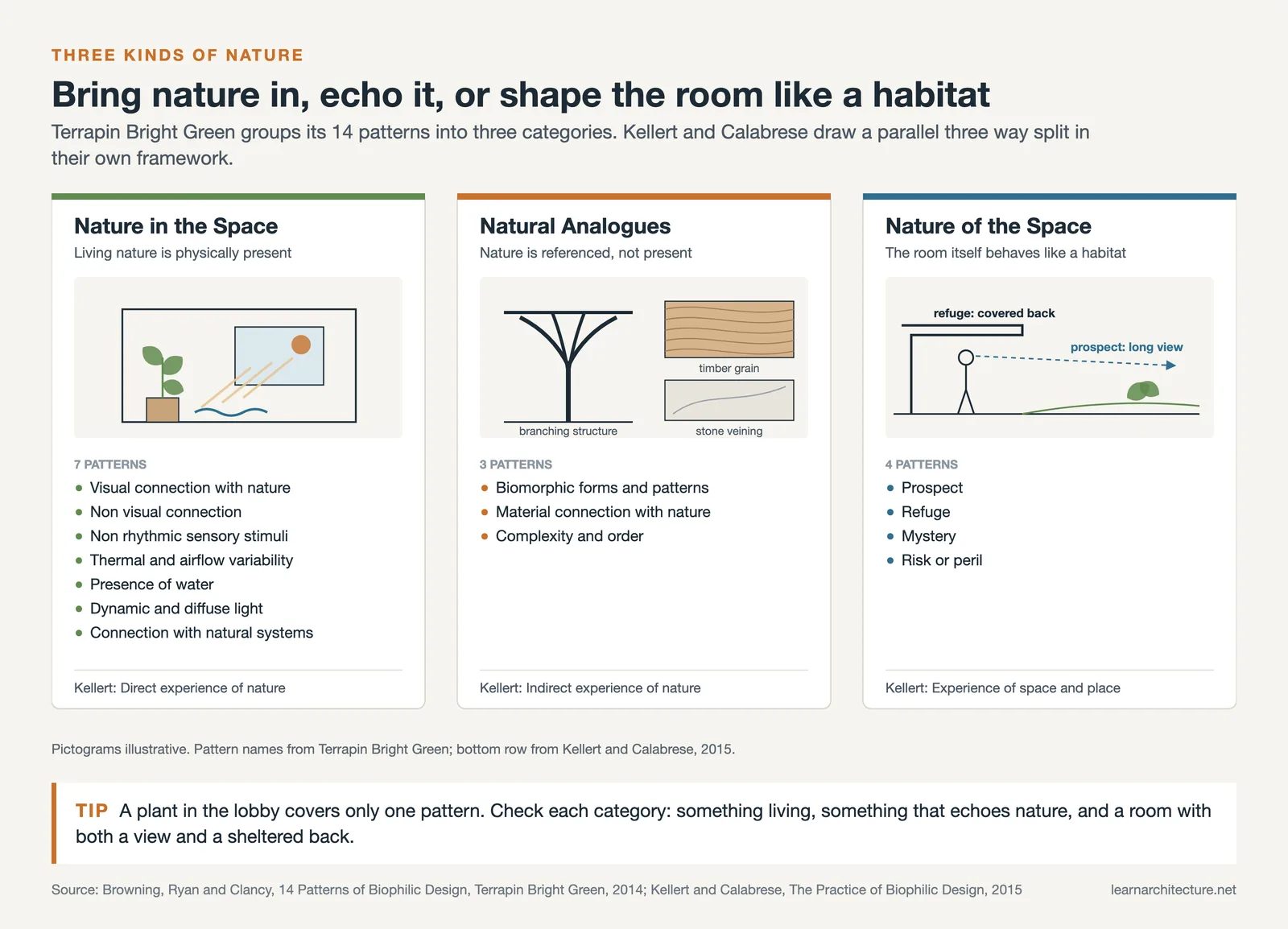
In architecture, biophilic design translates this idea into spatial strategies. Terrapin Bright Green’s report 14 Patterns of Biophilic Design (2014) organizes these strategies around three core categories: Nature in the Space (direct presence of plants, water, natural light), Natural Analogues (organic shapes, natural materials, textures referencing the living world), and Nature of the Space (spatial configurations that echo habitats, such as prospect-and-refuge dynamics).
This means biophilic design is far more than placing houseplants in a lobby. Buildings like Frank Lloyd Wright’s Fallingwater, which is built over a waterfall with locally sourced stone and views embedded into every room, represent early examples of how architecture can be structured around the human need for nature. More recently, Milan’s Bosco Verticale and Singapore’s Jewel Changi Airport have pushed the concept into large-scale, urban contexts.
📌 Did You Know?
Americans spend approximately 90% of their time indoors, according to a study conducted by the U.S. Environmental Protection Agency. This statistic is one of the primary reasons architects and researchers have turned to biophilic design principles as a public health issue, not just an aesthetic preference.
What Is Minimalist Architecture?

Minimalist architecture draws from two major intellectual currents: the Bauhaus movement in early 20th-century Germany, with its principle that “form follows function,” and Japanese Zen philosophy, particularly the concepts of Wabi-Sabi (finding beauty in imperfection) and Ma (the significance of negative space). These two traditions converged in the mid-20th century through architects like Ludwig Mies van der Rohe, whose famous dictum “less is more” became a guiding principle for an entire generation of designers.
In practice, minimalist architecture uses clean lines, restrained material palettes, and open plans to create spaces where every element serves a clear purpose. Ornamentation is stripped away. Structural elements are often left exposed. The focus shifts to proportion, light, and spatial flow rather than decoration.
Contemporary minimalist buildings, from Tadao Ando’s Church of the Light in Osaka to John Pawson’s residential work in the UK, demonstrate how spatial reduction can generate powerful emotional responses. The absence of complexity forces the occupant to engage with what remains: light, shadow, material, volume.
⚠️ Common Mistake to Avoid
Many people assume minimalist architecture means cold or sterile spaces. This misreads the philosophy. Architects like Tadao Ando and Peter Zumthor consistently achieve warmth and emotional depth through material honesty, refined proportions, and deliberate use of natural light. Minimalism is not about emptiness for its own sake; it is about removing distraction so that essential qualities can be experienced more fully.
Biophilic Design vs Minimalism: Core Principles Compared

At first glance, biophilic design and minimalist architecture can appear to be at odds. One introduces elements, the other removes them. But the comparison becomes more nuanced when you examine what each approach values.
Comparison of Biophilic Design vs Minimalist Architecture
The following table summarizes the key differences across core design dimensions:
| Design Dimension | Biophilic Design | Minimalist Architecture |
|---|---|---|
| Primary Goal | Strengthen human-nature connection | Eliminate non-essential elements |
| Natural Elements | Central to the design strategy | Used selectively, not defining |
| Material Palette | Wood, stone, water, plants, organic textures | Concrete, glass, steel, monolithic surfaces |
| Spatial Complexity | Layered, sensory-rich environments | Simplified, uncluttered spatial sequences |
| Philosophical Roots | Evolutionary biology, environmental psychology | Bauhaus, Japanese Zen, functionalism |
| Occupant Well-being | Achieved through nature immersion | Achieved through clarity and calm |
| Sustainability Link | Direct, through living systems integration | Indirect, through material efficiency |
Biophilic Design Principles and How They Work in Practice

The most widely cited framework for biophilic design principles is organized around 14 patterns, as detailed in the influential Terrapin Bright Green report “14 Patterns of Biophilic Design.” These range from visual connections with nature (windows framing garden views, skylights admitting direct sunlight) to more subtle interventions like prospect-and-refuge spatial arrangements, where rooms offer both open views and enclosed retreats, mirroring environments that provided safety and resource access for early humans.
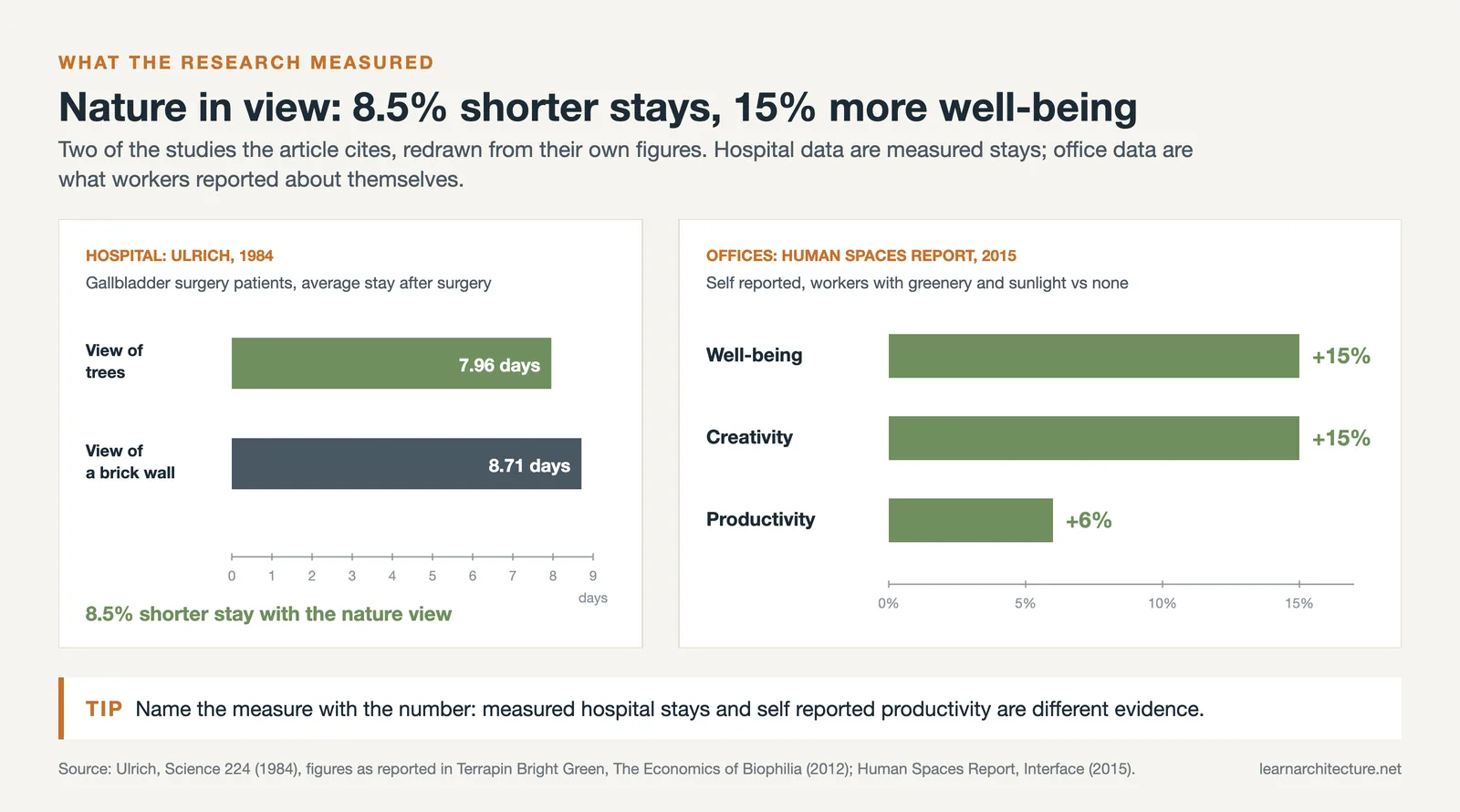
Water is another powerful biophilic tool. The sound of flowing water consistently reduces cortisol levels and lowers blood pressure. This is why water features in buildings are not purely decorative; they serve a measurable physiological function. Roger Ulrich’s landmark 1984 study comparing patient recovery rates based on whether hospital rooms had windows facing nature or a brick wall found that nature-facing patients recovered faster, required less pain medication, and had fewer complications.
💡 Pro Tip
When incorporating biophilic elements into a project, resist the temptation to treat them as an afterthought or a décor layer added at the end. Biophilic design works best when it drives spatial decisions from the schematic phase: orienting rooms toward garden views, positioning openings to frame sky and trees, and selecting structural materials for their tactile and sensory qualities. Retrofitting biophilia onto an already-completed scheme rarely achieves the same result.
Beyond plants and water, biophilic architecture also uses what researchers call natural analogues: organic shapes, fractal patterns, and materials that reference the living world without containing it directly. A ceiling with a branching structural pattern, stone flooring that shows natural veining, or timber cladding left in its rough-sawn state all trigger biophilic responses without requiring any maintenance or irrigation.
Biophilic Design Examples: Projects That Define the Approach
Several buildings have become benchmarks for what biophilic architecture can achieve at scale. The Amazon Spheres in Seattle, completed in 2018, are perhaps the most visible corporate example: three glass domes within Amazon’s headquarters that house over 40,000 plants from 30 countries. Employees access the spheres as a working and thinking environment, with research from Amazon reporting improvements in focus and satisfaction among staff who use the space regularly.
Singapore’s Jewel Changi Airport takes the concept further into a civic context. The building’s centerpiece is the Rain Vortex, the world’s tallest indoor waterfall at 40 meters, surrounded by a multi-level forest valley containing over 100,000 plants. The design, by Moshe Safdie, demonstrates that even a transit infrastructure project can be organized around the principles of nature integration.
🏗️ Real-World Example
Khoo Teck Puat Hospital (Singapore, 2010): Designed as a “hospital in a garden and a garden in a hospital,” KTPH integrated over 700 plant species across its facades, rooftops, and corridors. The building’s walls were specifically designed to channel prevailing winds and improve natural ventilation by 20-30%, reducing mechanical cooling loads while simultaneously creating a measurably calming environment for patients and staff. The project has become a global reference point for evidence-based biophilic design in healthcare architecture.
On a residential scale, biophilic interior design principles are increasingly applied in homes through large operable windows, internal courtyards, planted terraces, and the use of raw materials like stone, timber, and rammed earth. These strategies are accessible at many budget levels and can be incorporated incrementally over time.
How Does Minimalist Architecture Relate to Well-being?

Minimalist architecture achieves its effect through a different mechanism. Rather than adding stimuli, it removes distraction, creating spaces where the occupant’s attention can settle on what remains. For Tadao Ando, this typically means the quality of concrete, the angle of a light shaft cutting across a wall, or the sound of silence within a sealed enclosure. For John Pawson, it often means the relationship between surfaces and proportions that makes a room feel exactly the right size without excess.
Research on clutter and cognitive load supports the minimalist approach from a psychological standpoint. Studies at Princeton University’s Neuroscience Institute found that physical clutter competes for attention and reduces the brain’s ability to process information and focus. Environments with fewer competing visual inputs consistently produce lower stress responses and higher concentration scores.
The challenge for minimalism is that stripped-back spaces can feel alienating or sterile when not executed with care. The difference between a successful minimalist space and an uncomfortable one often comes down to the texture and warmth of the materials retained, the quality of light, and whether the occupant has a genuine connection to the objects and surfaces that remain.
🎓 Expert Insight
“Architecture should speak of its time and place, but yearn for timelessness.”
Frank Gehry
This observation applies equally to both biophilic and minimalist architecture. The most enduring examples of either approach achieve their effect by solving something fundamental about how humans experience space, light, and material, rather than through stylistic choices tied to a particular decade.
Where Biophilic Design and Minimalism Overlap
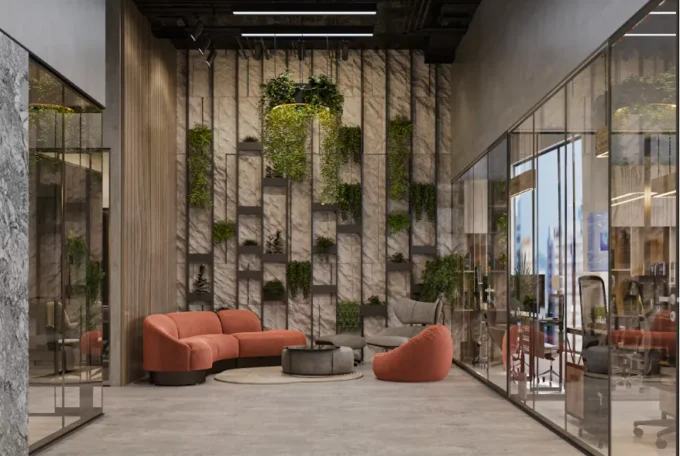
The assumption that these two approaches are mutually exclusive does not hold up against the evidence of built work. Warm minimalism, a term describing minimalist architecture enriched with natural materials and soft tactile surfaces, represents a practical synthesis that many contemporary architects have adopted. Rather than choosing between nature integration and spatial reduction, the approach asks: what is the minimum set of elements needed to create a space that is both calm and alive?
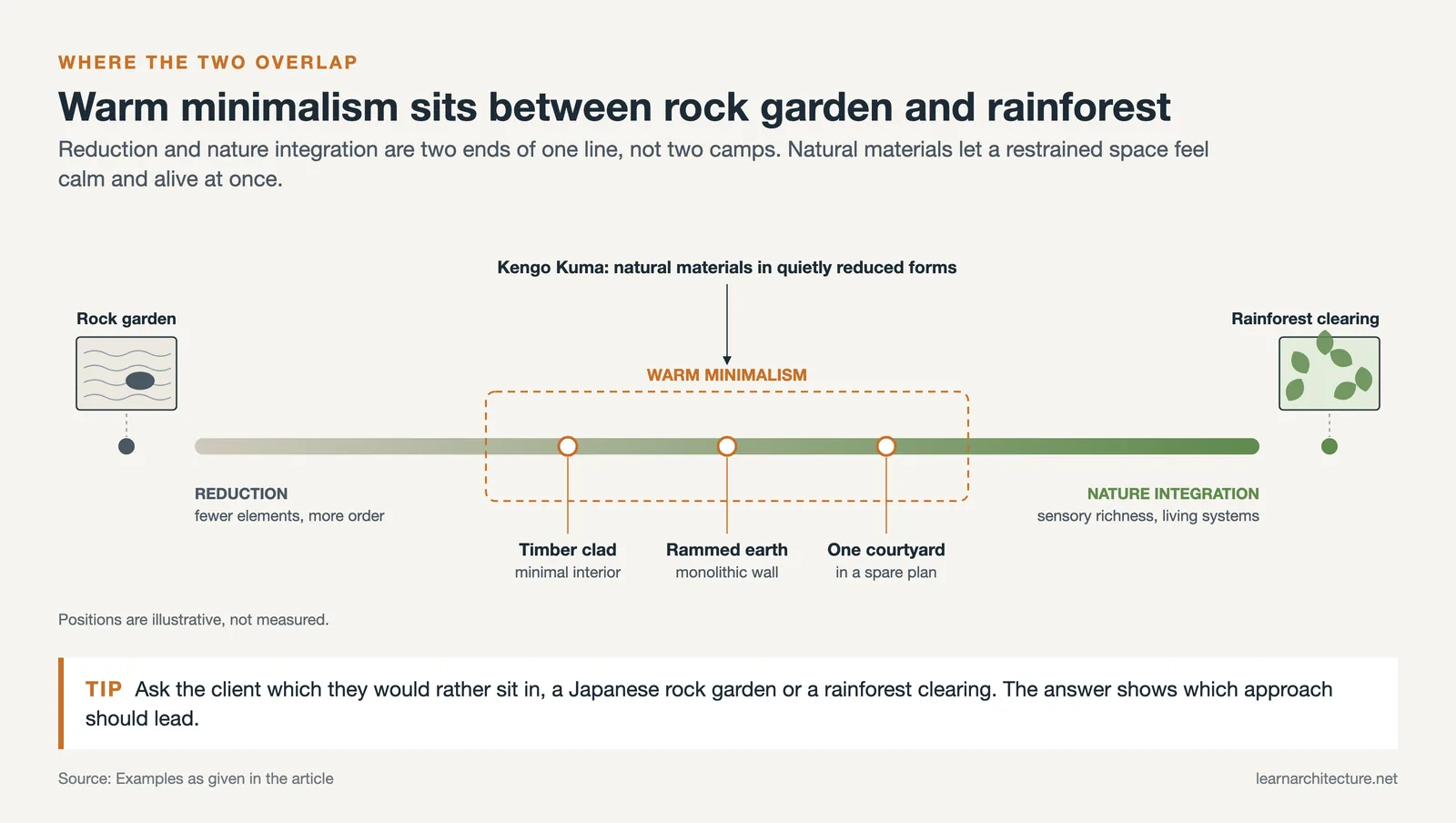
Timber-clad minimalist interiors, for example, use the visual and tactile qualities of wood to add warmth and sensory richness to an otherwise restrained palette. Rammed earth walls combine the raw material quality central to biophilic design with the monolithic, undivided surfaces characteristic of minimalism. Courtyards embedded in otherwise spare plans allow a single concentrated encounter with sky, light, and planting without adding visual noise elsewhere in the building.
Architects like Kengo Kuma, whose work consistently integrates natural materials into quietly reduced forms, represent this convergence in practice. His projects rarely feel maximalist or burdened with greenery, yet they consistently achieve a sense of organic presence through material selection, texture, and the careful management of natural light. For a deeper look at how material choices affect this balance, explore our guide to sustainable building materials.
💡 Pro Tip
When advising clients who want “a calm, natural space,” clarify early whether their priority is reduction (fewer elements, more order) or nature integration (sensory richness, living systems). The two are not the same, and conflating them leads to designs that satisfy neither goal. A simple diagnostic is to ask: would they prefer to sit in a Japanese rock garden or in a rainforest clearing? The answer usually reveals which philosophy should lead the project.
Biophilic Design Benefits in Architecture: What the Research Shows

The body of evidence supporting biophilic design benefits in architecture has grown substantially over the past two decades. Beyond Roger Ulrich’s foundational hospital study, research across office, education, and retail environments consistently shows that occupants in nature-integrated buildings report lower stress, better sleep quality, improved cognitive function, and higher overall satisfaction with their environment.
A 2023 meta-analysis published in the journal Building and Environment reviewed 30+ studies on workplace biophilic interventions and found consistent reductions in self-reported stress and improvements in attention restoration across settings. Workplaces incorporating biophilic elements also report lower absenteeism. Forest and Wood Products Australia’s research linking the presence of natural wood surfaces to employee satisfaction and productivity has been cited widely in workplace design guidance from organizations including the U.S. Green Building Council.
🔢 Quick Numbers
- Nature-view hospital rooms reduced patient recovery time by 8.5% compared to brick-wall rooms (Ulrich, 1984, published in Science)
- Offices with biophilic design elements reported a 15% increase in self-reported well-being and a 6% increase in productivity (Human Spaces Report, Interface, 2015)
- Offices with natural elements such as greenery and sunlight also reported 15% higher self-reported creativity (Human Spaces Report, Interface, 2015)
These figures matter for architects and developers because they translate into concrete business cases, not just aesthetic preferences. For clients who remain skeptical of nature-integrated architecture as a cost driver, framing biophilic design as a productivity and retention investment often changes the conversation.
Which Approach Is Right for Your Project?
The choice between a biophilic design framework and a minimalist approach depends on the project’s program, the client’s priorities, the site conditions, and the budget available for long-term maintenance. Neither approach is universally superior.
Biophilic design tends to deliver the strongest results in buildings where occupant well-being and dwell time are central concerns: healthcare facilities, schools, offices, and residential buildings where people spend most of their day. It also performs well in urban infill contexts where the built environment has displaced natural elements and users have limited access to green space. For architecture students interested in developing a personal approach, our articles on sustainable architecture principles provide a useful starting point.
Minimalist architecture is often better suited to civic or cultural programs where spatial clarity and the quality of a single material or experience are the primary objectives, or to clients who value order and simplicity over sensory variety. It also tends to age more gracefully in terms of maintenance, since there are fewer elements to replace or renew over time.
In residential projects, the hybrid approach of warm minimalism with embedded biophilic elements is increasingly the default in high-quality contemporary housing. It offers the serenity of a reduced palette while avoiding the sensory deprivation that pure minimalism can create in everyday living environments.
✅ Key Takeaways
- Biophilic design is grounded in evolutionary biology: humans have a documented physiological response to natural elements, and architecture can be structured to harness this connection.
- Minimalist architecture achieves well-being through a different route: reducing cognitive load and allowing occupants to engage with a smaller, more carefully chosen set of experiences.
- The two approaches are not mutually exclusive. Warm minimalism, rammed earth, and timber-led interiors represent built examples of their successful integration.
- Biophilic design delivers measurable benefits in healthcare, education, and workplace environments that have been consistently replicated across peer-reviewed research.
- The best design decisions come from understanding what the occupant genuinely needs: nature immersion, spatial calm, or both.









Leave a comment