


Table of Contents Show
Deconstructivism vs constructivism represents one of architecture’s most intellectually charged debates. Constructivism, born in 1920s Soviet Russia, used geometry and industrial materials to serve society. Deconstructivism, which emerged in the 1980s, deliberately fragmented those very forms to destabilize meaning and challenge order. Though the names sound related, their philosophies are almost diametrically opposed.

What Is Constructivism in Architecture?
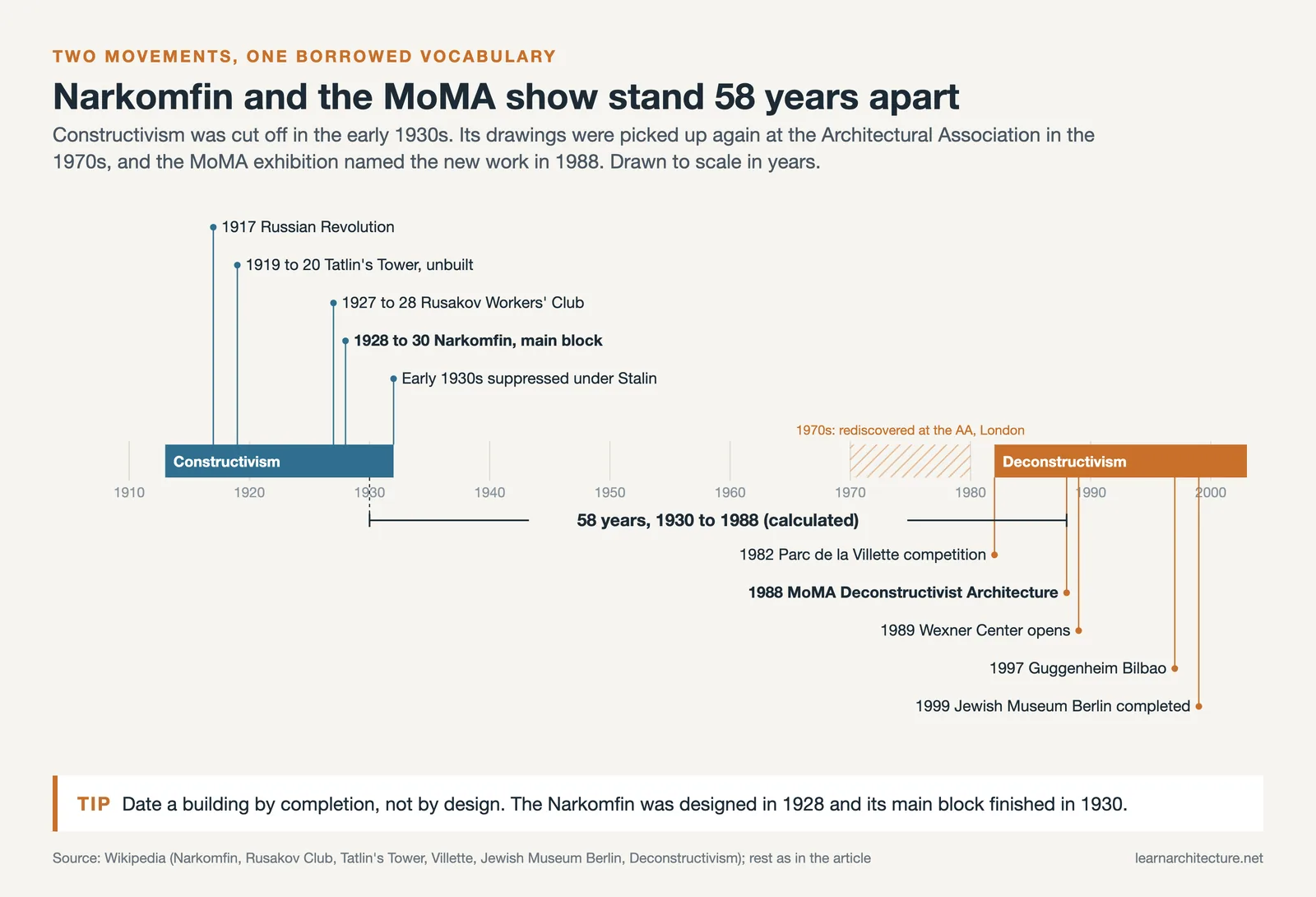
Constructivism emerged in the Soviet Union around 1913 and gained momentum after the 1917 Russian Revolution. It was not merely an aesthetic preference but an ideological commitment: architecture should serve the collective, reflect industrial progress, and reject bourgeois ornament. The movement’s architects believed that a new society required a new built form.
The constructivism movement drew heavily from Russian Futurism and Suprematism, using abstract geometric forms as its visual language. Steel, glass, concrete, and other industrial materials became the palette of choice. Facades were stripped of decoration; what remained was structure itself, expressed as honestly as possible. Form followed function in the most literal sense, but function was always tied to social purpose.
Key figures included Alexander Vesnin, Moisei Ginzburg, and El Lissitzky. Their work was characterized by rectilinear clarity, grid-based compositions, and an emphasis on collective housing, workers’ clubs, and state institutions. The most emblematic unbuilt project was Vladimir Tatlin’s proposed Monument to the Third International (1919), a rotating iron and glass tower intended to soar higher than the Eiffel Tower and house Soviet government functions. Although never constructed, it became a symbol of constructivist ambition.
💡 Pro Tip
When analyzing constructivist buildings in academic or professional contexts, pay close attention to how structural elements are expressed on the exterior. Constructivist architects treated the structural frame not as something to hide but as the primary aesthetic statement. If a building conceals its structure behind cladding, it is almost certainly not constructivist in spirit, regardless of its geometry.
Constructivism architecture was suppressed under Stalin in the early 1930s, replaced by Socialist Realism. Many projects were never built, and the movement’s built legacy is modest. However, its ideas traveled westward and resurfaced decades later in ways their originators never anticipated.

Key Constructivist Buildings
Among the most important realized works of constructivism architecture are the Rusakov Workers’ Club in Moscow (1927 to 1928) by Konstantin Melnikov, with its cantilevered concrete volumes projecting outward like mechanical arms, and the Narkomfin Communal House (designed 1928, main block completed 1930) by Ginzburg and Milinis, a pioneering experiment in collective living that prefigured later modernist housing blocks. El Lissitzky’s Ogonyok Printing Plant in Moscow (1932) remains a regional landmark to this day.
🏗️ Real-World Example
Narkomfin Building (Moscow, 1930): Designed by Moisei Ginzburg and Ignaty Milinis, this communal housing block was designed around the Constructivist ideal that architecture could actively reshape social behavior. It featured shared communal spaces, a roof terrace, a gym, and a library, with individual apartments deliberately kept minimal to push residents toward collective life. It is considered a direct predecessor of Le Corbusier’s Unité d’Habitation and influenced social housing design across Europe for decades.
What Is Deconstructivism in Architecture?
Deconstructivism is a postmodern architectural movement that emerged in the 1980s. Its name is a deliberate portmanteau of two sources: Russian Constructivism and “deconstruction,” the philosophical method developed by French philosopher Jacques Derrida. But where Constructivism built toward social ideals, deconstructivism in architecture questions whether any stable ideals are possible at all.
The movement came to public attention at the 1988 Deconstructivist Architecture exhibition at New York’s Museum of Modern Art, curated by Philip Johnson and Mark Wigley. The seven architects featured, Frank Gehry, Zaha Hadid, Rem Koolhaas, Peter Eisenman, Daniel Libeskind, Bernard Tschumi, and Coop Himmelb(l)au, shared no unified manifesto. What they shared was a willingness to disturb conventional architectural expectations through fragmentation, distortion, and apparent instability.
As Mark Wigley wrote in the MoMA catalogue, deconstructivism “gains all its force by challenging the very values of harmony, unity, and stability.” A deconstructive architect, he argued, is not someone who dismantles buildings but someone who locates the inherent dilemmas within them. Geometry becomes a site of conflict rather than resolution.
🎓 Expert Insight
“Deconstruction gains all its force by challenging the very values of harmony, unity, and stability, and proposing instead a very different view of structure: the view that the flaws are intrinsic to structure.”
Mark Wigley, Deconstructivist Architecture, MoMA Exhibition Catalogue, 1988
This framing is essential to understanding why deconstructivism is more than stylistic preference. Its fragmented forms are meant to be read as philosophical statements: that no building, and by extension no ideology, is free of internal contradictions.
Deconstructivism architects drew selectively from constructivism’s formal experiments while stripping away its social ideology. Zaha Hadid’s early drawings were direct adaptations of Malevich’s Architektons; her formal language emerged from constructivist geometry, but without any attachment to collectivist purpose. The visual dynamism remained; the political program did not.
Key Deconstructivist Buildings
The Guggenheim Museum Bilbao (1997) by Frank Gehry is perhaps the most recognized deconstructivist building in the world. Its titanium-clad, ship-like volumes shift and collide along the Nervión River, with no two facades alike. The building transformed Bilbao’s economy and became a global symbol of what icon architecture could do for a city, a phenomenon now known as the “Bilbao Effect.”
Daniel Libeskind’s Jewish Museum Berlin (1999) uses a fractured zinc facade and a disorienting interior of dead-end corridors and voids to force visitors into a physical experience of loss and rupture. The building’s form cannot be separated from its emotional content. Peter Eisenman’s Wexner Center for the Arts in Columbus, Ohio (1989), layered mismatched urban grids to produce a building that is structurally resolved but visually unsettling. Bernard Tschumi’s Parc de la Villette in Paris (1982 to 1998), often cited as the first built deconstructivist project, scattered red steel follies across a vast urban park in a seemingly arbitrary matrix, deliberately resisting any single reading.
Deconstructivism vs Constructivism: A Direct Comparison
Understanding constructivism vs deconstructivism requires looking beyond surface aesthetics. The differences run through every layer of architectural thinking, from ideology and material use to the relationship between form and function.

Comparison Table: Constructivism vs Deconstructivism
The following table summarizes the core differences between these two major movements:
| Aspect | Constructivism | Deconstructivism |
|---|---|---|
| Period | 1913 to 1932, Soviet Union | 1980s to present, global |
| Ideological basis | Marxist collectivism, social progress | Derridean philosophy, postmodern skepticism |
| Approach to form | Ordered geometry in service of function | Fragmented geometry as critique of order |
| Relationship to structure | Structure expressed honestly and proudly | Structure destabilized or made ambiguous |
| Social purpose | Central, explicit, non-negotiable | Absent or deliberately ambiguous |
| Key materials | Steel, glass, concrete (industrial) | Titanium, glass, steel, non-standard composites |
| Representative project | Narkomfin Building, Moscow (1930) | Guggenheim Bilbao (1997) |
How Constructivism Architecture Influenced Deconstructivism
The relationship between architectural styles across history is rarely a clean break, and that is especially true here. Constructivism and deconstructivism share more DNA than their opposing philosophies suggest. Both movements were defined by a rejection of classical conventions, both embraced geometric abstraction, and both used architecture as a form of ideological expression, even if the ideologies were different.

Constructivism, largely forgotten in the West after Stalin’s suppression, was rediscovered in the 1970s, particularly in architecture schools like the Architectural Association in London. Young architects including Zaha Hadid and Rem Koolhaas encountered constructivist drawings and projects and found in them a formal vocabulary that modernism had abandoned. Hadid’s early paintings were explicit reconstructions of Malevich’s Suprematist compositions. Koolhaas explored the constructivists’ social experiments in his writing. The formal dynamism of the Russian movement became raw material for a new generation building in a very different context.
This borrowing was conscious but not uncritical. Where constructivists believed that geometric precision could produce a better society, deconstructivists treated that same precision as a target. They took constructivist forms and bent, fractured, and collided them, making visible what they saw as the instability hidden inside any claim to rational order. The ideology of constructivism became, paradoxically, the object of deconstruction.
⚠️ Common Mistake to Avoid
A frequent error in architectural writing is treating deconstructivism as simply an extension or continuation of constructivism. The prefix “de” does not mean the movement came after and built upon constructivism in a linear sense. Deconstructivism uses constructivist formal language while fundamentally opposing constructivism’s ideological certainties. They share a visual grammar but disagree, sometimes violently, about what that grammar means and who it serves.

The Role of Ideology: Chaos by Design vs Structure as Belief
The deepest distinction in the constructivism architecture vs deconstructivism debate is not formal but ideological. Constructivism was anchored to a specific political program: the creation of a Soviet socialist society. Every design decision, from the siting of a workers’ club to the layout of a communal kitchen, was intended to support collective life. Architecture was a tool of social engineering in the most optimistic sense of the term.
Deconstructivism operates without such grounding. Its theoretical basis in Derrida’s philosophy offers no positive program, only critique. Deconstruction as a method identifies and exposes the contradictions and exclusions hidden within any text, structure, or system. Applied to architecture, this means revealing the instabilities concealed within conventional building forms. The result is architecture that makes you uneasy precisely because it refuses to reassure you.
This difference has significant consequences for how we evaluate each movement. Constructivist buildings can be judged, at least in part, by whether they fulfilled their social aims. Did the workers’ club bring the community together? Did the communal housing change how people related to one another? Deconstructivist buildings resist this kind of functional assessment. Their stated goal is to make you think, to disturb your assumptions, not to solve a specific social problem. Whether this is architecture’s highest calling or an abdication of responsibility remains one of the field’s most productive arguments.
For students exploring these ideas further, the relationship between historical movements and contemporary design practice is worth examining in depth. Both constructivism and deconstructivism show that architectural style is never purely aesthetic; it always carries philosophical and political weight.
💡 Pro Tip
When writing or presenting on deconstructivism, avoid defaulting to purely formal descriptions like “fragmented” or “asymmetrical.” These terms describe what the buildings look like but not why they look that way. The most persuasive analyses connect the formal choices to the philosophical program: explain what specific assumption the building is challenging, and how the spatial experience reinforces that challenge.
What Is Constructivism and Deconstructivism’s Legacy Today?
Both movements continue to shape contemporary architectural thinking, though in different ways. Constructivism’s influence is visible in the structural expressionism of High-Tech architecture, most directly in Richard Rogers’ Lloyd’s Building in London, where mechanical systems and structure are placed on the exterior for all to see. The movement’s emphasis on industrially honest materials runs through contemporary parametric design as well.
Deconstructivism’s legacy is more complicated. Its major practitioners, Gehry, Hadid, and Koolhaas, went on to become the defining starchitects of the late 20th and early 21st centuries. Their buildings shaped what ambition in architecture looks like for an entire generation. At the same time, deconstructivism’s philosophical intensity has faded. Most of what gets called deconstructivist today is better described as simply complex or unusual in form. The movement’s theoretical depth has often been replaced by formal novelty.
The broader questions raised by the constructivism vs deconstructivism debate remain live, though. Should architecture serve explicit social programs? Can form carry ideological meaning? Is complexity a virtue or an indulgence? These questions do not resolve neatly, which is part of what makes both movements worth studying.
For those interested in how contemporary architects like Zaha Hadid and Frank Gehry developed their formal languages, understanding the constructivist roots of deconstructivism is essential. The shapes that define their most celebrated buildings did not emerge from nowhere; they came from a specific historical encounter with a suppressed Russian avant-garde. Understanding that lineage changes how you see the work.
📌 Did You Know?
The 1988 MoMA Deconstructivist Architecture exhibition carried this debt in its very name, a portmanteau of Constructivism and Derrida’s deconstruction, a direct acknowledgment of how much deconstructivism owed to its Soviet predecessor. Several of the deconstructivist architects featured in the show, including Hadid and Koolhaas, had studied constructivist drawings extensively at the Architectural Association in London in the 1970s.

Constructivism Architecture vs Deconstructivism: Which Matters More?
This is perhaps the wrong question, but it is a useful one to sit with. Constructivism was shorter-lived as a movement, with its active period compressed into roughly two decades before political suppression ended it. Its built legacy is limited and geographically concentrated in Russia and former Soviet states, many of those buildings are poorly preserved or at risk of demolition. But its intellectual influence has been enormous: Bauhaus, Brutalism, High-Tech, and parametric design all carry constructivist DNA.
Deconstructivism has produced more buildings and more globally recognized landmarks. Its architects became household names in a way that constructivists never did. But critics argue that deconstructivism eventually collapsed into a style without substance, that the philosophical urgency of Eisenman and Tschumi was replaced by the spectacle of Gehry and Hadid, spectacular buildings that provoke less thought than awe. There is some truth to this, but it also underestimates the genuine intellectual ambition of the movement’s best work.
Both movements remind us that architectural form is never neutral. Every building encodes assumptions about how people should live, move, and relate to each other and to power. Constructivism encoded those assumptions with political confidence. Deconstructivism made those assumptions visible and unstable. Both are positions worth understanding, and arguing about.
Students and practitioners who want to go deeper into these ideas will find value in looking at the broader landscape of architectural styles and the landmark buildings that defined each era. The argument between structure and chaos is not over.
✅ Key Takeaways
- Constructivism emerged in Soviet Russia around 1913, using geometry and industrial materials to serve collective social ideals rooted in Marxist ideology.
- Deconstructivism appeared in the 1980s, drawing formally from constructivism but using fragmentation and instability to critique any stable ideology, including constructivism itself.
- Both movements rejected classical ornament, but for opposite reasons: constructivism to focus on function and social purpose, deconstructivism to expose the contradictions within conventional form.
- Key deconstructivist buildings include the Guggenheim Bilbao, the Jewish Museum Berlin, and the Parc de la Villette; key constructivist works include the Narkomfin Building and Melnikov’s Rusakov Club.
- The deepest distinction is ideological: constructivism believed architecture could serve a positive social program; deconstructivism is skeptical of all such programs.
- constructivism
- constructivism architecture
- constructivism architecture vs deconstructivism
- constructivism movement
- constructivism vs deconstructivism
- deconstructivism
- deconstructivism architects
- deconstructivism architecture
- deconstructivism buildings
- deconstructivism in architecture
- deconstructivism vs constructivism
- what is constructivism













Leave a comment