


Table of Contents Show
Futuristic buildings are no longer confined to concept renders or science fiction. These ten extraordinary structures, each completed and standing today, demonstrate what futuristic building design looks like when computational tools, advanced materials, and visionary architects converge in the real world. From self-cooling facades to living vertical forests, each one marks a shift in what architecture can be.
What Makes a Building Truly Futuristic?
Not every glass tower or curved facade qualifies as a futuristic building. The term carries specific meaning in architecture: a structure is genuinely futuristic when its form, material logic, or environmental systems depart so sharply from convention that it could not have been designed or built a generation earlier. That usually means parametric or computational design tools, structural innovation that defies visual expectation, or an integration of technology and ecology that was previously impossible.
Most futuristic buildings share a few traits. They tend to challenge orthogonal geometry, treating walls and roofs as continuous surfaces rather than separate planes. They frequently embed environmental performance into the form itself, not as an afterthought. And they almost always require engineering solutions that push the limits of what contractors, fabricators, and materials can deliver.
⚠️ Common Mistake to Avoid
Many people equate “futuristic” with simply “modern” or “contemporary.” In architecture, futuristic building design refers to structures that employ computational form-finding, advanced structural systems, or performance-driven facades in ways that were technically impossible before digital tools matured in the 2000s. A glass office block built in 2020 is contemporary; a parametrically designed shell structure with a self-regulating skin is futuristic.
1. Heydar Aliyev Center: Baku, Azerbaijan (2012)

Designed by Zaha Hadid Architects, the Heydar Aliyev Center is among the most recognizable futuristic buildings on the planet. The 619,000-square-foot cultural complex flows from the ground plane upward in a single continuous surface, with no visible corners, joints, or transitions between floor, wall, and roof. The white glass-fibre reinforced concrete shell was fabricated using a parametric model that controlled the curvature of every panel individually. No two panels are the same shape.
The structural challenge was immense. Engineers had to design a steel diagrid skeleton capable of supporting long-span cantilevers while allowing the facade panels to read as seamless. The building’s undulating form also required the development of a custom GFRC (glass-fibre reinforced concrete) panel system that could accommodate double curvature without visible seams. When completed, the structure won the Design Museum’s Design of the Year award and remains one of the clearest examples of parametric architecture translated into built form.
For architects and students interested in how algorithms drive form, the learnarchitecture.net guide to parametric architecture provides useful context for understanding the computational methods behind projects like this one.
🎓 Expert Insight
“The twenty-first century is a time when everything is possible.”
Zaha Hadid
Hadid’s philosophy made the Heydar Aliyev Center possible. The building is not just an aesthetic statement; it demonstrates that continuity between landscape, approach, and interior can be achieved structurally as well as visually, a principle that has influenced a generation of architects working in parametric and computational design.
2. Shanghai Tower: Shanghai, China (2015)

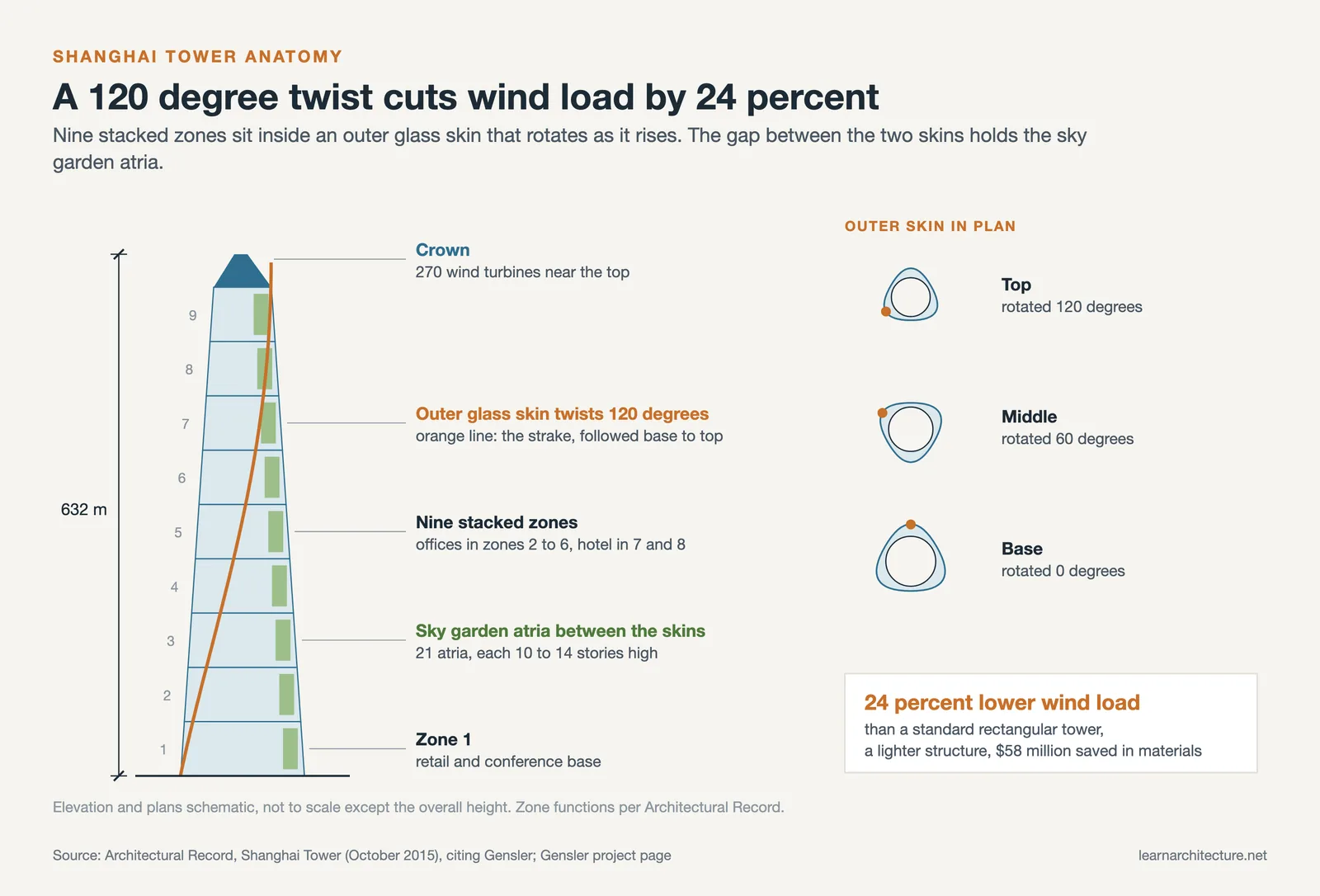
Standing 632 meters tall, the Shanghai Tower is the tallest building in China and the third tallest in the world. Designed by Gensler, its defining feature is a 120-degree twisting outer facade that rotates continuously from base to crown. This spiral form was not chosen for aesthetic reasons alone: wind tunnel testing showed the twist reduces wind loads on the structure by 24% compared to a standard rectangular tower, which allowed for a lighter structure and saved an estimated $58 million in materials.
The tower’s double-skin facade creates 21 enclosed sky garden atriums stacked vertically through the building, each rising between 10 and 14 stories. These spaces function as interior public zones (cafes, galleries, event spaces) within what is effectively a vertical city. The tower holds LEED Platinum certification and incorporates 270 small wind turbines near the top that power the exterior lighting.
The learnarchitecture.net deep-dive on Shanghai Tower’s design and engineering covers the parametric tools and structural systems behind the project in detail.
3. The Vessel: New York City, USA (2019)
Thomas Heatherwick’s Vessel at Hudson Yards is one of the most unusual public structures built in the United States in recent decades. The 150-foot-tall lattice of 154 interlocking staircases forms a climbable honeycomb that functions as both sculpture and public infrastructure. Its 2,500 steps and 80 landings offer 154 different viewing platforms across approximately one mile of total walkable surface.
The structure was fabricated in Italy from copper-colored steel and shipped in 65 sections to New York for assembly. Each of the individual staircases was engineered to cantilever outward from the central core, creating the impression that the structure fans open as it rises. The form was derived from ancient Indian stepwells, translated through Heatherwick’s characteristic approach of treating geometry as a cultural and experiential material. The Vessel represents futuristic building design applied not to a conventional building type but to public space itself.
💡 Pro Tip
When studying futuristic buildings for design research, focus on how the structural system drives the visual character rather than how the aesthetic was imposed on top of the structure. In projects like the Vessel and the Heydar Aliyev Center, form and structure are inseparable. Understanding that relationship is far more instructive than studying the geometry alone.
4. Gardens by the Bay (Supertrees): Singapore (2012)

The Supertrees at Gardens by the Bay, designed by Grant Associates and Wilkinson Eyre Architects, are vertical gardens rising between 25 and 50 meters above the ground. Eighteen of these tree-like structures are spread across the Bay South garden, each supporting a living canopy of ferns, bromeliads, and orchids through an internal irrigation system. The structures are not merely decorative: eleven of the Supertrees collect solar energy through photovoltaic cells embedded in the canopy, and several also function as air intake and exhaust ducts for the adjacent climate-controlled biomes.
The Supertrees represent a fusion of infrastructure, ecology, and futuristic building design rarely achieved at this scale. Their steel frameworks support between 162 and 1,000 plants each, and the largest structures feature canopy walkways accessible to the public at 22 meters above ground. The project won the World Architecture Festival Award for Landscape Architecture in 2012 and had welcomed more than 50 million visitors by 2018.
5. The Shard: London, United Kingdom (2012)

Renzo Piano’s 310-meter Shard is the tallest building in the United Kingdom, but its futuristic quality lies less in its height than in its form and material logic. The tower is composed of eight angled glass facades that do not meet at a conventional apex. Instead, they terminate at different heights, leaving the top of the building deliberately incomplete, as though it fades into the London sky. This fragmentary silhouette was intentional: Piano drew inspiration from church spires and the masts of sailing ships on the Thames.
The glazing system uses 11,000 glass panels, each with a slightly different angle of inclination, which causes the tower to reflect light differently depending on time of day and weather conditions. The building is mixed-use throughout, housing offices, a five-star hotel, residential apartments, and a public viewing gallery: a vertical neighborhood compressed into a single tapered form. The Shard demonstrates that futuristic building design can emerge from material precision and formal restraint as much as from dramatic curvature.
📌 Did You Know?
The Shard’s glass panels are self-cleaning. They are coated with a photocatalytic layer that breaks down organic dirt when exposed to sunlight and then uses rain to wash the particles away. With 11,000 panels at over 300 meters above street level, this was not a luxury; it was an engineering necessity. The technology had existed for years but had never been deployed at this scale before The Shard.
6. CCTV Headquarters: Beijing, China (2012)
Rem Koolhaas and Ole Scheeren’s CCTV Headquarters in Beijing is one of the most structurally audacious futuristic buildings in existence. Rather than designing a conventional tower, Koolhaas proposed a continuous loop: two leaning towers rise from a shared base, then extend horizontally at the top to join in a dramatic 75-meter cantilever. The structure forms a closed loop of floor space, housing the entire production cycle of the China Central Television network in a single interconnected building.
The engineering challenge was extraordinary. Because the building leans at an angle and its two towers do not stand plumb, conventional column-and-beam logic could not apply. Instead, the structural skin of the building, a diagonal steel diagrid pattern that visibly covers the exterior, carries the loads. The irregular pattern of the diagrid was generated by structural analysis software, with denser mesh in areas of higher stress. This makes the structure literally readable from the outside: where the mesh is tightest, the forces are greatest. The legacy of architects like Koolhaas continues to shape how the profession approaches civic and commercial commissions at scale.
7. Bosco Verticale: Milan, Italy (2014)


Stefano Boeri’s Bosco Verticale (Vertical Forest) comprises two residential towers of 110 and 76 meters in Milan’s Porta Nuova district. The towers host 800 trees, 4,500 shrubs, and 15,000 plants across their balconies, which the architects describe as the equivalent of about 20,000 square meters of forest on flat land. Every balcony was individually engineered to support trees of up to nine meters in height, set in concrete planters 1.1 meters deep, with welded steel frames and steel anchoring systems holding root balls through wind events.
The trees provide shade in summer, reducing air conditioning demand, while allowing sunlight through their bare branches in winter to warm the interiors. They also act as sound barriers, filter particulate matter from Milan’s air, and support biodiversity in an otherwise dense urban environment. The project won the International Highrise Award in 2014 and has been widely credited with establishing vertical forestation as a viable model for urban residential buildings. Several imitations have since been built or proposed in cities from Nanjing to Amsterdam.
🏗️ Real-World Example
Nanjing Vertical Forest (Nanjing, 2020): Directly inspired by Bosco Verticale, this twin-tower complex in Nanjing, China, designed by Stefano Boeri Architetti, incorporates over 1,000 trees and 2,500 cascading plants on its residential and hotel floors. The project demonstrated that the vertical forest typology could be adapted to a different climate zone and construction culture, validating Boeri’s model as an exportable futuristic building design approach rather than a one-off landmark.
8. Harbin Opera House: Harbin, China (2015)

MAD Architects’ Harbin Opera House rises from a wetland site in northeastern China in a form that seems to emerge from the landscape itself rather than sit upon it. The 79,000-square-meter complex houses two performance halls (a 1,600-seat grand theater and a 400-seat intimate hall) wrapped in a continuous skin of white aluminum panels that mimic the curves of windswept snow. The building’s form was developed through parametric modeling of natural topography, snow accumulation patterns, and acoustic requirements simultaneously.
The interior is equally striking. The grand theater’s wooden lattice ceiling spirals toward a central oculus in a shape derived from the natural forms of the surrounding wetland. The cladding transitions smoothly from the exterior into the interior, so that the threshold between outside and inside is often ambiguous. The building functions as a performance venue but also as a public landscape, with its curved roofscape open as a walkable promenade year-round. It is one of the most complete examples of a futuristic building where landscape, structure, and program are genuinely inseparable.
9. The Broad Museum: Los Angeles, USA (2015)
Diller Scofidio + Renfro’s Broad Museum on Grand Avenue in Los Angeles introduced a structural concept its architects call the “veil and vault.” The building’s outer skin, a porous latticed concrete shell, wraps the exterior in a pattern of deep coffers that control daylight, ventilate the facade naturally, and create a texture of shadow and light across the building’s surface. Inside, a single continuous gallery space at the top level is lit entirely by natural light filtered through the veil above.
The engineering of the veil required custom concrete formwork developed through computational design, with each coffer cell unique in geometry due to the overall curvature of the facade. The building sits on Grand Avenue in downtown Los Angeles and has become one of the most-visited museums in the United States since opening, attracting visitors as much for the architecture as for the contemporary art collection inside. It demonstrates that futuristic office building and institutional design does not require extreme height or dramatic massing to achieve genuine innovation.
💡 Pro Tip
When analyzing futuristic buildings for academic or professional work, study the relationship between daylight strategy and structural form. In buildings like The Broad and the Harbin Opera House, the envelope is doing multiple jobs simultaneously: controlling light, managing heat, carrying loads, and creating spatial identity. That integration is what separates genuinely innovative architecture from buildings that are merely visually unusual.
10. Apple Park: Cupertino, USA (2017)
Norman Foster’s Apple Park campus, known informally as the “spaceship,” is a 2.8-million-square-foot ring-shaped building housing Apple’s global headquarters. The circular form, 461 meters in diameter, creates a continuous office floor plate that wraps around a 9,000-tree orchard at its center. The building’s glass curtain wall is one of the largest in the world, comprising curved panels fabricated in Germany and assembled on-site with tolerances typically associated with aerospace manufacturing.
The energy strategy is equally ambitious. The campus runs entirely on renewable energy, with a 17-megawatt solar installation integrated into the roof. Natural ventilation is used for nine months of the year without mechanical cooling, made possible by the precise engineering of the curved glass facade and the surrounding landscape, which moderates microclimate around the building perimeter. Apple Park represents one of the most technically sophisticated examples of a large-scale futuristic office building designed not for spectacle but for performance. Foster + Partners has published detailed documentation on the project at fosterandpartners.com.
For broader context on how sustainable technologies are being integrated into buildings like Apple Park, ArchDaily’s coverage of Apple Park offers useful technical detail and photography.
What These Futuristic Buildings Have in Common
Across these ten projects, several patterns emerge. Every building was made possible by computational design tools that allow architects to generate, test, and fabricate geometry that would have been impossible to manage manually. Every project required structural innovation specific to its form, whether that meant a custom diagrid, a parametrically generated panel system, or a new approach to cantilevering loads. And in almost every case, the environmental performance of the building is embedded in its form rather than added on top of it.

These buildings also share a quality that is harder to quantify: they change the expectations of the people who encounter them. A futuristic building that works at its best not only delivers high-performance architecture but also expands the public’s sense of what the built environment can be. That is as true of the Vessel in New York as it is of the Supertrees in Singapore or the Heydar Aliyev Center in Baku.
The principles of parametric architecture that underpin many of these projects are increasingly accessible to architecture students and emerging practitioners through software platforms like Grasshopper and Rhino. Understanding those tools is now a prerequisite for anyone who wants to contribute to the next generation of innovative architecture. For further reading on the architects behind these structures, the guide to famous architects who transformed modern architecture covers several of the figures mentioned in this list.
External resources worth consulting include ArchDaily’s futuristic architecture tag, the Council on Tall Buildings and Urban Habitat at ctbuh.org for data on supertall structures, and Dezeen’s futuristic architecture coverage for current projects under development.
✅ Key Takeaways
- Futuristic buildings are defined by computational form-finding, structural innovation, and environmental performance embedded in the architecture itself, not applied as an afterthought.
- Parametric design tools made most of these structures possible: the Heydar Aliyev Center, CCTV Headquarters, and Harbin Opera House could not have been designed without them.
- Futuristic building design is not limited to towers or civic landmarks: The Broad Museum and Gardens by the Bay show that the same principles apply at different scales and building types.
- Environmental performance and formal innovation are increasingly inseparable: the best futuristic buildings use their shape to manage energy, light, and ecology rather than relying on bolt-on systems.
- The global spread of these projects, from Milan to Singapore to Baku, confirms that futuristic building design is no longer concentrated in a single city or region but represents a worldwide shift in architectural ambition.








Leave a comment