


Table of Contents Show
The golden ratio in architecture refers to the proportion of approximately 1.618:1, known as phi, that architects have used for over four millennia to create buildings that feel visually balanced. From the columns of the Parthenon to the glass panels of the Louvre Pyramid, golden ratio architecture examples appear across nearly every major period of building design.
Phi is everywhere in architecture, but few people stop to ask where this idea actually started, or why a single number keeps appearing in buildings separated by thousands of years and thousands of miles. The answer is less about mysticism and more about geometry: when you divide a rectangle at the golden ratio, you get smaller rectangles with the same proportions, creating a visual consistency that the human eye reads as order. This article traces specific golden ratio architecture examples from the ancient world through the 20th century, looks at the real measurements behind the claims, and examines how contemporary architects still draw on this proportion today.
What Is the Golden Ratio in Architecture?
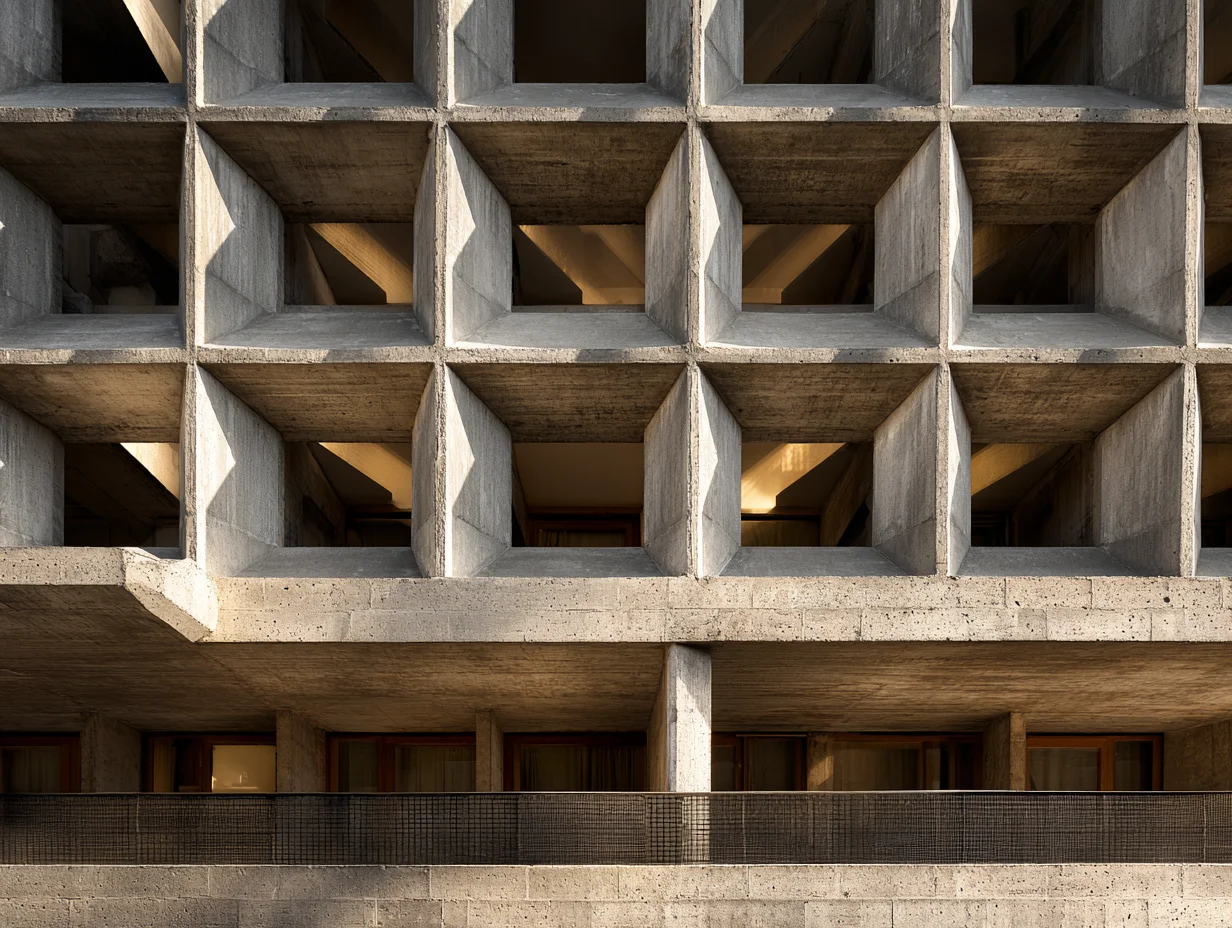
The golden ratio, represented by the Greek letter phi, describes a relationship between two quantities where the ratio of the larger to the smaller equals the ratio of their sum to the larger. Numerically, this works out to roughly 1.618. In building design, architects apply this proportion to set relationships between a facade’s width and height, between column spacing and column diameter, or between a room’s length and width.
The mathematical definition was first formally recorded by Euclid around 300 BCE in his Elements, where he called it division in “extreme and mean ratio.” The term “golden ratio” itself did not appear until 1835, when German mathematician Martin Ohm used the phrase “goldener Schnitt” in a textbook. The Greek letter phi was adopted even later, in the early 1900s, when American mathematician Mark Barr proposed it as a tribute to the sculptor Phidias.
🎓 Expert Insight
“To create architecture is to put in order. Put what in order? Function and objects.” — Le Corbusier, Towards a New Architecture (1923)
Le Corbusier’s lifelong effort to systematize proportion in architecture led directly to his Modulor system, which anchored building dimensions to both the golden ratio and the human body. His insistence on mathematical order continues to inform how architects think about proportion.
Architects do not always target phi deliberately. In many historical cases, builders relied on simple geometric constructions (compass and straightedge) that naturally produce proportions close to 1.618. Whether the result was intentional or emergent, the visual effect is similar: elements relate to each other at a scale the eye recognizes as coherent.
Ancient Origins of the Golden Ratio in Buildings
The earliest known examples of the golden ratio in architecture appear in structures built long before any mathematician named the proportion. Two ancient buildings dominate this discussion: the Parthenon in Athens and the Great Pyramid of Giza.
The Parthenon, Athens (447-432 BCE)
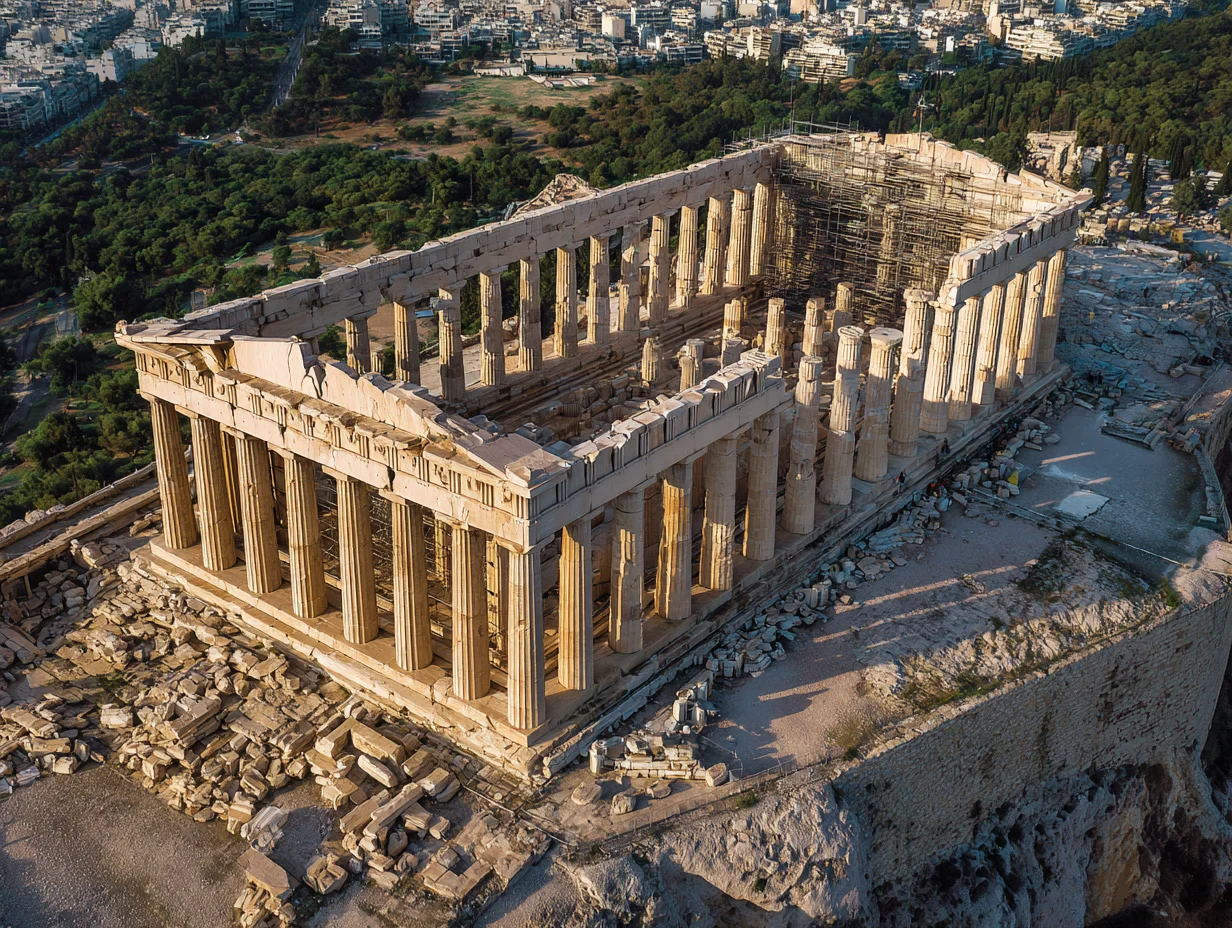
The Parthenon is the most frequently cited golden ratio architecture example in the ancient world. Completed around 432 BCE under the direction of architects Iktinos and Kallikrates, its facade displays proportions that approximate phi in several measurable ways. The width-to-height ratio of the facade comes close to 1.618, and researchers have identified golden rectangles within its columnar arrangement and entablature proportions.
However, a 4:9 ratio (approximately 1:2.25) also appears throughout the building, governing the relationship between column diameter and column spacing, and between the facade’s width and length. Whether the builders targeted phi specifically or arrived at it through a separate proportional system remains debated among scholars of Greek and Roman architecture. What is clear is that the Parthenon’s designers used rigorous mathematical relationships to achieve visual harmony, including subtle optical corrections like entasis (the slight swelling of columns) that prevent straight lines from appearing to sag.
The Great Pyramid of Giza (c. 2560 BCE)
The Great Pyramid predates the Parthenon by roughly two thousand years and offers an even older possible example of phi in construction. The ratio of the pyramid’s slant height (approximately 186.4 meters) to half its base (approximately 115.2 meters) yields a value close to 1.618. Egyptian builders likely arrived at these proportions through their use of the seked, a unit measuring horizontal run per unit of vertical rise, rather than through any awareness of phi as a concept.
📌 Did You Know?
The term “golden ratio” did not exist until 1835. For over 2,000 years before that, mathematicians simply called it “extreme and mean ratio.” The phi symbol was not adopted until the early 1900s, meaning ancient builders who used these proportions had no name for them at all.
How Renaissance Architects Applied the Golden Ratio

During the 15th and 16th centuries, architects began using the golden ratio with full awareness of its mathematical properties. Leon Battista Alberti’s treatise De re aedificatoria (1452) drew heavily on Vitruvius and classical proportional theory, while Luca Pacioli’s De divina proportione (1509), illustrated by Leonardo da Vinci, explicitly connected phi to visual beauty and architectural style.
Andrea Palladio applied proportional systems rooted in harmonic ratios to his villa designs in the Veneto region. While Palladio’s preferred ratios were often simpler intervals (1:1, 1:2, 2:3), several of his floor plans contain room proportions that approximate the golden rectangle. The Villa Rotonda near Vicenza, for instance, uses a centralized square plan with radiating symmetry, but the relationships between its internal rooms and external porticoes reflect proportional thinking directly descended from the same tradition that gave rise to phi.
Landmark buildings from this era demonstrate how Renaissance architects treated proportion as a moral and philosophical commitment, not just an aesthetic preference. The idea that a well-proportioned building could express cosmic order was central to their design philosophy.
Le Corbusier’s Modulor: Turning Phi into a Design System
No modern architect did more to formalize the golden ratio in building design than Le Corbusier. In 1948, he published The Modulor, a proportioning system that combined the golden ratio with the dimensions of the human body. The system generated two interlocking series of measurements (a “red series” based on a person’s height and a “blue series” based on the height with arm raised), each following Fibonacci-like progressions that converge on phi.
Le Corbusier applied the Modulor directly to the Unite d’Habitation in Marseille (1952), where it governed everything from apartment dimensions to the spacing of the brise-soleil on the facade. The Chapel of Notre-Dame du Haut in Ronchamp (1955) also reflects Modulor proportions in its wall thicknesses and window placements, though its sculptural form makes the underlying geometry less immediately visible.
The Modulor was ambitious but imperfect. Critics pointed out that it was calibrated to a 1.83-meter-tall man, leaving women and shorter populations underserved. Still, it remains the most rigorous attempt to turn the golden ratio in architecture from an observed phenomenon into a repeatable design tool.
Modern Golden Ratio Architecture Examples
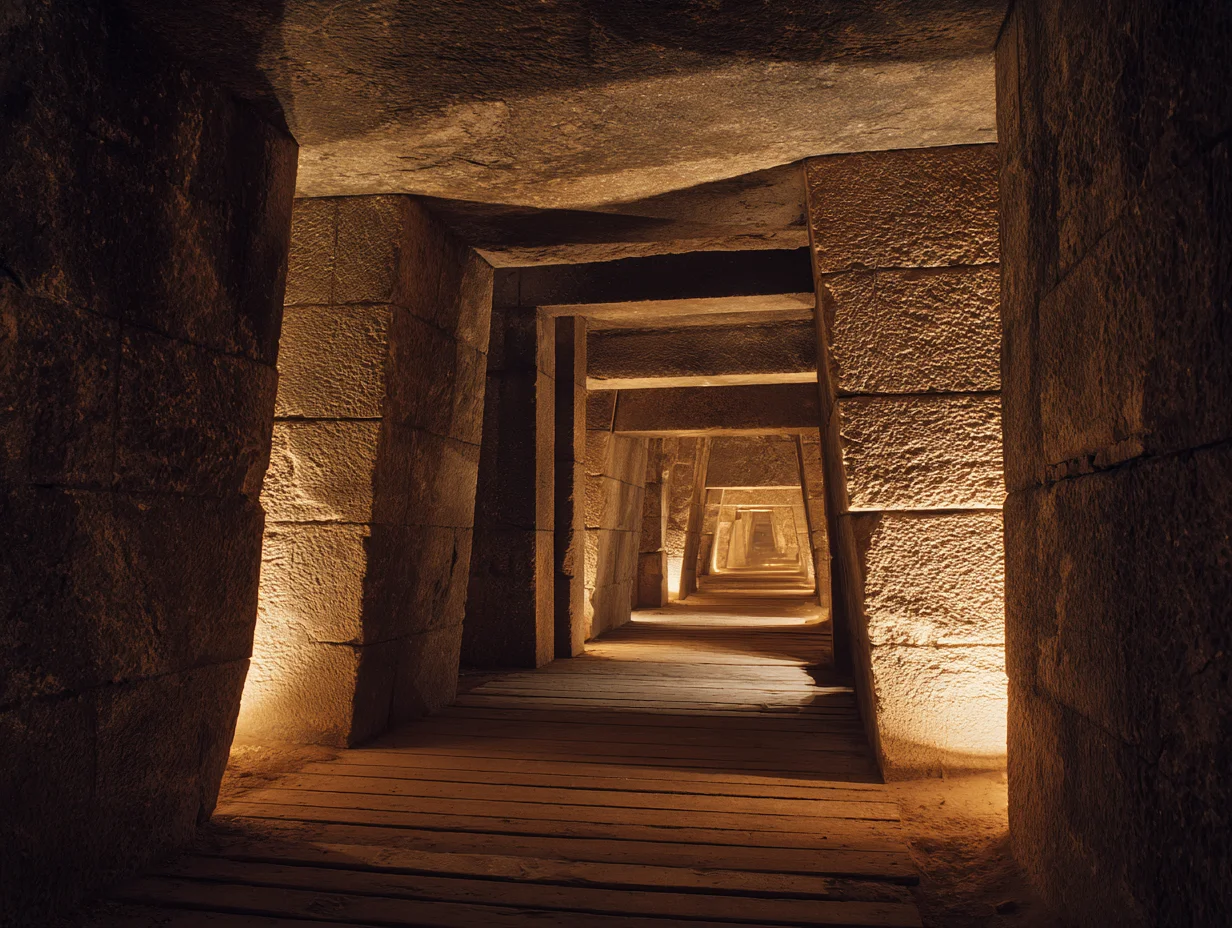
The golden ratio did not stop at mid-century modernism. Several prominent buildings from the late 20th and early 21st centuries use phi-based proportions in their facade design and spatial planning.
The United Nations Headquarters, New York (1952)
Designed by an international team led by Oscar Niemeyer and Le Corbusier (among others), the UN Secretariat Building is a glass slab whose height-to-width ratio follows golden ratio proportions. The relationship between horizontal and vertical divisions of the curtain wall also approximates phi, giving the tower a visual rhythm that avoids monotony despite its simple rectangular form.
🏗️ Real-World Example
Louvre Pyramid, Paris (1989): I.M. Pei’s glass pyramid at the Louvre uses a slope angle of approximately 51.7 degrees, closely matching the angle produced by a triangle whose height-to-half-base ratio equals phi. The pyramid contains 673 glass panels (not 666, as urban legend claims) and demonstrates how golden ratio geometry can integrate a modern intervention into a historic context without visual conflict.
Toronto’s Royal Ontario Museum Crystal (2007)
Daniel Libeskind’s crystalline extension uses angular geometries that do not follow classical golden ratio grids. However, the proportional relationships between the extension’s major facets and the existing heritage building were calibrated to maintain visual balance across two radically different architectural languages. This represents a looser, more contemporary interpretation of how architects apply proportional thinking without strict adherence to phi.
Why Does the Golden Ratio Work in Building Design?
Researchers have proposed several explanations for why phi-based proportions feel balanced to most viewers. One theory points to visual processing efficiency: the brain can parse a golden rectangle faster than a random rectangle because its subdivisions maintain consistent proportional relationships at every scale. Another draws on evolutionary biology, noting that phi appears frequently in natural growth patterns (branching, spirals, leaf arrangement), so the human visual system may be pre-tuned to recognize it as a signal of structural integrity.
A 2010 study published in the journal Psychological Science by a team at Duke University found that participants consistently rated golden rectangle proportions as more visually pleasing than other ratios, though the preference was moderate rather than overwhelming. This suggests that phi is one factor among many in architectural aesthetics, not a universal formula for beauty.
For practicing architects, the golden ratio offers a starting framework that can be adjusted to site, program, and structural requirements. It works best as a proportional guide rather than a rigid constraint.
The Bigger Picture
The golden ratio is not a magic number. Buildings that use it can be ugly, and buildings that ignore it can be stunning. What phi provides is a proportional logic that connects parts to wholes at every scale, from a single window opening to an entire facade. The real lesson from 4,500 years of golden ratio architecture examples is not that 1.618 guarantees good design, but that thinking carefully about proportion, at any ratio, separates architecture that endures from architecture that merely stands.
- architecture and the golden ratio
- architecture golden ratio
- examples of the golden ratio in architecture
- golden ratio and architecture
- golden ratio architecture
- golden ratio architecture examples
- golden ratio examples in architecture
- Golden Ratio in architecture
- golden ratio of architecture
- the golden ratio in architecture













Leave a comment