


Table of Contents Show
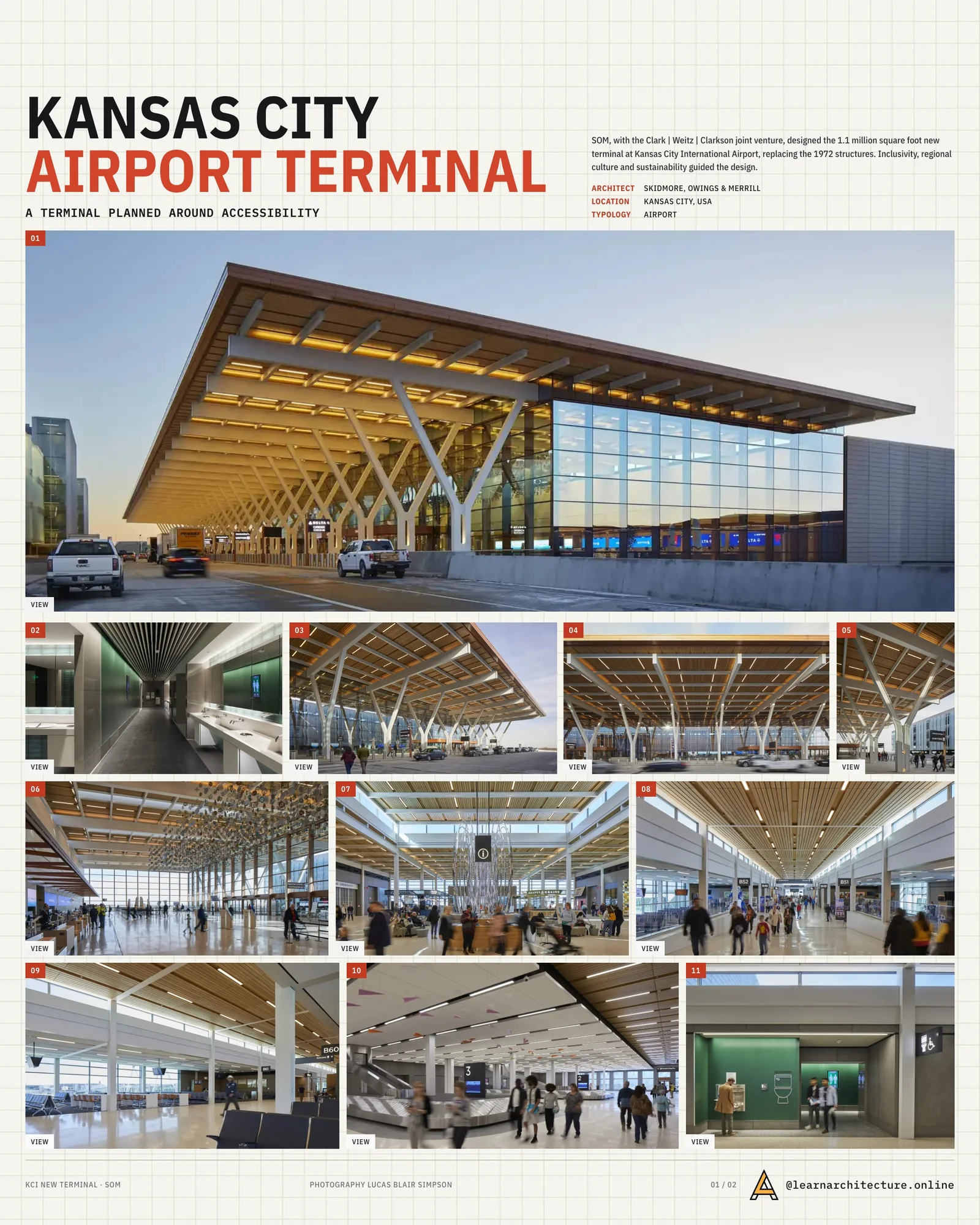
The new terminal at Kansas City International Airport (KCI) marks a transformative moment for both the city and the region. Designed by Skidmore, Owings & Merrill (SOM) with the Clark | Weitz | Clarkson (CWC) joint venture, the 1.1-million-square-foot terminal replaces the outdated 1972 structures with a unified, contemporary hub that redefines the passenger experience. More than a functional replacement, the project introduces an architectural identity grounded in inclusivity, regional culture, and long-term sustainability: values that guided the design from the earliest conversations with the community.

A Seamless Passenger Journey
The new terminal is anchored by an intuitive I-shaped plan that organizes circulation into two clear levels: departures above and arrivals below. Each level benefits from a dedicated access road, removing congestion and creating effortless transitions between drop-off, check-in, and the gate areas beyond. After a streamlined security sequence, passengers enter two parallel concourses connected by a central bridge that opens to sweeping, panoramic views of the airfield. In a departure from the previous multi-level system, all post-security spaces sit on the same level, allowing travelers of all ages and abilities to navigate the terminal with greater ease.
Spatial clarity blends with architectural warmth. A generous roof overhang shelters the main entry, while the structural rhythm of expressive Y-columns frames a transparent façade of glass and aluminum. Inside, the design prioritizes tactility: FSC-certified hemlock ceilings, marble terrazzo floors, and soft daylight create a calm, welcoming ambiance. Embedded throughout the concourses, mosaics salvaged from the former terminal preserve the site’s memory, weaving the airport’s past into its new identity.

Architecture Guided by Inclusivity
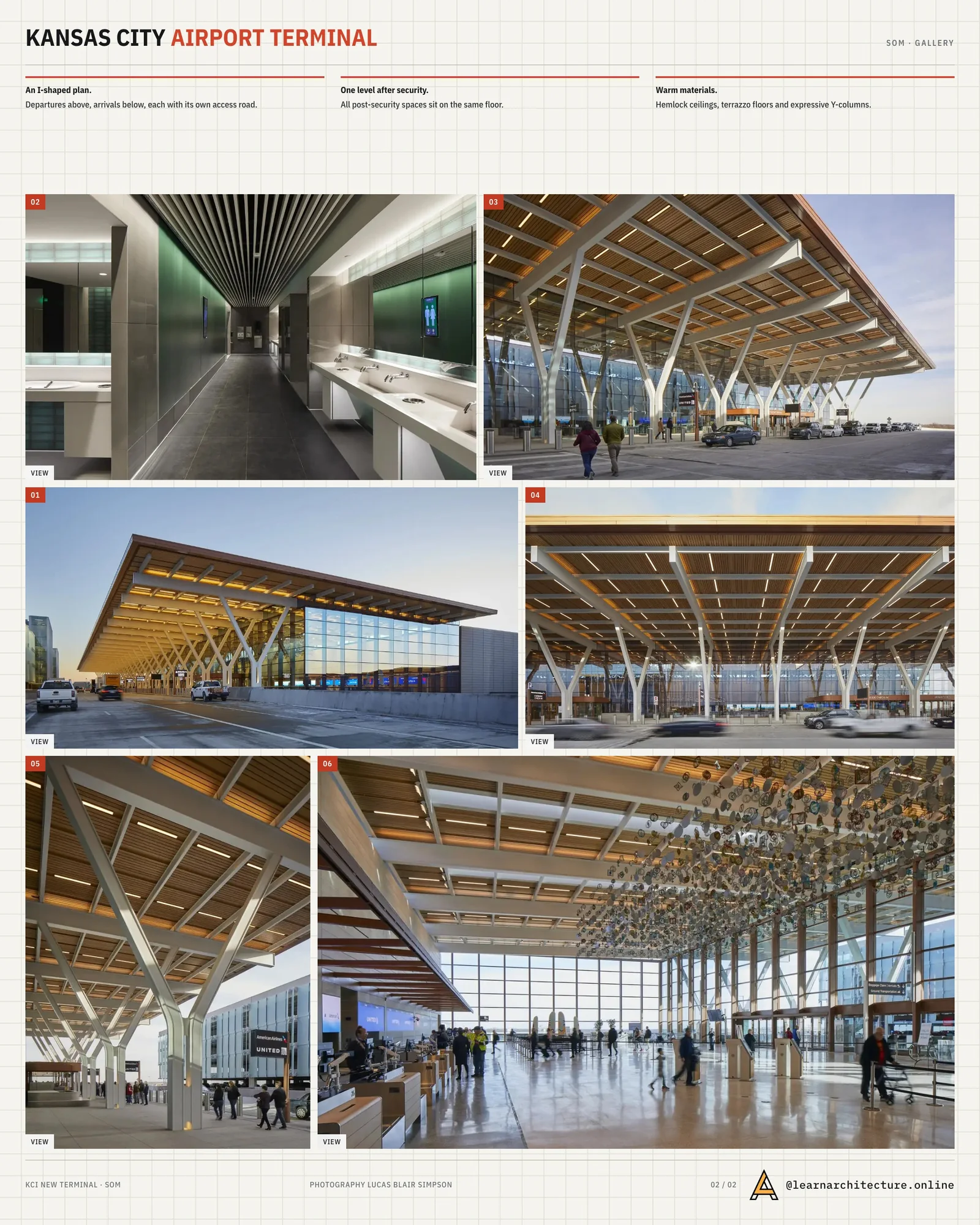
Kansas City’s vision for the new terminal, expressed in a public resolution, was for it to become “the most accessible in the world.” This aspiration shaped nearly every design decision. Every ticketing counter, gate desk, and information station is set at a wheelchair-accessible height; sightlines remain clear and intuitive; and wayfinding is both visual and tactile. The design team engaged extensively with community members, disability advocates, and local organizations to understand how the terminal could support all forms of travel.
This dialogue generated a range of inclusive features uncommon even in major international airports: a quiet room for travelers seeking sensory calm, a dedicated sensory room for neurodiverse children, and an Air Travel Experience simulator that allows passengers unfamiliar with air travel to rehearse their journey before the day of departure. All-gender restrooms, family rooms, lactation spaces, and a variety of seating configurations contribute to a terminal that offers dignity and comfort for everyone who passes through it.

A Terminal That Reflects Its Region
While the new facility embraces international standards of accessibility and design, it remains deeply rooted in Kansas City’s character. The building incorporates locally crafted materials, including wood finishes sourced from regional suppliers, and preserves fragments of the airport’s original artwork. Warm tones, expressive structural geometries, and broad visual connections to the landscape bring a distinctly Midwestern sensibility to the architecture. The project team, led predominantly by women, also sought to elevate local voices through community programming, public art, and ongoing consultation throughout all phases of development.

Built for the Future
Beyond its architectural form, the new KCI terminal sets ambitious benchmarks for sustainability. It is the first terminal and concourse project in the U.S. Midwest to achieve LEED v4 BD+C: NC Gold certification, and only the second in the country. The building operates entirely on electricity, with a long-term vision to transition fully to renewable energy once the airport’s forthcoming solar farm is complete. Conservation measures preserve native grasses and tree species from the original 1970s site development, while extensive daylighting strategies reduce reliance on artificial lighting. Materials selected for durability, local sourcing, and low environmental impact contribute to a terminal prepared for both present and future performance demands.

A New Standard for Airport Design
Kansas City International Airport’s new terminal is more than an infrastructural upgrade; it is a civic gesture that reshapes how a region welcomes the world. With its clear organization, warm architectural language, commitment to inclusivity, and forward-looking environmental strategies, the project establishes a new standard for equitable and sustainable airport design. It stands as a gateway: to the city, to the Midwest, and to a vision of air travel where every passenger feels seen, supported, and invited to move with confidence through a space built for all.
Photography: Lucas Blair Simpson © SOM


- Accessible Travel Infrastructure
- Airport Concourse Design
- All-Gender & Family Facilities
- Contemporary Terminal Design
- CWC Joint Venture
- Inclusive Terminal Design
- Kansas City Architecture
- Kansas City International Airport Terminal
- KCI New Terminal
- LEED Gold Airport
- Midwest Airport Architecture
- Passenger experience design
- regional materials in architecture
- Sensory Room Airport Design
- Skidmore Owings & Merrill
- SOM Airport Design
- SOM KCI Terminal Project
- Sustainable airport architecture
- U.S. Airport Redevelopment
- Y-Column Structural Design













Leave a comment