


Table of Contents Show
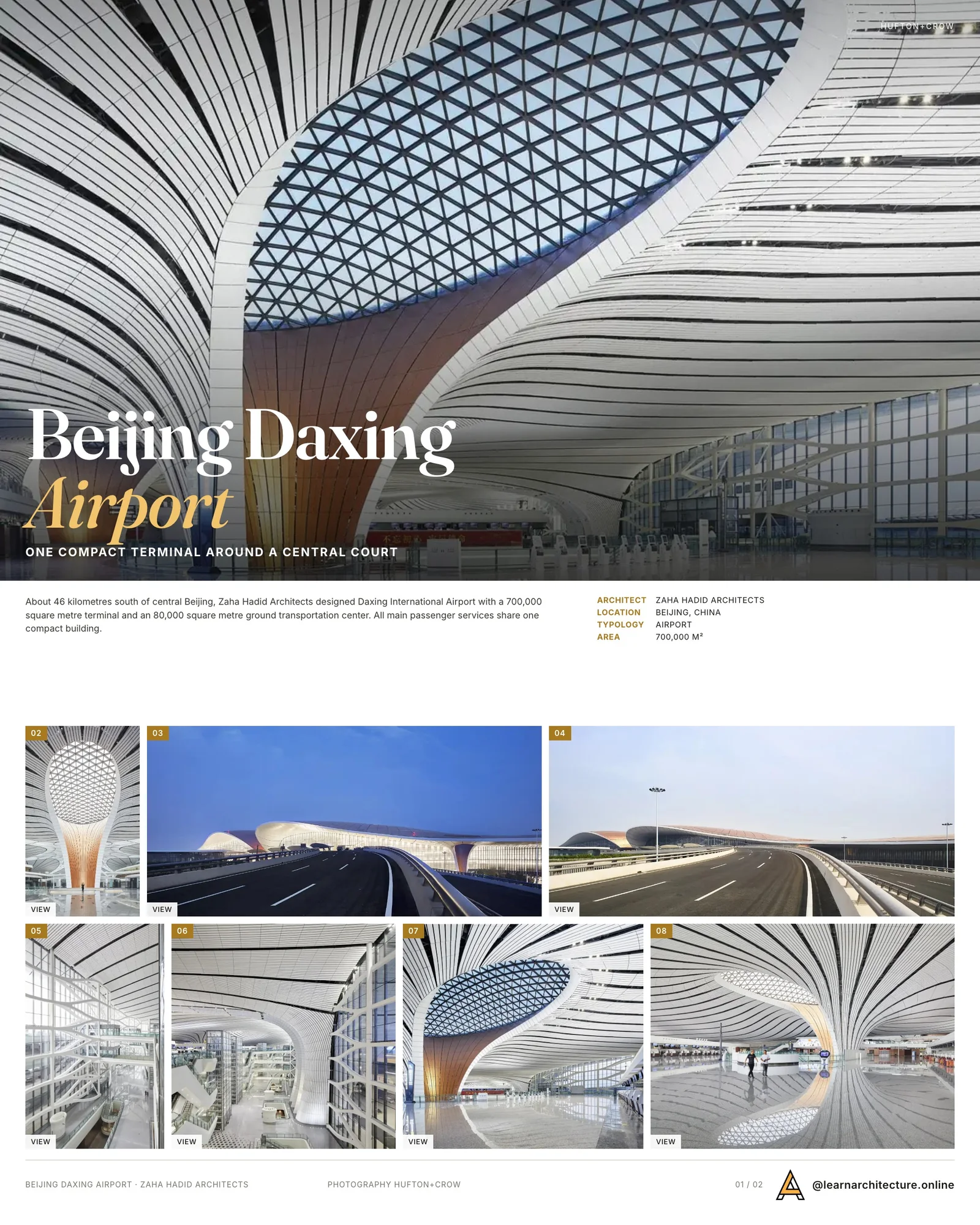
Designed by Zaha Hadid Architects, Beijing Daxing International Airport represents a transformative milestone in global aviation infrastructure. Located in the Daxing district, approximately 46 kilometers south of Beijing’s city center, the airport was conceived to relieve congestion at the capital’s existing airport while responding to the unprecedented growth in international and domestic air travel across the region. With direct express train connections reducing travel time to just 20 minutes, Beijing Daxing is not only an airport but a fully integrated multi-modal transportation hub anchoring China’s expanding national network.

A Strategic Infrastructure for a Rapidly Growing Region
Beijing Daxing was developed to support one of the world’s fastest-growing aviation markets. Initially designed to serve 45 million passengers annually, the airport is planned to accommodate 72 million travelers by 2025, with long-term capacity projected at 100 million passengers and 4 million tonnes of cargo per year. This ambitious scalability positions the airport as a critical driver of regional and national economic development, benefiting not only Beijing but also Tianjin and Hebei Province.
At the core of this strategy is the 700,000-square-meter passenger terminal, complemented by an 80,000-square-meter ground transportation center that seamlessly connects air travel with high-speed rail, metro, and local train services. This integration reinforces the airport’s role as a central node within China’s broader mobility ecosystem.

A Compact Terminal Inspired by Chinese Spatial Traditions
The architectural concept of Beijing Daxing International Airport reinterprets principles of traditional Chinese architecture, particularly the organization of interconnected spaces around a central courtyard. Rather than dispersing functions across separate terminals, the design consolidates all primary passenger services within a single, compact structure.
This configuration guides departing, arriving, and transferring passengers intuitively toward a vast multi-level central court, which acts as the spatial and operational heart of the terminal. The clarity of this organization significantly reduces wayfinding complexity while enhancing the overall passenger experience.

Vaulted Roofs, Light, and Structural Innovation
The terminal’s distinctive form is defined by six flowing vaults that extend from the roof down to the ground, simultaneously supporting the structure and channeling natural light deep into the interior. These sculptural forms direct passenger movement toward the central courtyard while creating a visually unified and legible environment.
A network of linear skylights further reinforces intuitive navigation, guiding travelers between check-in, security, and departure gates. With structural spans reaching up to 100 meters, the terminal achieves expansive column-free spaces that offer exceptional flexibility for future reconfiguration and evolving aviation technologies.

Radial Planning for Passenger Efficiency
A defining strength of the airport lies in its compact radial layout. Five aircraft piers extend from the central terminal, allowing a high number of aircraft to be parked directly at the building while keeping walking distances to a minimum. This design enables 79 airbridge-equipped gates to connect seamlessly to the terminal.
One of the most remarkable achievements of the plan is passenger convenience: the farthest boarding gate can be reached in under eight minutes on foot, eliminating the need for internal shuttle trains. The terminal is also capable of processing passengers from six full A380 aircraft simultaneously, ensuring operational efficiency even at peak demand.

Flexibility for Future Growth
Adaptability was a fundamental design driver. The airport, designated with the international code PKX, sets a new benchmark for terminal efficiency by concentrating operations within a single structure while remaining highly expandable.
The radial geometry allows for future pier extensions without disrupting the existing organization. Internally, the generous spans and modular planning ensure that retail areas, security zones, and lounges can evolve alongside changing passenger behaviors and technological advancements.

Sustainable Systems at an Infrastructure Scale
Environmental performance plays a major role in the airport’s long-term viability. Photovoltaic panels distributed across the development provide a minimum capacity of 10 megawatts, contributing to reduced operational carbon emissions. Heating systems utilize waste heat recovery, supported by a composite ground-source heat pump network serving nearly 2.5 million square meters.
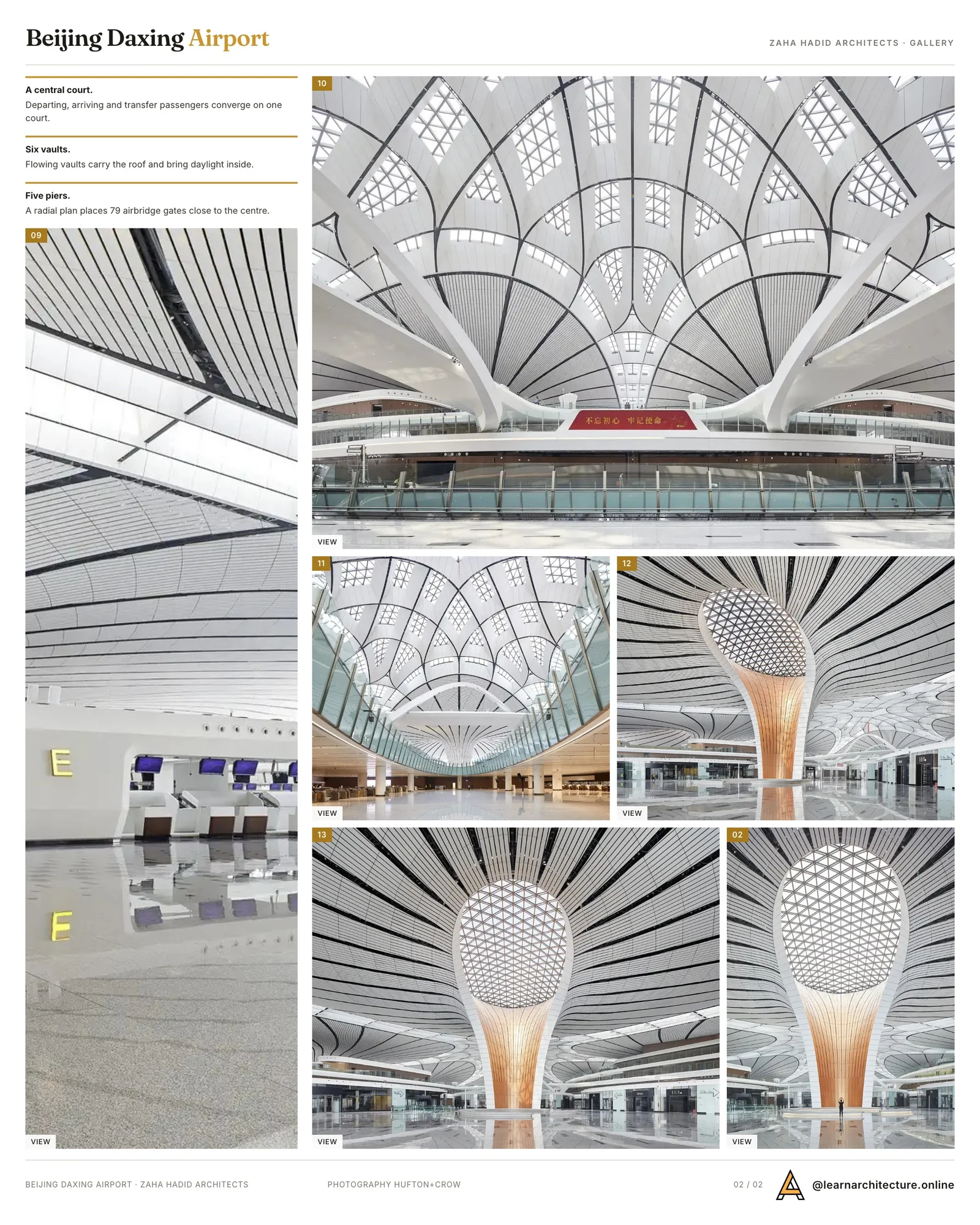
Water management is addressed holistically through rainwater collection and natural filtration systems. Up to 2.8 million cubic meters of water are managed through newly created wetlands, lakes, and streams that provide natural storage, purification, and permeation. These landscape strategies help mitigate flooding risks while counteracting the urban heat island effect, improving local microclimatic conditions.

A New Standard for Global Airports
Beijing Daxing International Airport demonstrates how infrastructure at an unprecedented scale can remain human-centered, legible, and efficient. By combining advanced engineering, cultural spatial principles, and sustainable systems within a compact architectural form, the project redefines expectations for contemporary airport design.
As air travel continues to expand across Asia and beyond, Beijing Daxing stands as a powerful example of how architecture can support mobility, economic growth, and environmental responsibility, positioning itself not only as China’s southern aviation gateway, but as a global benchmark for the future of air transport infrastructure.
Photography: Hufton+Crow


- Airport architecture design
- Airport sustainability systems
- Aviation hub China
- Beijing Daxing International Airport
- Beijing transport infrastructure
- Chinese architecture influence
- Contemporary airport design
- Future-ready airport design
- Global aviation infrastructure
- iconic airport architecture
- Large-scale public buildings
- Mega airport infrastructure
- Parametric architecture airports
- Passenger terminal design
- PKX Airport
- Radial terminal layout
- Sustainable airport design
- Transportation hub architecture
- Zaha Hadid Architects
- Zaha Hadid aviation projects











Leave a comment