


Table of Contents Show
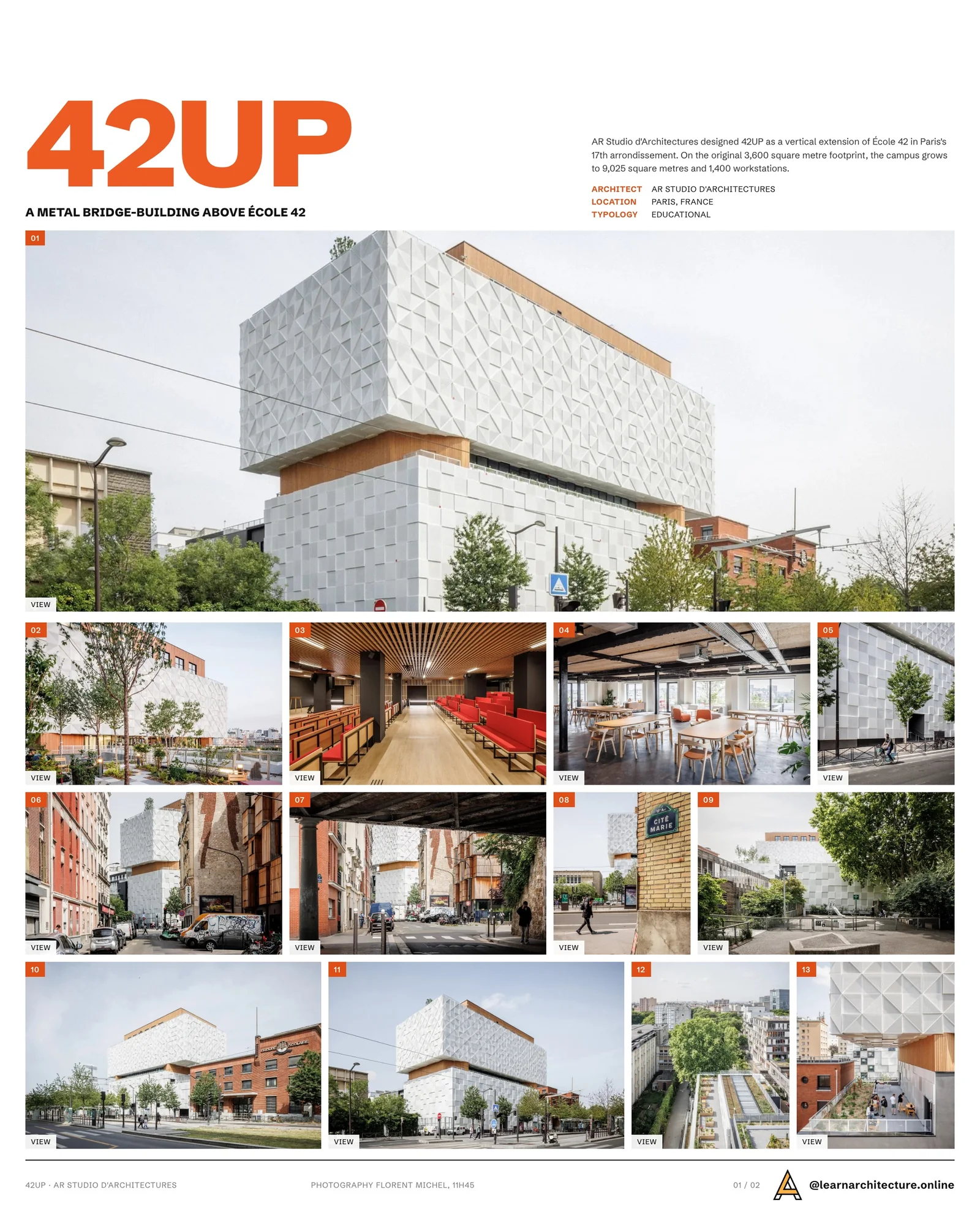
Located in the heart of Paris’s 17th arrondissement, 42UP, designed by AR Studio d’Architectures, represents a radical evolution of contemporary educational architecture. Conceived as an ambitious vertical extension to the renowned École 42, the project responds to growing spatial demands while embracing architectural restraint. Within an original footprint of 3,600 m², the intervention expands the campus to an impressive 9,025 m², doubling capacity and accommodating 1,400 workstations, all within an institution that operates 24/7, without teachers, without formal courses, and entirely free. The result is a compact yet powerful model for future urban learning environments.

Building Upon the Existing: Architectural Frugality as Strategy
Rather than demolishing and rebuilding, AR Studio d’Architectures adopted a strategy rooted in architectural frugality, preserving the existing structure and amplifying its potential. Originally constructed in 1962 on land reclaimed from Paris’s former fortifications, specifically Bastion 42, the building already carried historical weight. The architects reinforced this legacy by stacking new volumes above it, literally building on the city’s layers.
The extension consists of four additional base volumes and a striking five-story metal superstructure, rising approximately 18 meters above the original roofline. This approach significantly increased usable area while minimizing land consumption, a crucial consideration in dense urban contexts. Importantly, construction was carried out while respecting the site’s continuity and memory, allowing the digital campus to evolve without erasing its past.

Structural Boldness and Vertical Circulation as Experience
The most defining architectural gesture of 42UP is the metal “building-bridge” suspended above the existing structure. Supported by vertical circulation towers housing double Chambord staircases and a monumental 42-meter-long beam, this hovering volume demonstrates both structural daring and spatial delicacy. Beneath the beam, the third floor remains entirely column-free, opening onto a dramatic balcony with expansive city views.
This volumetric composition was not only visually striking but also logistically sophisticated. The school remained operational throughout most of the construction period, with students temporarily relocated to nearby NOC42 dormitories only during critical phases. This phased execution highlights the project’s precision and adaptability within a functioning educational ecosystem.

A Perforated White Skin Unifying Old and New
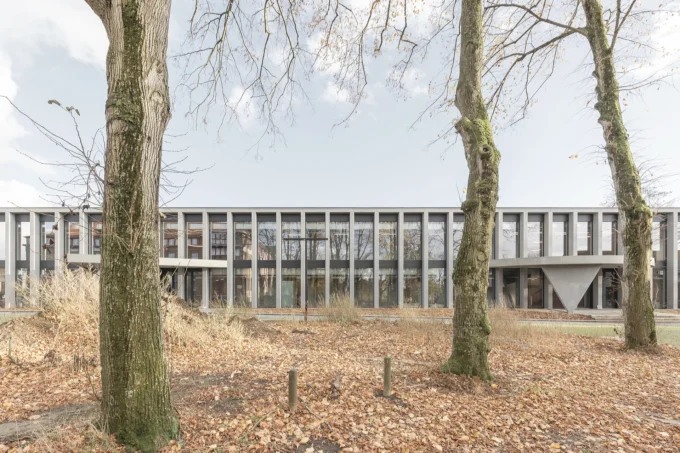
Wrapping both the original building and the extension is a white perforated metal façade, acting as a unifying architectural veil. In contrast to the black existing façade, this new skin introduces lightness while maintaining harmony with the adjacent NOC42 residential complex. Its precise 1.17 x 1.17-meter grid shifts into triangular modules across the superstructure, creating subtle relief and shadow play that evolves throughout the day.
Large double-height glazed panels, measuring 2.34 x 2.34 meters, puncture the façade at regular intervals, establishing a rhythmic architectural language. Beyond its aesthetic role, the micro-perforated envelope provides essential solar protection for a building filled with heat-generating computers, while still allowing generous daylight to penetrate deep into interior spaces. The façade’s transparency shifts according to light and weather, generating an ongoing dialogue between inside and outside.

An Urban Campus as a Living Ecosystem
42UP does not operate in isolation. It functions symbiotically with the NOC42 complex, developed as part of Paris’s Réinventer Paris initiative. Together, the two projects form a cohesive urban campus, combining learning, living, and leisure across Boulevard Bessières. This long-term vision, initiated in 2015, proposes a new typology for educational infrastructure, one that embeds academic life seamlessly into the city rather than isolating it on peripheral campuses.
By integrating student housing, shared amenities, and learning spaces, the project establishes a holistic environment where daily life and education coexist naturally, reinforcing both community and continuity.

Interior Organization and Maximum Spatial Efficiency
Inside, 42UP challenges traditional educational layouts. Enclosed classrooms are replaced by vast open floors, designed to support a wide range of learning styles, from focused individual work to spontaneous collaboration. Circulation runs along the perimeter, while niches and alcoves tucked behind staircases create quieter zones for concentration.
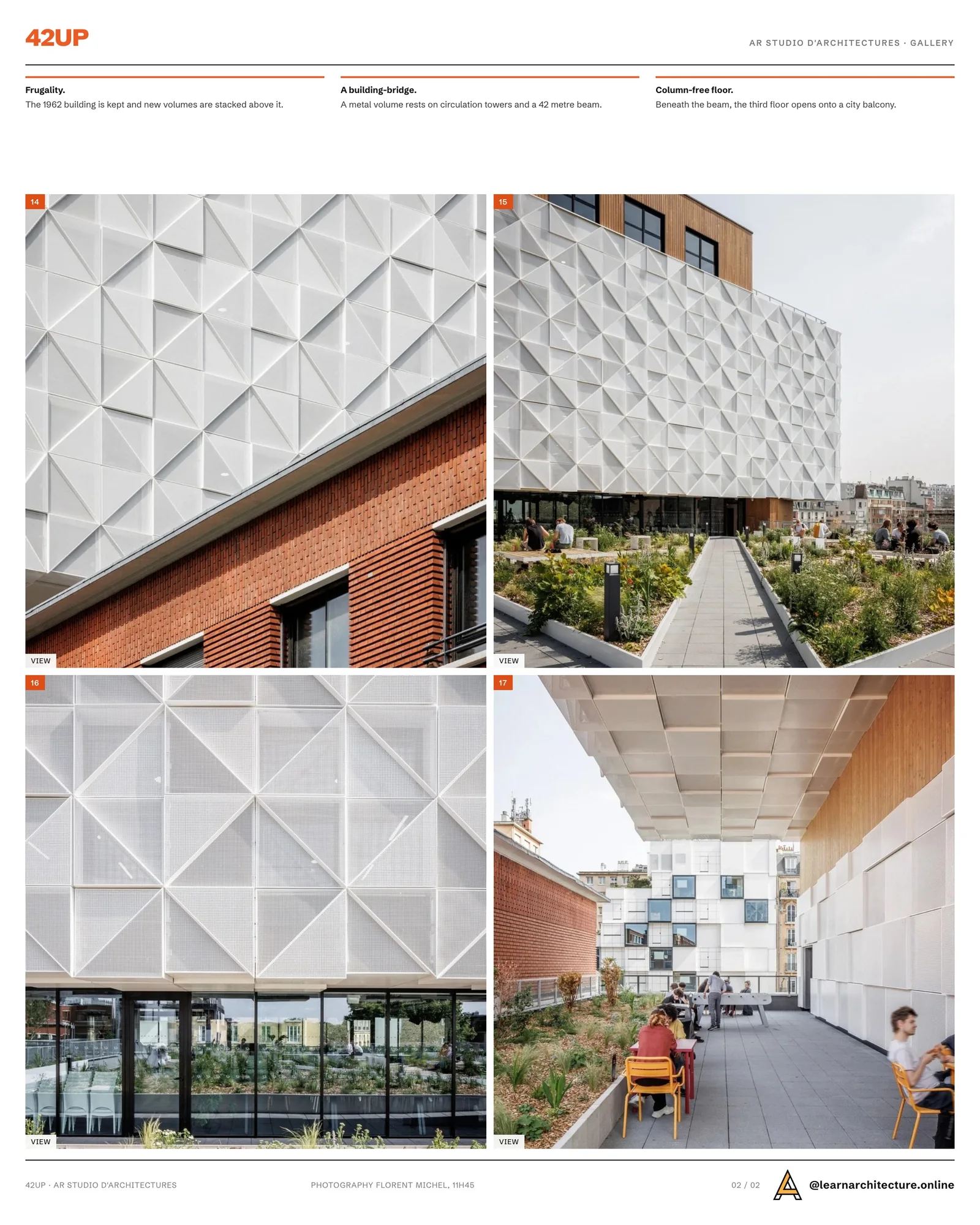
Acoustic comfort is ensured through wood wool ceiling panels and textile wall treatments, addressing the challenges of large, constantly occupied spaces. Each level is assigned a distinct color identity (red, green, or blue), helping users intuitively navigate the building while reinforcing spatial orientation within the dense vertical layout.

Vertical Movement as Art and Orientation
The project further enriches user experience through art. Curated by Nicolas Laugero Lasserre, large-scale street art interventions animate the four main staircases, transforming vertical circulation into immersive artistic journeys. Each stairwell presents a different artistic universe, offering visual landmarks that function simultaneously as wayfinding tools and cultural statements.
These interventions ensure that movement through the building is never purely functional; instead, it becomes a sequence of discovery, reinforcing the school’s ethos of creativity, exploration, and self-directed learning.

A New Paradigm for Urban Educational Architecture
With 42UP, AR Studio d’Architectures delivers more than an extension; it proposes a new architectural model for education in dense cities. By stacking space vertically, optimizing continuous use, and integrating structure, façade, art, and program into a cohesive whole, the project demonstrates how learning environments can be efficient, inspiring, and deeply urban. It stands as a forward-looking blueprint for future campuses that must do more, with less, within the city itself.
Photography: Florent MICHEL_©11h45




- 42UP School Extension
- adaptive reuse architecture
- AR Studio d’Architectures
- Architectural frugality
- Contemporary school design
- Digital campus design
- École 42 Paris
- Educational architecture Paris
- Innovative education spaces
- Metal façade architecture
- Modern educational buildings
- Open-plan learning spaces
- Paris architecture projects
- Perforated façade design
- Street art in architecture
- Structural innovation architecture
- sustainable urban architecture
- Urban campus design
- Urban learning environments
- Vertical campus architecture










Leave a comment