


Table of Contents Show
Cities are changing faster than our spreadsheets can keep up. AI tools revolutionizing urban planning aren’t a futuristic add‑on, they’re how we turn messy, multi-source data into decisions that move the needle on mobility, climate resilience, housing, and equity. In this guide, we share where AI truly helps, which tools matter, how to govern the data, and how to take projects from a pilot that looks great in a deck to results residents actually feel on the street.
Why AI Matters For Cities Now
Urbanization Pressures, Climate Risks, And Funding Gaps
We’re planning for more people, more extremes, and tighter budgets, often all at once. Urbanization adds demand to transit, utilities, and housing. Climate hazards intensify heat, flooding, smoke, and storms. Meanwhile, infrastructure dollars must stretch further, and public expectations for transparency are higher than ever. AI helps us synthesize geospatial, IoT, and demographic signals quickly, so we can prioritize projects with the biggest impact per dollar and defend those choices with clear evidence.

What AI Adds Beyond Traditional Planning Methods
Traditional tools are great at codifying what we already know: AI excels at finding patterns we missed. It ingests streams of satellite imagery, traffic sensors, and public comments, flagging hotspots and forecasting outcomes. Instead of annual studies that go stale, we maintain living baselines and scenario-specific forecasts. The payoff isn’t just speed, it’s consistency, traceability, and the ability to test “what if” questions across dozens of constraints before spending a dime.
Core AI Tool Categories Shaping Planning
Geospatial Intelligence And Computer Vision
Computer vision turns aerial and street-level imagery into structured layers: curb space usage, tree canopy gaps, sidewalk conditions, and construction activity. Combined with GIS, we can quantify illegal parking near bus lanes, detect new rooftop solar, or measure shade equity block by block. The result is a richer, regularly updated spatial picture without sending field crews everywhere.

Mobility Modeling And Demand Forecasting
ML-enhanced models digest fare data, app traces, bike counters, and signal logs to predict corridor demand by time of day and mode. We use these insights to design bus priority, microtransit zones, and pricing that balance throughput with fairness. Forecasts also help align freight windows and curb management with peak local activity, reducing double parking and smoothing deliveries.
Digital Twins And Scenario Simulation
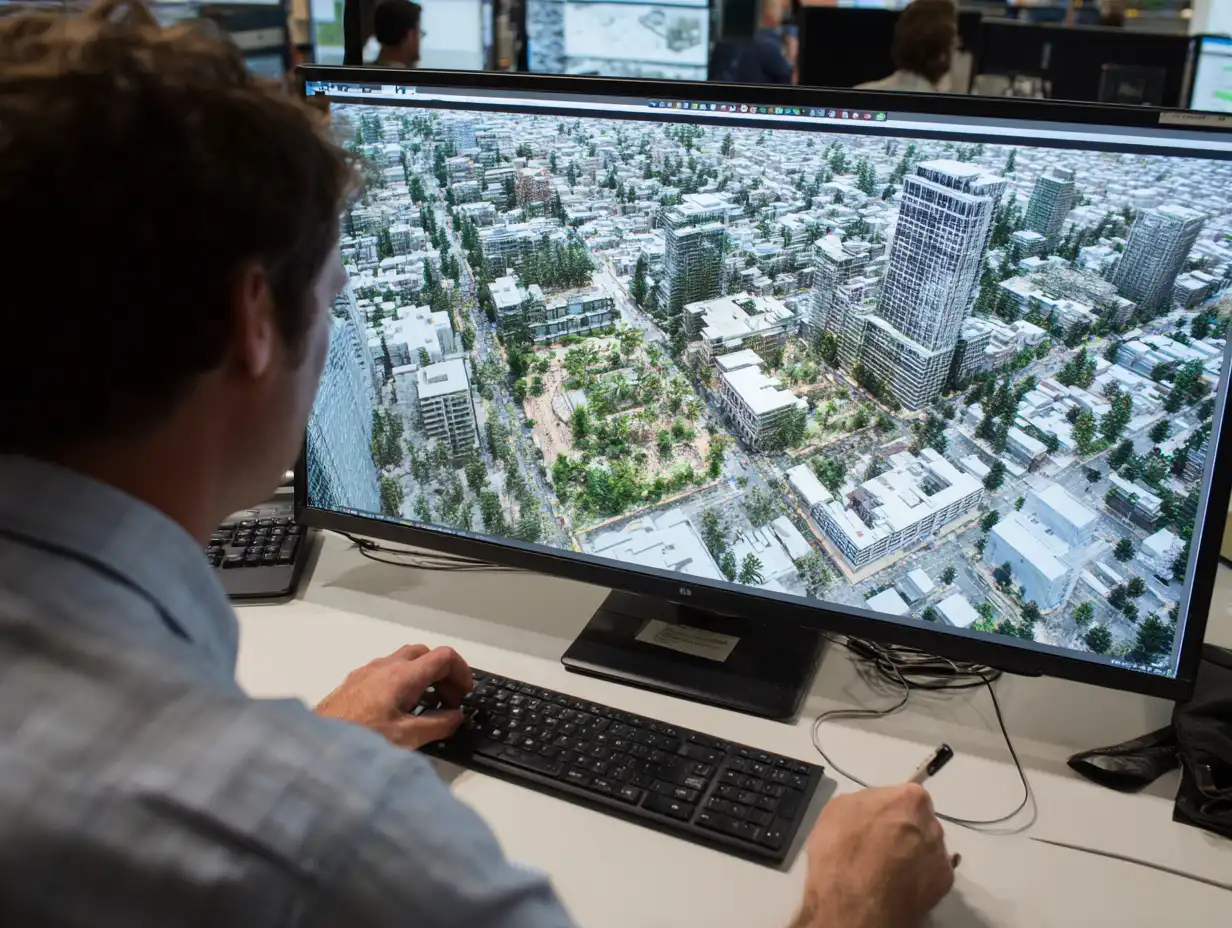
City digital twins mirror roads, utilities, parcels, and environmental systems. AI agents simulate travel choices, flood propagation, or power demand under policy and climate scenarios. We can test a road diet, green infrastructure, and development phasing together, then observe knock-on effects for congestion, runoff, and emergency response before committing in the field.
Generative Design For Zoning And Site Planning
Generative tools explore thousands of site and zoning configurations within constraints, height, setbacks, daylight, parking, stormwater, cost. We steer toward options that optimize housing yield, affordability mix, and open space while staying code-compliant. It’s not about replacing designers: it’s about surfacing better trade-offs early and documenting why the chosen alternative wins.
Natural Language Processing For Public Input And Policy Analysis
NLP helps us read the room at scale. We can classify and summarize thousands of comments, identify themes by neighborhood, and check whether draft policies conflict with existing ordinances. It also supports multilingual engagement, extracting sentiment and key issues so quieter voices don’t get lost in the process.
Data Foundations, Governance, And Ethics
Data Sources And Interoperability Across GIS, IoT, And Remote Sensing
Successful AI rests on tidy plumbing. We standardize schemas across parcels, permits, sensors, and imagery, using open standards where possible. Metadata matters: lineage, refresh cadence, known caveats. When datasets interoperate, we can join tree canopy to heat islands, link zoning to transit access, and analyze outcomes consistently.

Bias, Fairness, And Transparent Model Documentation
Every dataset has blind spots. We track representation across neighborhoods, audit performance by subgroup, and publish model cards: purpose, inputs, training windows, validation results, and limitations. Fairness reviews, before deployment, help us avoid locking past inequities into future decisions.
Privacy, Security, And Responsible Deployment
We minimize personally identifiable data, aggregate where possible, and apply differential privacy or synthetic data for sensitive use cases. Security controls and access logs are table stakes. Just as important: purpose limitation and sunset clauses so models don’t outlive their mandates or drift into new uses without consent.
From Pilot To Practice: Integrating AI Into Planning Workflows
Selecting High-Impact Use Cases And Success Metrics
Start where the pain is clear and outcomes are measurable, signal timing, heat mitigation targeting, or permit triage. Define KPIs up front (travel time reliability, cooling benefits per dollar, review days saved) and commit to a baseline so we can prove lift, not just showcase dashboards.

Teams, Procurement, And Vendor Management
We pair domain experts with data scientists, and we buy for interoperability. Contracts should require data export, model documentation, and performance reporting. No black boxes. We also scope pilots with pathways to scale, APIs, training, and governance baked in from day one.
Change Management, Training, And Upskilling
Tools don’t transform cities, people do. We budget for staff training, create playbooks, and set office hours for power users. Wins get socialized with before/after visuals. When planners trust the workflow, adoption sticks and turnover doesn’t erase hard-won progress.
Real-World Results: City Examples And Outcomes
Traffic Signal Optimization And Multimodal Operations
Several cities have used AI to optimize signals, coordinating bus priority with pedestrian safety phases. We’ve seen corridors cut bus delay while holding or improving walk times. Pairing this with computer vision at intersections helps monitor near-misses, not just crashes, so we can proactively adjust timings.
Climate Resilience: Heat Mapping, Flood Risk, And Green Infrastructure
Using thermal imagery and land cover data, we pinpoint heat islands and target tree planting where shade reduces exposure most. Flood models combining elevation, drainage, and forecast rainfall help place bioswales and permeable surfaces where they actually intercept runoff. Cities like Rotterdam and Singapore publicly share twin outputs to build confidence in these choices.

Housing, Land Use, And Equity-Centered Site Selection
We apply multi-criteria AI scoring, transit access, amenities, parcel assemblage potential, environmental risk, to identify sites for affordable housing. NLP on community feedback flags displacement fears early, prompting anti-displacement measures. Think of this as AI powering our urban strategy: for example, siting EV chargers in underserved areas, prioritizing bus lanes on corridors with long commutes, and targeting cooling centers where seniors live alone.
Measuring Impact And Avoiding Pitfalls
KPIs, Ground-Truthing, And Continuous Validation
We don’t declare victory on model outputs alone. We ground-truth with field audits, rider surveys, and sensors. KPIs get tracked over seasons, not just launch month. Drift checks and recalibration keep models honest as land use and travel patterns evolve.

Communicating Uncertainty And Building Public Trust
We share ranges, not just point estimates, and explain what could move results. Simple visuals, prediction intervals, scenario bands, go a long way. Public-facing summaries in plain language, translated where needed, turn skeptics into collaborators.
Common Failure Modes And How To Mitigate Them
Typical traps: weak baselines, vendor lock-in, data silos, and piloting forever. We mitigate with open standards, clear exit ramps, reproducible notebooks, and a standing review board that can pause or pivot projects before cost sinks grow.
Conclusion
AI tools are reshaping how we diagnose problems, test ideas, and deliver equitable outcomes in urban planning. If we invest in clean data, transparent models, and practical workflows, we can move from shiny pilots to durable improvements residents feel every day. Start small, measure hard, and scale what works, that’s how we build cities that are faster, fairer, and future-ready.
- AI for sustainable cities
- AI innovations in city planning
- AI urban planning tools
- AI-driven urban design
- AI-powered smart cities
- artificial intelligence in city planning
- city infrastructure AI tools
- city planning innovations
- digital urban planning solutions
- future of urban planning
- future-proof city planning
- intelligent city design
- smart city AI solutions
- smart city planning tools
- smart city technology
- urban development AI technologies
- urban development AI tools
- urban planning automation
- urban planning software
- urban planning tech advancements
















Leave a comment