


Table of Contents Show
Designed by 317designstudio, the Qingshan Forest Junior High School Classroom transforms a conventional indoor learning space into an immersive environment inspired by the ritual of gathering around a campfire in the forest. Located in Xizhi District, an area known for its frequent rainfall and humid climate, the project responds directly to the educational and environmental realities of Qingshan Elementary and Junior High School, a school deeply rooted in Scouting education.
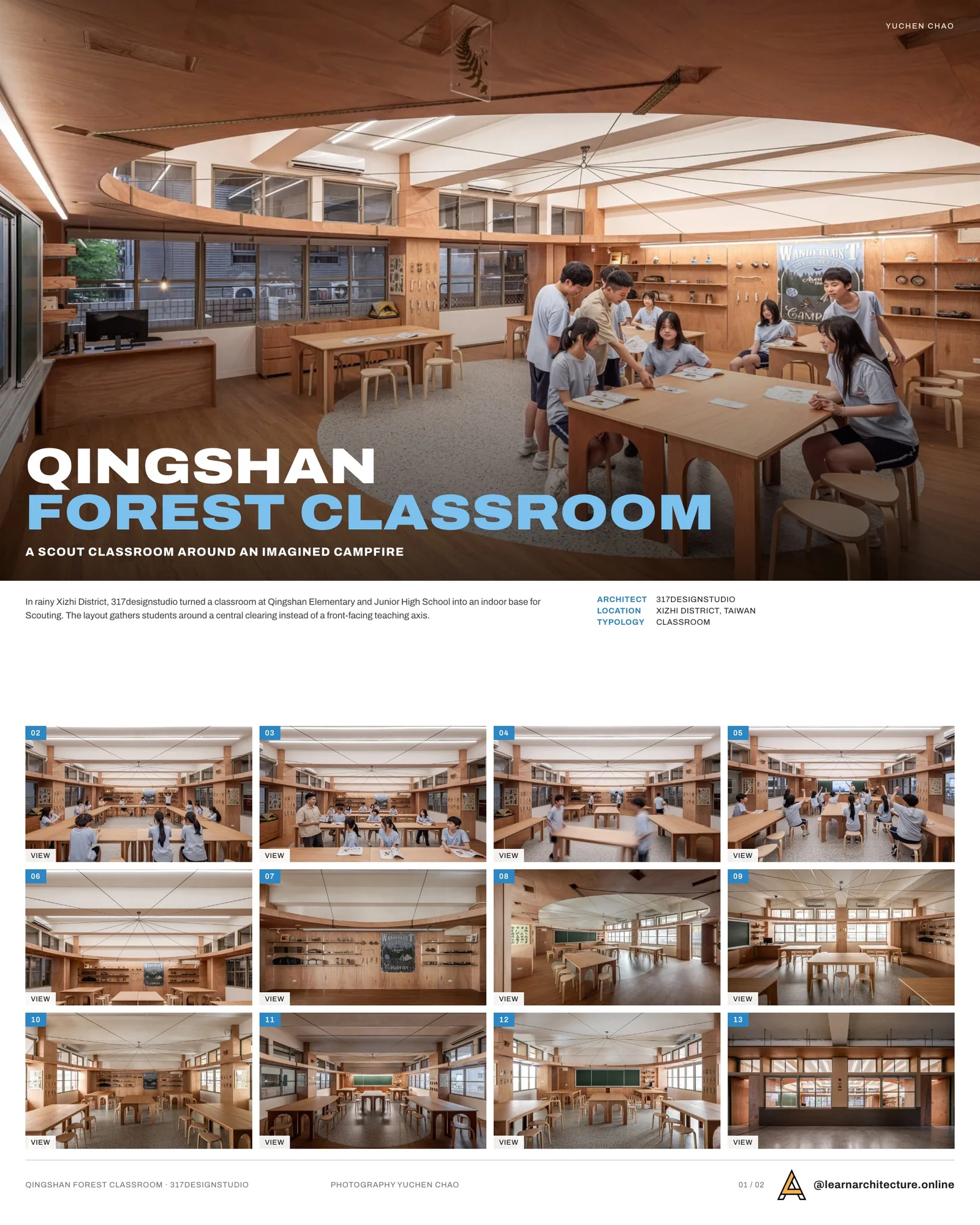
Rather than replicating the layout of a standard classroom, the project proposes an entirely different spatial narrative, one that replaces rows of desks and front-facing instruction with collective presence, interaction, and experiential learning. The result is a space that does not merely host Scouting activities, but actively embodies Scouting values through architecture.

Responding to Climate and Educational Limitations
In Xizhi District, outdoor activities are often disrupted by persistent rain. For a school where Scouting plays a central role, this posed a significant challenge. Activities such as survival training, knot-tying, tent pitching, and teamwork exercises frequently had to be relocated indoors. However, existing classrooms were ill-equipped for this transition. Limited floor area, rigid furniture systems, and insufficient storage restricted movement and undermined the hands-on, action-based learning that Scouting requires.
The new Scout classroom was envisioned as a solution to these constraints: an adaptable indoor base that could simulate the spirit and spatial qualities of outdoor Scouting while remaining functional within a school building. The aim was not to imitate nature literally, but to translate its social and symbolic dimensions into an interior setting.

A Center-Oriented Spatial Concept Inspired by the Campfire
At the heart of the project lies the concept of “Qingshan Forest”, where the classroom is imagined as a forest clearing organized around a shared campfire. This idea informed the entire spatial structure. Instead of a front-facing teaching axis, the layout is center-oriented, encouraging students to gather, sit, move, and interact as a group.
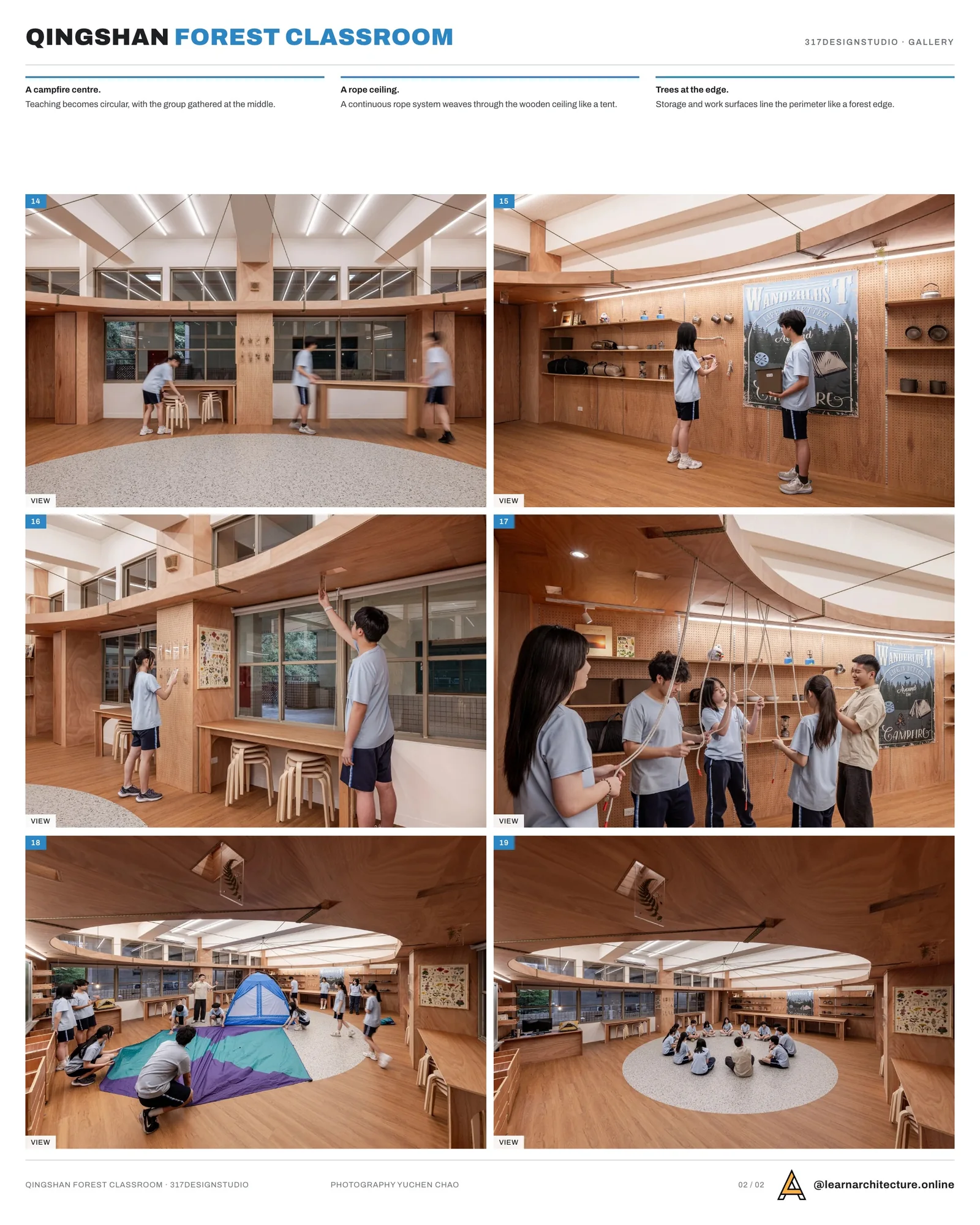
This central zone acts as the emotional and functional core of the space. It supports discussions, demonstrations, and collaborative activities, shifting the learning dynamic away from hierarchy and toward participation. Teaching becomes circular rather than linear, reinforcing equality, attentiveness, and group awareness, key principles within Scouting culture.
Surrounding this central “clearing,” storage units, work surfaces, and functional elements are positioned like trees at the edge of a forest. They define the perimeter while maintaining visual openness toward the center, ensuring that the sense of collective presence is never lost.

Rope, Wood, and the Architecture of Scouting
One of the most distinctive features of the classroom is the continuous rope system woven through the wooden ceiling structure. This installation evokes the image of a tent canopy while referencing essential Scouting skills such as knot-tying, tension, and interdependence. The rope functions simultaneously as symbolism and structure, an architectural expression of unity, cooperation, and shared responsibility.
The extensive use of wood further reinforces the forest metaphor. Warm tones, tactile surfaces, and visible grain create a calm, grounded atmosphere that contrasts sharply with the sterile finishes of typical classrooms. Together, rope and wood establish an interior landscape that feels both protective and open, structured yet flexible.
Importantly, these elements are not decorative. They guide movement, frame gathering areas, and subtly shape how the space is used, ensuring that form and function remain inseparable.

Nature, Participation, and Student-Made Elements
Nature enters the classroom not only through materiality but also through student participation. Walls and ceilings incorporate acrylic panels embedded with plant specimens handcrafted by students themselves. These abstract botanical layers introduce texture, color, and depth while reinforcing a tangible connection to the outdoors.
By involving students in the creation of the space, the project strengthens their sense of ownership and belonging. The classroom becomes a living archive of collective effort, one that evolves alongside its users and reflects the values of care, observation, and respect for nature that Scouting promotes.

A Multifunctional Base for Learning and Exchange
Beyond its role as a Scout classroom, Qingshan Forest functions as a multifunctional base. It accommodates club meetings, skill training, group discussions, inter-school exchanges, and community activities. Its flexible layout allows furniture to be reconfigured or cleared entirely, supporting a wide range of scenarios without compromising the spatial concept.
By translating the ritual of a forest campfire into architectural form, the project enables Scouting values to be learned not only through instruction but through everyday spatial experience. Cooperation, attentiveness, and shared presence are embedded into how the room works, how it feels, and how it is inhabited.
Ultimately, Qingshan Forest Junior High School Classroom demonstrates how interior architecture can transcend functional requirements to become an active educational tool, one that teaches through space itself.
Photography: YuChen Chao Photography


- 317designstudio
- Alternative classroom layouts
- Center-oriented classroom
- Climate-responsive interior design
- Educational interior architecture
- Educational space innovation
- Experiential learning spaces
- Forest-inspired interior
- Innovative learning environments
- Interior architecture for education
- Junior high school architecture
- Multifunctional school spaces
- Nature-inspired learning spaces
- Qingshan Forest Junior High School Classroom
- Rope installation architecture
- School interior design Taiwan
- Scout classroom design
- Scouting education architecture
- Student-centered design
- Wood interior architecture










Leave a comment