


Table of Contents Show
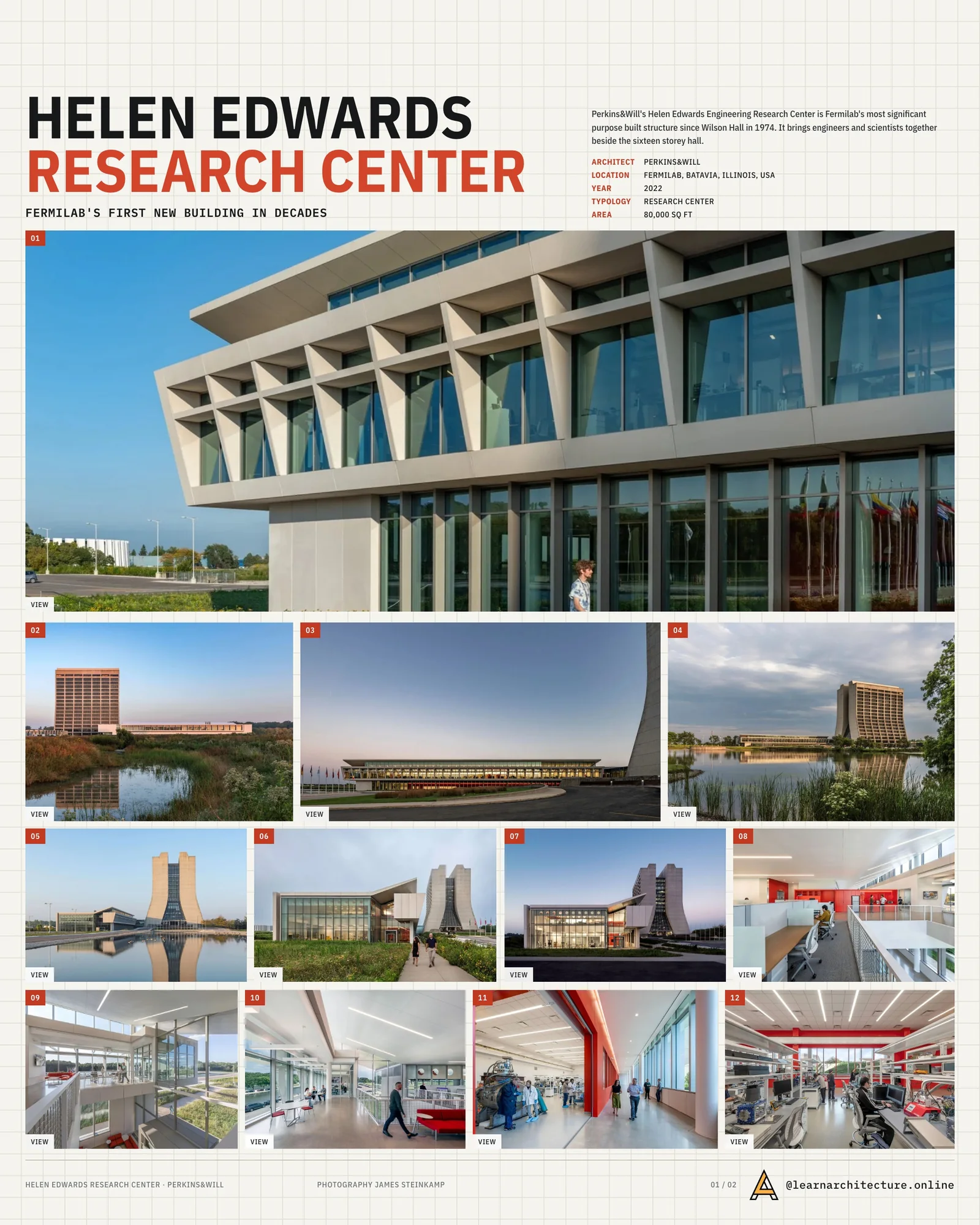
Perkins&Will has completed a transformative addition to Fermilab’s campus in Batavia, Illinois: the Helen Edwards Engineering Research Center. This state-of-the-art research facility spans approximately 80,000 square feet and stands as the laboratory’s most significant purpose-built structure since the completion of the iconic Wilson Hall in 1974. Named in honor of the renowned accelerator physicist Dr. Helen Edwards, the building embodies a forward-thinking approach to scientific infrastructure that merges functionality with environmental responsibility.

Bridging Legacy and Innovation at America’s Premier Particle Physics Laboratory
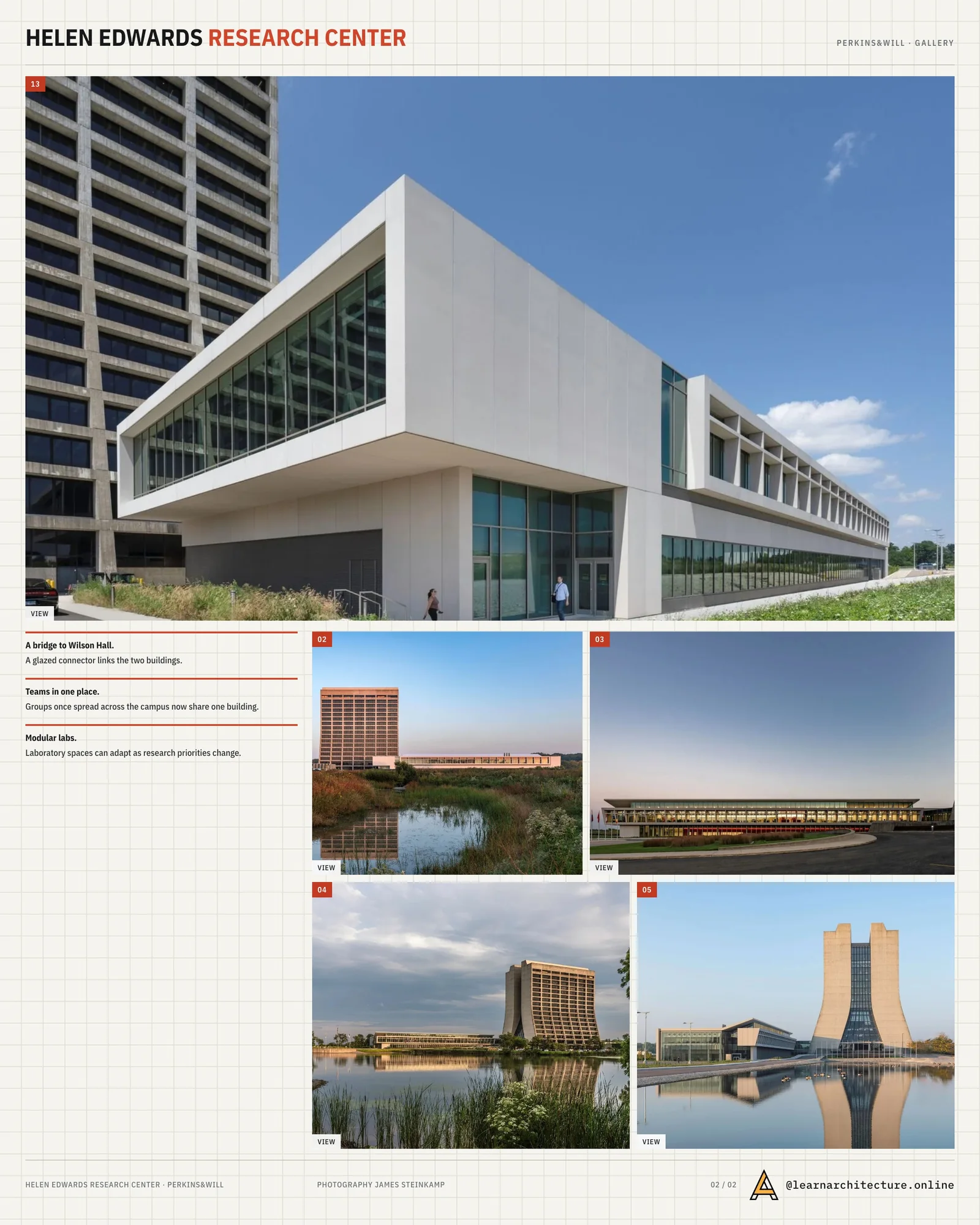
Situated adjacent to the sixteen-story Wilson Hall, the research center establishes a physical and intellectual connection between engineering teams and the scientists who depend on their technical expertise. A transparent, bridge-like connector at ground level and first floor seamlessly links both structures, facilitating the exchange of knowledge and fostering interdisciplinary collaboration. This architectural decision reflects educational architecture principles that prioritize accessibility and open communication.
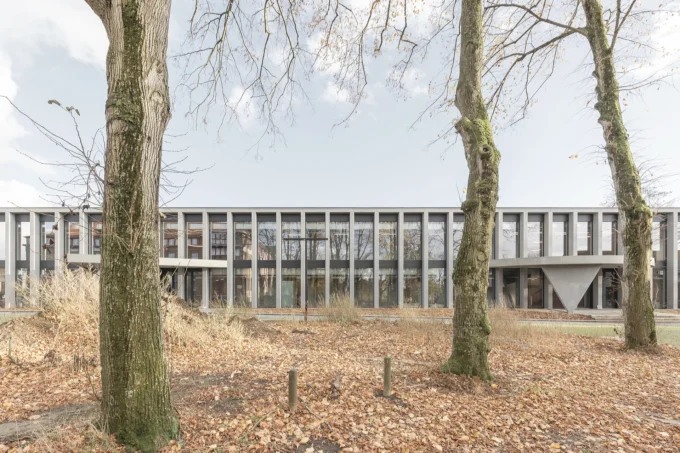
The building’s exterior presents a refined composition of geometric forms and textured concrete surfaces that echo Wilson Hall’s architectural vocabulary while asserting its own contemporary identity. A restrained material palette emphasizes precision and clarity, qualities essential to the scientific endeavors housed within. Rather than competing with its distinguished neighbor, the facility complements the existing campus landscape, demonstrating how modern research centers can respect historical context while advancing architectural expression.

Purpose-Built Spaces for Groundbreaking Scientific Research
The Helen Edwards Engineering Research Center represents Fermilab’s inaugural purpose-built facility that integrates engineering and research functions under one roof. This two-story structure brings together scientists, engineers, and technicians who previously operated across the expansive 6,800-acre campus. By consolidating these teams, the building dramatically enhances operational efficiency and enables real-time collaboration on complex technical challenges.
Laboratory spaces within the facility feature modular configurations designed to adapt as scientific priorities evolve. Specialized research areas include cleanrooms for precision assembly work, vibration-sensitive laboratories for delicate instrumentation, and cryogenic facilities essential for developing components for the Deep Underground Neutrino Experiment (DUNE). The upper level incorporates reinforced structural capacity (designed for live loads of 100 pounds per square foot rather than the typical 50 pounds) to accommodate future programmatic shifts that may demand greater structural performance.
Two-inch-deep cable trenches align with office module spines throughout the upper level, providing flexible infrastructure for electrical and communications systems. This forward-thinking approach ensures workstations can be reconfigured without disruptive construction, supporting the building’s fifty-year design horizon. Daylit laboratories with transparent workspaces place scientific inquiry on display, reinforcing Fermilab’s commitment to open knowledge-sharing and public engagement with innovative architectural design.

Environmental Stewardship Through Sustainable Design Strategies
Sustainability forms an integral component of the Helen Edwards Engineering Research Center’s design philosophy. A 20,000-square-foot green roof system crowns the building, providing thermal insulation while managing stormwater runoff, critical considerations in an era of climate variability. This vegetated surface reduces heat island effects and supports local biodiversity, transforming a typically underutilized building element into an environmental asset.
High-performance mechanical systems minimize energy consumption through intelligent design and advanced technologies. Expansive windows throughout the facility maximize natural daylight penetration, reducing reliance on artificial lighting and creating healthier work environments for researchers and engineers. Energy modeling conducted by Arup, the project’s engineering consultant, informed facade development and the design of a 300-foot-long daylighting shelf that optimizes solar access while controlling glare.
The physical connection to Wilson Hall serves sustainability goals beyond mere circulation convenience. By sharing infrastructure between buildings, the design eliminates redundant mechanical and electrical systems, demonstrating how thoughtful campus planning reduces resource consumption. These strategies align with contemporary green architecture principles that view buildings not as isolated objects but as components of larger ecological and operational systems.

Honoring a Pioneer in Particle Physics
The facility commemorates Dr. Helen Edwards, who devoted four decades to advancing particle physics at Fermilab. Her leadership in designing, constructing, commissioning, and operating the Tevatron accelerator established it as the world’s most powerful particle collider for 25 years. This groundbreaking instrument enabled the discoveries of the top quark in 1995 and the tau neutrino in 2000, two of three fundamental particles first identified at Fermilab. Dr. Edwards’ achievements earned her a MacArthur “Genius Grant” in 1988 and the National Medal of Technology in 1989.
Following Dr. Edwards’ death in 2016, a congressional resolution introduced in February 2023 proposed naming the building in her honor. President Biden signed this resolution into law in December 2024 as part of the Water Resources Development Act. The formal dedication ceremony took place in December 2025, with officials from the U.S. Department of Energy, state and local government, and national research partners in attendance. According to Dr. Darío Gil, Undersecretary for Science at the Department of Energy, “Dr. Edwards’ scientific work is a symbol of the pioneering spirit of U.S. research. Her contributions to the Tevatron and the lab helped the United States become a world leader in the study of elementary particles.”

Supporting the Future of Neutrino Science and Quantum Research
While honoring past achievements, the Helen Edwards Engineering Research Center looks firmly toward future scientific frontiers. The facility serves as a collaborative laboratory where interdisciplinary teams design, construct, and test technologies across multiple research domains including neutrino science, particle detection, quantum science, electronics development, and application-specific integrated circuit (ASIC) design. These diverse capabilities position Fermilab to address emerging questions in fundamental physics.
The building plays a particularly vital role in supporting DUNE, an international collaboration hosted by Fermilab that aims to unlock mysteries of neutrino behavior and matter-antimatter asymmetry in the universe. Components for DUNE’s near detector will be assembled and tested in the center’s specialized facilities before deployment to the experiment’s South Dakota location. This direct connection between design, fabrication, and scientific discovery exemplifies how thoughtfully conceived architectural infrastructure accelerates research progress.
Completed in fall 2022 and officially opened in January 2024, the Helen Edwards Engineering Research Center cost approximately $75 million, funded through the Department of Energy’s Science Laboratory Infrastructure program. Construction was managed by Mortenson with comprehensive engineering services provided by Arup. The project earned recognition from the U.S. Green Building Council and stands as a model for how research institutions can invest in facilities that serve both immediate scientific needs and long-term sustainability objectives.
As particle physics enters a new era of discovery, one that increasingly relies on artificial intelligence, machine learning, and quantum technologies, the Helen Edwards Engineering Research Center provides the flexible, collaborative, and environmentally responsible workspace necessary to pursue these ambitious goals. The building not only honors a scientific legacy but actively shapes the future of research, ensuring that Dr. Edwards’ pioneering spirit continues to inspire generations of scientists and engineers working to understand the fundamental nature of our universe.
Photography: James Steinkamp


- Batavia Illinois architecture
- collaborative research space
- Deep Underground Neutrino Experiment
- DUNE facility
- educational research center
- Fermilab research facility
- Green roof design
- Helen Edwards Engineering Research Center
- laboratory architecture
- LEED certified building
- particle physics laboratory
- Perkins&Will architecture
- science facility design
- Sustainable research building
- Wilson Hall connection









Leave a comment