


Table of Contents Show
Green architecture projects represent some of the most forward-thinking work happening in the built environment today. These buildings go beyond energy-efficient HVAC systems and solar panels to challenge how we think about cities, materials, and the relationship between structures and the natural world. From forests growing on tower facades to offices that generate more power than they use, the examples below show what’s possible when sustainability becomes the central design driver.

What Makes a Building a True Green Architecture Project?
Not every building with a living wall or a LEED plaque qualifies as genuine green architecture. A truly sustainable architecture example integrates ecological responsibility across the full building lifecycle: site selection, material sourcing, construction methods, operational energy, water use, and eventual deconstruction. The most rigorous benchmarks come from certification systems like LEED (U.S. Green Building Council), BREEAM, and the Living Building Challenge, each of which measures performance against measurable thresholds rather than intentions.
According to the UN Environment Programme’s 2022 Global Status Report for Buildings and Construction, the building sector accounts for 37% of global energy-related CO2 emissions. That figure underlines why the green architecture projects below matter not just as design achievements, but as practical models for reducing the industry’s environmental footprint.
⚠️ Common Mistake to Avoid
Many designers and clients confuse “green aesthetics” with green performance. A building covered in plants or clad in wood is not automatically sustainable. Greenwashing is common in real estate marketing: projects that include token solar panels or a small green roof while still consuming far more energy than a well-designed conventional building. True eco-friendly buildings are measured by actual, monitored performance data, not by the presence of greenery in the renders.

1. Bosco Verticale, Milan, Italy
Designed by Stefano Boeri Architetti and completed in 2014, Bosco Verticale (Vertical Forest) consists of two residential towers hosting 800 trees, 4,500 shrubs, and 20,000 plants from about a hundred species across their balconied facades. The vegetation is equivalent to about five hectares of parkland on flat land, concentrated on an area of approximately 1,000 square meters.
The planting strategy does more than provide visual interest. The vegetation acts as a thermal buffer, reducing heating and cooling loads by providing seasonal shade in summer and allowing solar gain in winter when deciduous trees shed their leaves. The project also produces oxygen, filters particulate matter, and supports urban biodiversity. Bosco Verticale has since inspired a growing series of vertical forest buildings by the same practice in cities ranging from Eindhoven to Nanjing.
💡 Pro Tip
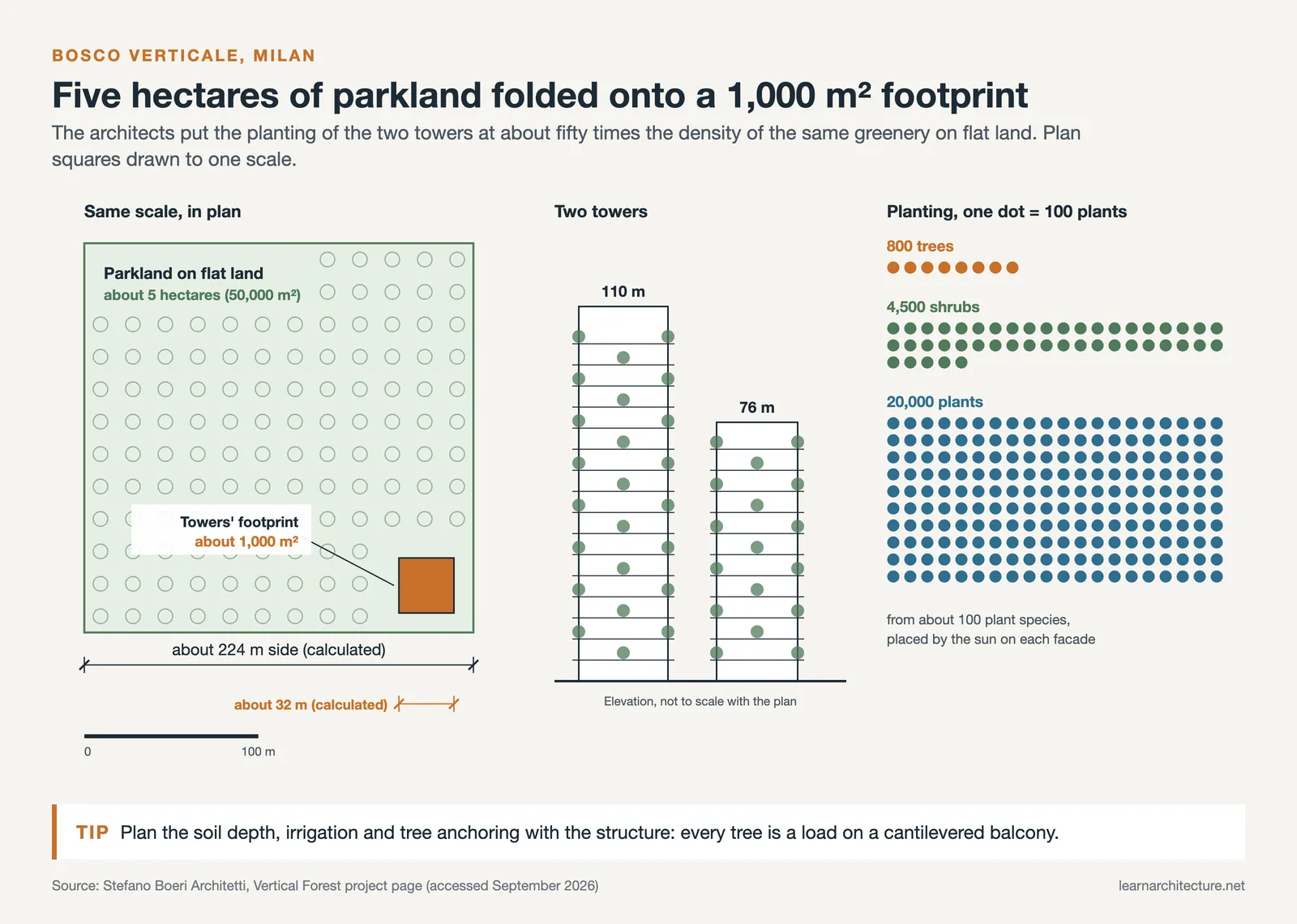
When working on facade planting schemes at any scale, coordinate early with a specialist arborist during the structural design phase. The weight loading for mature trees on upper-level balconies can be substantial, and designing for root containment depth is far easier during schematic design than during construction documents. Bosco Verticale’s structural engineers had to account for trees weighing up to 1,000 kg each, including root ball and growing medium.
2. The Edge, Amsterdam, Netherlands
The Edge, completed in 2014 and designed by PLP Architecture, achieved a BREEAM rating of 98.36%, making it one of the highest-scoring sustainable office buildings ever assessed. The building is not just energy-efficient; it is billed as energy-positive, but it produces more electricity than it consumes only when the solar panels OVG installed on neighbouring university roofs are counted along with its own rooftop and south-facing facade panels.
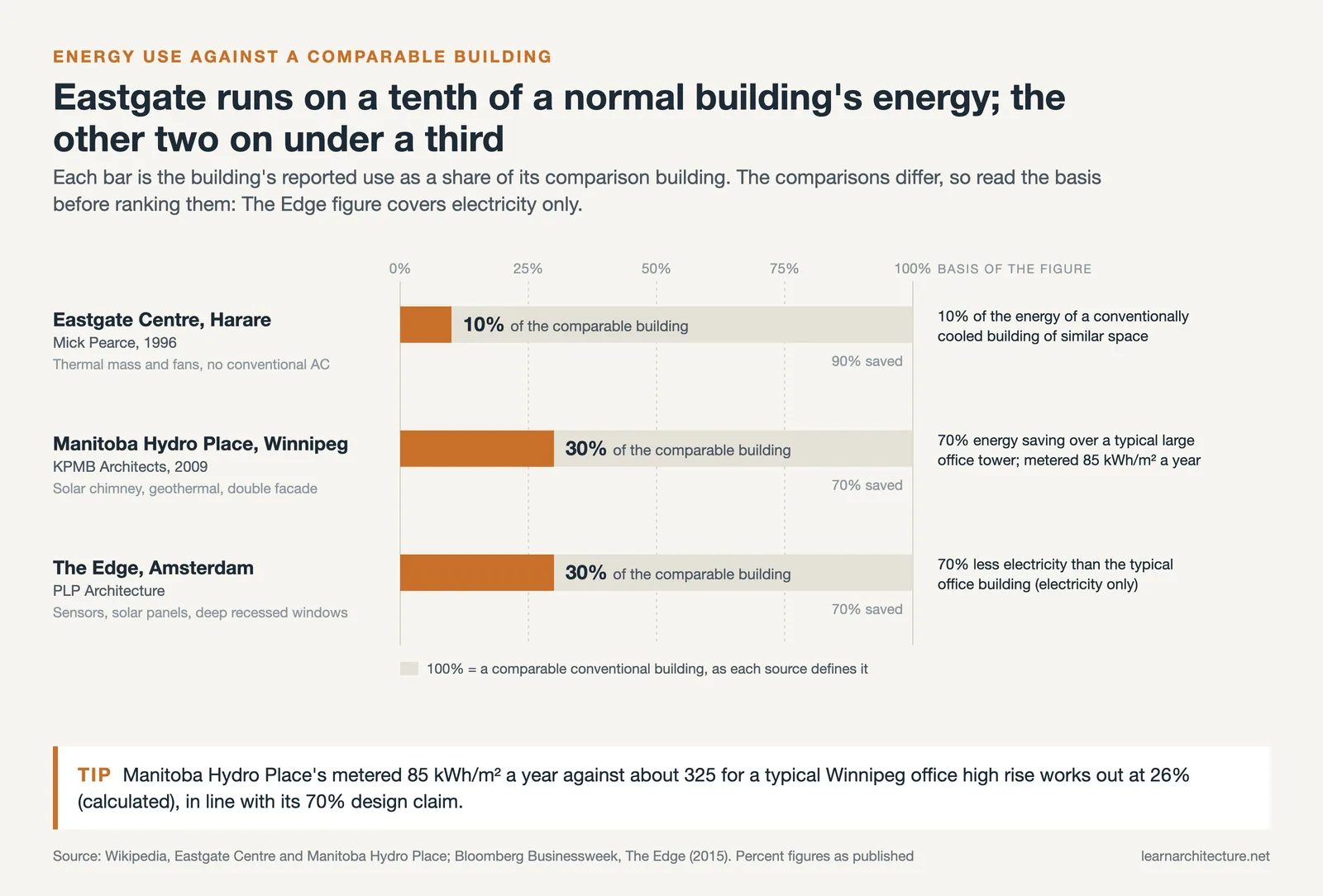
The building’s intelligence comes from a network of 28,000 sensors that monitor temperature, light levels, humidity, and occupancy in real time. Heating, cooling, and lighting adjust automatically based on who is in each space and what conditions they need. The result is a working environment that uses roughly 70% less electricity than the typical office building.
🔢 Quick Numbers
- The Edge scored 98.36% under BREEAM, the highest rating recorded at the time of completion (BREEAM, 2014)
- Green buildings use 25-35% less energy than conventional buildings (World Green Building Council, 2023)
- The building sector accounts for 37% of global energy-related CO2 emissions (UNEP Global Status Report, 2022)

3. Bullitt Center, Seattle, USA
Often called the greenest commercial building in the world, the Bullitt Center in Seattle was completed in 2013 and designed to meet the Living Building Challenge, the most demanding green building standard currently in use. The building is net-zero energy, net-zero water, and uses only materials free from a defined list of toxic chemicals.
100% of the building’s energy comes from a 575-panel photovoltaic array on its roof. Rainwater is collected, filtered, and treated on-site to produce potable water. Composting toilets eliminate the need for connection to the municipal sewer system. The structure is built to a 250-year design life, compared with the 40 to 50 years typical of most commercial buildings, which dramatically reduces the embodied carbon cost per year of use.
One often-cited design detail is the “irresistible staircase”: a bright, visually prominent stairwell positioned at the building’s most attractive corner to encourage occupants to walk rather than take the elevator, directly reducing operational energy consumption from building systems.
🎓 Expert Insight
The Bullitt Center was built to show that net-zero performance can work in an ordinary commercial office, not just in a laboratory setting, with every system tested by real occupants.
This reflects a core challenge in sustainable architecture: demonstrating that high-performance standards hold up under everyday occupancy. The Bullitt Center’s annual energy and water monitoring data, published publicly, has been critical in validating the Living Building Challenge as a credible benchmark.
4. Gardens by the Bay, Singapore
Designed by Grant Associates (landscape) and Wilkinson Eyre (structures) and opened in 2012, Gardens by the Bay is a 101-hectare park in central Singapore featuring two large conservatories and 18 “Supertrees,” vertical structures between 25 and 50 meters tall. The Supertrees are covered with over 162,900 plants representing 200 species and act as vertical gardens integrated with active sustainability systems.
Eleven of the 18 Supertrees are fitted with photovoltaic cells that harvest solar energy for lighting. The structures also serve as air intake and exhaust ducts for the adjacent conservatories, making them functional components of the cooling system rather than purely decorative elements. The two conservatories, the Flower Dome and Cloud Forest, are among the largest glass greenhouses in the world and use a passive cooling strategy that brings cool air in at low level and exhausts warm air at high level, reducing air conditioning loads significantly. For more on how Singapore approaches sustainable building at scale, the Building and Construction Authority of Singapore’s Green Mark scheme provides detailed performance criteria used across the city-state.

5. One Central Park, Sydney, Australia
Completed in 2014 and designed by Ateliers Jean Nouvel with landscape architect Patrick Blanc, One Central Park in Sydney is a mixed-use residential development that has become one of the most recognized examples of green building design in the southern hemisphere. Its two towers are covered with vertical gardens comprising over 35,000 plants and 383 species of Australian flora.
The project’s most technically ambitious feature is its heliostat system: a series of motorized mirrors cantilevered from the taller tower that track the sun’s movement throughout the day and redirect sunlight down into the shaded courtyard and park below. This system addresses one of the most common weaknesses of urban high-rise development, where towers shade surrounding public spaces for large parts of the day.
📌 Did You Know?
The heliostat at One Central Park is the largest in the Southern Hemisphere. Its 320 individual mirrors redirect sunlight up to 60 meters, illuminating areas of the park that would otherwise receive no direct sun at all during winter months. The system was engineered by Arup and required custom tracking software to follow the sun’s path across Sydney’s latitude throughout the year.
6. Eastgate Centre, Harare, Zimbabwe
Designed by Zimbabwean architect Mick Pearce and completed in 1996, the Eastgate Centre in Harare is one of the most cited examples of biomimicry applied to sustainable architecture. The building’s climate control system was directly modeled on the self-regulating ventilation of African termite mounds, which maintain a near-constant internal temperature despite large diurnal temperature swings outside.
The building has no conventional air conditioning or central heating. Instead, its thermal mass absorbs heat during the day and releases it at night, while a network of fans cycles air through the building on a programmed schedule to optimize heat storage and release. The Eastgate Centre uses roughly 10% of the energy consumed by a comparable conventionally air-conditioned building of the same size, according to data published at completion. This is a strong example of how passive design strategies can deliver performance outcomes that active mechanical systems often fail to match on a lifecycle cost basis.

7. Manitoba Hydro Place, Winnipeg, Canada
Completed in 2009 and designed by KPMB Architects, Manitoba Hydro Place is a 22-story office tower designed to perform in one of North America’s most challenging climates, where winter temperatures regularly drop below -30°C and summers can exceed 35°C. The building uses 70% less energy than a conventional office tower of comparable size, a figure independently verified through post-occupancy monitoring.
Key design moves include south-facing winter gardens that capture solar heat in cold months, a solar chimney that draws fresh air through the building via thermal buoyancy, and a geothermal system that uses ground source heat exchange to buffer the building’s heating and cooling loads. Programmable daylight-responsive lighting reduces electricity demand further. The building has been widely studied as a benchmark for sustainable high-rise design in continental climates. Readers interested in the principles behind this approach can explore passive house design principles as a complementary resource.
💡 Pro Tip
When reviewing sustainable architecture projects for cold climates, look at whether the energy savings figures have been verified through post-occupancy evaluation rather than relying solely on modeled predictions. Design-stage energy models frequently overestimate savings by 20-30% compared to actual metered performance, a gap known as the “performance gap.” Manitoba Hydro Place is noteworthy precisely because its monitored results align closely with the design targets.
8. The Crystal, London, UK
Developed by Siemens and completed in 2012, The Crystal in London became the world’s first building to achieve both BREEAM Outstanding and LEED Platinum certification simultaneously. The building serves as a permanent exhibition on sustainable urban development and functions as a demonstration project for the building technologies Siemens develops commercially.
The building generates electricity through photovoltaic panels and solar thermal collectors, while ground source heat pumps provide heating and cooling by exchanging energy with the ground beneath the site. A 60,000-litre rainwater harvesting tank collects and treats precipitation for toilet flushing and irrigation. The flooring includes carpets manufactured from recycled fishing nets, and the building’s operational systems are connected to a smart building management platform that monitors and optimizes every major energy flow in real time.

Why These Sustainable Architecture Projects Matter
Each of the eight green architecture projects above demonstrates something specific and replicable: that it’s possible to build high-performing, commercially viable buildings that dramatically reduce operational energy and carbon emissions without sacrificing occupant comfort or architectural quality. They are not experiments conducted in controlled conditions; they are occupied buildings with years of performance data behind them.
The lessons they offer are increasingly relevant as building codes worldwide tighten their energy and carbon requirements. For architects, developers, and students of sustainable building design, understanding how these projects solved specific technical problems, whether that’s ventilation in a hot climate, heating in a cold one, or integrating vegetation into a structural facade, is more useful than simply admiring them as icons. For deeper study on green building rating systems referenced throughout this article, the World Green Building Council maintains an extensive library of case studies and technical resources.
For a broader introduction to the principles underlying these projects, see our guide to eco-friendly building materials and our overview of green architecture design costs and value.
✅ Key Takeaways
- The most impressive green architecture projects achieve measurable performance outcomes, not just green aesthetics. Look for independently verified post-occupancy data, not design-stage predictions alone.
- Passive design strategies (thermal mass, natural ventilation, solar orientation) frequently outperform active mechanical systems on a lifecycle cost and carbon basis, as demonstrated by the Eastgate Centre and Manitoba Hydro Place.
- Living facades and vertical forests, as seen at Bosco Verticale and One Central Park, provide quantifiable thermal, ecological, and air quality benefits when properly engineered and maintained.
- Net-zero and energy-positive buildings are commercially viable today. The Edge and Bullitt Center have both demonstrated this at scale in real-world occupancy conditions.
- The most ambitious sustainable architecture examples, like the Bullitt Center, design for a 250-year building lifespan, significantly reducing the embodied carbon cost per year of use.
Four More Projects Worth Knowing
The eight above are the clearest demonstrations, but four more have entered the reference set recently and are worth adding to it.
CopenHill (Amager Bakke), Copenhagen, Denmark
BIG turned a waste-to-energy plant into a public recreation landmark. CopenHill processes 440,000 tonnes of waste a year and converts it into clean energy for 150,000 homes, while its sloped roofscape doubles as a ski slope, hiking trail and climbing wall. The aluminium-brick facade carries planters that green the exterior. It is the strongest argument available that infrastructure and public amenity need not be separate buildings.
Portland International Airport Terminal, Portland, USA
ZGF Architects completed the new main terminal with one of the largest mass timber roofs in the world. The structure uses glue-laminated timber from sustainably managed Pacific Northwest forests, substantially lowering embodied carbon against a conventional steel-and-concrete alternative, while the bioclimatic design maximises daylight and natural ventilation across a building type that usually does neither.
Gelephu Mindfulness City, Bhutan
BIG is designing Gelephu Mindfulness City as a new urban centre built on harmony between people and landscape. Neighbourhoods follow the natural contours of river valleys, and the masterplan prioritises local materials, hydropower and urban farming. It received a 2025 Holcim Foundation Award and is the most ambitious attempt yet to apply these principles at city rather than building scale.
Founders Hall, University of Washington, Seattle, USA
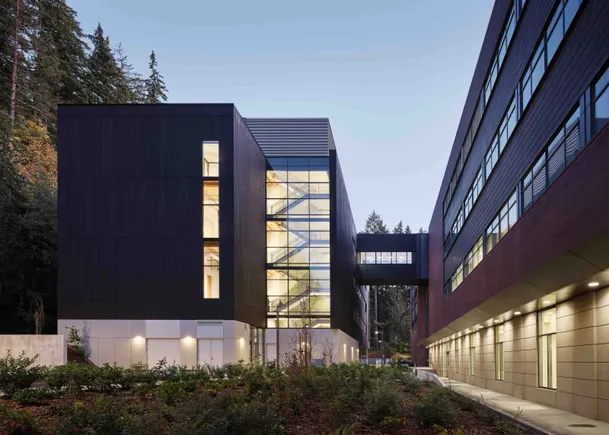
Recognised by the 2025 AIA COTE Top Ten Awards, Founders Hall brings mass timber to the University of Washington campus. The five-storey structure uses cross-laminated timber and glulam as primary structure, cutting embodied carbon against a steel-frame equivalent, and interweaves classrooms, offices and gathering space around a central stair.
What These Projects Have in Common
Passive strategies come first and cost least. The Eastgate Centre’s termite-mound ventilation and CopenHill’s natural airflow through facade openings show that orientation and form can eliminate or dramatically reduce mechanical systems before any budget is spent on technology.
Mass timber has moved from experiment to default where structure and carbon are both in question: Portland and Founders Hall are the same argument at two different scales.
The order of operations matters more than the technology. Sustainability works best when it shapes a project from the first sketch rather than being added at the end. Orient the building to the sun, use shape and shading to control heat and glare, and rely on daylight and natural ventilation wherever possible. Only then layer in efficient systems, renewable energy and low-carbon materials. This sequence reduces the building’s demands before spending money on technology to meet them, which is the difference between a sustainable building and an expensive one.
For the frameworks that measure any of this, see our comparison of LEED, BREEAM and WELL.
- best sustainable buildings in the world
- Eco-friendly Buildings
- environmentally friendly architecture
- famous green architecture
- green architecture case studies
- green architecture projects
- green building design
- sustainable architecture examples
- sustainable architecture projects
- sustainable building design examples





Leave a comment