


Table of Contents Show
Zaha Hadid Architects has completed some of its most ambitious projects in China, ranging from the Guangzhou Opera House (completed in 2010) to the massive Beijing Daxing International Airport (opened in 2019). These architect Zaha Hadid buildings blend fluid, parametric forms with local cultural references, reshaping skylines in Beijing, Guangzhou, Shanghai, Changsha, and beyond.
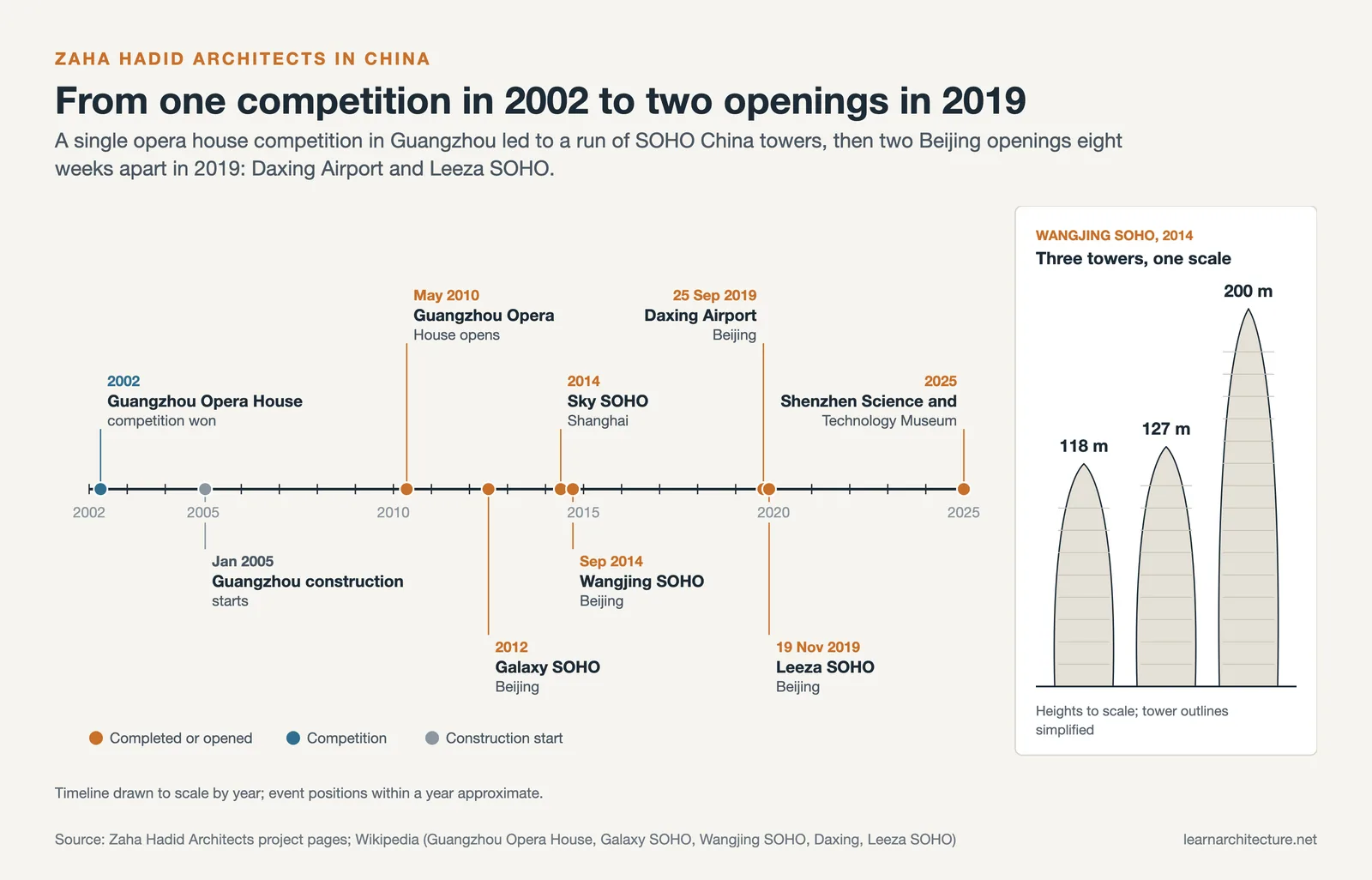
Few international firms have left as deep an imprint on China’s built environment as Zaha Hadid Architects. Since winning the Guangzhou Opera House competition in 2002, ZHA went on to design a string of commercial towers, cultural centers, and transportation hubs that redefined what Chinese cities could look like. Under the leadership of the late Zaha Hadid and her partner Patrik Schumacher, the firm earned a reputation for translating complex geometries into real buildings at extraordinary scales. China’s rapid urban growth, combined with an appetite for bold architectural statements, gave ZHA the canvas to push boundaries that would have been difficult elsewhere. The projects below represent the highlights of this productive relationship between a visionary London-based practice and one of the fastest-developing countries on the planet.
Guangzhou Opera House: Where Zaha Hadid Architect Buildings Began in China

The Guangzhou Opera House was the first major project by architect Zaha Hadid in China, and it remains one of the most recognizable cultural buildings in southern China. In 2002, the municipality of Guangzhou launched an international competition to design an opera house on the banks of the Pearl River. Zaha Hadid’s “double pebble” concept beat proposals from Coop Himmelb(l)au and Rem Koolhaas, and construction started in 2005.
The finished building, which opened in 2010, consists of two sculpted volumes wrapped in a triangulated skin of granite, glass, and steel. The larger volume houses a 1,804-seat grand auditorium equipped with advanced acoustic technology, while the smaller structure contains a 443-seat multifunctional hall alongside a restaurant, bar, and shops. The design drew inspiration from river stones shaped by erosion, and the building’s folded geometry lets natural light penetrate deep into interior lobbies and circulation spaces. Guangzhou Pearl River Foreign Investment Architectural Designing Institute served as the local architect, with structural engineering handled by SHTK in Shanghai.
Occupying 70,000 square meters, the Opera House ranks as the third-largest performing arts center in China after the National Centre in Beijing and the Shanghai Grand Theatre. It established the Zhujiang New Town district as Guangzhou’s cultural heart and helped position the city as a major cultural destination within the Pearl River Delta region, which includes Shenzhen, Hong Kong, and Macau.
Galaxy SOHO: Reinventing the Beijing Courtyard

Galaxy SOHO, completed in 2012, is perhaps the most instantly recognizable of all Zaha Hadid Architects buildings in China. Developed by SOHO China, the complex sits in central Beijing and consists of four flowing, dome-shaped volumes connected by bridges and platforms. There are no straight edges or sharp corners anywhere in the structure. The design was a reinterpretation of the traditional Chinese courtyard, where connected open spaces create layered, immersive environments.
The project marked the beginning of a productive partnership between ZHA and SOHO China, led by CEO Zhang Xin. According to the official ZHA project page, the three lower levels contain retail and entertainment facilities, the middle floors offer flexible office spaces for businesses of varying sizes, and the top levels feature bars, restaurants, and cafes with views along Beijing’s main avenues. The total built area spans roughly 330,000 square meters across 15 above-ground levels and 3 below-ground levels. BIAD (Beijing Institute of Architecture and Design) served as the local design partner.
Galaxy SOHO did attract controversy. Heritage preservation groups criticized the demolition of older Beijing vernacular structures to make way for the project. The Beijing Cultural Heritage Protection Center filed an objection, arguing that the development disrupted the historic urban fabric of the area. This tension between modernization and heritage preservation remains an ongoing discussion in Chinese urbanism, and Galaxy SOHO became a flashpoint in that debate.
Wangjing SOHO: Three Mountain Towers in Northeast Beijing

Located in Beijing’s Wangjing district, roughly halfway between the Capital Airport and the city center, Wangjing SOHO was the second major collaboration between architect Zaha Hadid and SOHO China. Completed in 2014, the development comprises three towers standing 118, 127, and 200 meters tall, designed to evoke interweaving mountains that merge building and landscape.
The total above-ground floor area reaches 392,265 square meters, with an additional 129,000 square meters below ground that includes parking for 8,256 bicycles and priority charging spaces for electric vehicles. According to the ZHA project description, the towers feature thin floor plates that provide flexible, open-plan office space. Double-insulated, low-e glazing systems and horizontal aluminium louvers provide sun shading, while the envelope insulation reduces heating and cooling demands in Beijing’s harsh continental climate.
Wangjing has become a hub for technology companies, hosting offices for Microsoft, Siemens, Daimler, and numerous Chinese tech startups. The project responded to this demand by offering a wide range of office sizes, from single-employee units for new firms to large open-plan floors for established companies. A 60,000-square-meter public park surrounds the base, creating a community anchor in a district that had previously been dominated by residential blocks built in the 1990s.
Sky SOHO: Zaha Hadid Architects Projects in Shanghai

Sky SOHO, completed in 2014 in Shanghai’s Hongqiao Business Zone, was the fourth SOHO China project to involve architect Zaha Hadid works. The 342,500-square-meter development sits within the Linkong Economic Park, connected to a major transportation hub with subway, rail, and proximity to both Shanghai’s city center and the airport.
The concept stripped the design back to four parallel slabs arranged on an 8.4-meter grid, with a building depth of roughly 18 meters. These elongated elements are tied together by a sinuous retail podium and a continuous metallic ribbon, with a green roof that ZHA likened to calligraphy. The four primary volumes are pinched together at their centers to form intimate courtyards framed by connecting bridges. SIADR (Shanghai Institute of Architectural Design and Research) served as the local design institute.
Sky SOHO provides 220,000 square meters of office space and 23,000 square meters of retail across 11 above-ground levels, with 123,000 square meters below ground. Its location in the Hongqiao zone gives tenants direct access to one of Shanghai’s busiest transportation nodes, making it an attractive address for multinational and local enterprises.
Beijing Daxing International Airport: The Largest Zaha Hadid Architects Project

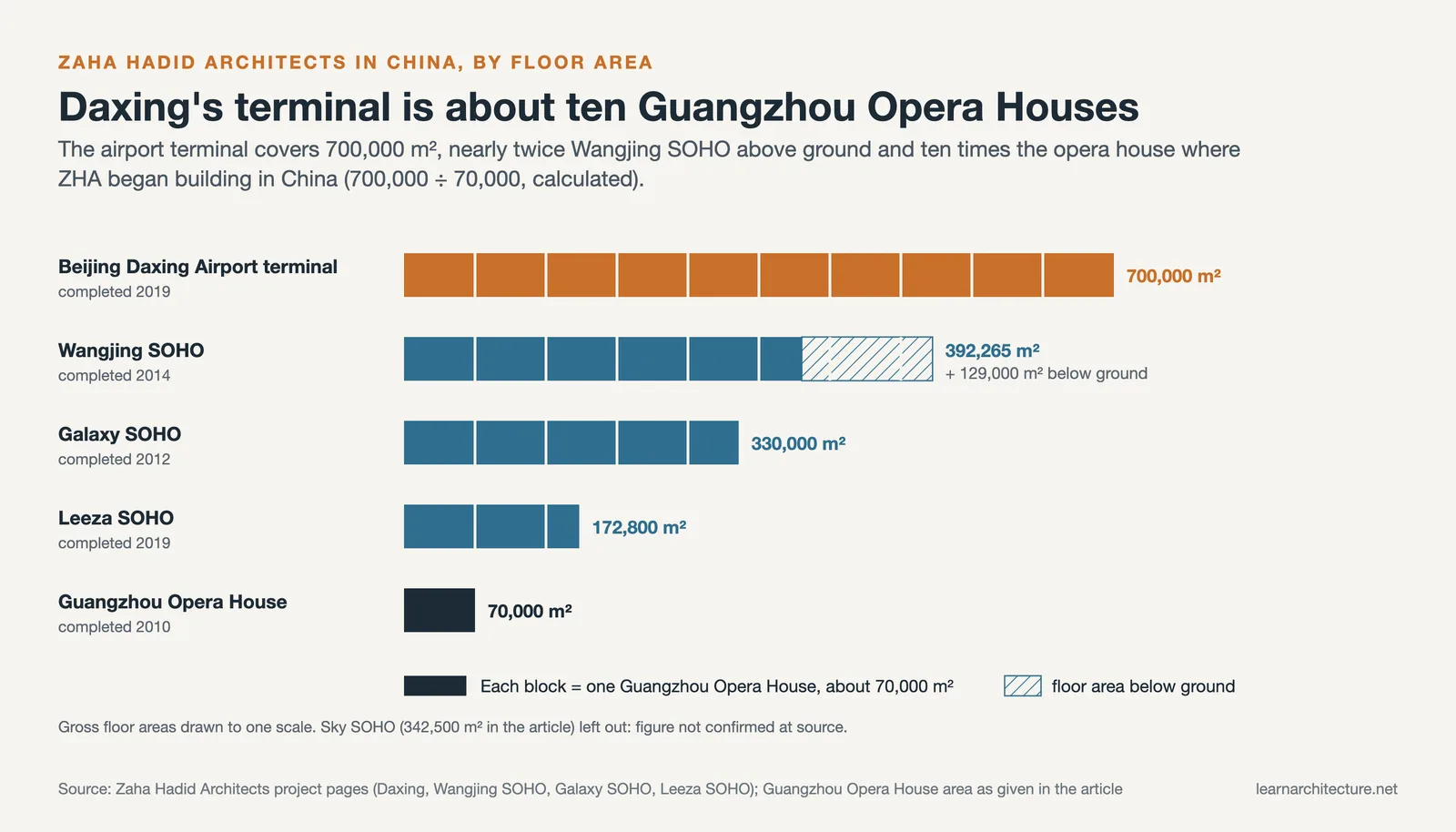
Beijing Daxing International Airport (PKX), which opened on September 25, 2019, stands as the crowning achievement of Zaha Hadid Architects projects in China and the firm’s largest completed work anywhere. The 700,000-square-meter passenger terminal, co-designed with ADP Ingenierie (ADPI) and built by BIAD, cost an estimated $11.5 billion and was constructed in approximately five years with over 40,000 workers at peak activity.
Nicknamed “the starfish” for its radial plan, the terminal features a central hub connected to six curved spokes. The compact layout means the farthest boarding gate is reachable within an 8-minute walk from the center. According to Architizer, the hyperboloid steel roof grid contains over 170,000 steel members, spans more than 350,000 square meters, and is supported by C-shaped columns with structural spans of up to 100 meters.
The design draws on principles found in traditional Chinese architecture, organizing interconnected spaces around a central courtyard. This grand atrium at the terminal’s heart serves as a multi-level meeting space where natural light floods in through a network of linear skylights. These skylights also function as an intuitive wayfinding system, guiding passengers toward their gates.
Key Facts About Beijing Daxing Airport
The following table summarizes the essential data about this record-setting transportation hub:
| Feature | Details |
|---|---|
| Terminal Area | 700,000 m² (7.5 million sq ft) |
| Initial Capacity | 45 million passengers per year |
| Planned Full Capacity (by 2040) | 100 million passengers per year |
| Runways | 4 civilian + 1 military |
| Construction Cost | Approximately $11.5 billion |
| Architects | ZHA + ADP Ingenierie (ADPI), built by BIAD |
| Opened | September 25, 2019 |
Sustainability features include photovoltaic panels providing at least 10MW of power, a ground-source heat pump system covering nearly 2.5 million square meters, and a rainwater management system that stores and purifies up to 2.8 million cubic meters of water through constructed wetlands, lakes, and streams. The airport won the Architizer A+Awards Project of the Year in 2020.
“We explored a completely new combined model of lighting, heating, structure, wayfinding, and airplane traffic that defined the building form. It was truly multidisciplinary.”
Wolf Mangelsdorf, Partner at Buro Happold (project collaborator), via Buro Happold
Leeza SOHO: The World’s Tallest Atrium in a Tower

Leeza SOHO, the third and final Zaha Hadid Architects buildings developed with SOHO China in Beijing, opened on November 19, 2019. This 45-story, 207-meter-tall tower is located in the Fengtai business district, a growing financial hub between central Beijing and the newly opened Daxing Airport. The 172,800-square-meter tower provides Grade A office space for small and medium-sized businesses.
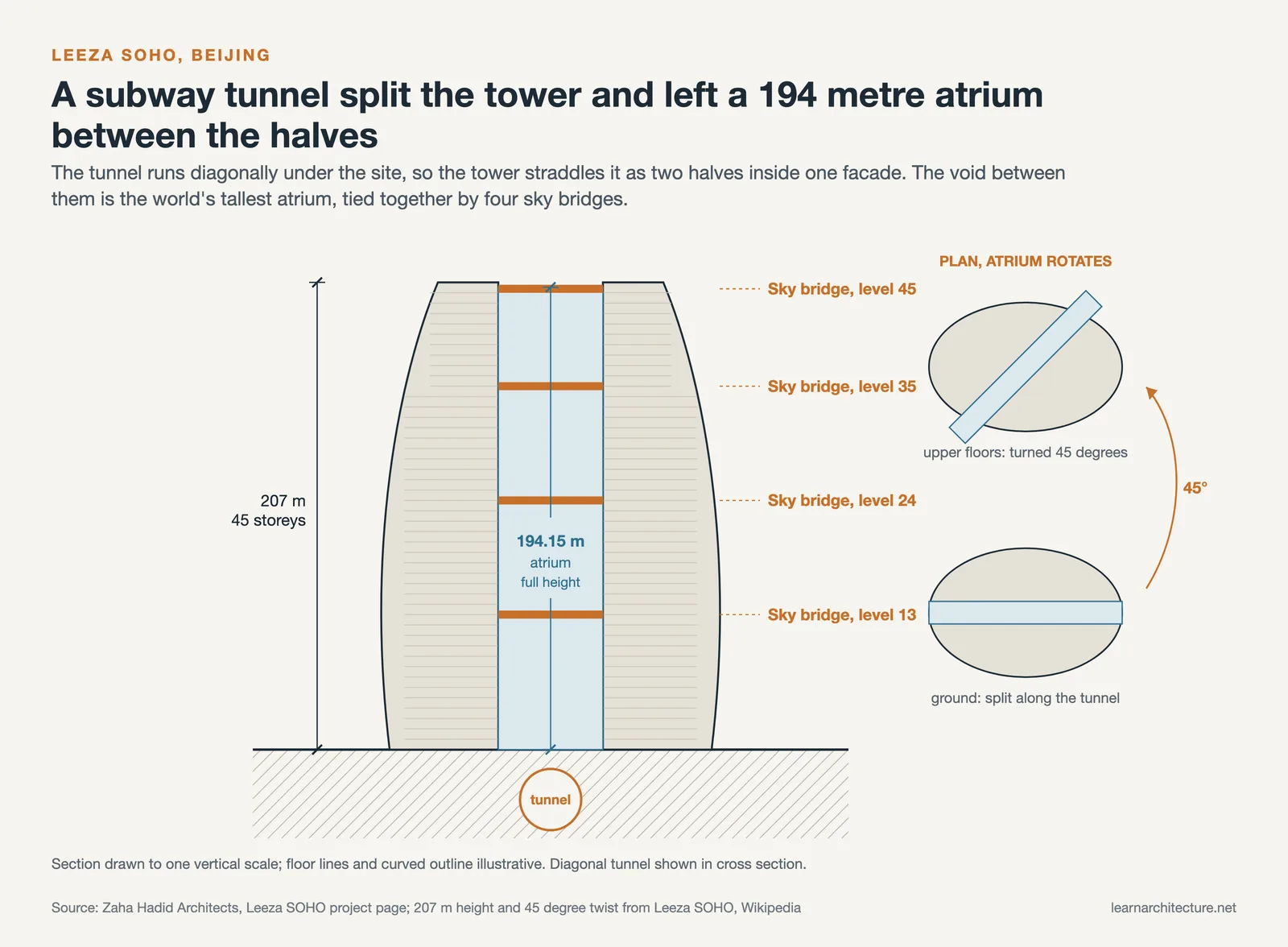
What makes Leeza SOHO structurally remarkable is the site constraint that shaped its form. An underground subway tunnel diagonally bisects the plot, which forced the architects to split the building into two halves. Between those halves, a central atrium rises 194.15 meters, making it the tallest atrium in the world, surpassing the void in the Burj Al Arab hotel in Dubai. As the atrium ascends, it twists 45 degrees, aligning the upper floors with views along Lize Road. Four sky bridges connect the two halves at levels 13, 24, 35, and 45.
The tower’s double-insulated glass curtain wall steps at an angle on each floor, creating narrow ventilation registers that draw outside air through operable cavities. Designed to achieve LEED Gold certification, the building uses a 3D BIM energy management system that monitors environmental conditions in real time, along with heat recovery from exhaust air, high-efficiency mechanical systems, and a green roof with a photovoltaic array. Below ground, 2,680 bicycle parking spaces with lockers and showers encourage alternative commuting.
Changsha Meixihu International Culture and Art Centre
Located on the shores of Meixi Lake in Changsha, Hunan province, the Meixihu International Culture and Art Centre is the largest and most versatile cultural complex in the region. Completed in stages, the ensemble comprises three separate cultural institutions: a contemporary art museum (MICA), an 1,800-seat grand theater, and a multipurpose hall. Each building is defined by an organic architectural language shaped by pedestrian routes that weave through the site, connecting to neighboring streets and providing views of Meixi Lake.
The three institutions create external courtyards at the points where pedestrian routes intersect, offering spaces for outdoor events and sculpture exhibitions. The complex connects directly with Line 2 of Changsha’s metro system, making it accessible from across the city. Changsha has historical significance as a city located on ancient trade routes through China, and the center builds on that tradition by functioning as a contemporary cultural hub. The project demonstrates how architecture can serve as a catalyst for urban development, anchoring new neighborhoods around cultural programming rather than purely commercial functions.
What Makes Zaha Hadid Architects Projects in China Stand Out?
Across these seven projects, certain recurring themes define the ZHA approach in China. The firm consistently draws on local cultural references, whether it is the courtyard typology reinterpreted at Galaxy SOHO, the river-stone metaphor at Guangzhou Opera House, or the traditional courtyard planning principles at Daxing Airport. At the same time, each project deploys advanced computational design and engineering tools, from the hyperboloid steel grid at Daxing to the BIM-driven energy management at Leeza SOHO.
Scale is another defining factor. China’s construction ecosystem, with its large labor forces, efficient supply chains, and appetite for ambitious timelines, allowed ZHA to build at sizes that would be nearly impossible in most Western markets. The Daxing Airport terminal alone covers 700,000 square meters; the four SOHO China projects together total approximately 1.4 million square meters of built space, according to the ZHA project archive.
The firm’s work in China also reflects the country’s broader trajectory of economic and cultural development. From the early 2000s, when international architects were invited to create landmark buildings for the 2008 Olympics era, through to the 2020s focus on sustainable technology hubs and cultural centers, ZHA’s Chinese portfolio mirrors the evolution of China’s urban ambitions. Recent projects like the Cao’e River Culture and Art Center in Shaoxing, the Shenzhen Science and Technology Museum (opened in 2025), and a series of cultural buildings planned along the Zhedong Canal in Hangzhou suggest this relationship will continue to produce significant architecture for years to come.
“China attracts the best talent from around the world. It’s important to work with architects who understand what the next generation requires; connecting communities and traditions with innovative new technologies to embrace the future.”
Zhang Xin, CEO of SOHO China, on Leeza SOHO, via ArchDaily
Note: Project data such as construction costs, completion timelines, and capacity figures are based on information published by Zaha Hadid Architects, ArchDaily, Dezeen, and Wikipedia as of early 2026, and may be subject to updates as projects evolve.











Leave a comment