


Table of Contents Show
Sagrada familia architecture is a singular fusion of Gothic structural logic, Art Nouveau organic naturalism, and Catalan Modernisme that has no precise parallel in architectural history. Antoni Gaudí took over the project in 1883 and reimagined what a sacred building could be, treating stone, light, and geometry as instruments of spiritual experience. Though still under construction after more than 140 years, the basilica is recognized as one of the most significant works of architecture ever conceived.
What Architectural Styles Define the Sagrada Familia?
La Sagrada Familia architecture does not belong cleanly to any single style. Gaudí began with the Latin cross plan and pointed arches of Gothic tradition but departed from Gothic convention at almost every other turn. He rejected flying buttresses entirely, replacing them with an interior system of branching columns that distribute structural loads the way a tree trunk and limbs distribute wind forces. This allowed the walls to open up for stained glass on a scale that pure Gothic construction could never achieve.
At the same time, the Sagrada Familia architecture style draws heavily from Art Nouveau, visible in the building’s fluid, curved surfaces, its ceramic tile ornamentation, and its insistence that the building’s visual language come from the natural world rather than historical precedent. Gaudí studied bone structures, branching trees, coral formations, and shell geometries obsessively, and the results are visible in every tower and facade. The combination of Gothic verticality with Art Nouveau surface ornament and genuinely novel structural engineering gives the building its unique character among all the architectural styles Gaudí synthesized.
💡 Pro Tip
When studying the architecture of Sagrada Familia, examine the transition points between structural elements rather than the surfaces alone. Gaudí’s most innovative thinking shows up in how he resolves the junction between a column, a vault, and a skylight. Those intersections reveal his geometry far better than any photograph of a facade.
Gaudi Architecture at Sagrada Familia: The Structural System

The most technically remarkable aspect of gaudi architecture at la Sagrada Familia is the column system inside the nave. Gaudí designed branching columns that split at different heights, like the forks of a tree, with each branch calibrated to carry the exact load above it. The columns are inclined rather than vertical, following the trajectory of forces through the structure. This meant Gaudí could eliminate the external buttresses that had been Gothic architecture’s defining structural compromise for centuries.
To arrive at these forms, Gaudí constructed a famous inverted scale model using strings and small bags of lead shot. By hanging weights from a scaled plan of the ceiling, he created a catenary network in tension. When photographed and flipped, the model showed the compression paths that the real structure needed to follow. The angled columns and vaulted forms seen in the built work derive directly from this physical computation, carried out decades before computers could model such geometry.
The geometry itself belongs to a family of shapes called ruled surfaces: hyperboloids, paraboloids, helicoids, and conoids. These forms can be generated by moving a straight line through space according to a mathematical rule. Gaudí chose them not only for their structural efficiency but because they create complex, richly shadowed surfaces from simple geometric operations, and because they enhance acoustic performance inside the nave.
📐 Technical Note
Gaudí’s interior columns achieve inclination angles that follow the resultant of vertical loads and horizontal forces at each point in the structure, typically ranging from 6° to 30° from vertical depending on position. This inclination eliminates the horizontal thrust that requires buttressing in conventional Gothic vaulting. The geometry was verified and extended using parametric software including CATIA and Rhinoceros after Gaudí’s death, as his original workshop documentation was largely destroyed in 1936.
The Three Facades: Nativity, Passion, and Glory

Understanding the sagrada familia architectural styles means understanding its three main facades, each conceived as a distinct narrative and visual experience.
The Nativity Facade
The Nativity Facade, on the east side, is the only facade completed under Gaudí’s direct supervision, finished in 1930. It is the most densely ornamented surface of the building: its four bell towers (each around 100 meters tall) are encrusted with vegetation, animals, figures, and inscriptions that celebrate the birth of Christ. Gaudí used actual plants, animals, and human figures as casting models for the stone sculpture, ensuring that the naturalistic detail was grounded in real forms rather than stylized approximations. This facade was granted UNESCO World Heritage status independently of the rest of the building.
The Passion Facade
The Passion Facade, on the west, was designed by Gaudí but built after his death by sculptor Josep Maria Subirachs between 1954 and 2005. Its character is starkly different: angular, skeletal, and severe, reflecting the suffering of the Crucifixion. The slanted columns on this facade are among the most explicit expressions of Gaudí’s tensile-structure logic applied to compression, leaning at angles that recall suspension bridge cables translated into stone. The facade has been controversial since completion, as some critics argue Subirachs’ figurative style departs significantly from Gaudí’s original vision.
The Glory Facade
The Glory Facade, on the south, is the largest and most symbolically significant of the three, representing the path of the human soul toward God. As of 2025 it remains largely unbuilt, representing the single largest remaining construction task on the project. Gaudí left fewer precise specifications for this facade than for the others, which makes its realization the most interpretive and contested aspect of the ongoing construction.
🎓 Expert Insight
“The Sagrada Familia is recognized as a testament to Gaudí’s approach to architecture, combining Gothic traditions with radically innovative forms to redefine the structure of a cathedral.”
ArchDaily editorial, 2026
This framing captures why the building resists easy categorization. Gaudí did not reject Gothic tradition so much as solve its structural problems from first principles, arriving at forms that look nothing like historical Gothic but share its spatial ambitions entirely.
Towers and the Symbolic Program of the Sagrada Familia
When complete, the Sagrada Familia will have eighteen towers arranged in a symbolic hierarchy. Four bell towers on each facade represent the twelve Apostles. A tower over the apse represents the Virgin Mary. Four towers around the central spire represent the four Evangelists. The central tower, dedicated to Jesus Christ, reaches 172.5 meters, making it the tallest point of the completed basilica.
In February 2026, the final section of the central Christ tower was installed, bringing the structure to its full height for the first time. This milestone marked the culmination of 144 years of construction and coincides with the centenary of Gaudí’s death. Barcelona is simultaneously serving as the UNESCO World Capital of Architecture for 2026, an alignment that gives the completion year unusual significance in global architectural culture.
📌 Did You Know?
The Sagrada Familia operated for 137 years without a building permit. Barcelona’s city authority granted its first official permit in 2019, after the foundation agreed to pay approximately 41 million USD to fund public transport improvements in the surrounding neighborhood. It is almost certainly the most famous building in architectural history to have spent over a century in legal limbo.
Light and Color: The Interior Experience
The sagrada familia architecture features one of the most ambitious stained-glass programs in contemporary sacred architecture. The eastern windows use warm amber and gold tones to represent the morning light of creation and nativity. The western windows use cool blues and greens to evoke twilight and the Passion. The combined effect is that the interior changes character dramatically throughout the day as sunlight moves through the building, animating the forest-column nave with shifting color.
Gaudí designed the column system specifically to hold this light. The branching canopy at ceiling level opens into a series of circular skylights surrounded by hyperboloid surfaces. These create pools of direct light that fall between the columns while the surrounding space is bathed in diffused, colored light from the side windows. The spatial experience is genuinely unlike any other interior in architecture, combining the height and verticality of Gothic with the sensory richness of a forest in full leaf.
💡 Pro Tip
If you are visiting the Sagrada Familia to study its architecture, arrive early in the morning and enter through the Nativity Facade. The eastern light fills the nave with the warmest tones of the stained glass program at that time of day. By midday the light is more diffuse and less revealing of Gaudí’s color intentions. Afternoon visits through the Passion Facade entrance show the cool western palette to best effect.
How Gaudí’s Nature-Inspired Approach Shaped the Sagrada Familia Architecture Style

Gaudí’s relationship with nature was not ornamental: it was structural. He observed that natural forms achieve extraordinary structural efficiency because they have been optimized by evolutionary pressure over millions of years. A bone cross-section distributes stress through internal lattice geometry. A palm trunk tapers as height increases, matching the reduction in load. Gaudí translated these observations directly into building design, using animal and plant geometry as engineering references rather than simply as decorative motifs.
This approach is visible across the entire building. The parabolic arches in the crypt follow the same proportions as the arch of a standing human spine under compression. The towers taper and spiral using helical geometry drawn from plant phyllotaxis, the pattern governing how leaves and seeds arrange themselves around a stem. Even the ceramic trencadís surface treatment, the mosaic of broken tile fragments that covers the tower finials, was developed by Gaudí in part because the irregular surface scatters reflected light the way water surface does.
🏗️ Real-World Example
Park Güell (Barcelona, 1914): Designed by Gaudí as a residential garden complex for the Güell family, Park Güell served as a direct testing ground for many of the structural and ornamental ideas later refined in the Sagrada Familia. The inclined viaduct columns follow the same load-path logic as the nave columns, and the trencadís ceramic technique appears throughout, giving architects who visit both sites a clear picture of how Gaudí developed his structural vocabulary across different scales and programs.
What Makes the Sagrada Familia Architecture Different from Gothic Cathedrals?
The comparison with Gothic architecture reveals just how far Gaudí’s design departed from its precedents. Medieval Gothic cathedrals achieve their height through a system where thin walls and large windows are stabilized by external flying buttresses that transfer lateral thrust away from the building. The result is powerful but complex: the buttresses dominate the exterior, the plan is constrained by their placement, and the interior feels like it is in tension with invisible forces pressing inward.
Gaudí’s approach at the Sagrada Familia resolved the lateral thrust problem internally. His branching columns work like a three-dimensional load distribution network, transferring forces at each branch node so that by the time loads reach the floor, they travel almost vertically through the column shafts. No external buttresses are needed. The exterior is freed from the structural apparatus that defines every major Gothic cathedral, which is why the Sagrada Familia’s exterior reads as a forest of towers and ornament rather than as a skeleton of structural buttresses.
⚠️ Common Mistake to Avoid
Many architecture students describe the Sagrada Familia as a Gothic building with Art Nouveau decoration. This misses the central innovation. Gaudí did not decorate a Gothic structure with Art Nouveau surfaces. He replaced Gothic structural logic entirely with a new system derived from natural geometry, then gave that system an organic surface language. The building looks the way it does because of how it stands, not because ornament was applied afterward.
The Ongoing Construction: Technology, Continuity, and Controversy
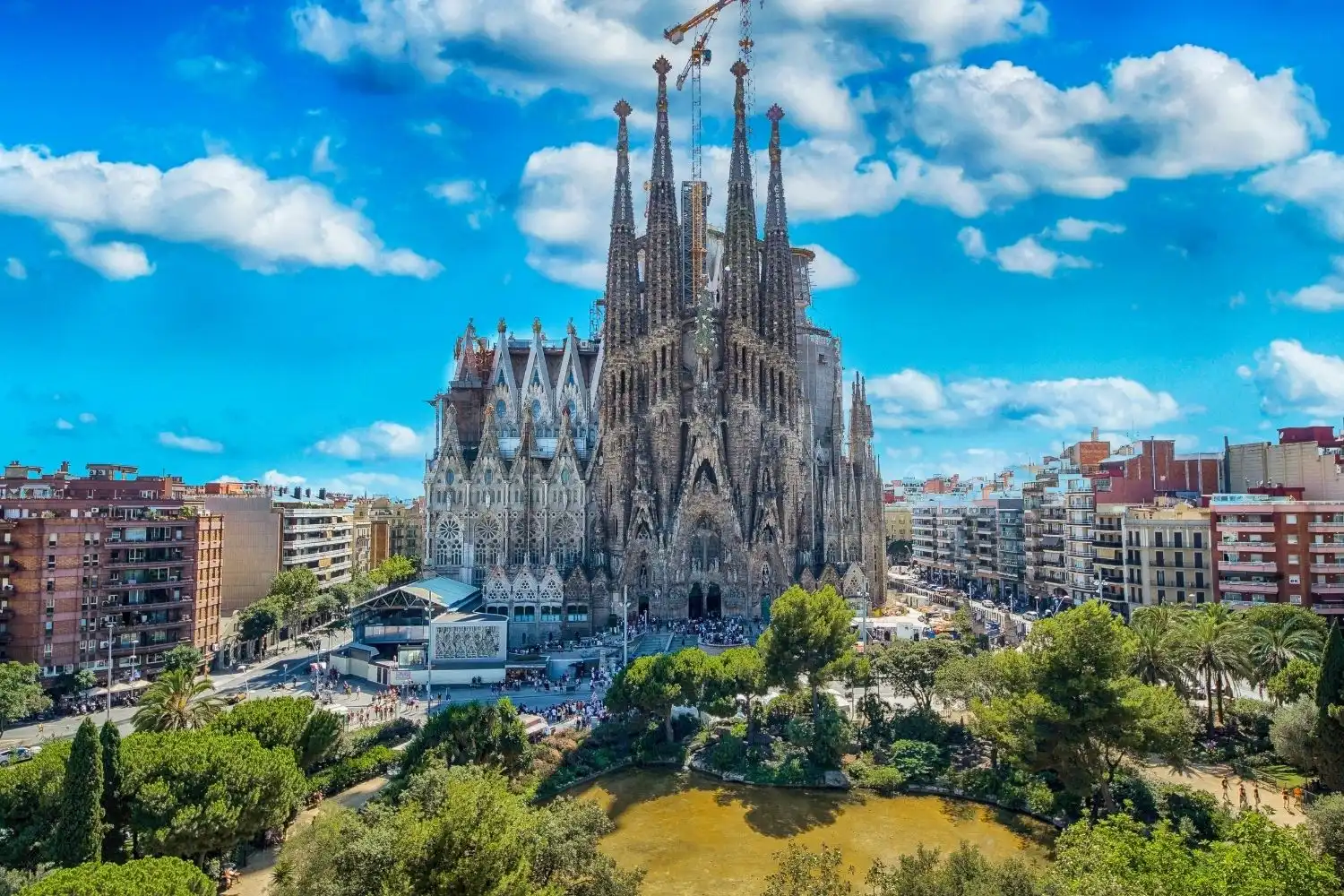
The Sagrada Familia has been built using entirely different technologies in each of its main construction phases. The earliest work under Gaudí used hand-carved stone and brick masonry. Reinforced concrete appeared on the Nativity Facade spires between 1915 and 1934. After Gaudí’s death in 1926 and the destruction of his workshop documentation during the Spanish Civil War in 1936, subsequent architects reconstructed the design from surviving plaster models and fragments. From the 1990s onward, parametric CAD tools, 3D printing for plaster model generation, and high-strength concrete have allowed the complex ruled surfaces to be built with a precision that manual methods could not have achieved.
The ongoing construction raises genuine architectural questions about authorship and continuity. Since all work after 1926 has been carried out by architects interpreting Gaudí’s intentions rather than executing his direct instructions, critics have debated how much of the completed building reflects Gaudí’s vision. The Nativity Facade, built under his supervision, and the incomplete crypt are the only portions with unambiguous historical authenticity. For most architecture scholars, however, the structural logic and spatial program are consistent enough with Gaudí’s documented principles that the building reads as a coherent whole despite its 140-year construction span.
For a broader understanding of how landmark buildings define architectural movements, the article on landmark buildings that shaped architectural eras at learnarchitecture.net provides useful historical context. The biomimicry principles at work in Gaudí’s column system are explored further in the site’s guide to biomimicry in architecture, which includes other buildings that draw structural logic from natural organisms. The golden ratio, another mathematical principle Gaudí used in several proportional decisions, is examined in depth in the articles on the golden ratio in architectural aesthetics and how architects apply the golden ratio in design. For the broader European context in which Gaudí worked, the guide to iconic architectural styles of Europe traces the Gothic and Moderniste movements that shaped his formation.
🔢 Quick Numbers
- 172.5 meters: final height of the central Jesus Christ tower, making it the tallest structure in Barcelona upon completion (Sagrada Familia Foundation, 2026)
- 4.5 million annual visitors: pre-pandemic figures from the Junta Constructora, making it the most visited monument in Spain
- 18 towers total when complete: 12 Apostles, 4 Evangelists, 1 Virgin Mary, 1 Jesus Christ (Sagrada Familia Foundation design specifications)
- 1936: year Gaudí’s workshop was destroyed during the Spanish Civil War, eliminating most original drawings and plans
The Sagrada Familia’s Place in Architectural History
The sagrada familia architecture occupies an unusual position in the canon because it cannot be fully understood through any of the standard stylistic categories. It is not a Gothic building, though it inherits Gothic spatial ambitions. It is not a pure Art Nouveau building, though its surfaces speak that language. It is not a modern building in the Corbusian sense, though its structural logic is genuinely original and its rejection of historical ornament as a primary driver is consistent with modernist thinking. Gaudí developed his ideas from first principles, drawing on natural science, geometry, and Catholic theology simultaneously, and the result resists easy categorization precisely because it was not designed to fit any existing category.
This is part of why the building continues to attract serious architectural scholarship more than a century after Gaudí’s death. The ruled-surface geometry he pioneered has been revisited by parametric architects, the structural efficiency of his branching column system is studied in engineering courses, and the integration of light, color, and symbolic program in the interior remains a benchmark for sacred architecture worldwide. The building also raises enduring questions about construction time, architectural continuity, and how we evaluate a work that spans multiple generations of designers and technologies.
Key external sources for further research include the official Sagrada Familia Foundation website, the ArchDaily AD Classics entry, and the Dezeen coverage archive, which tracks recent construction milestones in detail.
✅ Key Takeaways
- Sagrada Familia architecture combines Gothic structural ambition with Art Nouveau organic ornament and genuinely original structural engineering, placing it outside any single historical style.
- Gaudí’s branching column system eliminates flying buttresses entirely by routing structural loads through inclined, forked columns derived from natural geometry, particularly tree structures and bone cross-sections.
- The three facades (Nativity, Passion, Glory) each carry a distinct visual language and symbolic program; only the Nativity Facade was completed under Gaudí’s direct supervision.
- The building’s ruled-surface geometry (hyperboloids, paraboloids, helicoids) was developed through physical catenary models before being reconstructed in parametric software after Gaudí’s death.
- In February 2026, the central Christ tower reached its final height of 172.5 meters, marking the effective structural completion of the building 144 years after construction began.
- architecture of sagrada familia
- architecture sagrada familia
- gaudi architecture la sagrada familia
- gaudi architecture sagrada familia
- la sagrada familia architecture
- la sagrada familia architecture style
- sagrada familia antoni gaudi architecture
- sagrada familia architectural styles
- sagrada familia architecture
- sagrada familia architecture features
- sagrada familia architecture style










Leave a comment