


Table of Contents Show
Walk into a museum and we’re not just crossing a threshold into culture, we’re stepping into a story shaped by walls, light, and the rhythm of space. How museums tell stories through architecture starts long before a label on a plinth. It’s in the approach, the first sightline, the way a stair turns our bodies and our attention. In this guide, we explore how architecture becomes the narrative engine of a museum: aligning with curatorial vision, framing site identity, choreographing movement, and weaving materials, technology, and community into an experience we remember long after we leave.
Architecture as Narrative: From Container to Storyteller
Narrative Intent and Curatorial Vision
When we talk about museum architecture, we’re talking about intent. Buildings can echo the mission of the collection, quietly or loudly. Think of the Jewish Museum Berlin, where Daniel Libeskind’s fractured geometry makes absence tangible, or the National Museum of African American History and Culture in Washington, D.C., whose bronze corona references craft, resilience, and ascent. We start by articulating the story the institution wants to tell: What emotions should the first steps evoke? Where should tension rise? What deserves intimacy, and what demands spectacle?

Designing the Visitor Journey as Plot
Every floor plan is a plot. We choose when visitors encounter the “inciting incident,” how they ascend to a climax, and where they pause to process. Spirals like the Guggenheim’s invite a continuous narrative thread: looped galleries offer episodic chapters: black-box spaces interject surprise. The goal is coherence with room for serendipity, clear structure without overdetermining how people feel. We choreograph the beats: reveal, compress, release, and remember.
Site and Identity
Responding to History, Landscape, and Urban Fabric
Museums converse with their surroundings. The Louvre Pyramid reframes a historic palace with a precise, contemporary gesture: Tate Modern channels the industrial Thames into cultural energy: the Museum of Islamic Art in Doha perches on a man‑made island to capture horizon, water, and light. We read the site’s layers, topography, past uses, pedestrian flows, so the building feels inevitable, not imposed.

Cultural Symbols and Material Legibility
Materials are vocabulary. Stone signals permanence, timber suggests warmth, weathering steel hints at memory and time. Symbolism works best when it’s legible without being literal. The NMAAHC’s lattice is both ornament and filter: The Broad’s “veil and vault” communicates openness while protecting the collection. We select materials and forms that carry meaning, then let daylight, texture, and craft translate that meaning into felt experience.
Spatial Sequencing and Wayfinding
Thresholds, Processions, and Moments of Pause
The first door matters. A generous threshold calms the body, prepares the mind, and sets tempo. Processional routes, ramps, stair towers, gently sloped galleries, can build momentum, while niches and benches create humane pauses. We design rhythms of compression and release: a narrow passage heightens attention: a double‑height gallery rewards it. These micro‑dramas help visitors pace their own engagement.

Legible Paths, Landmarks, and Orientation Cues
Great wayfinding starts with geometry, not signage. We use clear axes, daylight beacons, and distinctive landmarks, a sculptural stair, a courtyard tree, a view back to the city, to reduce cognitive load. Secondary cues follow: intuitive signage, consistent iconography, and distinct material palettes per wing. When visitors rarely have to ask, “Which way?” we know the architecture is doing narrative work under the surface.
Light, Material, and Atmosphere
Daylight, Darkness, and the Drama of Display
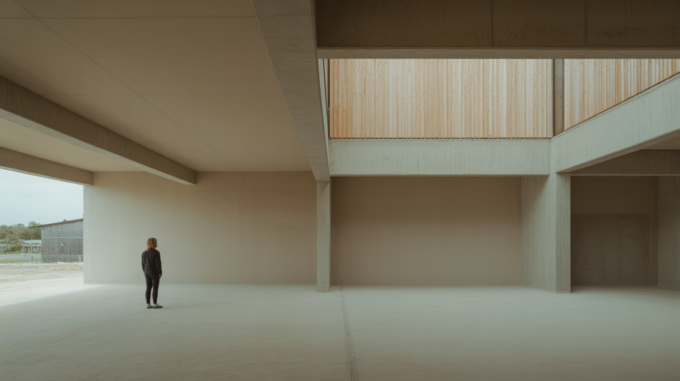
Light is our narrator. We harvest north light for even galleries, introduce shafts of sun for drama, and dial in darkness for conservation or immersion. The Cour Visconti at the Louvre folds daylight through a delicate canopy: contemporary art spaces like Dia Beacon balance luminous volume with protection for sensitive works. We script transitions, from bright lobbies to dim galleries, to cue emotion and focus without straining the eyes.

Tactility, Acoustics, and Environmental Comfort
Atmosphere is more than what we see. Handrails with a pleasant grip, floors that don’t tire feet, and acoustics that soften chatter all shape how long we linger. We target reverberation times suited to speech and quiet contemplation, specify low‑VOC finishes, and integrate fresh air discreetly. Comfort isn’t an add‑on: it’s the substrate that lets stories land.
Integrating Exhibits, Technology, and Flexibility
Modular Galleries and Adaptive Reuse
Collections change. Buildings should, too. We favor modular wall systems, generous back‑of‑house routes, and robust floor loading so curators can rehang without heroics. Adaptive reuse, Tate Modern, MASS MoCA, adds another narrative layer, letting old structures host new ideas. Flexibility protects the institution’s future and keeps the visitor experience fresh.

Digital Layers, Immersion, and Conservation Needs
From AR wayfinding to projection‑mapped rooms, digital tools can deepen context when they’re purposeful and restrained. We plan power, data, rigging points, and acoustic control from day one, so tech integrates cleanly and can be upgraded. At the same time, conservation drives the envelope: precise temperature and humidity, light budgets, and secure circulation for art. The trick is balancing immersion with stewardship, spectacle with silence.
Accessibility, Community, and Sustainability
Universal Design and Cognitive Ease
If a story isn’t accessible, it isn’t complete. We design routes that treat mobility devices as first‑class citizens, provide seating with variety, and use high‑contrast graphics and plain language. Clear sightlines, tactile maps, and multisensory cues support visitors with diverse cognitive and sensory needs. Universal design isn’t a checklist: it’s empathy translated into space.

Social Spaces, Public Realm, and Long-Term Stewardship
Museums are civic living rooms. Plazas, cafes, and free‑to‑enter halls invite repeat visits and blur the line between institution and city. On the back end, we prioritize low‑carbon materials, passive strategies, high‑efficiency systems, and maintainable details. Longevity is part of the narrative: a building that performs well over decades gives communities a stable cultural anchor.
Conclusion
When we get it right, museum architecture doesn’t just contain exhibitions, it frames meaning, nudges attention, and builds memory. From site response to light choreography, from wayfinding to universal design, each decision is a line in the story. As we continue to design and renew museums, let’s keep asking the narrative questions: What do we want people to feel here? What should they carry out into the world? The answers live not only on the walls but in the spaces between them.
- architectural design for museums
- Architectural storytelling
- architecture and storytelling
- architecture in museums
- designing museums
- designing narrative spaces
- how architecture tells stories
- how museums are designed
- impact of architecture on museums
- innovative museum design
- museum architecture
- museum architecture inspiration
- museum architecture trends
- museum design concepts
- museum experience design
- museum space design
- museum storytelling
- narrative architecture
- storytelling in architecture
- storytelling through design







Leave a comment