




Table of Contents Show
Nestled within the lush landscapes of Anji, a region celebrated as China’s “Bamboo Hometown,” the Anji International Convention and Exhibition Center emerges as a transformative cultural gateway for the Liangshan Future Sci-Tech City. Once an aging industrial zone at the city’s edge, the site has been reimagined as a vibrant core for future innovation. Surrounded by rolling mountains, clear streams, and an expansive ecological backdrop, the project embodies the spirit of the “Two Mountains” philosophy, which positions green development and ecological protection as essential to sustainable growth.
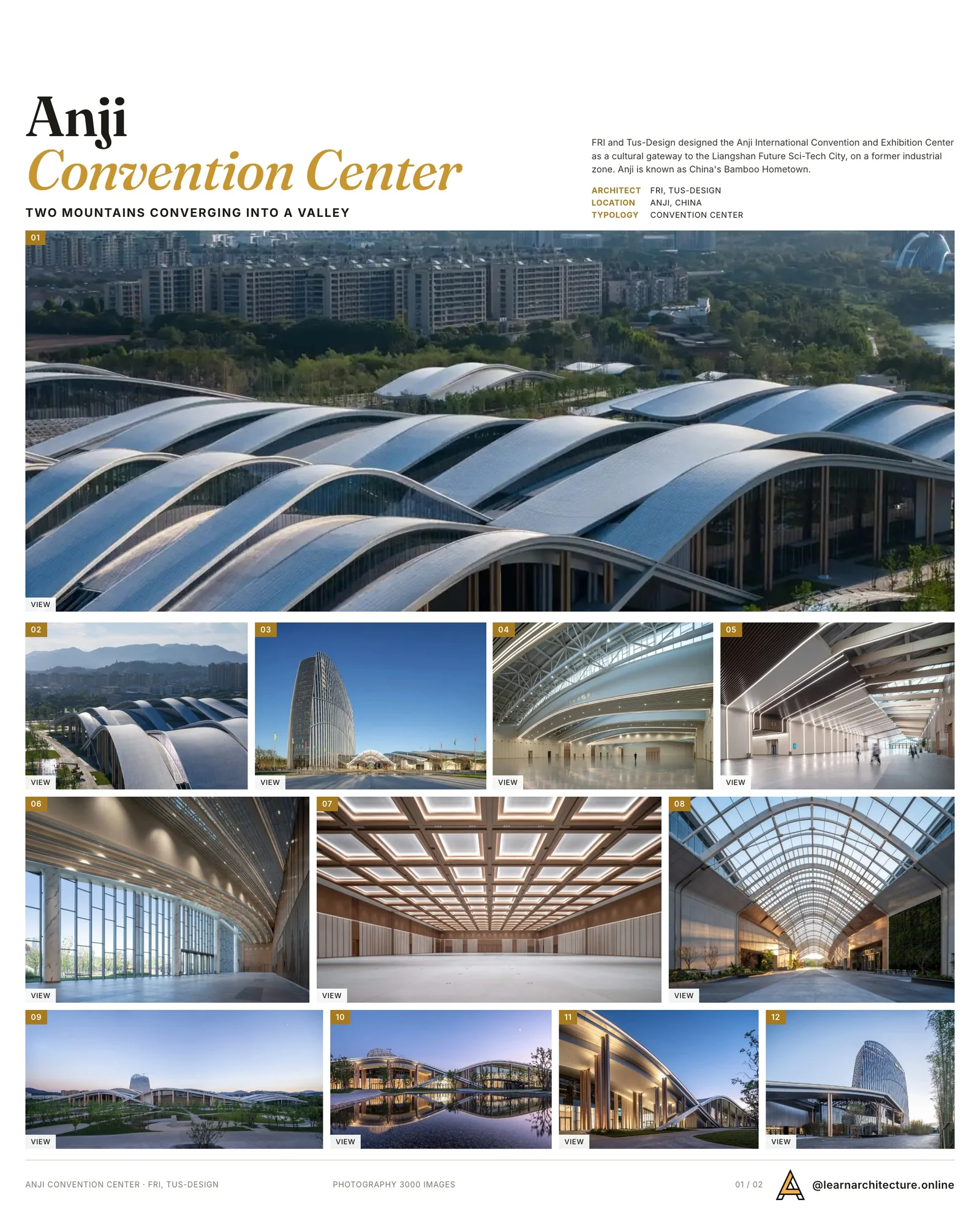
By situating the project within this context of natural abundance and ongoing urban regeneration, FRI + Tus-Design position the center not only as a piece of civic architecture but also as a critical contributor to the evolving landscape identity of Anji. The design amplifies the region’s scenic qualities while supporting the city’s ambition to blend nature, technology, and cultural exchange.

A Concept Inspired by Converging Mountain Ranges
At the heart of the architectural concept lies the idea of “Two Mountains Converging into a Valley.” This metaphor is translated into two sculptural architectural masses that slide gently toward one another, forming a ceremonial central space: the “valley.” The form captures the essence of mountain silhouettes: rising, folding, advancing, and receding with rhythmic precision.
The rooflines are particularly expressive. Layered, tensile, and sharply contoured, they mirror the sweeping ridgelines that define Anji’s geography. The undulating profile conveys a sense of split bamboo strips, echoing local craftsmanship and the city’s longstanding connection to bamboo culture. The curvature of the steel roof structure emulates bamboo’s natural resilience: flexible yet strong. This refined structural language honors the spirit of local literati figures such as Wu Changshuo, known for their expressive, confident brushwork and poetic interpretations of natural scenery.

Cross-Shaped Organization for Fluid Functionality
The building’s operational efficiency and spatial clarity are grounded in a cross-shaped masterplan. This geometric strategy places the primary public areas at the center while distributing secondary functions along the outer edges.
The east to west corridor serves as the project’s major organizing spine. It connects the bustling urban frontage along Lingfeng South Road to the serene waterfront environment of the Huxi River. With its panoramic transparency and lightweight structural expression, this corridor serves as both circulation space and landscape observatory. To its north lies the expansive 10,000-square-meter Exhibition Hall; to its south, the hotel and hospitality programs form a stately counterbalance.
Running perpendicular is the north to south axis, known as the “Convention Valley.” This linear interior street links the Cultural and Art Center to the north with the emerging Urban Business District to the south. Operating as the convention center’s busiest social zone, it becomes an immersive and weather-protected marketplace during major events. Its monumental scale, framed by long-span, column-free spaces, fosters both formal and informal interactions.
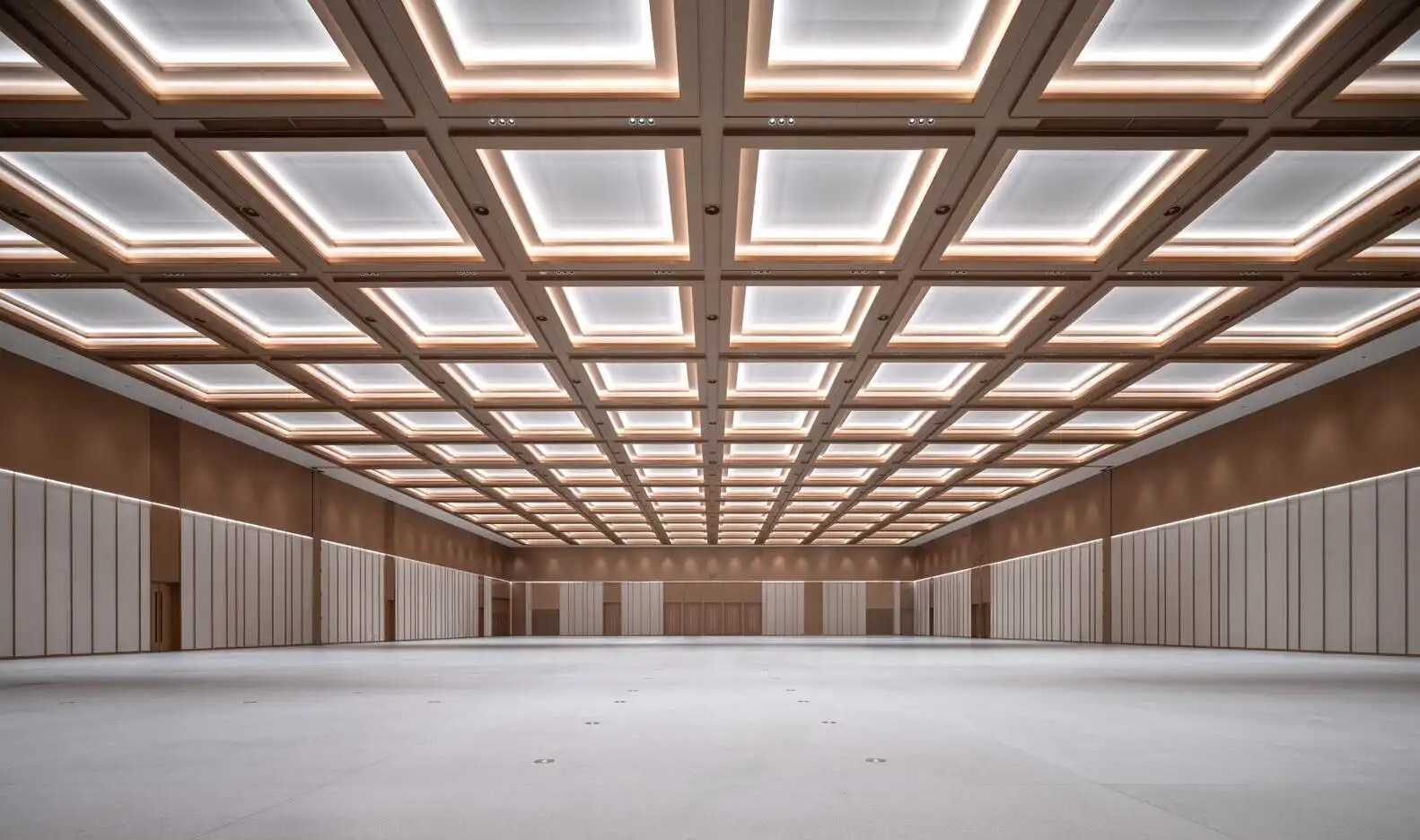
Both major halls (the main Exhibition Hall and the Multi-Functional Hall) feature structural spans achieved through elegantly arched steel trusses. These trusses reveal their geometry proudly in the interior, tracing the contours of the roof and emphasizing the building’s sweeping continuity.

Material Expression Rooted in Landscape and Craft
Materiality plays a key role in reinforcing the project’s connection to place. The architectural palette includes aluminum panels, UHPC, and other refined surfaces designed to capture and reinterpret the tactile qualities of bent bamboo strips. Light and shadow animate the curved surfaces throughout the day, echoing the shifting layers of Anji’s surrounding hillsides.
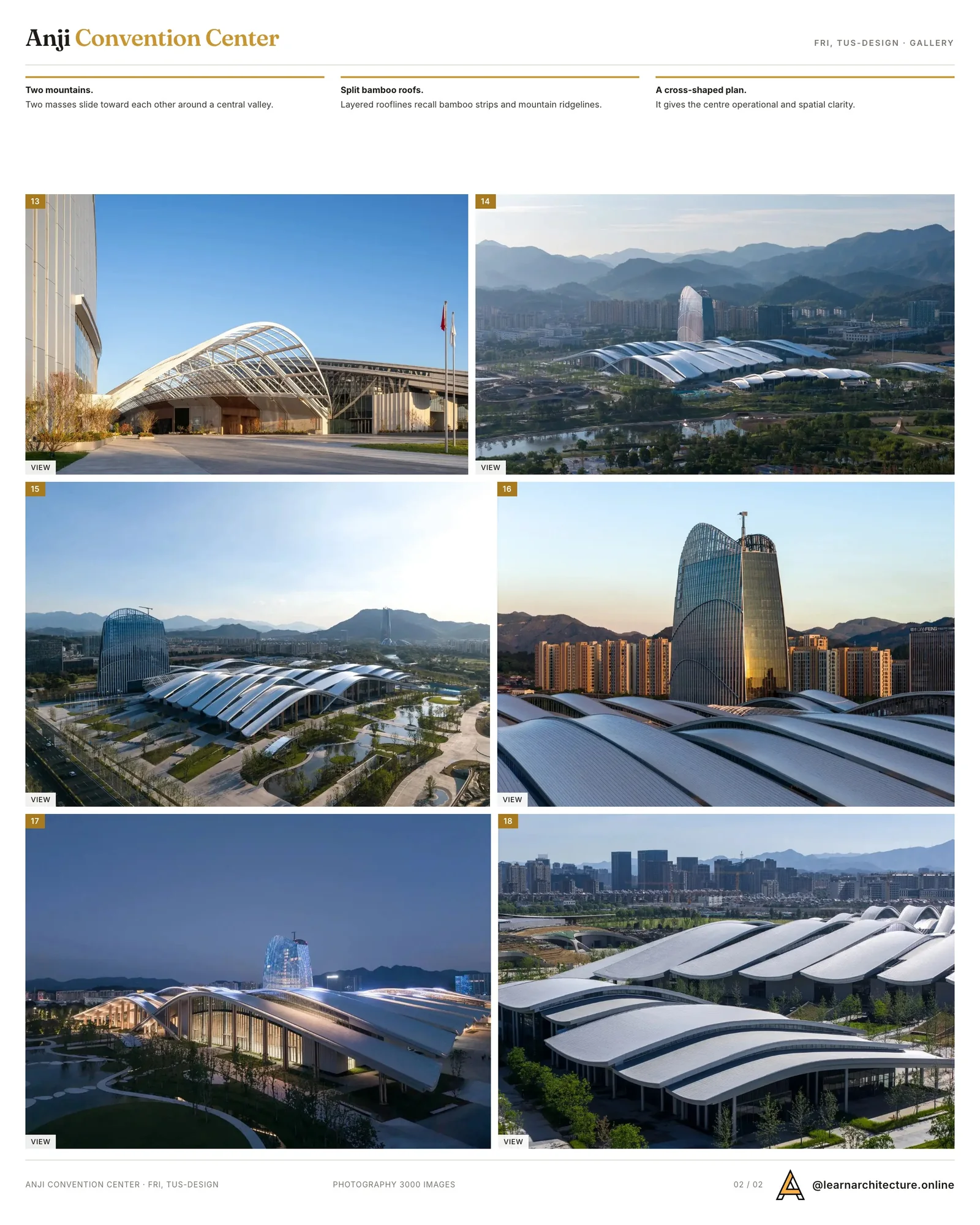
The two wings of the center alternately rise toward the sky or settle gently into the terrain, reflecting the varied rhythms of a mountain range. This dynamic expression creates a silhouette that is simultaneously grounded and soaring: a building that behaves like a landscape in motion. Whether viewed up close or from afar, the center’s form reads as a contemporary continuation of Anji’s natural topography.

A Civic Landmark for the Future Sci-Tech City
Beyond its architectural sculpting, the convention and exhibition center fulfills a vital role in shaping the Liangshan Future Sci-Tech City. It is envisioned as an anchor for international exchange, industry exhibitions, high-level forums, and academic gatherings. The design prioritizes flexibility, accommodating large-scale trade events as well as cultural and economic showcases.
By linking the new urban district with Anji’s unique ecological resources, the center becomes a conduit for cultural storytelling, technological dialogue, and environmental awareness. Its roof, geometry, and spatial organization work together to merge urban life, nature, and culture into a single unified experience.

Integrating Architecture, Nature, and Urban Identity
Ultimately, the Anji International Convention and Exhibition Center stands as a compelling example of how architecture can interpret local identity while serving contemporary urban needs. Its layered mountain-inspired forms, bamboo-referenced structural expression, and cross-shaped planning create a building that is both visually iconic and deeply rooted in context.
By weaving together natural symbolism, functional clarity, and cultural continuity, the project becomes more than a venue; it becomes a living landscape, a civic catalyst, and a landmark for a city transitioning confidently toward its ecological and technological future.
Photography: 3000 images


- Anji International Convention and Exhibition Center
- Bamboo culture in architecture
- Bamboo-inspired architecture
- China convention center design
- Civic landmark design
- Contemporary Chinese architecture
- Cross-shaped masterplan
- ecological urban development
- Exhibition hall design
- FRI Architecture
- Landscape-integrated design
- Liangshan Future Sci-Tech City
- Mountain landscape architecture
- Mountain-inspired roof geometry
- Steel truss roof structure
- Sustainable civic architecture
- Tus-Design
- Two Mountains philosophy
- UHPC façade
- Urban regeneration in Anji







Leave a comment