


Table of Contents Show
Taipei 101 is a 508-meter supertall skyscraper in Taipei, Taiwan, widely recognized for its bamboo-segmented exterior, world-record-breaking tuned mass damper, and earthquake-resistant structural system. Completed in 2004, it held the title of the world’s tallest building until 2010 and remains one of the most technically advanced high-rise structures ever constructed.

What Makes Taipei 101’s Architecture Unique?
The building’s form draws directly from traditional East Asian symbolism. Each of the eight stacked segments references the number eight, considered auspicious in Chinese culture for representing prosperity and abundance. The overall silhouette mirrors a stalk of bamboo (a plant associated with resilience, flexibility, and upward growth), making the Taipei 101 design one of the most culturally grounded expressions of high-rise architecture in the world.
Designed by C.Y. Lee & Partners Architects, the tower rises 101 floors above ground (the number itself a nod to the idea of exceeding perfection) with five basement levels below. Each of the eight main segments is slightly offset from the one below, creating the stepped profile that gives the building its iconic pagoda-like appearance from a distance.
💡 Pro Tip
When analyzing Taipei 101’s form, look at the outward-curving brackets at each floor-segment transition. These “ruyi” motifs are not just decorative; they serve as secondary canopies that deflect wind away from the facade, reducing pressure on the curtain wall glazing in the floors below. It’s a rare case where ornament and engineering function are genuinely unified.

Taipei 101 Height and Structural Scale
At 508 meters to the architectural tip (449.2 meters to the roof), Taipei 101 presented structural engineers at Evergreen Consulting Engineering with an extraordinary challenge. The site sits in a seismically active zone near several fault lines and is regularly exposed to typhoon-force winds from the Pacific. The tower needed to withstand both lateral wind loads and ground motion simultaneously.
The primary structural system consists of a reinforced concrete and steel composite mega-frame. Eight super-columns, each measuring 2.4 by 3 meters in cross-section and filled with high-strength concrete, form the core vertical load path. These columns are connected at eight-story intervals by outrigger trusses that tie the perimeter frame to the central core, a configuration that dramatically increases lateral stiffness without adding excessive mass.
🔢 Quick Numbers
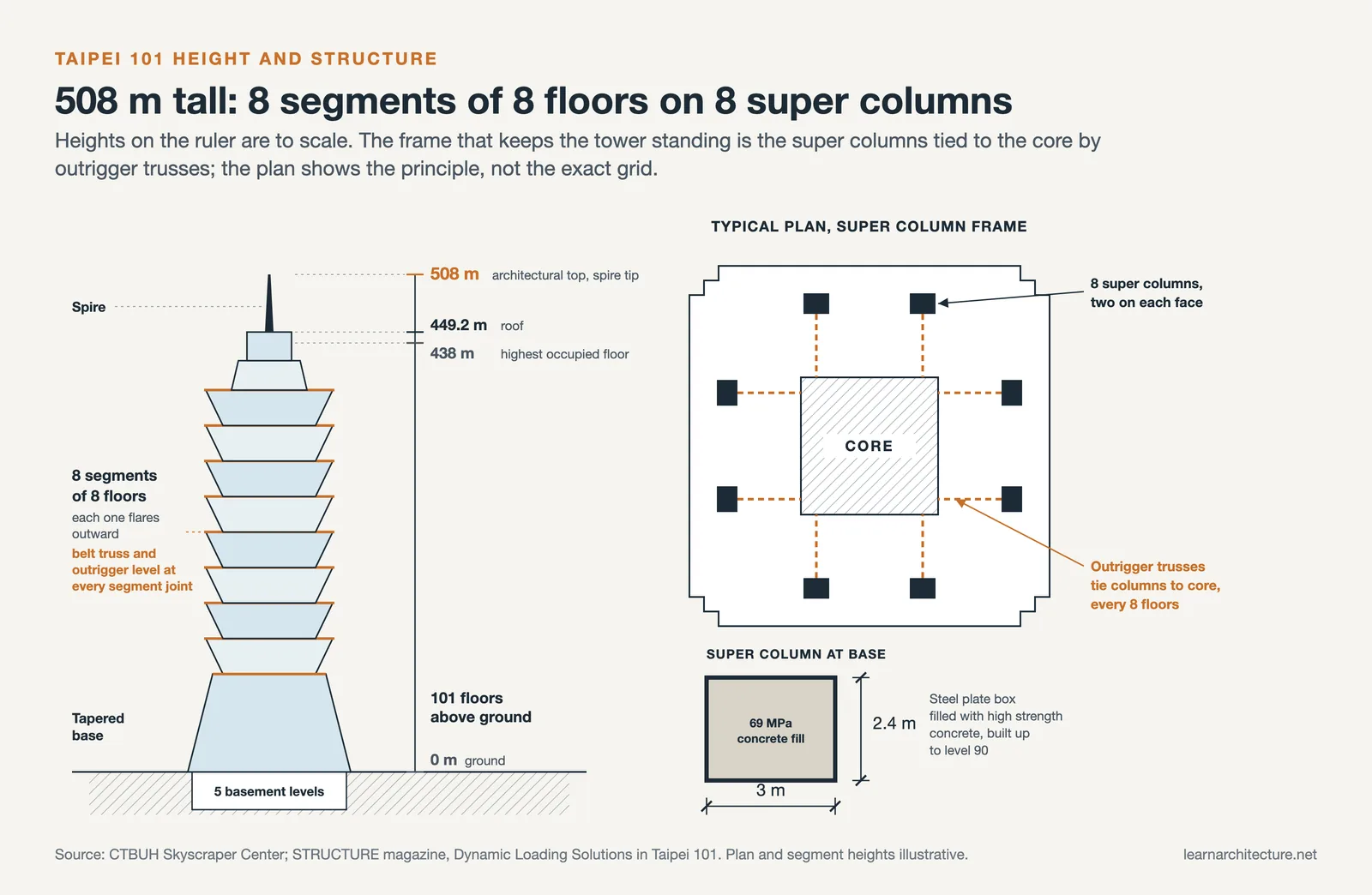
- 508 meters total height including spire; 449.2 meters to roof (CTBUH, 2004)
- 660 metric tons: weight of the world’s largest tuned mass damper, installed at floors 87 to 92
- Designed to withstand winds of 60 m/s (216 km/h) and the strongest earthquakes expected in a 2,500-year cycle (Taipei 101 Observatory)
- 101 above-ground floors plus 5 basement levels; construction began in 1999 and was completed in 2004
The Taipei 101 Tuned Mass Damper: How It Works
The most celebrated engineering feature of the tower is its tuned mass damper: a 660-metric-ton steel pendulum sphere suspended between floors 87 and 92. It is the largest and heaviest damper of its type publicly visible anywhere in the world, and the only one designed to be a tourist attraction in its own right.
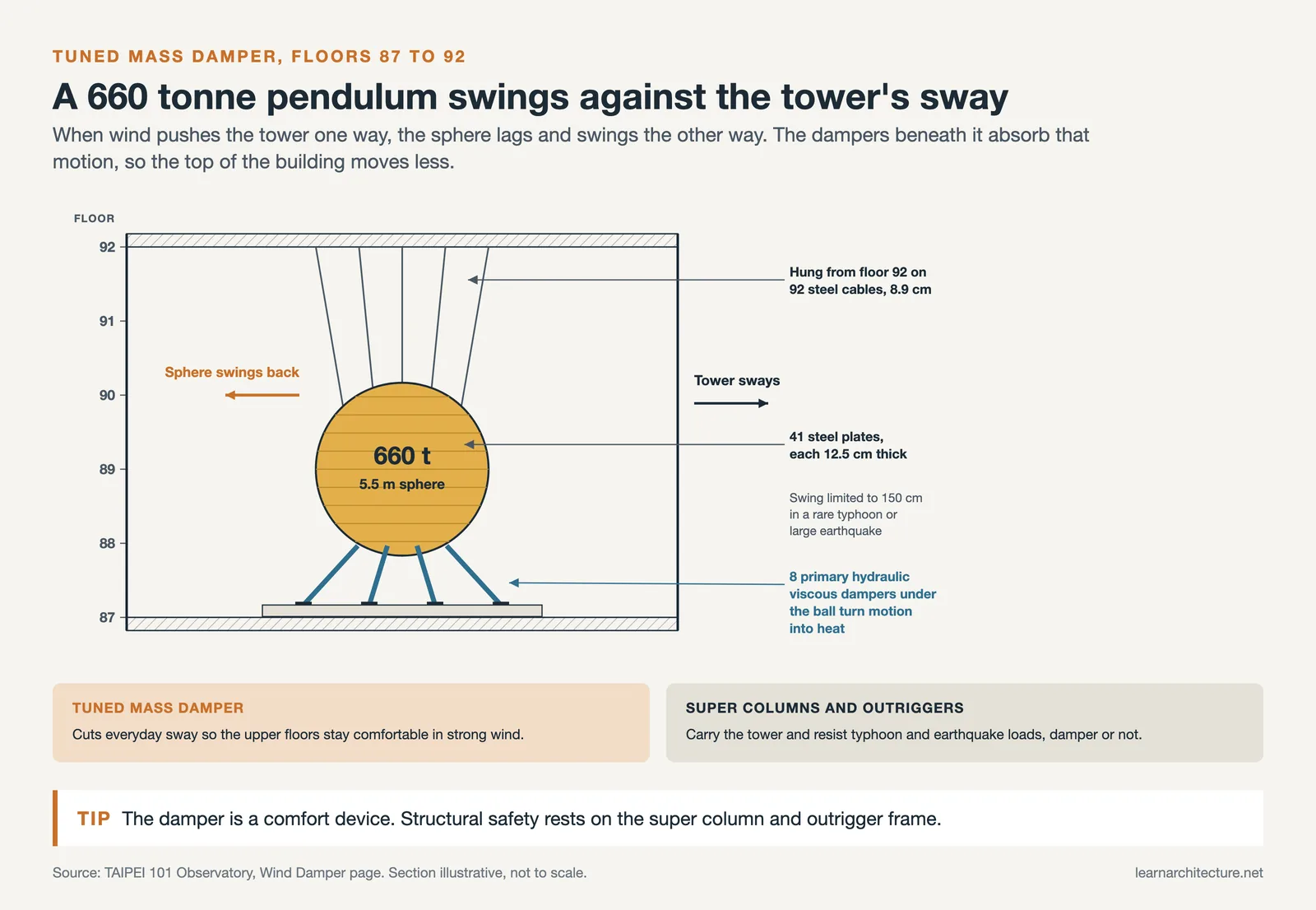
The damper works on a simple physical principle: when wind or seismic energy causes the building to sway in one direction, the pendulum swings in the opposite direction, absorbing kinetic energy and reducing occupant-perceptible movement by up to 40 percent. Eight hydraulic shock absorbers at the base of the sphere dissipate the energy as heat.
What sets the Taipei 101 damper apart from comparable systems in towers like Shanghai Tower or Citigroup Center in New York is its scale and visibility. Most tuned mass dampers are hidden in mechanical floors; here, it is enclosed in a glass observation deck and backlit in gold, transforming a piece of structural engineering into a cultural and visitor centerpiece.

Taipei 101 Wind Resistance Strategies
Beyond the damper, Taipei 101 wind resistance is achieved through the building’s aerodynamic shaping. The stepped profile reduces vortex shedding, the cyclical wind pressure fluctuations that occur when wind wraps around a blunt cylindrical or rectangular tower. By breaking the tower into distinct eight-floor segments with slightly recessed connections, the design disrupts the coherent formation of vortex shedding across the full height of the building.
The corners of each segment are chamfered at a 45-degree angle, further reducing wind drag. Wind tunnel testing during the design phase at RWDI in Ontario, Canada validated these aerodynamic choices and allowed engineers to fine-tune the relationship between facade geometry and damper sizing.
⚠️ Common Mistake to Avoid
Many architecture students assume the tuned mass damper is the primary method of wind resistance in Taipei 101. In reality, the damper handles occupant comfort under normal wind conditions, not structural survival under extreme loads. The primary structural resistance comes from the mega-column and outrigger truss system, which is designed to keep the building standing under typhoon and earthquake conditions even if the damper were inactive.
Taipei 101 Bamboo Design: Symbol and Structure
The Taipei 101 bamboo design is more than a visual reference. Bamboo is structurally analogous to the tower in several meaningful ways: it is hollow (like the building’s central core), segmented (like the eight stacked modules), and achieves extraordinary height-to-width ratios through distributed wall thickness rather than solid mass. Engineers at Evergreen Consulting referenced bamboo’s structural behavior when developing the tower’s core wall proportioning strategy.
The exterior cladding reinforces the metaphor through its coloring. The green-tinted glass and the gold-painted steel spire echo the color gradients of mature bamboo in different seasons. At street level, the base of the tower flares outward in a shape that resembles the root system of a large bamboo plant, providing additional visual stability and a generous covered public plaza.
For students and architects exploring biophilic design principles, Taipei 101 offers a compelling case study in how natural forms can be translated into structural logic rather than applied as surface decoration. The distinction matters: decorative naturalism applies natural imagery to a building’s skin, while structural naturalism allows natural growth patterns to inform the building’s skeleton. Taipei 101 does both simultaneously.

Taipei 101 Structural Design: Foundation and Below-Grade Engineering
The building sits on an alluvial plain with poor soil bearing capacity, a significant complication given the tower’s weight and seismic exposure. The foundation system uses 380 piles, each 1.5 meters in diameter, driven 80 meters into the ground and extending as far as 30 meters into the bedrock beneath the soft upper soils. The piles are connected by a 3-meter-thick concrete mat foundation that distributes loads across the entire building footprint.
During construction, engineers discovered an active fault running closer to the site than originally assessed. The foundation design was revised mid-construction to increase pile density and reinforce the pile cap connections, adding cost and time but significantly improving the building’s seismic performance profile.
📐 Technical Note

The eight mega-columns in Taipei 101 are hollow steel box sections filled with high-strength concrete rated at 69 MPa (10,000 psi) compressive strength, built up to level 90. The outrigger trusses connecting these columns to the central core span two full floors and are fabricated from weathering steel (ASTM A588) to minimize corrosion risk in the humid subtropical climate.
Taipei 101 Sustainable Features
When the tower achieved LEED Platinum certification in 2011, becoming the world’s tallest and largest LEED Platinum building at that time, it marked a significant retrofit achievement. The building had not been designed with LEED certification as an explicit target, yet its passive and active systems were comprehensive enough to qualify at the highest level after a post-occupancy assessment and targeted upgrades.
Key Taipei 101 sustainable features include a high-performance double-skin curtain wall that reduces solar heat gain, a building automation system managing lighting and HVAC across all 101 floors in real time, and rainwater harvesting for landscape irrigation and toilet flushing. The tower’s cooling system uses a seawater-cooled chiller arrangement that reduces energy consumption compared to standard air-cooled configurations typical in the region.
The LEED Platinum retrofit involved replacing over 1,000 lighting fixtures with LED systems, upgrading the elevator regenerative drive systems to recapture braking energy, and installing sub-metering across all tenant floors to provide granular energy consumption data. According to the U.S. Green Building Council’s 2011 certification documentation, these upgrades reduced the building’s annual energy use by approximately 10 percent from its pre-retrofit baseline.
For a deeper look at how high-rise buildings pursue environmental performance, the USGBC’s LEED resources provide detailed rating criteria, while CTBUH (Council on Tall Buildings and Urban Habitat) maintains a comprehensive database of supertall building performance data.
💡 Pro Tip
If you are studying supertall building sustainability for a thesis or competition entry, Taipei 101’s LEED Platinum retrofit is a more instructive case study than many new-build certifications. It demonstrates how operational efficiency gains (elevator regeneration, LED retrofits, sub-metering) can achieve significant certification improvements without altering a building’s fundamental structure or facade. This “deep retrofit” model is increasingly relevant as the built environment focus shifts from new construction to existing stock.

Taipei 101’s Legacy in Supertall Architecture
Since losing its “world’s tallest” title to the Burj Khalifa in 2010, Taipei 101 has maintained its relevance not through height records but through the depth and coherence of its engineering and cultural ambition. It remains a benchmark study for supertall skyscraper structural systems and is regularly cited in structural engineering curricula alongside the Empire State Building, Petronas Towers, and Shanghai Tower as a defining example of how site conditions, cultural context, and engineering innovation can be unified in a single building.
For architects and students exploring landmark tall buildings, ArchDaily’s detailed Taipei 101 project coverage and the official Taipei 101 building documentation are useful primary references for technical specifications and design narrative.
🏗️ Real-World Example
Shanghai Tower (Shanghai, 2015): Like Taipei 101, Shanghai Tower uses a tuned mass damper and aerodynamic tapering to manage wind loads, but its 120-degree twisting form reduces wind loads by 24% compared to a straight tower of the same height, according to Gensler’s structural analysis. The two towers together illustrate how supertall wind engineering has evolved from passive mass damping toward active aerodynamic shaping as the primary control strategy.
✅ Key Takeaways
- Taipei 101’s bamboo-inspired design is not purely symbolic; the segmented form directly reduces vortex shedding and wind pressure on the facade.
- The 660-ton tuned mass damper handles occupant comfort under normal wind loads; the mega-column and outrigger frame system provides primary structural resistance under extreme conditions.
- The tower’s LEED Platinum certification in 2011 was a retrofit achievement, demonstrating that operational upgrades alone can deliver significant sustainability improvements in existing supertalls.
- Foundation engineering on Taipei 101 required mid-construction revisions after an active fault was discovered closer to the site than initially assessed, a reminder that geotechnical risk assessment continues throughout construction, not just at the design stage.
- Taipei 101 remains a core case study for understanding how cultural symbolism, seismic engineering, and wind aerodynamics can be integrated into a coherent architectural concept.





Leave a comment