


Table of Contents Show
Norman Foster architecture is defined by a direct relationship between technology, sustainability, and human experience. From a working-class upbringing in Manchester to designing Apple Park, the Reichstag dome, and the Gherkin, Foster built a practice that consistently proves that structural precision and ecological responsibility are not opposing forces. His approach treats every building as a problem worth solving rigorously, at every scale.
What Is Norman Foster’s Architectural Style?
The norman foster architectural style sits firmly within the high-tech architecture movement, a current that emerged in Britain during the late 1960s and reached its peak influence through the 1980s and 1990s. Where other movements of that period favored historical references or sculptural expression, Foster’s work focused on exposing structure, celebrating engineering logic, and letting materials speak directly.
His buildings are not minimal in the sparse, ascetic sense. They are precise. Structure is expressed rather than hidden. Mechanical systems, when they serve a visual purpose, are placed where they can be seen and understood. Glass and steel dominate, but not as decoration; they are chosen because they perform: transmitting light, reducing weight, and enabling the open-plan interiors that Foster consistently prioritizes.
Three qualities appear across virtually every project in his five-decade portfolio:
- Structural transparency: the logic of how a building stands is usually visible from outside and inside.
- Environmental integration: natural light, ventilation, and orientation are addressed from the earliest stages of design, not added later.
- Civic generosity: even commercial commissions often include public spaces, ground-level access, or features that benefit the surrounding city.
This combination distinguishes the architecture Norman Foster produces from purely commercial modernism. His buildings tend to feel purposeful rather than arbitrary, even when they are large and complex.
💡 Pro Tip
When studying the norman foster architecture style, pay close attention to how his early projects from the 1970s, particularly the Willis Faber & Dumas building in Ipswich, already contain the core ideas he would develop over the next four decades. The green roof, the open floor plan, and the dark glass curtain wall all point toward what became a signature approach. Starting with early work, rather than the famous later buildings, gives you a clearer picture of how his thinking developed.
What Is Norman Foster’s Architecture Philosophy?

Understanding the norman foster architecture design philosophy requires stepping back from individual buildings and looking at the ideas that drive the firm’s process. Foster has described architecture as “the expression of values,” and that phrase carries weight throughout his portfolio.
Several core principles run through his design philosophy:
Doing More With Less
This idea, inherited partly from Buckminster Fuller (whose question “How much does your building weigh?” became the title of a 2010 documentary about Foster), shapes how the firm approaches materials and structure. Lighter structures use fewer raw materials, cost less to heat and cool, and often perform better environmentally. This is not austerity; it is efficiency applied creatively. The Gherkin’s aerodynamic profile reduces wind loads on the structure, which in turn reduces the amount of steel required. The building’s shape is not arbitrary; it is the result of engineering logic applied with visual intelligence.
Technology as a Tool, Not a Goal
Norman Foster’s high tech architecture is sometimes misread as technology for its own sake. In practice, the firm uses advanced methods and materials because they solve problems more effectively. Computer modeling arrived at Foster + Partners earlier than at most practices, but its purpose was always to test environmental performance, structural behavior, and spatial quality, not to generate novel forms algorithmically. This discipline keeps the work grounded even when it is technically ambitious.
Cities and Infrastructure as Part of Architecture
Foster has consistently argued that individual buildings cannot be evaluated in isolation from their urban context. His major infrastructure projects (Stansted Airport, Bilbao Metro, Hong Kong Airport, the Millau Viaduct in France) reflect the belief that the quality of transit systems and public infrastructure shapes daily life as profoundly as the buildings people inhabit. A great airport terminal, in his view, deserves the same design intelligence as a great museum.
🎓 Expert Insight
“Architecture is an expression of values.”
Norman Foster, interview with The European, 2014
This concise statement captures the foundation of his design approach. Unlike architects who privilege form or concept above all else, Foster insists that every design decision reflects a moral position on how people should live, move through cities, and relate to the environment.
Norman Foster: A Life in Architecture, Early Career and Influences
Norman Foster was born in 1935 in Reddish, near Manchester, to working-class parents. His father worked as a machine painter and his mother at a bakery. Foster left school at 16, worked as a clerk at Manchester Town Hall, and served in the Royal Air Force before studying architecture at the University of Manchester. A fellowship then took him to Yale, where he graduated with a master’s degree in 1962 and met Richard Rogers.

Back in the UK, he cofounded Team 4 with Rogers and their respective wives. The practice lasted only four years before Foster established his own firm, Foster Associates, in 1967. The early work was modest in scale but radical in thinking. The Reliance Controls factory in Swindon (1967), designed with Team 4, demonstrated the industrial aesthetic that would define high-tech architecture: exposed steel, lightweight cladding, and flexible open interiors.
Three influences are especially visible in the norman foster a life in architecture narrative:
- Buckminster Fuller, whose preoccupation with structural efficiency and the weight of buildings shaped Foster’s long-term interest in doing more with less.
- American modernism, absorbed at Yale, particularly the work of Louis Kahn and the Case Study Houses, which showed how structural clarity and open planning could coexist.
- Aviation: Foster has been a licensed pilot for much of his career. Aircraft design’s insistence on lightness, performance, and aerodynamic logic has been a consistent point of reference in his architectural work.
For a broader look at how other architects of similar influence developed their philosophies, see the guide to famous architects who transformed modern architecture on learnarchitecture.net.
📌 Did You Know?
When Foster + Partners won the commission to design the HSBC Main Building in Hong Kong in 1979, the firm had never built anything taller than three storeys. With a construction cost of roughly US$668 million (the most expensive building in the world at the time) and no prior experience in a country completely unfamiliar to them, the project was an act of extraordinary ambition. It went on to define Foster’s international reputation and is still regarded as one of the most technically innovative office towers ever built. (Source: Dezeen, 2019)
Norman Foster High Tech Architecture: Key Buildings

The range of norman foster architecture buildings is genuinely unusual. Most architects develop a signature building type: a specialty. Foster’s firm has designed airports, parliament buildings, cultural institutions, commercial towers, transportation infrastructure, and private residences, and has done so across six continents. What follows is a selection of the buildings that best illustrate how his architectural ideas developed.
Willis Faber & Dumas, Ipswich (1975)
This three-storey office building in a small English city is arguably the most quietly radical building in Foster’s portfolio. The curved glass curtain wall follows the irregular shape of the urban block around it, a gesture of contextual respect unusual for modernist architecture at the time. The roof is entirely covered in grass. Inside, escalators connect open-plan floors designed to encourage movement and interaction. The building received listed status in 1991, one of the youngest buildings in England to be protected. It remains in use as an office building, which is itself evidence that good architecture ages well.
HSBC Main Building, Hong Kong (1986)
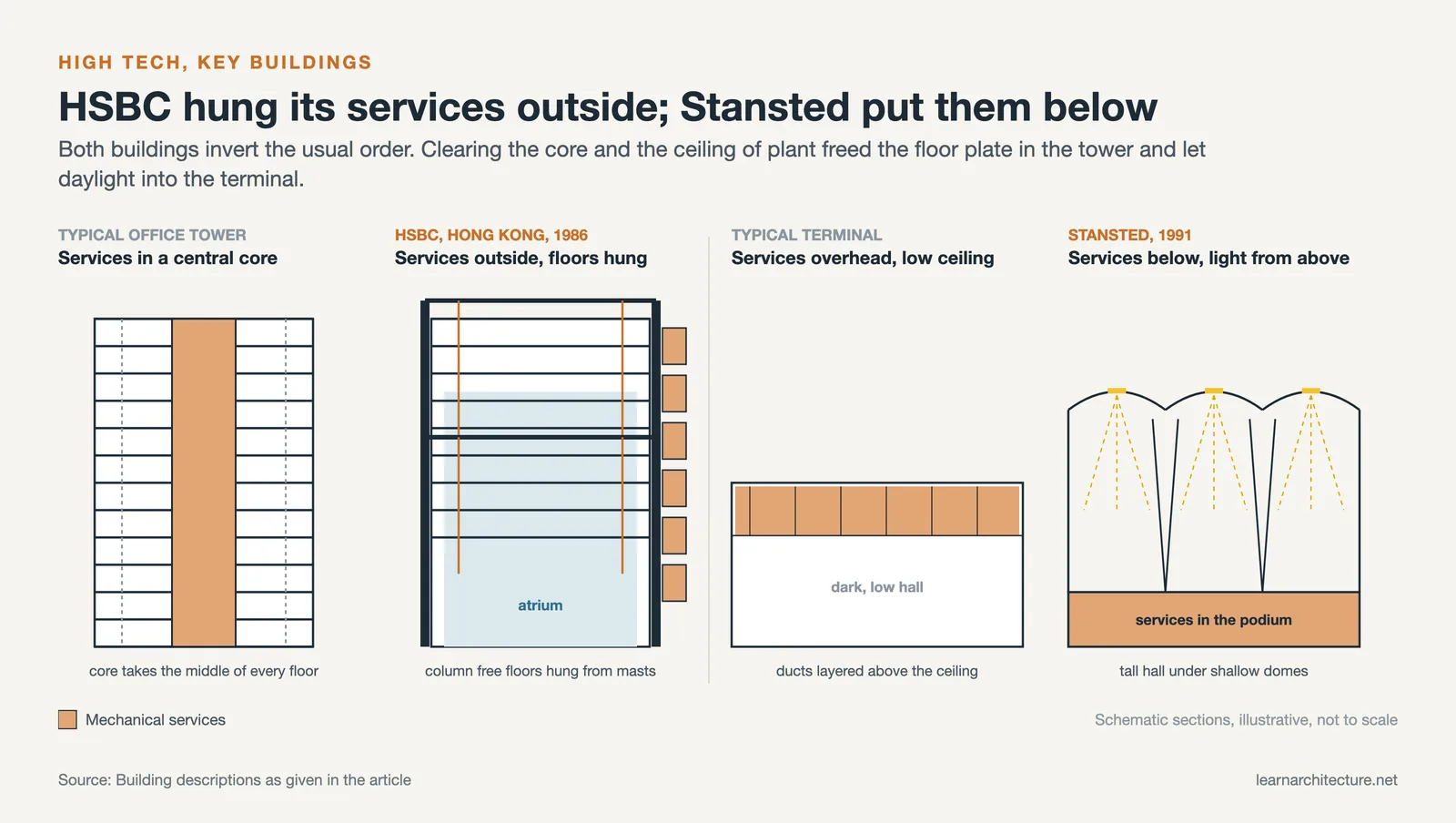
The HSBC headquarters reversed the conventional logic of the office tower. Rather than housing services inside a central core, Foster moved them to the exterior, suspending floors from masts and freeing the interior for flexible, column-free space. A large atrium at ground level connects to the public plaza below, which has since become a major public gathering space for Hong Kong’s Filipino domestic workers on weekends. The building cost roughly US$668 million to construct and was, at the time of completion, the most expensive building ever built.
Stansted Airport, Essex (1991)
Before Stansted, airports were typically dark, low-ceiling environments with mechanical services layered visibly overhead. Foster inverted this logic. Services were placed below the terminal floor, within a structural podium, while the roof became a series of shallow domes that admitted natural light throughout. The effect was a terminal that felt calm and spatially legible; passengers could orient themselves intuitively. Stansted set a template that many subsequent airport terminals, including Foster’s own Chek Lap Kok in Hong Kong, would follow.
Reichstag, Berlin (1999)
The commission to restore the German parliament building after reunification gave Foster an opportunity to address the relationship between architecture and political symbolism directly. His addition, a glass dome above the plenary chamber, is accessible to the public via a spiral ramp. Visitors walking up the ramp look directly down through a glass floor into the parliament below. The symbolism is explicit: citizens above their representatives. The dome also functions as a passive ventilation system, drawing warm air up through the chamber and exhausting it from the apex.
30 St Mary Axe: The Gherkin, London (2004)
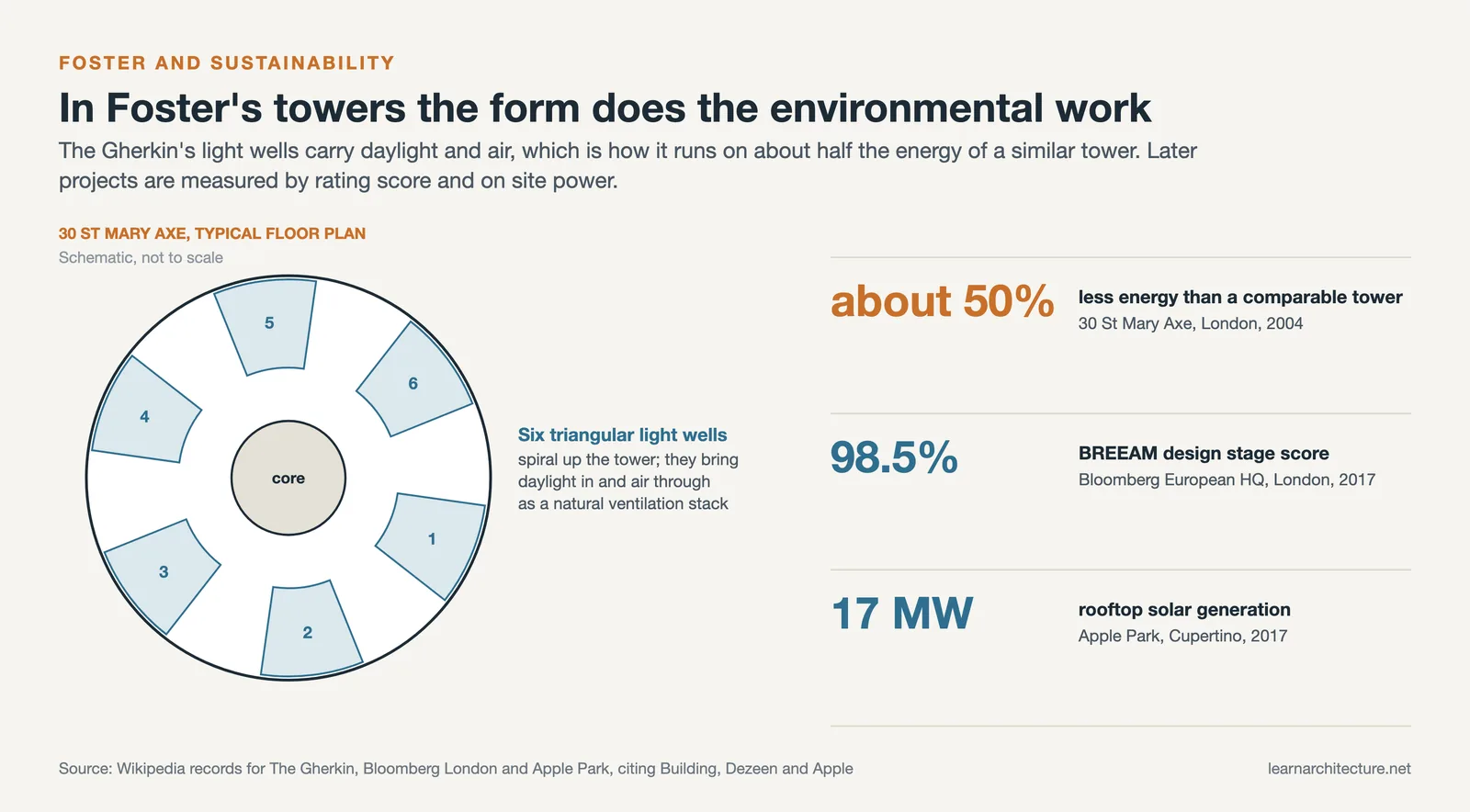
The building that made Norman Foster a household name outside the architecture world, the Gherkin is the clearest example of Foster’s architecture at its most resolved. Its aerodynamic profile reduces wind loads on the tower compared to a standard rectangular building of the same height, a structural benefit that also reduces the amount of steel required. Six triangular light wells spiral up the building’s perimeter, providing natural ventilation to the offices and distributing daylight to interior spaces. According to the building’s operators, these passive strategies reduce energy consumption by around 50% compared to a conventional office tower of similar size.
🏗️ Real-World Example
Apple Park, Cupertino (2017): When Steve Jobs personally contacted Foster to design Apple’s new headquarters, the brief was for a building that would be “a little like a spaceship.” The result is a 2.8 million square foot ring-shaped campus housing approximately 12,000 employees. The building runs entirely on renewable energy, including a 17-megawatt rooftop solar installation. Its curved glass facade, a single continuous element, required the development of new fabrication techniques for curved structural glass panels at that scale. The campus retains 80% of the site as green space, reversing decades of car-park dominated suburban development in Silicon Valley.
Video: Norman Foster, Striving for Simplicity
In this in-depth interview from the Louisiana Channel, Foster reflects on his career, his philosophy of simplicity, and the relationship between technology, nature, and the built environment. It is one of the most candid extended conversations available with him on the record.
How Does Norman Foster’s Architecture Design Philosophy Compare to His Contemporaries?
High-tech architecture is sometimes grouped as a single tendency, but the architects working within it made meaningfully different choices. Comparing Foster to his peers helps clarify what is specific to the norman foster architecture philosophy.
Norman Foster vs. Renzo Piano
Both architects are associated with high-tech architecture through their collaboration on the Centre Pompidou in Paris (1977), but their subsequent work diverged significantly. Piano moved toward warmer, more craft-oriented materiality, integrating terracotta, timber, and stone alongside steel and glass. His buildings tend to be quieter and more contextually deferential. Foster’s work remained committed to technological expressionism, with glass and steel continuing to dominate even as the environmental agenda became more prominent. For a deeper look at Piano’s approach, learnarchitecture.net has a dedicated guide on Renzo Piano architecture.
Norman Foster vs. Peter Zumthor
Zumthor represents the opposite pole of contemporary architecture from Foster. Where Foster’s work is urban, large-scale, and technically ambitious, Zumthor’s is small, atmospheric, and rooted in material texture and sensory experience. Both are deeply serious about craft and environmental performance, but they define these terms completely differently. Zumthor works slowly and selectively; Foster operates at a global scale with hundreds of staff. The comparison is instructive precisely because both are considered to produce exceptional architecture through completely different means. See learnarchitecture.net’s profile of Peter Zumthor’s architectural philosophy for a closer look.
The contrast between these approaches reflects a broader question about what architecture should prioritize: civic scale and technological ambition, or intimate craft and sensory depth. Neither answer is wrong, but understanding both positions sharpens your reading of any building you encounter.
⚠️ Common Mistake to Avoid
A common misconception about Norman Foster’s architectural style is that it is primarily about aesthetics: that he simply likes glass and steel. In reality, these materials are chosen because they perform. The Gherkin’s glass is double-glazed with solar-control blinds sandwiched between layers; the ventilation cavities reduce heat gain without mechanical cooling. When studying Foster’s work, always ask why a material or structural choice was made before evaluating whether it looks good. The two questions are related.
Norman Foster Architecture and Sustainability

Foster + Partners began addressing environmental performance in the early 1970s, before sustainability became a mainstream architectural concern. The Willis Faber building’s green roof, the natural ventilation strategies in HSBC Hong Kong, and the passive cooling system in the Reichstag dome are all early evidence of an environmental agenda that predates the current industry language around green buildings.
This history matters because it distinguishes Foster’s sustainability work from the add-on approach common in contemporary practice, where ecological features are applied to buildings whose fundamental design logic ignores environmental performance. In Foster’s work, environmental thinking tends to be structural; it shapes the form, orientation, and material logic of the building from the earliest stages.
The Gherkin uses approximately half the energy of a conventional office tower of comparable size. Apple Park runs entirely on renewable energy. The Bloomberg European Headquarters in London, completed in 2017, achieved a BREEAM Outstanding rating of 98.5%, the highest score ever recorded for a major office building at the time (BREEAM, 2017).
🔢 Quick Numbers
- Bloomberg European HQ achieved a BREEAM Outstanding rating of 98.5%, the highest ever recorded for a major office building at the time of certification (BREEAM, 2017)
- The Gherkin’s passive ventilation system reduces energy consumption by approximately 50% compared to a conventional office tower of similar height and floor area (The Gherkin, Foster + Partners)
- Apple Park’s rooftop solar installation generates 17 megawatts of power, making it one of the largest on-site renewable energy installations at any corporate campus globally (Apple, 2017)
For a wider perspective on how sustainability is reshaping contemporary architectural practice, see learnarchitecture.net’s coverage of green architecture projects redefining sustainable design.
The Legacy of Norman Foster Architecture
The influence of Norman Foster’s architecture on the profession is difficult to overstate. His buildings made high-tech modernism legible to a general public that might otherwise have found it cold or alienating. The Gherkin is genuinely loved in London; it has a nickname, which is something very few contemporary buildings achieve. The Reichstag dome draws more visitors annually than almost any other building in Germany.
Within the profession, his influence runs in two directions. Directly, it is felt through the firm’s scale and output: Foster + Partners consistently ranks as one of the largest architecture practices in the world, and the density of talent that has passed through it over five decades means that his approach has shaped thousands of architects now working independently. Indirectly, his insistence on environmental performance as a structural rather than cosmetic consideration has become something close to a professional standard, a shift that was not inevitable and owes a significant debt to the example his buildings set.
The book Norman Foster: A Life in Architecture by Deyan Sudjic, published in 2010, remains the most thorough single account of his career and design thinking for those who want to go deeper into the biographical and intellectual context behind the buildings.
Other influential figures working in a related tradition include Oscar Niemeyer, whose civic-scale ambition and structural expressionism offer an interesting contrast to Foster’s technological rationalism. The broader history of architects who redefined what a building could be is covered in learnarchitecture.net’s guide to innovative ideas in architecture.
💡 Pro Tip
If you are using Norman Foster’s work as a case study for research or studio projects, focus on the relationship between form and environmental performance in a single building rather than trying to summarize his entire output. The Gherkin is particularly well-documented from a technical standpoint: structural engineering reports, energy performance data, and detailed section drawings are widely available. Working through a single building in depth teaches you more than surveying twenty projects at surface level.
✅ Key Takeaways
- Norman Foster’s architectural style belongs to the high-tech movement, characterized by structural transparency, engineering expressionism, and the prominent use of glass and steel.
- His design philosophy centers on doing more with less: using technology and structural logic to produce buildings that are lighter, more efficient, and more generous to their urban context.
- Environmental performance has been part of his work since the early 1970s, long before sustainability became a mainstream industry concern.
- Key buildings (Willis Faber, HSBC Hong Kong, Stansted Airport, the Reichstag, the Gherkin, Apple Park) each demonstrate a specific aspect of his approach applied at a different scale and building type.
- His legacy operates on two levels: the direct impact of individual buildings that have become civic landmarks, and the indirect influence on how an entire generation of architects thinks about structure, environment, and scale.
Further reading on the Norman Foster Foundation’s own platform at normanfosterfoundation.org offers access to lectures, publications, and educational programs developed by Foster himself. For primary source material on his buildings, fosterandpartners.com maintains detailed project documentation across the firm’s full portfolio. Additional critical analysis of his high-tech approach is available through Dezeen’s Norman Foster archive, which includes both historical profiles and contemporary reviews. For academic perspectives, the Journal of Architecture on JSTOR contains peer-reviewed analysis of his major works and their relationship to broader architectural history.
- architecture norman foster
- foster norman architecture
- norman foster a life in architecture
- norman foster architectural style
- norman foster architecture
- norman foster architecture buildings
- norman foster architecture design philosophy
- norman foster architecture philosophy
- norman foster architecture style
- norman foster high tech architecture
- what is norman foster architectural style












Leave a comment