



Table of Contents Show
The skills that make architecture graduates employable go beyond studio talent and software fluency. Hiring partners look for proof of communication, business sense, technical coordination, and visual storytelling, all qualities that can be built before graduation. Five side skills, when combined with a solid design portfolio, separate candidates who get callbacks from those who do not.
Architecture school teaches you how to design. It does not always teach you how to land a job. Walk into any small or mid-sized firm during hiring season and you will hear the same complaint from principals: most graduates have impressive design work but cannot write a clear email, mark up a redline efficiently, or explain their idea to a client without jargon. The candidates who get hired are not always the most talented designers. They are the ones who arrive with a useful side skill that the firm needs on day one.
The good news is that side skills are easier to build than you might think. Most of them require a few weeks of focused practice rather than years of training. The five below come up consistently in hiring conversations at firms ranging from small studios to global practices.

Why Side Skills Matter More Than You Think
Design ability gets you through the first portfolio review. Side skills get you the offer. According to the National Association of Colleges and Employers, in their Job Outlook 2025 survey, nearly 90 percent of employers screen new graduate resumes for evidence of problem-solving ability, more than 80 percent look for teamwork, and over 75 percent look for communication skills. Technical software ranks lower than these foundational competencies on most hiring lists.
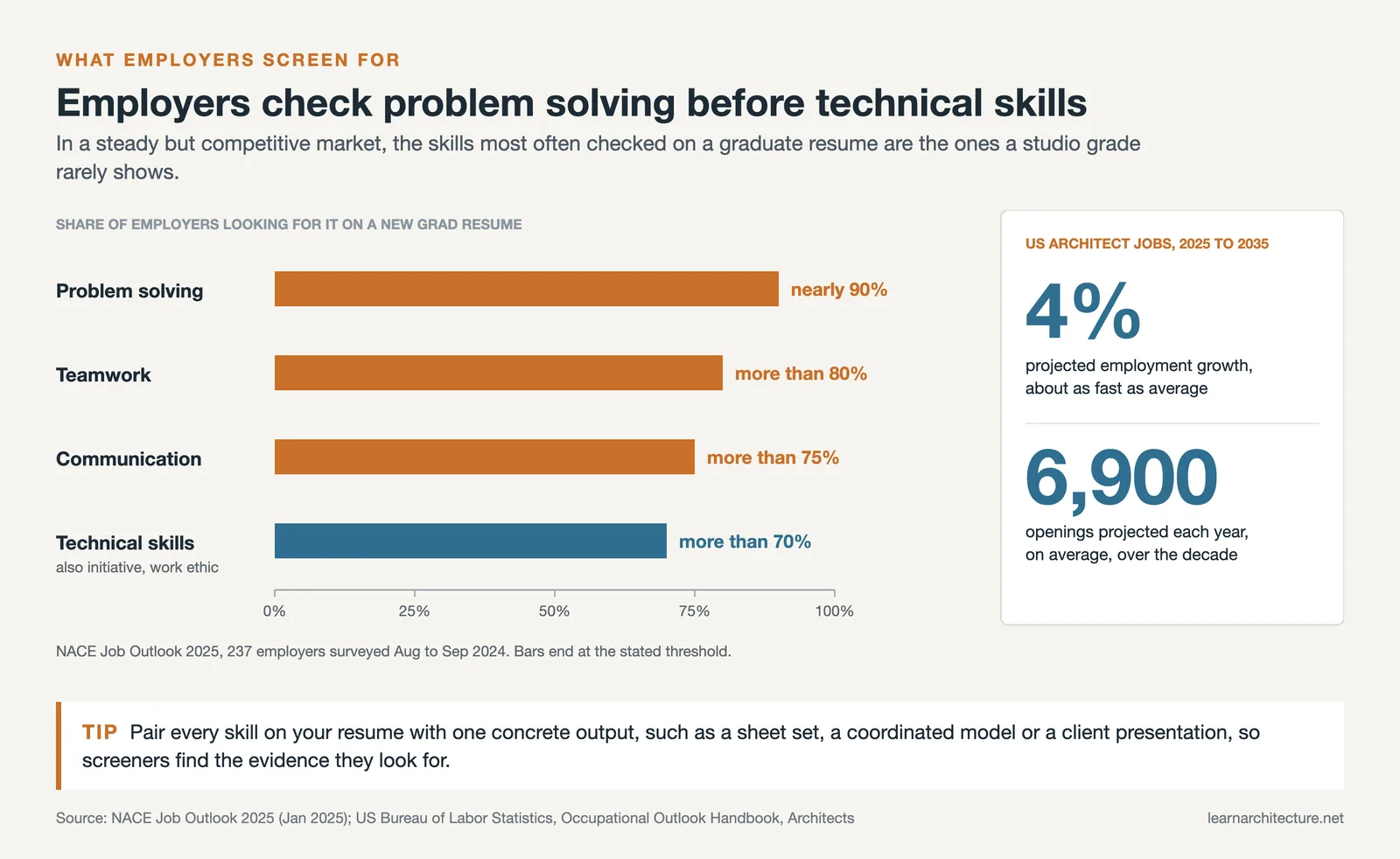
Architecture is no exception. The U.S. Bureau of Labor Statistics projects employment for architects to grow about 4 percent from 2025 to 2035, with roughly 6,900 openings each year, a competitive but steady market that rewards candidates who bring something extra to the table.
💡 Pro Tip
When updating your resume, list one specific output for every skill claim. Instead of “proficient in Revit,” write “produced 30-sheet DD set in Revit for a 12,000 sq ft office fit-out.” Specific outputs survive applicant tracking systems and resonate with project architects who skim resumes in under 30 seconds.

1. Strong Written and Verbal Communication
Communication is the most undervalued architecture skill among graduates and the most valued among hiring partners. Designers who can write a clear scope email, summarize a meeting in three bullet points, or pitch a concept in 90 seconds save firms hours of back-and-forth every week. NACE’s Job Outlook 2024 survey found that written communication ranks among the top three resume attributes employers look for, just behind problem-solving and teamwork.
In practice, communication shows up in client emails, redline mark-up notes, RFI responses, and interview presentations. A graduate who can take meeting notes that the project architect actually uses is worth more than one who produces beautiful renders but cannot explain them. Strong listening is part of the same skill set, and it is what allows architects to translate vague client briefs into clear design intent.
How to build it before you graduate
Start a habit of writing weekly project updates for yourself in plain English, no jargon, no passive voice. Practice presenting your studio work to non-architects: a parent, a friend in another field, a sibling. If they understand the concept in two minutes, your communication is working. Sites like Harvard Business Review publish free pieces on professional writing that translate directly to architectural practice.
🎓 Expert Insight
“Architecture is the reaching out for the truth.”
Louis Kahn
Kahn’s framing applies directly to communication in practice. The architects who advance fastest are the ones who can articulate that truth, the design intent, in language a contractor, a client, and a planning officer can all understand. Strong communication is how good ideas survive the long path from sketch to construction site.
2. BIM Coordination and Software Fluency Beyond Revit
Knowing Revit gets you in the door. Knowing how Revit talks to other tools gets you the job. BIM coordination, the practice of merging architectural, structural, and MEP models to find clashes before construction, has become a baseline expectation in most mid-sized and larger firms. Graduates who can navigate Navisworks, run a Solibri check, or use Revit’s Dynamo to automate sheet creation are immediately useful on a real project.
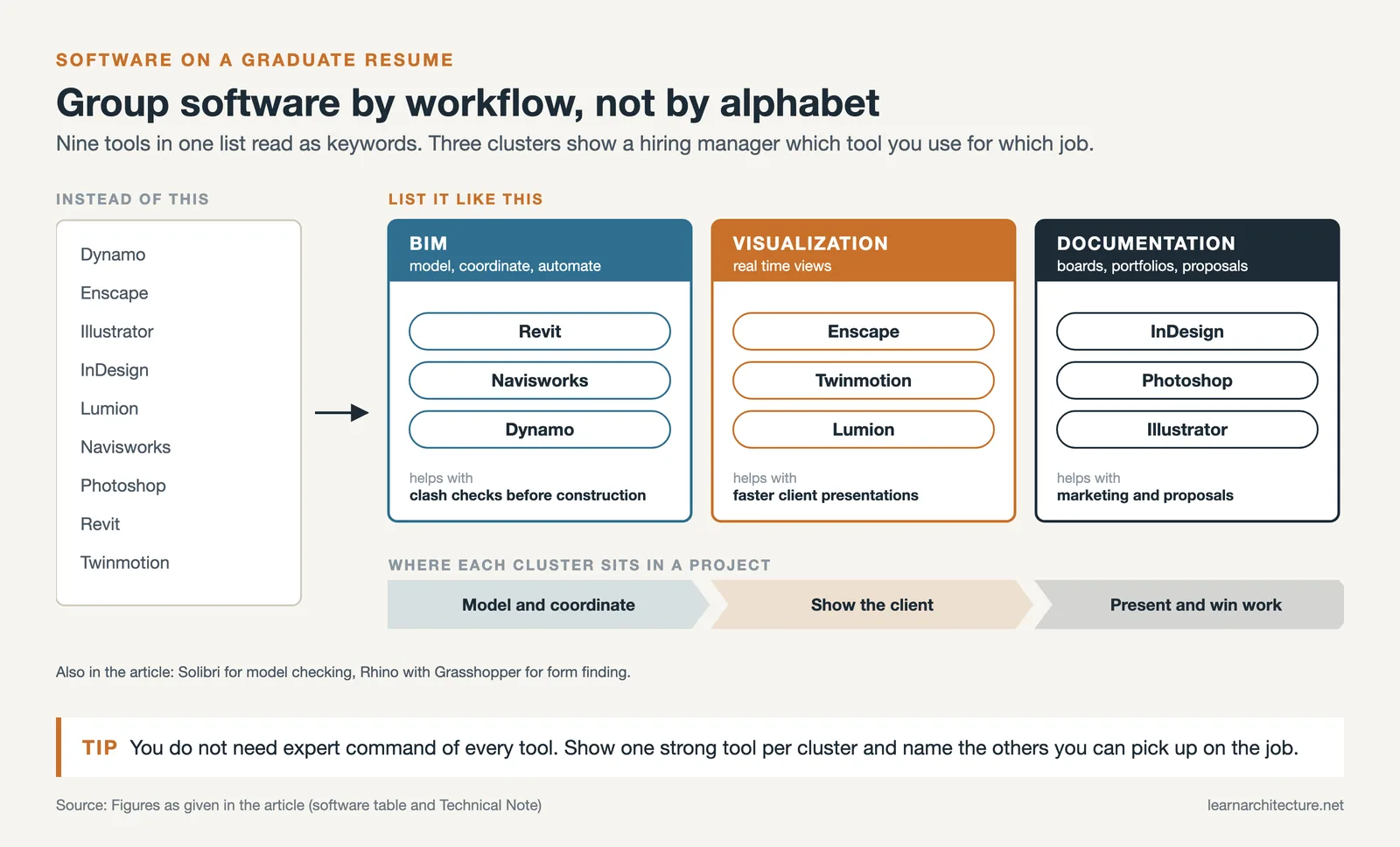
The wider software stack matters too. Rhino with Grasshopper, Enscape or Twinmotion for real-time visualization, and basic Photoshop and InDesign for documentation rounds out a graduate’s technical profile. You do not need expert-level command of all of them. You need to know which tool to reach for and how to learn the rest on the job.

What firms actually use day to day
Hiring software lists vary by firm size and project type. The table below shows where each tool typically fits in the workflow.
| Tool | Primary Use | Where It Helps Graduates |
|---|---|---|
| Revit | BIM authoring, documentation | Production-ready on day one in most firms |
| Navisworks / Solibri | Clash detection, model coordination | Differentiates BIM-fluent candidates |
| Rhino + Grasshopper | Form-finding, parametric modeling | Useful in concept and computational studios |
| Enscape / Twinmotion | Real-time visualization | Speeds up client presentations |
| InDesign + Photoshop | Portfolios, presentation boards | Critical for marketing and proposals |
For a deeper look at how parametric tools fit into a graduate’s skill set, the guide on parametric design tools covers Grasshopper, Dynamo, and Forma in practice.
📐 Technical Note
When listing software on a resume, group tools by capability rather than by name. A BIM cluster (Revit, Navisworks, Dynamo), a visualization cluster (Enscape, Twinmotion, Lumion), and a documentation cluster (InDesign, Photoshop, Illustrator) reads more clearly than a long alphabetical list and signals that you understand workflow, not just software.
3. Graphic Design and Visual Communication
Architecture is graphic design. A portfolio, a presentation board, a competition entry, and a planning submission are all judged on visual hierarchy, typography, and layout before anyone reads the text. Reviewers at firms like OMA and BIG have noted in published reviewer feedback that cluttered or inconsistent layouts can overshadow even strong design work, which means graphic skill directly affects how your architectural work is perceived.
Graphic skills also pay off after hiring. Junior architects produce client presentations, marketing one-sheets, competition boards, and social media images for the firm. A graduate who can open InDesign, set up a clean grid, and pair two fonts without making it look like a high school project is valuable from week one.
⚠️ Common Mistake to Avoid
Many students treat the portfolio as a render gallery rather than a graphic design project. Mixing different fonts, image sizes, and color treatments across spreads makes a portfolio feel disjointed even when individual projects are strong. Pick one type pairing, one grid, and one image treatment, and apply them across every spread.
For practical layout examples and grid systems, the guide on how to build an architecture portfolio walks through page formats, typography, and image treatment. Students preparing for internship applications can also reference what to include in a winning internship architecture portfolio.

4. Basic Business and Project Management Literacy
Most architecture graduates leave school knowing how to design a building but not how a project gets paid for, scheduled, or staffed. Even a basic understanding of fee structures, project phasing, and contract types makes a junior architect dramatically more useful. It also signals to a principal that you are thinking about practice, not just design.
Project management literacy includes reading a project schedule, understanding what a percent-complete invoice means, knowing the difference between a CD set and a DD set, and tracking your own hours against a phase budget. None of this is taught in studio. All of it shows up in your first week.
What to learn before your first day
Get familiar with the AIA contract documents, especially B101 and A201. Read a few articles on AIA’s resource site about how firms structure fees and bill clients. Try a free trial of a project management tool like Monograph or Deltek, or simply read their blogs to understand the language.
🏗️ Real-World Example
HawkinsBrown’s Here East Project (London, 2018): The firm’s reuse of the former Olympic press and broadcast center hinged as much on tight project management and stakeholder coordination as on design. The team coordinated multiple tenant fit-outs, phased construction, and existing-building constraints, the kind of work where graduates with even basic schedule and contract literacy contribute immediately rather than spending months learning the language of practice.
5. Light Coding and Computational Thinking
You do not need to be a software engineer. You do need to be comfortable opening a Grasshopper definition someone else built, modifying a Dynamo script, or writing five lines of Python to rename 200 files. This is the side skill that has shifted the fastest in the last five years, and it is now showing up in junior architect job listings at firms working on complex facade, fabrication, or large-scale BIM projects.
Computational thinking, the ability to break a problem into reusable steps, transfers across every tool. A graduate who can automate a repetitive task, like generating sheet borders or running a daylighting study across 50 design options, removes hours of grunt work from a senior architect’s plate. That is the kind of contribution that gets you remembered at promotion time.
🔢 Quick Numbers
- Employment for architects projected to grow 4% from 2025 to 2035 (U.S. Bureau of Labor Statistics, 2025)
- Nearly 90% of employers screen graduate resumes for problem-solving ability (NACE Job Outlook 2025)
- More than 75% of employers look for evidence of communication skills on graduate resumes (NACE, 2025)

How to start coding without a CS degree
Begin with Grasshopper, which is visual programming and gentler than text-based code. From there, work through a free Python intro on Codecademy or Coursera, focusing on basic loops, lists, and file operations. The architectural payoff comes quickly: in a weekend, you can write a script that batch-exports views from Revit or renames a folder of project files to a consistent convention.
✅ Key Takeaways
- Communication, both written and verbal, is the most undervalued and most hireable side skill in architecture.
- BIM coordination beyond Revit, including Navisworks, Dynamo, and Rhino-Grasshopper, separates candidates in mid-sized and larger firms.
- Graphic design fluency is what makes a portfolio readable and a junior architect useful for client deliverables.
- Even basic business and project management literacy signals that you understand practice, not just design.
- Light coding and computational thinking remove repetitive work from senior staff and accelerate promotion paths.
Final Thoughts
The skills that make architecture graduates employable are rarely the ones that get celebrated in studio. They are the quiet ones, writing a clear email, setting up a clean InDesign grid, running a clash detection, reading a fee proposal, automating a tedious task, that make a junior architect indispensable on a real project. Build one or two of them well before you graduate and you will stand out in a stack of resumes that all look the same on the design side.
Pick the skill closest to your interests, give it a focused four to six weeks of practice, and put one specific output on your portfolio or resume. That is enough to change how you are read in interviews. For more on framing your skills in application materials, the guide on architecture portfolio tips covers how to map role requirements to proof points across portfolio spreads.
Career outlook figures and survey data cited in this article reflect the most recent publicly available reports from the U.S. Bureau of Labor Statistics and the National Association of Colleges and Employers. Hiring practices vary by firm size, region, and project type.
- architectural design skills
- architectural designer skills
- architecture needed skills
- architecture required skills
- architecture skills
- hard skills for architecture
- skills architecture
- skills for architecture
- skills needed for architecture
- skills required for architecture
- what skills are needed for architecture
- what skills do you need to be an architecture














Leave a comment