



Table of Contents Show
Aspiring architects need a blend of creative vision, technical ability, and interpersonal strength to build a lasting career. Whether you are still in school or preparing for your first job at a firm, developing these five skills early will set you apart from the competition and prepare you for the real demands of professional practice.
The path to becoming a licensed architect is long. Between a five-year B.Arch or a post-graduate M.Arch, the Architectural Experience Program (AXP), and the ARE exams, most aspiring architects spend a decade or more in training before they can stamp a set of drawings. That timeline makes it critical to invest in the right skills from the start, so every year of education and experience compounds into real capability.
Design Thinking and Creative Problem-Solving
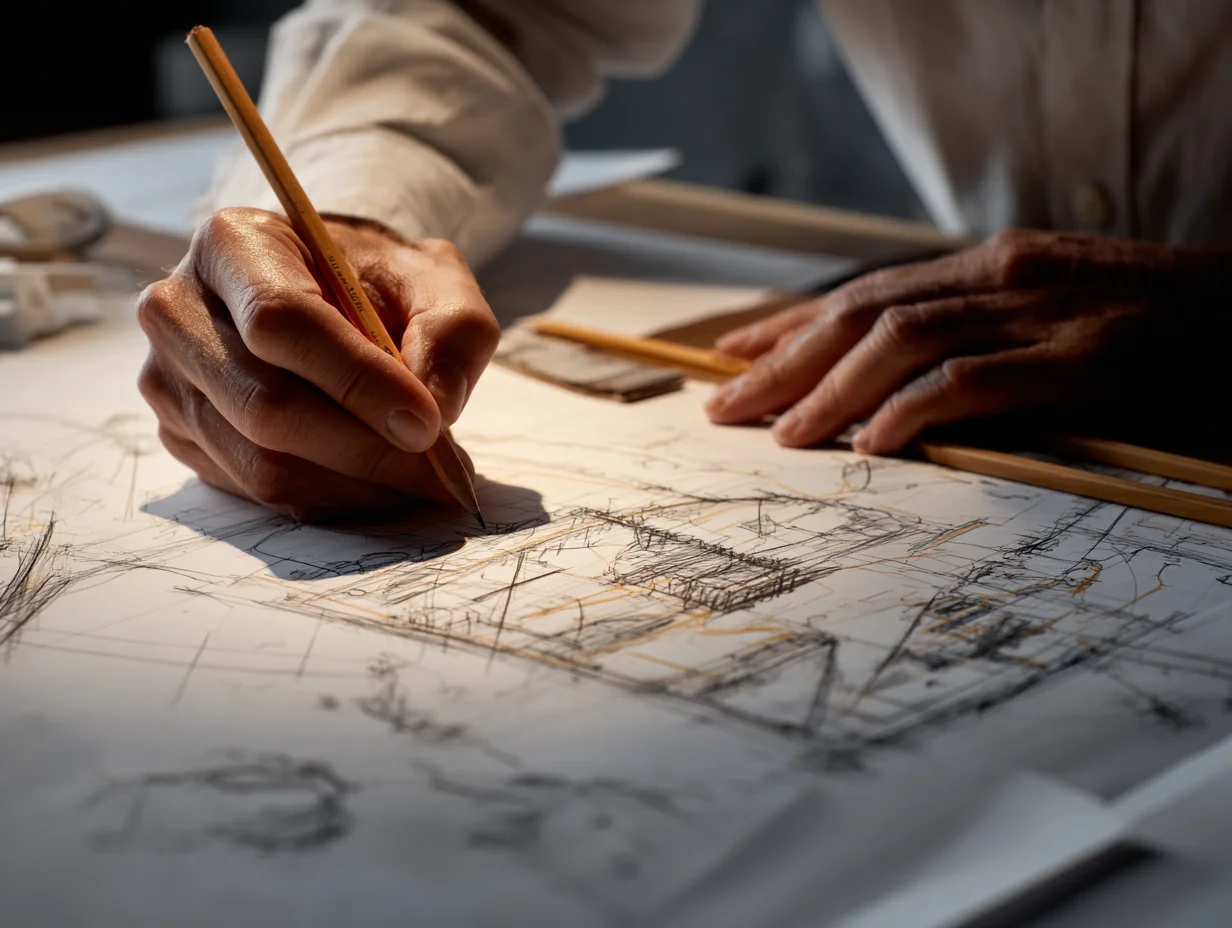
Design thinking sits at the core of what architects do. It is not about making things look good, though aesthetics matter. It is about identifying a problem, exploring constraints, generating options, testing those options, and refining a solution that works for real people in real spaces. Clients rarely arrive with a clear brief. They show up with a budget, a site, a vague wish list, and a set of contradictions. The architect’s job is to sort through those inputs and propose something that no one in the room had imagined but everyone immediately recognizes as right.
Strong design thinkers develop this skill by sketching constantly. Freehand drawing trains the eye to see proportion, light, and spatial relationships faster than any software can. A quick pencil study of a floor plan alternative takes thirty seconds; rebuilding the same option in Revit takes thirty minutes. Speed of iteration is a competitive advantage, and it starts with a pencil and trace paper.
💡 Pro Tip
Keep a small sketchbook with you at all times, not for polished drawings, but for capturing spatial ideas on the spot. Experienced architects often trace their best design breakthroughs back to a rough sketch on a napkin or in a waiting room. The habit of observing buildings, intersections, and public spaces with a critical eye sharpens your design instincts faster than any studio assignment.
Beyond sketching, aspiring architects should practice analyzing built projects. Visit buildings, photograph details, and ask why the architect made specific choices about circulation, material transitions, or window placement. Reading case studies on ArchDaily and Dezeen adds depth, but physically walking through a space teaches lessons that images on a screen cannot replicate. For a deeper look at how architects approach the full design process, the guide to what an architect actually does covers each project phase from first sketch to construction administration.
Technical Proficiency in Software and Documentation
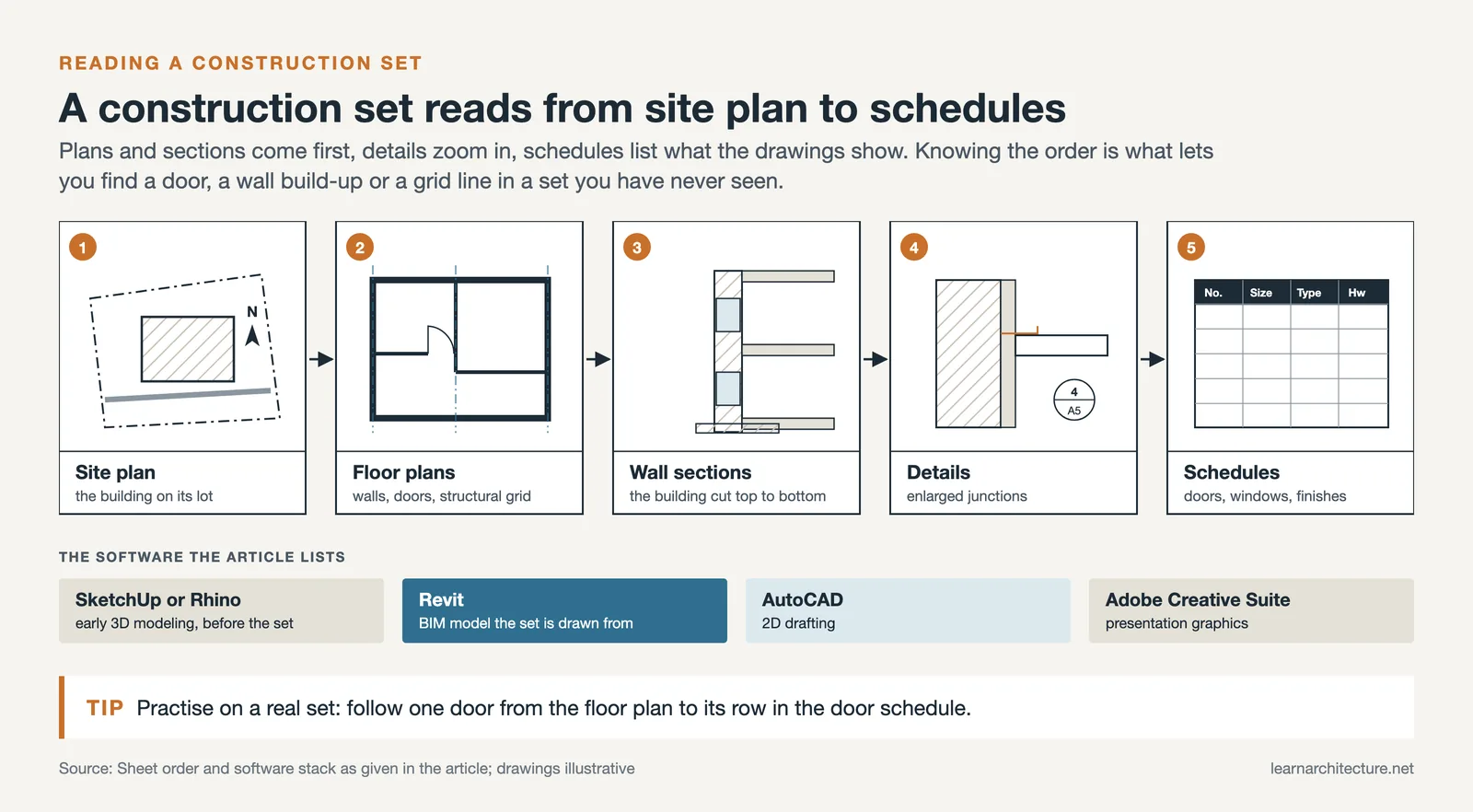
Creativity alone does not get buildings built. Aspiring architects need strong technical skills, and that starts with software fluency. The industry standard stack for most firms includes AutoCAD for 2D drafting, Revit for BIM (Building Information Modeling), SketchUp or Rhino for early-stage 3D modeling, and Adobe Creative Suite for presentation graphics. Knowing one tool well is not enough; firms expect graduates to move between platforms depending on project phase and deliverable type.
Revit deserves special attention because BIM has become the backbone of project delivery in most mid-to-large firms. A Revit model is not just a 3D drawing. It is a database that links geometry to material data, cost estimates, energy performance, and coordination with structural and MEP engineers. Understanding how to build a clean, well-organized Revit model, with proper families, shared parameters, and workset discipline, separates productive team members from those who slow the project down.
🎓 Expert Insight
“The computer is just a tool. You still need to know what a wall section is before you can draw one digitally.”
Bob Borson, Licensed Architect and Creator of Life of an Architect
This reminder matters because students sometimes confuse software proficiency with architectural competence. Tools change every few years, but the ability to read, produce, and coordinate construction documents is a skill that remains valuable for an entire career.
Documentation skills go beyond software. Aspiring architects should understand how a set of construction documents is organized, from site plans and floor plans through wall sections, details, and schedules. They should be able to read a door schedule, interpret a structural grid, and mark up a set of drawings during construction administration. These are the tasks that fill most of an architect’s working hours, and they are the tasks that protect public health, safety, and welfare, which is the legal reason licensure exists. If you are still deciding whether architecture is the right career for you, the honest breakdown of whether architecture is a good career covers the day-to-day realities and long-term outlook.
How Can Aspiring Architects Improve Communication Skills?
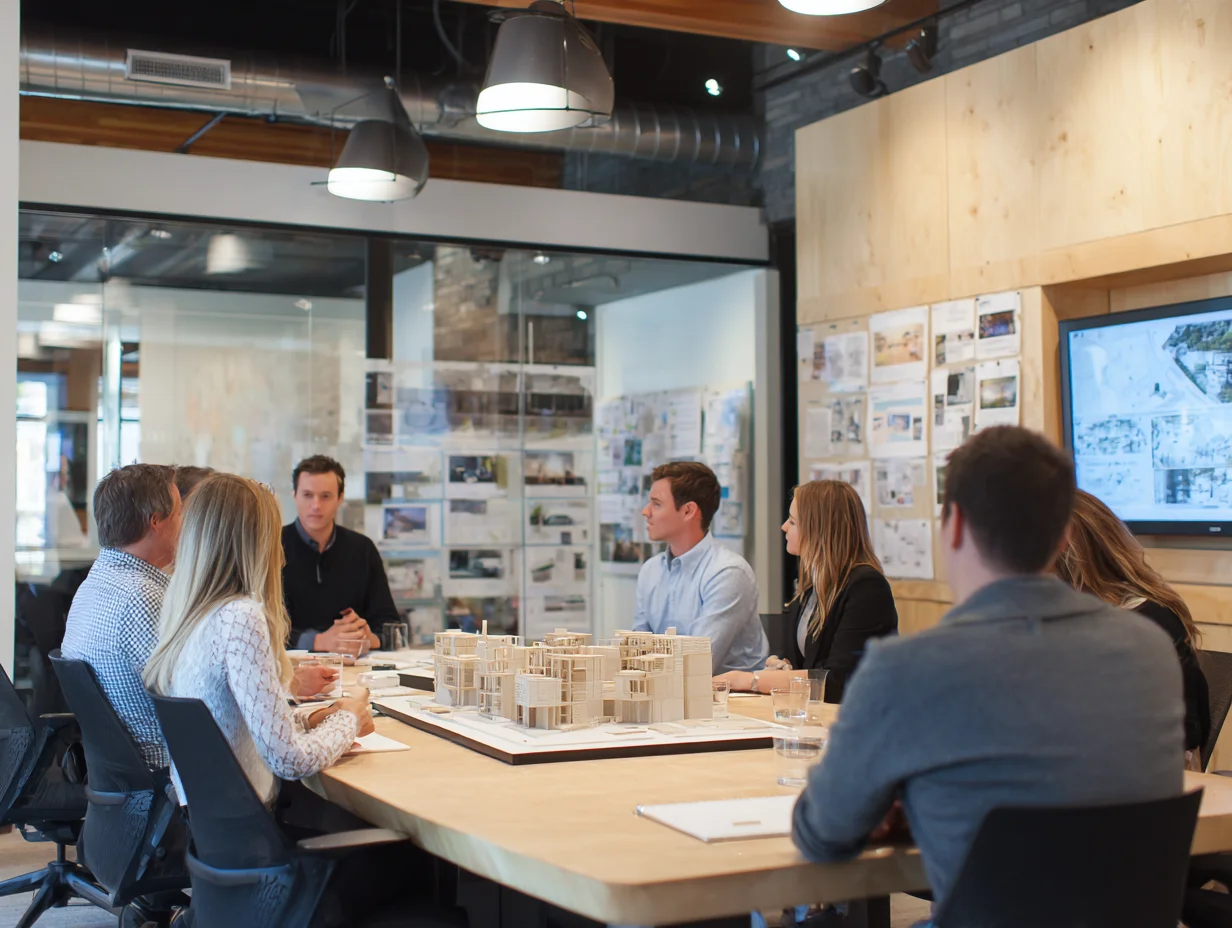
Communication is the skill that separates architects who lead projects from those who only execute tasks. Every building project involves multiple stakeholders: clients, contractors, engineers, consultants, planning boards, and end users. The aspiring architect who can explain a design concept to a client in plain language, defend a material choice to a building official, and coordinate a detail with a structural engineer is already more valuable than a colleague who designs well but struggles to articulate ideas.
Verbal communication matters in design critiques, client presentations, and construction meetings. Written communication shows up in emails, meeting minutes, specifications, and RFI responses. Visual communication, the ability to produce clear diagrams, annotated sketches, and well-composed presentation boards, ties everything together. Architecture is a team sport, and the team only functions when information flows clearly between all players.
Start building this skill in school. Volunteer to present your studio work rather than letting a teammate handle it. Write concise project descriptions for your portfolio instead of relying only on images. Practice explaining your design decisions in two sentences rather than twenty. For guidance on putting together a portfolio that communicates effectively, the step-by-step guide to building an architecture portfolio covers layout, project selection, and narrative structure.
⚠️ Common Mistake to Avoid
Many architecture students fill their portfolios entirely with high-quality renders and neglect process work. Firms want to see how you think, not just how you render. Including concept sketches, site analysis diagrams, and development drawings alongside final images shows that you can communicate the full arc of a design process, which is exactly what you will need to do on a real project.
Project Management and Collaboration

Architecture projects do not happen in isolation. Even a small residential addition involves coordinating schedules, budgets, building codes, contractor bids, and client expectations. Skills for aspiring architects should include basic project management: the ability to break a large task into smaller milestones, track progress, manage time, and adapt when things change, which they always do.
In school, this looks like managing your studio workload without burning out. The guide to surviving architecture school covers practical strategies for time management, including working backwards from deadlines and treating studio hours like a job. In practice, it scales up to managing deliverables across a team of ten or more people, each producing drawings, models, and specifications that need to align perfectly.
Collaboration is equally important. Modern architecture projects use integrated project delivery methods that require architects, engineers, and contractors to work together from day one. The American Institute of Architects (AIA) contract documents, which govern most projects in the United States, define the architect’s role as one of coordination and communication across disciplines. Learning to work productively with people who have different priorities, whether that is a structural engineer focused on load paths or a client focused on the budget, is a skill that no software tutorial can teach.
🏗️ Real-World Example
The Edge (Amsterdam, 2015): Designed by PLP Architecture, The Edge was developed through close collaboration between the architect, engineer Arup, and client Deloitte from the earliest design stages. This integrated approach helped deliver one of the world’s most sustainable office buildings, achieving a BREEAM Outstanding score of 98.4%. The project demonstrated that early, structured collaboration between disciplines produces results that no single team could achieve alone.
Why Is Sustainability Knowledge Essential for Aspiring Architects?

Sustainability is no longer a specialization. It is a baseline expectation. Building codes are ratcheting up energy performance requirements every cycle, clients are asking for lower operating costs, and the public increasingly expects architects to address carbon emissions. According to the UNEP Global Status Report for Buildings and Construction, the buildings sector accounts for roughly 37% of global energy-related CO2 emissions. That number makes every design decision an environmental decision.
Essential skills for aspiring architects now include a working knowledge of passive design strategies (orientation, shading, natural ventilation, thermal mass), energy modeling basics, and familiarity with rating systems like LEED and Passive House. You do not need to be a certified energy consultant on day one, but you should understand how your design choices affect a building’s energy use intensity (EUI) and embodied carbon footprint.
🔢 Quick Numbers
- Buildings account for approximately 37% of global energy-related CO2 emissions (UNEP, 2024)
- Green buildings use up to 30% less energy than conventional buildings (Dodge Construction Network, 2024)
- LEED-certified projects have reported 35% lower water consumption on average (USGBC, 2023)
Firms are actively looking for graduates who can contribute to sustainability goals from their first week. Knowing how to run a basic daylight analysis in Revit, understanding the implications of glazing ratios on energy performance, or being familiar with life-cycle assessment (LCA) tools gives you a practical edge over candidates who treat sustainability as an abstract concept. The collection of sustainable architecture projects on learnarchitecture.net shows how these principles translate into real built work across different climates and building types.
💡 Pro Tip
Start learning energy modeling early, even at a basic level. Tools like Sefaira (now integrated into SketchUp) or Revit’s built-in energy analysis let you test design decisions against performance targets before the engineering team gets involved. Architects who can have an informed conversation about energy use intensity (EUI) targets during schematic design earn trust from both clients and consultants faster than those who defer all performance questions to the mechanical engineer.
How to Start Building These Skills Today
You do not need to wait for a job offer or a graduate program to begin turning these skills into daily habits. Here are concrete steps you can take right now:
Pick one software tool and get proficient. If you only learn one program this year, make it Revit. Free educational licenses are available through Autodesk’s education portal, and YouTube tutorials from channels like Balkan Architect and The Revit Kid can take you from beginner to competent in a few months of consistent practice.
Build your portfolio as you go. Do not wait until graduation. Every studio project, competition entry, and personal design exercise is a potential portfolio piece. For advice on what reviewers actually look for, the guide to best projects for an architecture student portfolio covers essential project types and presentation strategies.
Seek out internships early. The aspiring architect who logs real firm experience before graduation enters the job market with a significant advantage. Internships teach you how offices operate, how documents are produced, and how clients interact with design teams. The overview of what it is actually like to be an architect covers the daily realities of practice and can help you prepare for what you will encounter.
Join a professional organization. Student memberships in the AIA or RIBA are inexpensive and provide access to networking events, mentorship programs, and continuing education content that can accelerate your growth well before licensure.
✅ Key Takeaways
- Design thinking and freehand sketching remain the most direct path to faster, better design iteration, regardless of what software you use.
- Technical proficiency in BIM tools like Revit is now a baseline expectation at most firms, not a bonus skill.
- Communication skills, verbal, written, and visual, determine whether you lead projects or only execute tasks assigned by others.
- Project management and collaboration are daily realities of practice; developing these habits in school gives you a head start.
- Sustainability knowledge is no longer optional. Understanding energy performance, passive design, and carbon impact is expected from day one.
Final Thoughts
The aspiring architect who develops these five skills, design thinking, technical proficiency, communication, project management, and sustainability awareness, enters the profession prepared for what the work actually demands. Architecture is a long career, and the professionals who thrive are the ones who keep learning, keep sketching, and keep asking how their buildings can perform better for the people who use them. Start building these skills now, and the rest of the career path, from licensure to leadership, will follow.












Leave a comment