



Table of Contents Show
A freelance architect who prices services correctly can earn a stable income while keeping clients coming back. The key is matching your fee structure to your project type, experience level, and market. This guide covers seven pricing strategies used by independent architects and 3D visualization artists, with real benchmarks and formulas you can apply today.
Setting fees is one of the first challenges any freelance architect faces after leaving a traditional firm. Charge too little and you burn through hours without covering overhead. Charge too much without communicating the value, and prospects walk away. The difference between a thriving freelance practice and one that stalls out often comes down to how well you understand and present your pricing.
Below, you will find the most common pricing models used in freelance architecture and visualization work, along with specific rate ranges, calculation methods, and tips for choosing the right model for each project.
Why Pricing Matters for a Freelance Architect

Pricing is not just about covering costs. It signals your positioning in the market. A freelance architect designer who charges $50 per hour sends a very different message than one charging $150. Both may do excellent work, but clients interpret the fee as an indicator of experience, reliability, and output quality.
According to ZipRecruiter, the national average salary for freelance architects in the United States sits around $62,975 per year, with top earners reaching $109,500. That range translates roughly to $30 to $55 per hour, though many experienced freelancers charge well above that figure when billing on a project basis. Your pricing model directly affects where you land in this range.
Another factor to consider: freelance architect salary figures reported by job boards often reflect platform-based gig work, not independent practice with direct clients. Architects who build their own client pipeline and handle full-scope design services typically earn significantly more per project than those competing on hourly-bid platforms.
💡 Pro Tip
Before setting any rate, calculate your true annual overhead: software subscriptions, insurance, self-employment taxes, hardware depreciation, and unpaid time spent on marketing and admin. Most freelance architects find that 30 to 40 percent of their working hours are non-billable. Factor that into every pricing model you use.
Hourly Rate Pricing
Hourly billing is the most straightforward model and the one most freelance architects start with. You track your hours, multiply by your rate, and invoice the client. It works well for projects with unclear scope, consultation work, and early-stage design exploration where the number of revisions is hard to predict.
Freelance architect jobs on platforms like Upwork and Fiverr tend to cluster in the $25 to $75 per hour range. Independent architects working directly with homeowners or developers typically charge $75 to $200 per hour depending on specialization, location, and project complexity. A freelance interior architect in a major metro area, for example, may bill $120 or more per hour for space planning and material specification work.
The main downside of hourly billing is that it penalizes efficiency. The faster you work, the less you earn. It also creates tension with clients who feel anxious watching the clock. For these reasons, many experienced freelancers move toward project-based or value-based pricing as they gain confidence in estimating scope.
How to Calculate Your Minimum Hourly Rate
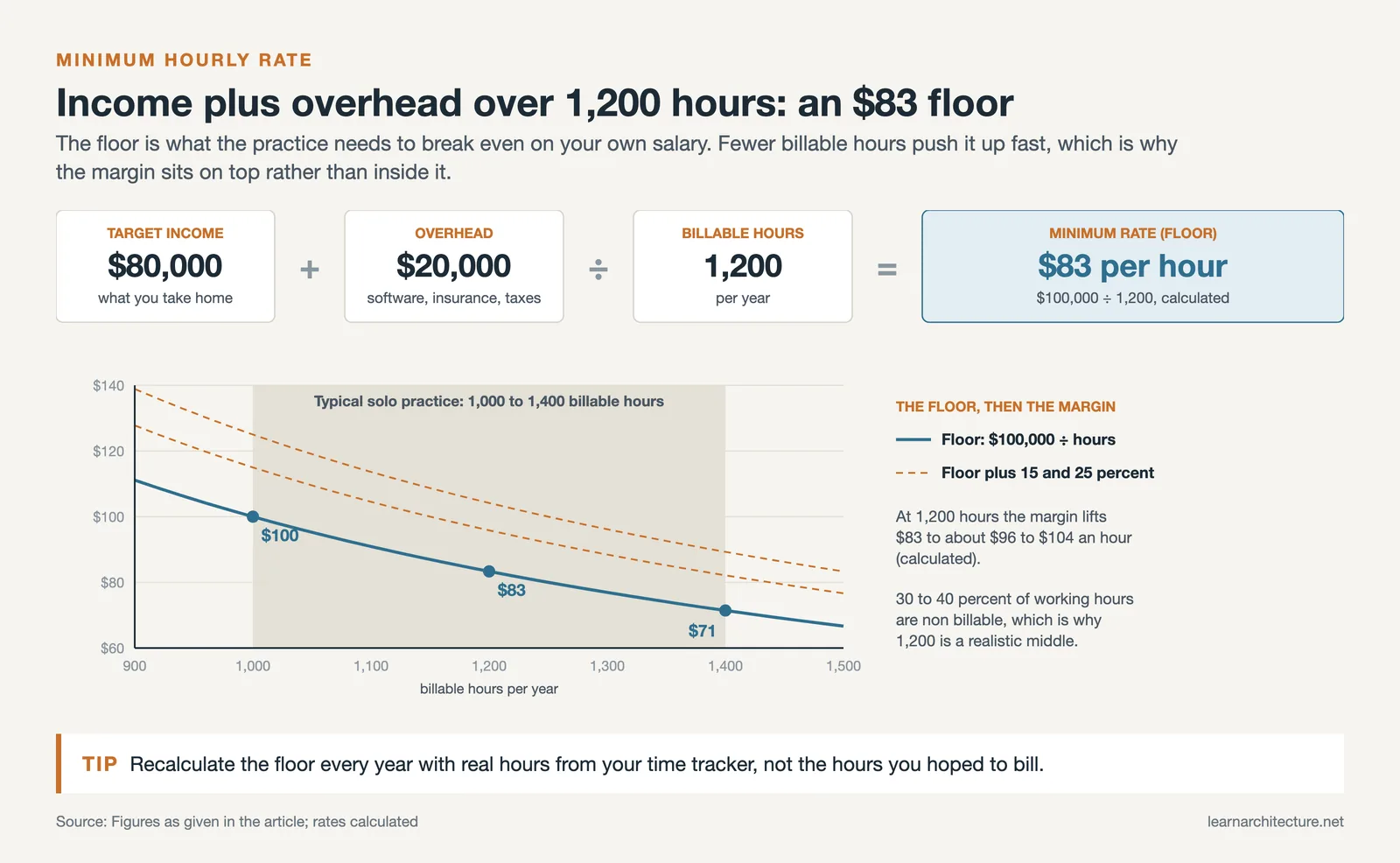
Start with your target annual income. Add your estimated annual business expenses (software, insurance, equipment, taxes, marketing). Divide by the number of billable hours you can realistically work per year. Most solo practitioners bill between 1,000 and 1,400 hours annually after accounting for admin, marketing, vacations, and sick days.
For example, if you want to earn $80,000 per year and your overhead is $20,000, you need $100,000 in revenue. At 1,200 billable hours, your minimum rate is roughly $83 per hour. That is your floor, not your target. Add a margin of 15 to 25 percent to account for slow months and late payments.
Fixed Fee (Lump Sum) Pricing

A fixed fee means you and the client agree on a total price for a defined scope of work before the project starts. This model is common for freelance architects handling residential additions, interior renovations, or permit-ready drawing sets where the deliverables are clear from the outset.
The American Institute of Architects (AIA) calls this a “stipulated sum” arrangement. It works best when you can accurately estimate your hours based on past project data. The risk shifts to you: if the project takes longer than expected, you absorb the extra time. If you finish early, you keep the difference.
To protect yourself, define the scope in writing. List every deliverable, the number of included revision rounds, and what constitutes “additional services” outside the agreement. The AIA’s guidance on charging for services recommends specifying exactly which phases and tasks are covered under your fixed fee.
⚠️ Common Mistake to Avoid
Many new freelance architects quote a fixed fee without capping the number of revisions. Unlimited revisions on a flat rate is a fast path to unpaid work. Specify “two rounds of revisions included” (or whatever number fits your workflow), and state your hourly rate for additional rounds in the contract.
Percentage of Construction Cost
This is the traditional fee model used in full-service architecture. The architect’s fee is calculated as a percentage of the total construction budget. According to Archtoolbox, the gross design fee typically ranges from 3 to 15 percent (or more) of the total cost of construction. Smaller projects command higher percentages because the base effort remains similar regardless of scale.
For a freelance architect handling a $300,000 residential renovation at 10 percent, the fee would be $30,000. This model aligns the architect’s compensation with project complexity, which makes it attractive for both parties. However, it requires the client to have a defined construction budget early in the process, which is not always the case.
The AIA’s B101-2017 agreement shifted the calculation basis from “cost of the work” to “owner’s budget for the cost of the work,” giving architects more predictability. If you use this model, make sure to define whether your percentage applies to the initial budget or the final construction cost, as the difference can be significant.
How Much Does a Freelance Architect Charge Per Square Foot?
Some freelancers for architects prefer a per-square-foot model, especially for residential design. Rates vary widely: $2 to $5 per square foot for basic floor plans, $5 to $15 for full design development packages, and $15 to $30 or more for complete construction document sets with engineering coordination. Location, project complexity, and the architect’s specialization all affect this range.
🔢 Quick Numbers
- Average freelance architect salary in the US: $62,975 per year (ZipRecruiter, 2025)
- Typical architectural fees: 3 to 15 percent (or more) of construction cost (Archtoolbox)
- 67 percent of architecture and engineering firms use hourly billing as their primary pricing method (Monograph, 2026)
Value-Based Pricing for Design Services
Value-based pricing sets the fee according to the outcome the client receives, not the hours you spend. If your design work helps a developer secure $2 million in pre-sales through compelling renderings, the value of that work far exceeds the 40 hours it took you to produce it.
This model works best for freelance architects and 3D artists whose output directly influences revenue: marketing renderings for real estate developers, competition entries for architecture firms, and branding-quality visuals for hospitality projects. A single photorealistic exterior rendering can range from $500 to $5,000 depending on complexity, but the commercial value to the client may be many times that figure.
To apply value-based pricing, you need to understand the client’s goals. Ask what they plan to do with the deliverables. If the renderings will appear in a $50 million investor presentation, that context justifies a very different fee than images for a personal portfolio. Frame your pricing around the return your work generates, not just the time it consumes.
🎓 Expert Insight
“The number one thing that inflates rendering costs isn’t complexity, it’s an ambiguous project brief.”
Alex Smith, Co-owner, Render 3D Quick
This applies equally to architects and visualization artists. A well-prepared brief with finalized materials, reference images, and clear deliverables keeps your project on budget. When the brief is vague, revisions pile up and timelines stretch, eating into your profit margin regardless of which pricing model you use.
Retainer and Subscription Models
A retainer agreement means the client pays a fixed monthly fee in exchange for a set number of hours or a defined package of services. This model provides predictable income for the freelance architect and guaranteed availability for the client. It works especially well for ongoing relationships: a developer who needs regular permit drawings, a real estate agency that requires monthly rendering packages, or a firm that outsources freelance jobs for architects on a rolling basis.
Typical retainer arrangements range from 10 to 40 hours per month. Price the retainer at a slight discount compared to your standard hourly rate (10 to 15 percent off) to incentivize the commitment. Specify what happens to unused hours: do they roll over, expire, or convert to a credit? These details prevent disputes down the line.
For 3D artists offering architectural visualization, a subscription model can work similarly. Some studios offer packages like “4 interior renderings per month” or “1 animation plus 3 stills” at a flat monthly rate. This approach builds recurring revenue and reduces the time you spend on proposals and negotiations.
Pricing for 3D Visualization and Rendering Services

Freelance jobs architect professionals take on increasingly include 3D visualization work. If you offer rendering services alongside traditional design, you need a separate pricing structure for this deliverable category.
Current market rates for architectural renderings vary based on type. Interior renderings typically range from $200 to $1,500 per image. Exterior renderings run $500 to $4,000. Aerial views cost $450 to $2,000. Animations start around $3,000 to $5,000 per minute for basic walkthroughs and can reach $15,000 or more per minute for marketing-grade productions.
Several factors drive the price: scene complexity, realism requirements, custom modeling needs (especially for furniture, fixtures, and equipment), and turnaround time. Rush delivery within five business days typically adds a 30 to 50 percent premium. Providing clean CAD files, finalized material specifications, and reference images upfront can significantly reduce production time and keep costs predictable for both you and your client.
Comparison of Pricing Models for Freelance Architects
The table below summarizes how each pricing model fits different project types and experience levels.
| Pricing Model | Best For | Typical Range | Risk Level |
|---|---|---|---|
| Hourly Rate | Consulting, unclear scope, early-stage design | $50 to $200/hr | Low (for architect) |
| Fixed Fee | Defined deliverables, permit sets, small renovations | $2,000 to $50,000+ | Medium |
| % of Construction Cost | Full-service residential and commercial projects | 3% to 15% or more | Medium |
| Value-Based | Marketing renderings, competition entries, investor decks | Varies by project impact | Low (if scoped well) |
| Per Square Foot | Residential floor plans, design development | $2 to $30/sq ft | Medium |
| Monthly Retainer | Ongoing client relationships, recurring work | $1,500 to $8,000/month | Low |
| Per Rendering | 3D visualization, archviz freelance | $200 to $5,000/image | Low to Medium |
How to Choose the Right Pricing Strategy
There is no single best model. Most successful freelance architects use a combination of approaches depending on the client and project type. A useful framework: match your pricing model to the level of scope clarity at the time of engagement.

If the scope is vague (the client says “I want to renovate my kitchen but I’m not sure what I want”), start with hourly billing for the discovery and schematic phase. Once the scope is defined, switch to a fixed fee for design development and construction documents. This hybrid approach protects both parties.
For freelance architect jobs that involve pure deliverables (a set of renderings, a permit drawing package, a 3D model), fixed or per-unit pricing almost always makes more sense than hourly billing. You can estimate the effort accurately, and the client gets a clear price upfront.
If you are a freelance architect just starting out, begin with hourly rates while you build your project database. Track every project: hours spent, deliverables produced, client type, and total fee. After 10 to 15 projects, you will have enough data to price confidently on a fixed or value basis.
💡 Pro Tip
Always present your fee alongside the scope, timeline, and deliverables in a written proposal. Clients rarely object to a well-justified fee. They object to fees that appear without context. A one-page proposal that lists what the client gets, when they get it, and what it costs converts at a much higher rate than a number dropped in an email.
Contracts, Payment Terms, and Protecting Your Income


Pricing strategy means nothing without a contract that enforces it. Every freelance architect should use a written agreement for every project, regardless of size. The AIA B101 contract is the industry standard, but smaller freelance projects may not require a full AIA document. At minimum, your agreement should cover scope of services, fee and payment schedule, revision limits, ownership of deliverables, and termination terms.
Payment structure matters as much as the total fee. Require an upfront deposit (25 to 50 percent for small projects, 10 to 20 percent for larger ones). Bill at milestones, not at the end. For hourly work, invoice biweekly or monthly. For fixed fees, tie payments to deliverable submissions: 30 percent at schematic design, 30 percent at design development, 30 percent at construction documents, and 10 percent at project completion.
Late payment is a reality of freelance work. Include a late fee clause in your contract (1.5 percent per month is standard in many states). More importantly, stop work if payment falls behind schedule. Continuing to produce deliverables while invoices remain unpaid trains the client that payment is optional.
Your architecture portfolio is the single most powerful tool for justifying your pricing. Clients who see high-quality past work are far less likely to push back on fees. Update it regularly with your strongest recent projects.
🏗️ Real-World Example
Woodhull Architecture (Portland, Maine): This 25-person firm reduced budget overages by 66 percent after switching from spreadsheet-based time tracking to dedicated practice management software. Their experience shows that even small improvements in tracking billable hours and project costs translate directly to better fee estimation and higher profitability, a lesson equally valuable for solo freelancers.
When and How to Raise Your Rates
Raising rates is uncomfortable but necessary. Costs increase annually (software subscriptions, insurance, taxes), and your skills improve with every project. If you have not raised your rates in the past 12 months, you are effectively earning less than you were a year ago.
Apply new rates to new clients immediately. For existing clients, give 30 to 60 days notice and frame the increase around the value you provide, not your expenses. “Based on the results we’ve delivered on your last three projects, my rate for new engagements will increase to $X effective [date]” works better than “my costs went up.”
A good benchmark: raise your rates by 5 to 15 percent annually if you are consistently booking at capacity. If you are losing 20 to 30 percent of proposals on price, you are likely priced correctly for your market. If you are winning every proposal, you are probably too cheap.
Your earning potential as a freelance architect is not fixed by industry averages. Architects who combine strong design skills with smart business practices, such as value-based pricing, tight contracts, and a focused specialization, consistently earn above the median.
✅ Key Takeaways
- Calculate your minimum hourly rate based on target income, overhead, and realistic billable hours before choosing any pricing model.
- Match the pricing model to scope clarity: hourly for vague projects, fixed fees for defined deliverables, percentage of construction cost for full-service work.
- Value-based pricing works best for freelance architects and 3D artists whose output directly influences client revenue, such as marketing renderings or investor presentations.
- Always use a written contract with defined scope, revision limits, payment milestones, and late fee terms.
- Raise your rates by 5 to 15 percent annually; if you win every proposal, your pricing is too low.
Final Thoughts
Pricing is a skill, and like any skill in architecture, it improves with practice and data. Start tracking your hours and project outcomes from day one. Build a database of past project fees, hours worked, and profit margins. Over time, you will develop an accurate instinct for pricing that serves both your financial goals and your clients’ expectations.
The freelance architect who prices with confidence, communicates value clearly, and backs everything with a solid contract is the one who builds a sustainable, profitable practice. Whether you are taking on your first freelance jobs for architects or expanding an established independent practice, the pricing strategies above give you a framework to work from and refine as your career grows.
Fee figures cited in this article are approximate and vary by region, specialization, project scope, and market conditions. Always verify current rate benchmarks for your specific location and practice area.












Leave a comment