


Table of Contents Show
The Greenlab Diamonds Factory, designed by Design Work Group, represents a significant shift in how industrial buildings are conceived and experienced in India. As the country’s first purpose-built lab-grown diamond manufacturing facility, the project sets out not only to accommodate advanced production processes but also to challenge the visual and spatial norms traditionally associated with factory architecture. Spanning approximately 95,000 square feet in its initial phase, the building brings together manufacturing, processing, and office environments within a cohesive, human-centered architectural framework.
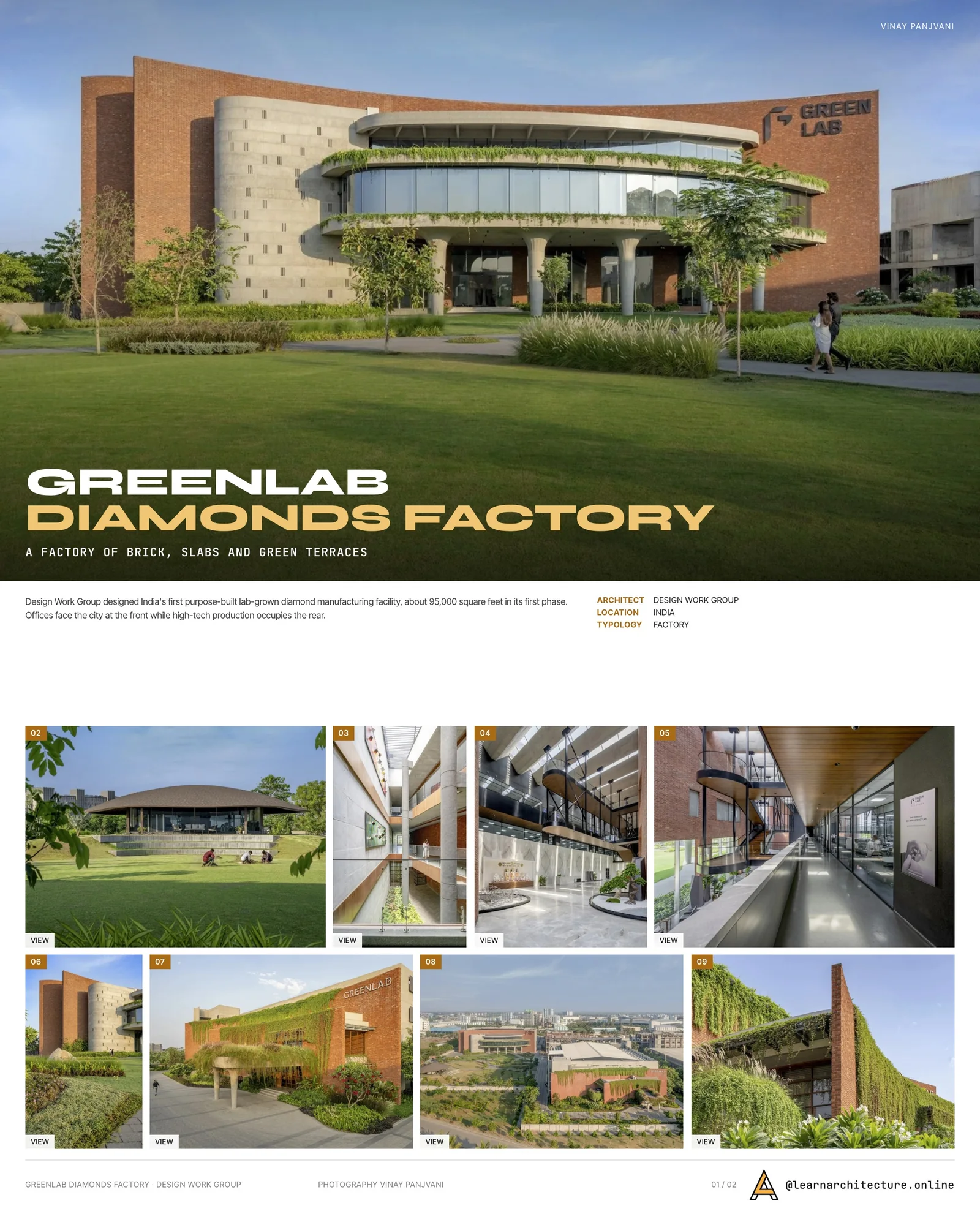
Rather than presenting itself as a closed and purely utilitarian structure, the factory is envisioned as a contemporary workplace, one that balances efficiency with comfort, technology with nature, and industrial rigor with architectural elegance.

A Dual Identity: Production Meets Workplace
The organization of the building is based on a clear yet fluid duality. The front elevation addresses the city and users with welcoming office spaces, while the rear zones are dedicated to high-tech diamond production. This deliberate contrast allows the factory to operate efficiently without isolating its administrative and human components from the architectural experience.
Across four well-structured floors, office areas and manufacturing zones coexist without visual or functional conflict. Circulation paths are carefully planned to ensure smooth movement of people and materials, while also maintaining clarity between clean office environments and controlled production spaces. This layered planning approach transforms the factory into a vertical ecosystem rather than a single-purpose industrial shed.

Breaking the Industrial Stereotype
One of the most striking aspects of the Greenlab Diamonds Factory is its façade. Instead of relying on sealed metal skins or anonymous cladding systems, the architects employ exposed RCC slabs, brick cladding, and integrated greenery to create depth, rhythm, and texture. These elements give the building a sense of permanence and warmth, grounding it in its local context while projecting a contemporary identity.
Brick surfaces soften the scale of the structure and provide a tactile quality often missing in industrial architecture. The exposed concrete slabs express structural honesty, while planted terraces and landscaped edges introduce nature into what is typically a hard, mechanical environment. Together, these elements establish a façade language that is both functional and expressive.

Landscape as an Architectural Strategy
Landscape plays a central role in shaping the character of the Greenlab campus. Greenery is not treated as an afterthought but as an integral architectural component, woven through courtyards, circulation spaces, and outdoor zones. The extensive landscaping helps regulate microclimate conditions, improves visual comfort, and contributes to employee well-being.
Between the two main building phases, a landscaped communal ground acts as a shared space for interaction and pause. This outdoor area incorporates a small library and sit-out pavilion, offering employees a quiet retreat from the intensity of production floors. By providing spaces for rest, learning, and informal exchange, the project reinforces a sense of community within the industrial setting.

Phase Two: Expanding Scale and Experience
The second phase of the Greenlab Diamonds Factory expands the facility by an additional 78,000 square feet, introducing a dedicated diamond processing unit. This phase elevates the architectural ambition of the project through the inclusion of a triple-height foyer that functions as a ceremonial arrival space.
The foyer is designed to leave a lasting impression. Wedge-shaped skylights bring controlled natural light deep into the interior, enhancing spatial drama while reducing reliance on artificial lighting. A hanging observatory bridge spans the volume, allowing visitors and staff to visually engage with the building from multiple perspectives. This moment of architectural spectacle is carefully balanced with the factory’s operational needs, ensuring that form never compromises function.

Human-Centered Industrial Design
Despite its scale and technical complexity, the Greenlab Diamonds Factory prioritizes the human experience. Office interiors are filled with daylight, views of greenery, and generous circulation areas that reduce the stress often associated with industrial workplaces. Staircases, corridors, and transitional spaces are treated as architectural moments rather than leftover zones.
By integrating offices, production floors, and communal areas within a unified spatial language, the building encourages transparency and connection across departments. This openness reflects the company’s forward-looking ethos and reinforces the idea that advanced manufacturing environments can also be inspiring places to work.

Sustainability Beyond Technology
While the factory’s primary innovation lies in the production of lab-grown diamonds (a more sustainable alternative to traditional mining), the architecture itself reinforces this commitment. The extensive use of greenery, daylighting strategies, and durable materials supports long-term environmental performance and reduces operational impact.
More importantly, sustainability here is understood as a holistic concept, encompassing environmental responsibility, employee well-being, and architectural longevity. The project avoids short-lived stylistic gestures in favor of robust, timeless design decisions that will age gracefully alongside the company’s growth.

Conclusion: A New Paradigm for Industrial Architecture
The Greenlab Diamonds Factory stands as a powerful example of how industrial buildings can transcend their conventional limitations. By merging advanced manufacturing, thoughtful workplace design, and landscape-driven architecture, Design Work Group has created a facility that is as progressive in its spatial thinking as it is in its technological ambition.
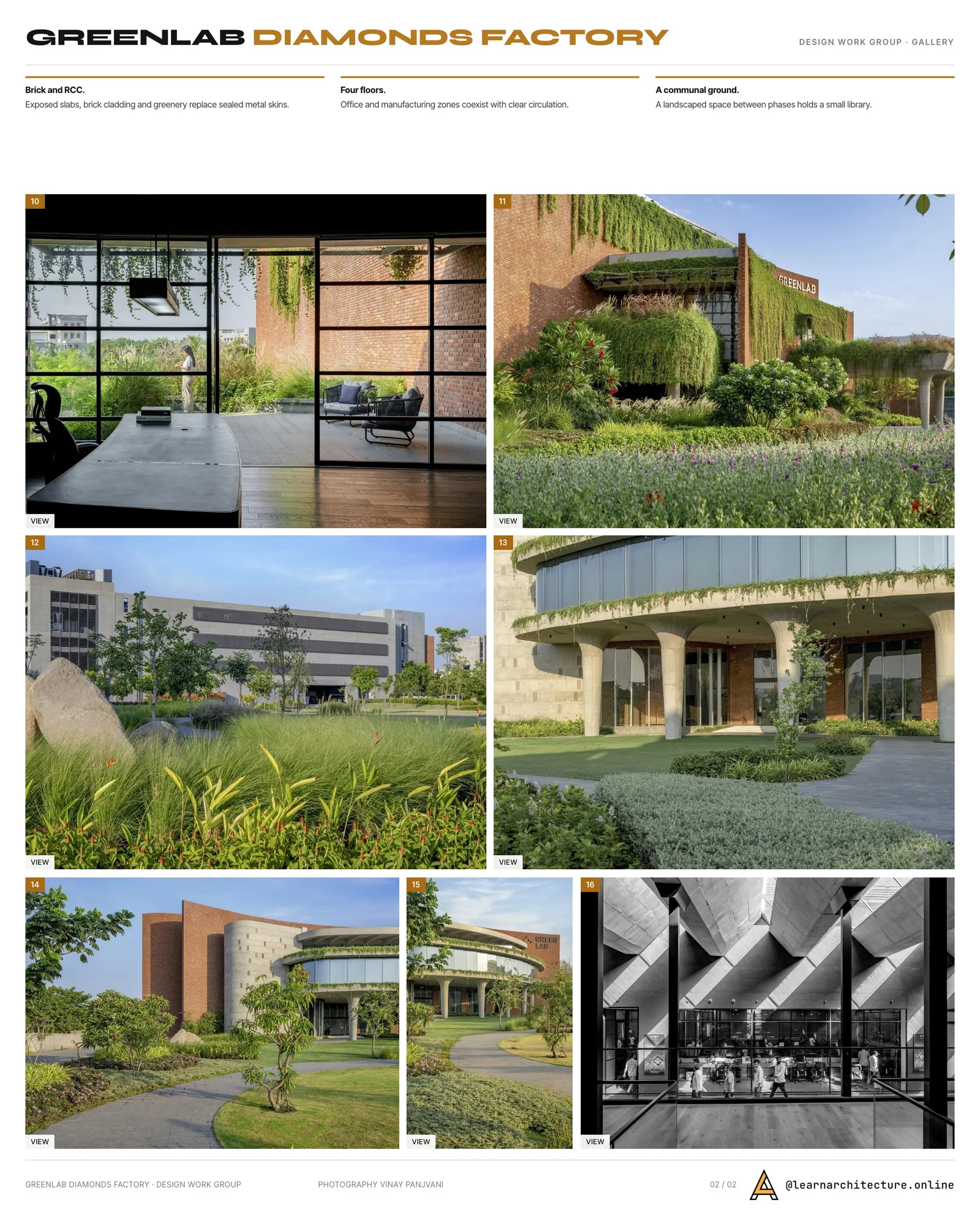
More than a factory, Greenlab is a statement about the future of industry in India, one where functionality and elegance, efficiency and humanity, coexist seamlessly. It sets a new benchmark for industrial architecture, proving that places of production can also be places of pride, comfort, and architectural distinction.
Photography: Vinay Panjvani


- Adaptive industrial architecture
- Architecture for technology industries
- Brick and concrete facade design
- Contemporary industrial buildings
- Design Work Group
- Diamond processing facility
- Factory architecture with greenery
- Greenlab Diamonds Factory
- Human-Centered Industrial Design
- Indian contemporary architecture
- Industrial architecture India
- Industrial campus architecture
- Innovative factory design
- Lab-grown diamond factory
- Landscape-integrated factories
- Modern factory interiors
- Sustainable Factory Design
- Sustainable manufacturing spaces
- Triple height industrial foyer
- Workplace design in manufacturing











Leave a comment