


Table of Contents Show
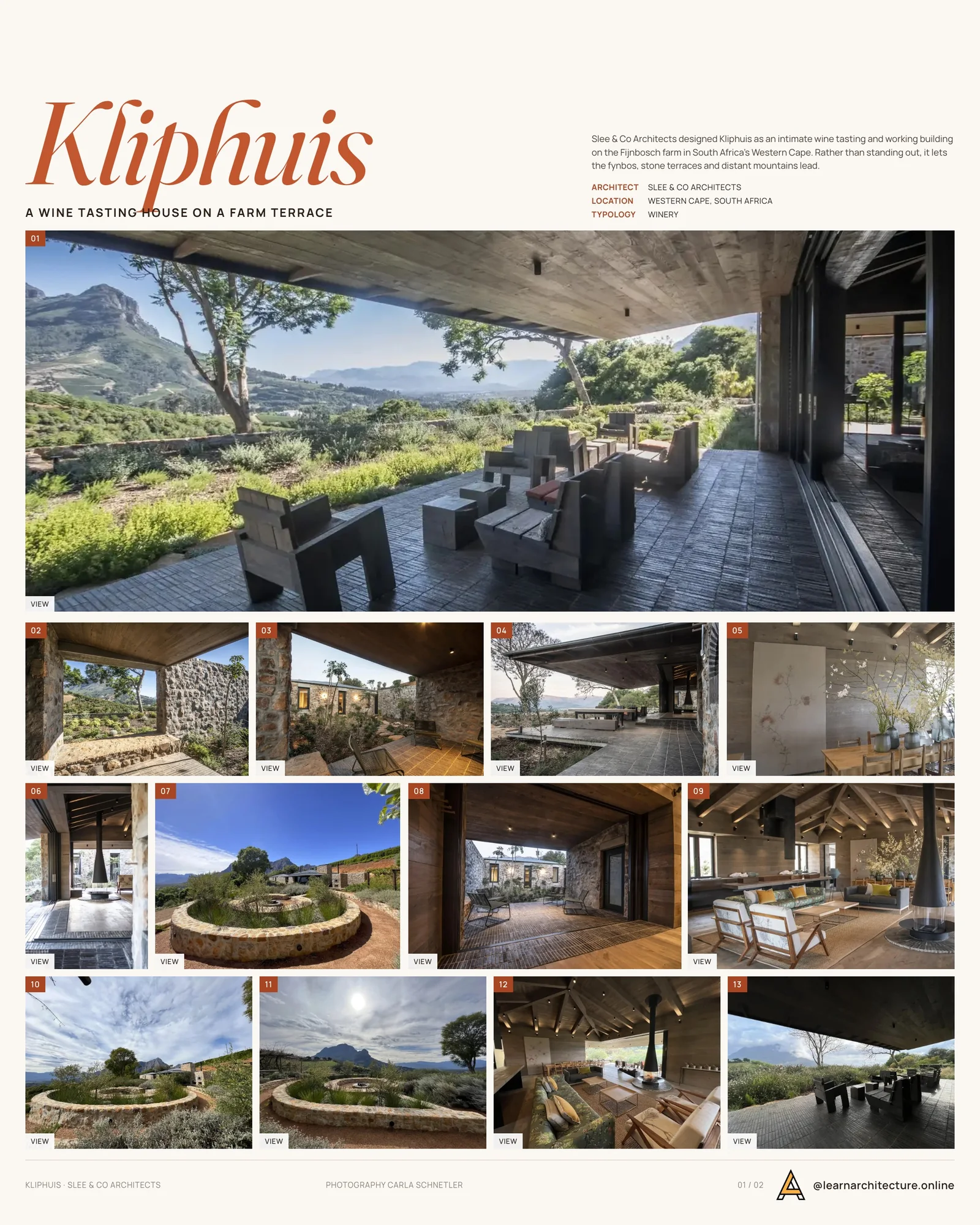
Designed by Slee & Co Architects, the Kliphuis for Capensis Wines is an intimate wine-tasting and working environment deeply rooted in the agricultural, climatic, and material character of the Fijnbosch farm in South Africa’s Western Cape. Conceived as both a destination for bespoke wine experiences and a functional farm facility, the building is shaped by restraint, locality, and a profound respect for landscape. Rather than standing out as an architectural object, Kliphuis blends quietly into its surroundings, allowing the fynbos vegetation, stone terraces, and distant mountain ranges to remain the true protagonists.

A Site-Responsive Strategy Rooted in Fijnbosch
Capensis Wines derive their identity from the terroir of Fijnbosch: its topography, altitude, and unique microclimate. From the outset, the architectural strategy sought to mirror these qualities rather than compete with them. To avoid disrupting productive farmland, the building was carefully positioned on an existing terrace where a former farm cottage once stood. This decision not only minimized environmental impact but also reinforced continuity with the site’s layered agricultural history.
From this elevated position, visitors are constantly oriented toward long views of the Simonsberg and Drakenstein mountain range, ensuring that the landscape remains an ever-present backdrop to the tasting experience.

Programmatic Clarity and Courtyard Organization
The brief called for a building capable of hosting tailored wine-tasting experiences, adapted to the needs of individual clients. Programmatically, this included a lounge, tasting area, wine room, chef’s demonstration kitchen, and a farm office, all under one architectural language but subtly differentiated.
The final arrangement consists of a free-standing farm office with kitchenette and bathroom facilities, placed adjacent to the main tasting building. These two volumes are connected by a sheltered courtyard, creating a calm transition between work and hospitality. This courtyard functions as both a spatial buffer and a climatic moderator, reinforcing the slow, deliberate pace of movement through the complex.

Stone Walls as Memory and Structure
The most defining architectural gesture lies in the extension of the existing terrace walls, which were developed into the stone enclosure of both the office and the tasting pavilion, collectively known as the Kliphuis (literally “stone house”). The stone was harvested directly on the farm and assembled in an informal, hand-crafted manner, intentionally echoing the character of the original terrace construction.
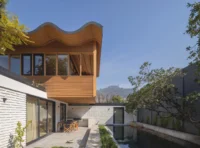
This approach gives the building a sense of permanence and belonging, as if it had always emerged from the terrain. Floating above these robust walls, low-slung dark corrugated roofs define the interior spaces while visually receding into the landscape. The roofs cantilever outward to form a generous tasting stoep, offering shade and framing expansive views across the Banhoek Valley.

Timber as Structure, Finish, and Ethos
All timber used throughout the project originated from alien vegetation cleared from the farm. The logs were cut, sawn, and dried on-site, reinforcing a closed-loop material strategy rooted in stewardship of the land. Timber is employed extensively (for roof structures, ceilings, floors, wall cladding, built-in furniture, and fittings), creating a warm, tactile interior that balances the weight of stone.
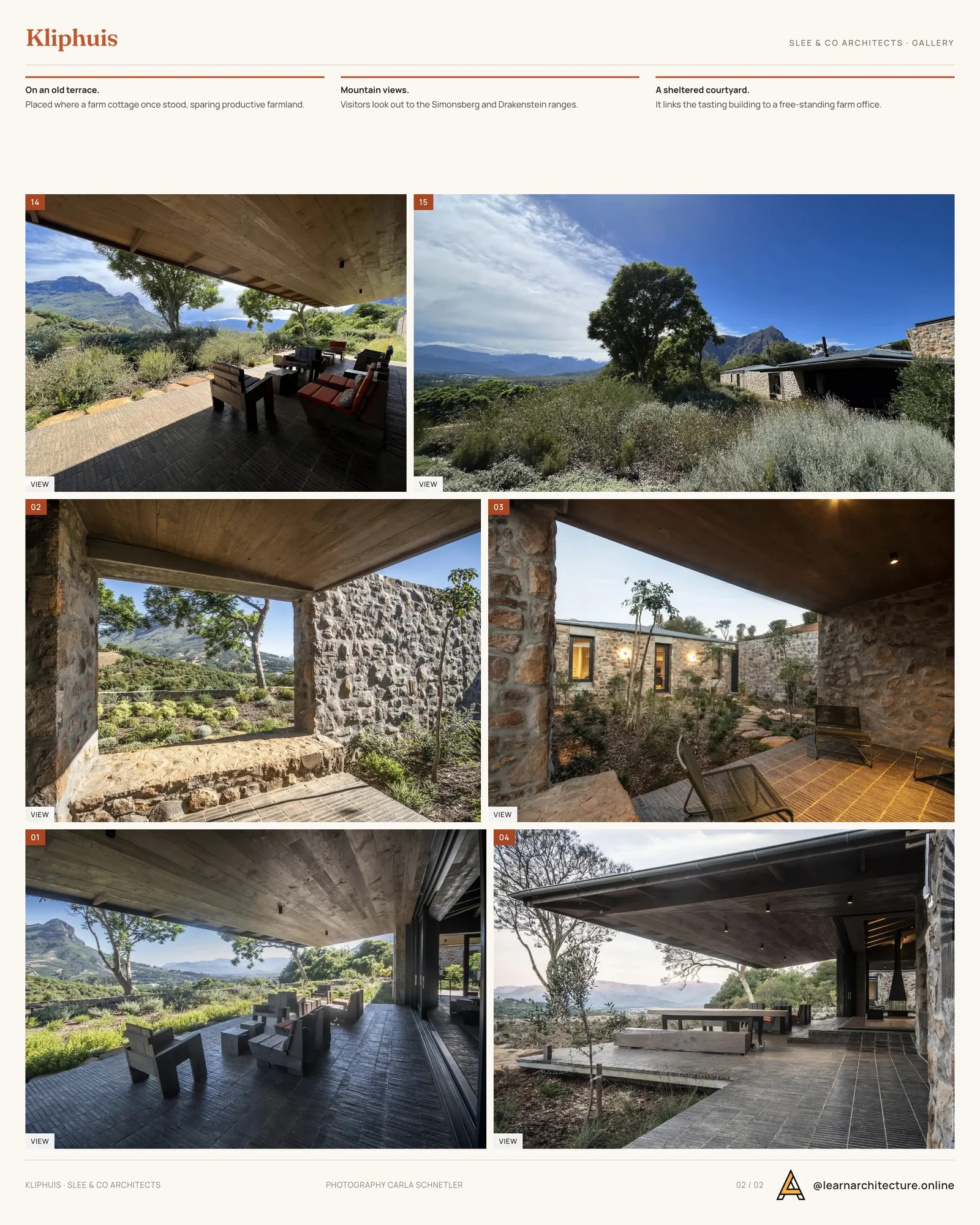
This natural palette is complemented externally by robust clay “koppies” used in outdoor flooring areas, grounding the architecture further in local tradition and texture. Throughout the project, material choices are honest, durable, and expressive of their origins.

Indoor and Outdoor Continuity and the Tasting Stoep
Large aluminum glazed sliding doors disappear seamlessly into cavities within the stone walls, allowing the tasting space to fully open onto the stoep, the surrounding fynbos garden, and the sweeping landscape beyond. This dissolving of thresholds ensures that tastings unfold as an immersive experience, equally connected to climate, scent, sound, and view.
The stoep itself becomes an extension of the interior, designed for both formal tastings and informal gatherings. Its relationship to the valley below is uninterrupted, reinforcing the architectural aim of framing rather than dominating the scenery.

Interior Atmosphere and Bespoke Wine Experiences
Inside, the tasting room is conceived as a calm, refined living space rather than a conventional commercial venue. A lounge area centered around a fireplace creates intimacy and comfort, supported by a small wine room and a large tasting table that seats up to 18 guests.
A carefully detailed serving counter doubles as a chef’s demonstration kitchen, supported by a compact, fully equipped industrial kitchen discreetly integrated into the plan. All major furniture pieces, including the counter, tasting table, sideboard, and cupboards, were crafted from on-site timber, reinforcing the building’s coherent material narrative.
Soft furnishings and a restrained approach to artwork reflect the subtle tones of the surrounding landscape, ensuring that interiors remain quiet, atmospheric, and focused on the wine experience.

Climatic Comfort for All Seasons
Environmental comfort was addressed through simple, effective strategies suited to the local climate. An evaporative cooling system allows the building to remain comfortable during hot summer months without the need to close doors, maintaining continuous airflow and visual connection to the outdoors.
In winter, a double-combustion wood-burning fireplace provides efficient heating, creating a welcoming and cozy environment for tastings during the colder Cape seasons. This seasonal adaptability ensures that Kliphuis functions as a year-round destination.

Landscape, Fire, and Outdoor Hospitality
Hospitality extends well beyond the interior. The generous stoep houses a large Cape hearth for outdoor cooking and gatherings, accompanied by a pizza oven positioned to one side. Within the fynbos garden, a fire pit offers an informal setting for evening entertaining.
At the far end of the terrace, beneath a revived old vine pergola, a long tasting table invites guests deeper into the landscape on calm, windless days. These layered outdoor spaces allow the tasting experience to unfold across scales, from intimate interiors to expansive open-air settings.

Architecture That Serves Place, Product, and People
The Kliphuis for Capensis Wines is a precise and measured architectural response to its context. Rather than pursuing iconic form, Slee & Co Architects deliver a building shaped by terroir, craft, and continuity. Every decision, from siting and material sourcing to climatic strategy, reinforces a sense of belonging to the land.
In doing so, Kliphuis becomes more than a tasting room or farm office. It is an architectural extension of Capensis Wines themselves: grounded, expressive of place, and quietly confident in its connection to landscape, labor, and hospitality.
Photography: Carla Schnetler
- Architecture in vineyards
- Bespoke wine tasting design
- climate-responsive architecture
- Contemporary South African architecture
- Farm-based wine architecture
- Fynbos landscape architecture
- Indoor outdoor tasting spaces
- Kliphuis Capensis Wines
- Landscape integrated buildings
- Minimalist hospitality architecture
- Rural architecture South Africa
- Slee & Co Architects
- Stone and timber architecture
- Sustainable winery buildings
- Terroir-driven architecture
- Vernacular modern architecture
- Wine estate architecture
- Wine tasting pavilion design
- Wine tourism architecture
- Winery architecture South Africa









Leave a comment