


Table of Contents Show
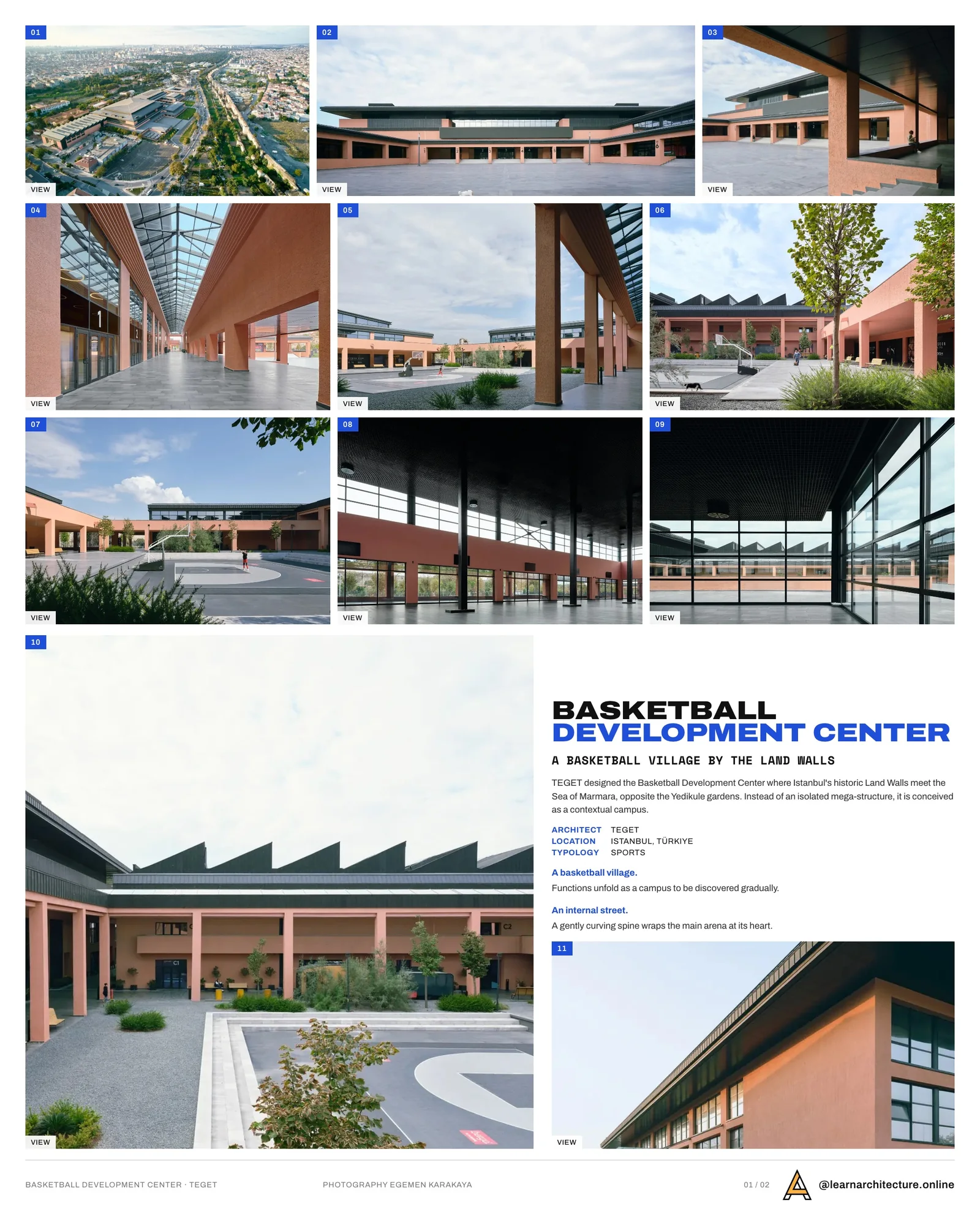
Designed by TEGET, the Basketball Development Center (BDC) is positioned at a highly charged urban threshold where the historic Istanbul Land Walls meet the Sea of Marmara, directly opposite the Yedikule gardens. Set between the fortification line and the Balıklı Greek Hospital campus, the project engages one of Istanbul’s most layered landscapes, where history, agriculture, infrastructure, and contemporary urban life intersect. Rather than asserting itself as an isolated mega-structure, the BDC is conceived as a contextual campus, shaped by its surroundings and embedded within the city’s spatial logic.

Urban Context and Campus Logic
The building’s layout responds closely to the east to west grid of the Balıklı Greek Hospital, whose organization is based on courtyards, plazas, and organically branching circulation paths. This spatial DNA informs the BDC’s masterplan, aligning the sports complex with existing movement patterns and reinforcing continuity across institutional boundaries. Instead of enclosing all functions within a single volume, the project unfolds as a basketball village, structured to encourage gradual discovery and everyday use.
This approach allows the BDC to maintain a strong dialogue with the historic walls while respecting their scale and presence. The campus does not turn its back on the city; instead, it extends public life toward the fortifications, redefining the relationship between heritage and contemporary sports architecture.

Spatial Organization Around an Internal Street
At the center of the BDC lies the main arena, conceived as the programmatic and symbolic heart of the campus. Surrounding this core is a gently curving internal street, which functions as the primary circulation spine. Along this street, a sequence of sporting, administrative, social, and cultural spaces is arranged in a compact yet legible pattern.
This internal street structure allows the campus to reveal itself incrementally, creating moments of compression and expansion through plazas, shaded passages, and green pockets. Seven distinct building volumes line this route, with eave heights ranging from 4 to 21 meters, forming a continuous yet modulated architectural edge opposite the historic walls.

Massing Strategy and Architectural Character
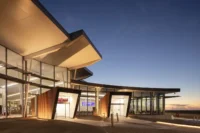
The building masses shift rhythmically back and forth, carving out streets, courtyards, and landscaped pockets between them. This strategy breaks down the scale of the complex and prevents the long street-facing façade from becoming monolithic. The varied roofscape, alternating between lower and higher pitched roofs, further softens the overall silhouette, allowing the campus to sit more comfortably within its sensitive surroundings.
On the side facing the fortifications, a sequence of modestly scaled roofs rises in a controlled manner, accommodating technical equipment while maintaining visual restraint. The campus is unified through a plastered shell, whose simplicity reinforces an anonymous architectural language shaped by function and context rather than iconic form-making.

A Deliberate Alternative to Iconic Sports Architecture
One of the project’s most defining qualities is its conscious departure from the introverted, mega-iconic sports buildings typically found on city outskirts. Instead of imposing a singular monumental object, the BDC adopts a balanced relationship between inside and outside, between façade and plan.
The sheltered internal street and the **portico level (acting as a secondary ground plane)**create spatial transitions between volumes. These elements mediate scale, climate, and movement, offering shaded social zones while reinforcing continuity across the campus. This architectural attitude prioritizes urban integration over spectacle, allowing the BDC to operate as part of the city rather than as an isolated destination.

Comprehensive Basketball Program and Facilities
Programmatically, the BDC is a fully equipped basketball ecosystem. The multifunctional main arena seats 10,000 spectators and is designed to host international tournaments as well as events organized by globally recognized institutions. Complementing this central venue are three youth training halls, each with a capacity of 500 spectators, supporting talent development and grassroots participation.
Another key building brings together the Turkish National Basketball Teams and the Turkish Basketball Federation under one roof. This facility accommodates athletic preparation, technical training, and administrative planning, strengthening institutional collaboration. It also contains a 1,000-seat court, suitable for both competition and training, carefully organized to support athletes’ needs before and after games.

Beyond Sport: A Basketball Village for Everyday Life
The BDC extends well beyond conventional sports programming. The campus includes a camp and accommodation center, enabling year-round use by professionals from Turkey and abroad. Seminars, conferences, workshops, and meetings animate the site throughout the year, ensuring continuity beyond event-based peaks.
Social and cultural functions are deliberately woven into the spatial fabric: a basketball museum, library, event courtyard, and food & beverage areas transform the campus into a hybrid urban destination. By blending sportive, commercial, and cultural programs, the BDC attracts a diverse user group and increases daily engagement.

Basketball Flowing from Court to City
At its core, the Basketball Development Center operates as a new public ground for sport. Basketball is not confined to enclosed halls; it extends into streets, plazas, and shared spaces, becoming part of everyday urban life. The campus supports multiple scenarios and age-specific activities, offering alternatives for athletes, visitors, and city residents alike.
Through its spatial openness, contextual sensitivity, and programmatic hybridity, the BDC creates new pathways for awareness, participation, and accessibility. It stands as a contemporary model for how sports architecture can strengthen urban life while respecting historical context.
Photography: Egemen Karakaya


- Architecture and sport integration
- Architecture near historic sites
- Basketball arena design
- Basketball campus design
- Basketball Development Center
- Basketball training facilities
- Community-focused sports spaces
- Contemporary sports facilities
- Context-driven architecture
- Cultural and sports hybrid buildings
- Istanbul Land Walls architecture
- Modern arena design Turkey
- Multi-functional sports campus
- Public sports architecture
- Sports architecture Istanbul
- Sports village architecture
- TEGET architects
- Turkish Basketball Federation building
- Urban integration in sports design
- Urban sports complexes







Leave a comment