


Table of Contents Show
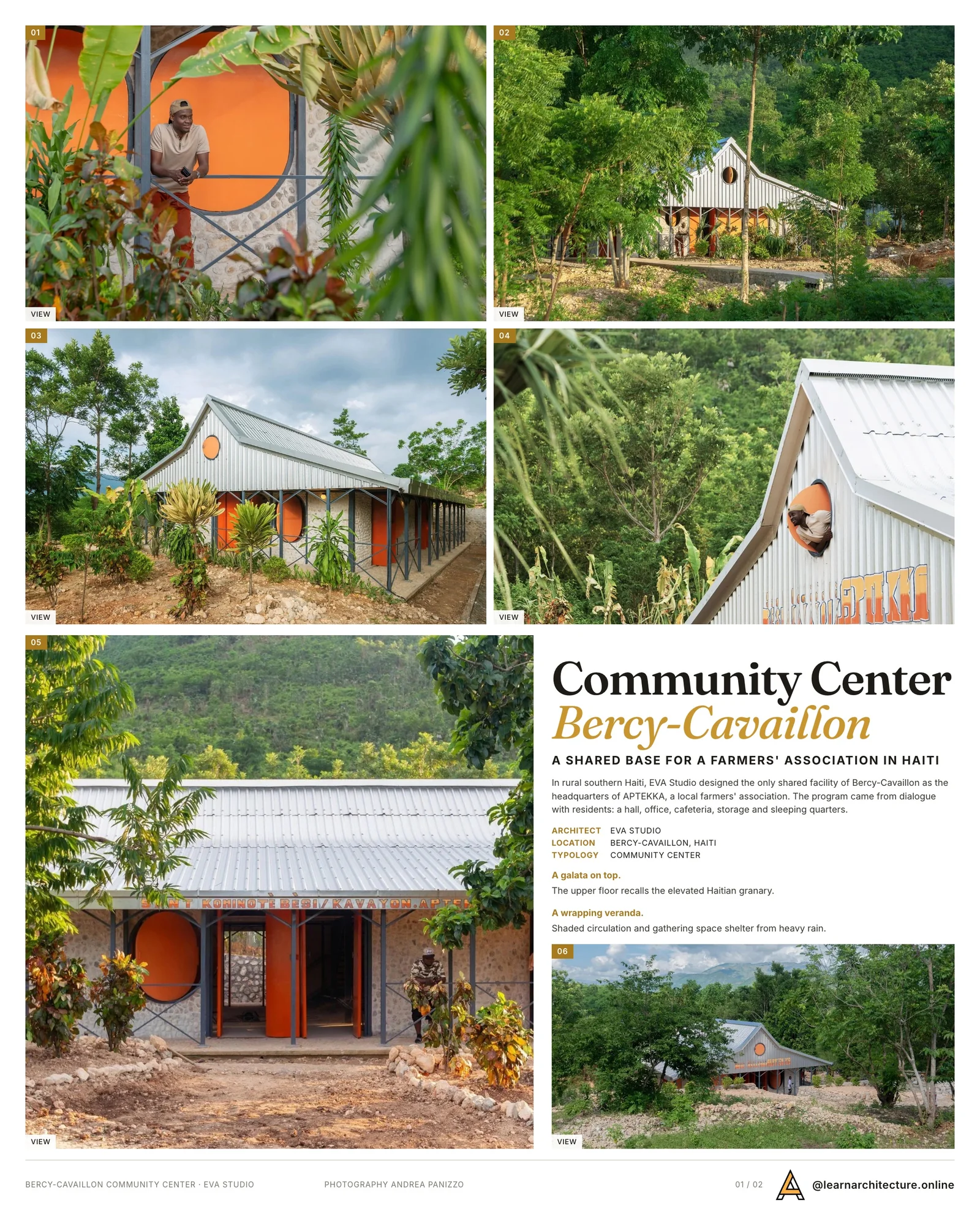
Tucked within the lush tropical landscape of southern Haiti, the Community Center in Bercy-Cavaillon by Emergent Vernacular Architecture (EVA Studio) stands as a powerful example of architecture shaped by resilience, collaboration, and cultural intelligence. Conceived as the only shared facility in a remote rural community, the project transcends the idea of a conventional building. It operates as a social, educational, and environmental anchor, offering space for training, gathering, rest, and cultural expression while embodying the values of local knowledge, collective effort, and long-term sustainability.

Architecture Rooted in Community and Necessity
The center was developed for the rural community of Bercy-Cavaillon and serves as the headquarters for APTEKKA, a local farmers’ association dedicated to supporting small-scale agriculture and strengthening food security. In a region deeply affected by political instability, economic hardship, and extreme climate events, organizations like APTEKKA play a critical role in maintaining both livelihoods and cultural continuity.
Rather than imposing an external architectural vision, EVA Studio grounded the project in extensive dialogue with residents. The resulting program reflects the community’s real needs: a multifunctional hall for meetings and events, an office, a cafeteria, storage areas for agricultural products, and sleeping quarters for participants traveling from distant villages. This participatory approach ensured that the building would not only be used but truly belong to the people who inhabit it.

A Spatial Structure Inspired by Haitian Vernacular
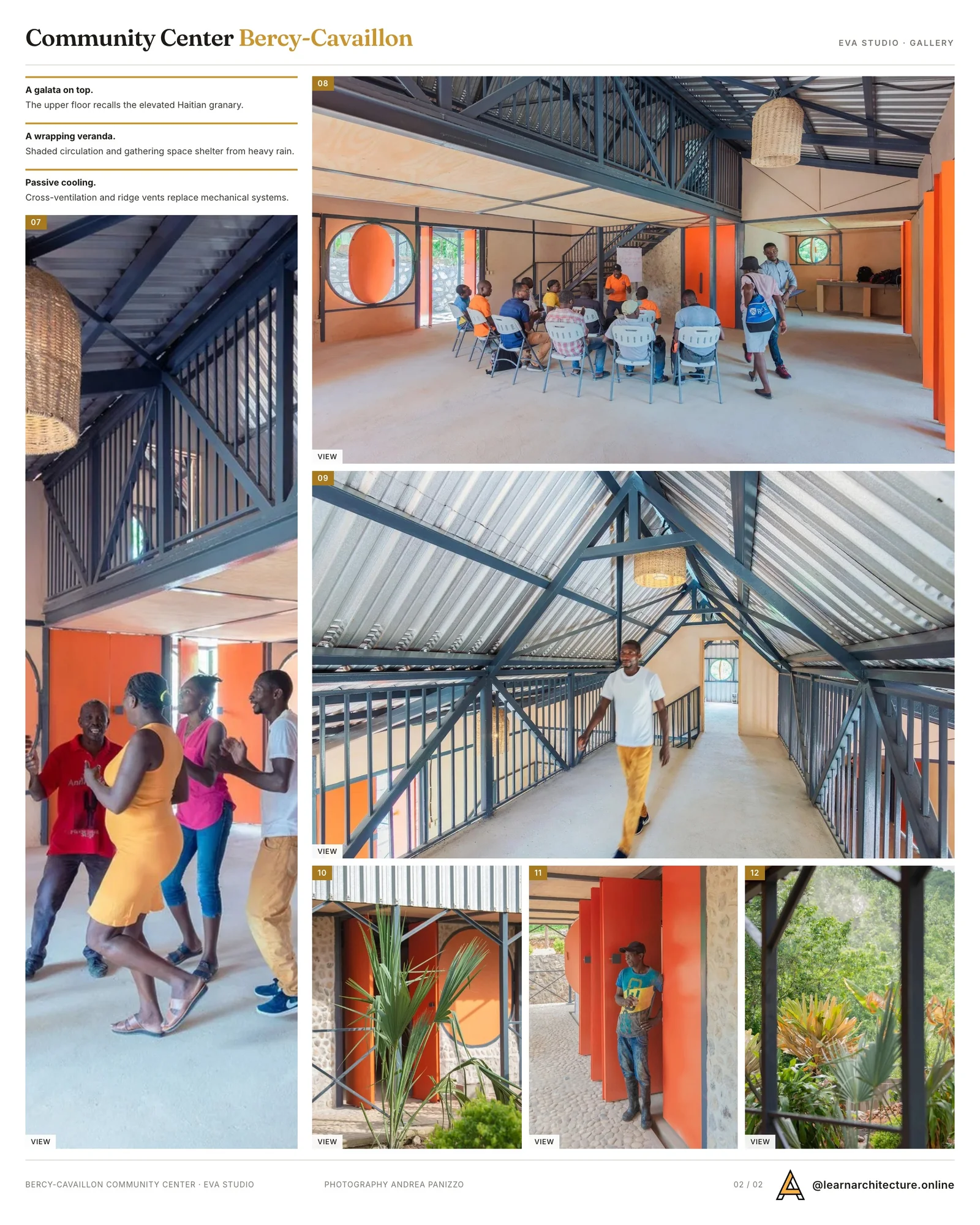
The building is organized over two levels, each responding to different climatic and functional requirements. The ground floor accommodates the most public functions, including the large multipurpose hall and communal spaces. Above, a generous upper floor houses storage areas and a dormitory, allowing the center to support extended training sessions and regional gatherings.
This upper level draws inspiration from the traditional Haitian galata, a type of elevated granary designed for natural ventilation and crop preservation. By referencing this vernacular model, the architects embedded cultural memory directly into the spatial logic of the building. A continuous veranda wraps around the structure, offering shaded circulation, informal gathering areas, and protection from heavy rainfall, an architectural gesture that enhances both comfort and social interaction.

Passive Strategies for Climate and Comfort
Located in a hot and humid tropical climate, the building relies heavily on passive environmental strategies rather than mechanical systems. Cross-ventilation is carefully orchestrated through generous openings, while ridge vents allow warm air to escape naturally. These principles, drawn from bioclimatic traditions of the tropical house, ensure interior comfort even under challenging climatic conditions.
Rainwater is collected directly from the roof and integrated into the building’s operational system, reinforcing the project’s environmental autonomy. These strategies are not technological add-ons but rather an extension of local building intelligence: proof that climate-responsive architecture already exists within vernacular traditions.

Local Materials and Low-Carbon Construction
Material selection was guided by both ecological responsibility and long-term maintenance considerations. With the exception of the steel structure and roof (designed to be dismantled and reused), the majority of materials are sourced locally. Stones from a nearby river were used in construction, while excavated soil was repurposed for earth plaster finishes.
This reliance on local materials significantly reduces the project’s carbon footprint while strengthening local building knowledge. It also ensures that future repairs can be carried out by the community itself, without dependence on imported systems or specialized labor. The building thus becomes not only sustainable in performance, but sustainable in its capacity to endure and evolve.

Building Resilience Through Hybrid Construction
Southern Haiti has experienced devastating natural disasters in recent years, including Hurricane Matthew in 2016 and a major earthquake in 2021. Within this context, the question of how to build safely, affordably, and durably becomes critical.
EVA Studio responded by developing a hybrid construction system inspired by the lakay riral, the traditional rural house. This approach combines locally familiar steelwork techniques with simple traditional methods that are easy to repair. The result is a structure that offers improved seismic resistance while maintaining thermal comfort and adaptability. Importantly, the system is designed to be replicated, enabling the project to function as a model for future resilient construction in the region.

Collective Labor and Cultural Continuity
Construction unfolded over more than two years and faced numerous challenges, including severe weather, material shortages, political unrest, and transport disruptions caused by gang blockades. Yet the project progressed through the extraordinary commitment of the community itself.
Residents participated through the tradition of konbit, a collective system of unpaid communal labor rooted in mutual aid. This cultural practice transformed the building process into a shared act of solidarity. The center is therefore not only built for the community, but literally built by the community, embedding social cohesion into its foundations.

Landscape as Cultural and Ecological Regeneration
The project extends beyond architecture into landscape restoration. In collaboration with agronomists and inspired by the traditional jardin kreyòl, over one hundred trees and plant species were introduced to the site, including rare and endangered varieties. This intervention restores biodiversity while reinforcing agricultural knowledge and cultural heritage.
The center thus becomes a living ecosystem, simultaneously educational, productive, and symbolic, positioning architecture as a tool for ecological repair and cultural continuity.

Conclusion
The Community Center in Bercy-Cavaillon exemplifies how architecture can operate with humility and power at the same time. Through participatory design, vernacular intelligence, material restraint, and collective construction, EVA Studio delivers more than a building: it creates a resilient social infrastructure. In a context marked by instability and vulnerability, the project offers a compelling architectural response grounded in dignity, collaboration, and long-term care. It stands as a reminder that the most meaningful architecture often emerges not from spectacle, but from deep engagement with place, people, and tradition.
Photography: Andrea Panizzo


- Architecture and community
- architecture and culture
- Architecture and Ecology
- Architecture and Resilience
- Architecture in Haiti
- bioclimatic architecture
- climate responsive design
- Collective Construction
- Community Architecture
- Community Center Bercy-Cavaillon
- Emergent Vernacular Architecture
- EVA Studio
- Humanitarian Architecture
- Local materials architecture
- low carbon architecture
- Participatory architecture
- Rural Architecture
- Social Infrastructure
- Sustainable Architecture
- vernacular architecture








Leave a comment